What does a senior applications scientist do?
A senior applications scientist imports and exports data as well as managing user interface security. They must identify issues in their company's database system and resolve them. They are also responsible for designing equipment to automate database systems.
Senior applications scientist responsibilities
Here are examples of responsibilities from real senior applications scientist resumes:
- Manage study protocols and study conduct, intimately involve in the toxicology and pharmacokinetic study protocol development process.
- Design, develop and implement DNA base assays and immunoassays.
- Subject matter expert for applications of a pathogen detection system base on principles of PCR and mass spectrometry.
- Develop, validate and implement robust methods for pharmacokinetic, immunogenicity (ADA) and immunodepletion ELISAs, and cell based-bioassays.
- Develop novel applications for FDSS6000 HTS instrument.
- Conduct genotyping and phenotyping of models as required.
Senior applications scientist skills and personality traits
We calculated that 16% of Senior Applications Scientists are proficient in Software Development, Data Collection, and Next-Generation Sequencing.
We break down the percentage of Senior Applications Scientists that have these skills listed on their resume here:
- Software Development, 16%
Designed and documented appropriate instrument performance tests, worked with software development to automate these tests and transferred process to manufacturing.
- Data Collection, 10%
Lead 510(k) data collection and manage data analysis and summary presentation.
- Next-Generation Sequencing, 9%
Established a Next-generation sequencing platform and developed assays for high-throughput genetic analysis using Ion Torrent Personal Genome Machine (PGM).
- Data Analysis, 5%
Performed biological screening for a pharmaceutical drug development corporation, inclusive of data analysis and communicating pertinent results to other scientists.
- Customer Support, 5%
Promoted from the customer support team to help develop the company's technology and realize new markets for sales.
- Technical Support, 5%
Developed and implemented a customer technical support model utilizing online training materials for internal and external use.
Most senior applications scientists use their skills in "software development," "data collection," and "next-generation sequencing" to do their jobs. You can find more detail on essential senior applications scientist responsibilities here:
Communication skills. The most essential soft skill for a senior applications scientist to carry out their responsibilities is communication skills. This skill is important for the role because "medical scientists must be able to explain their research in nontechnical ways." Additionally, a senior applications scientist resume shows how their duties depend on communication skills: "coordinate biopsy and clinical studies to support technical claims substantiation and communication. "
Observation skills. Many senior applications scientist duties rely on observation skills. "medical scientists conduct experiments that require monitoring samples and other health-related data.," so a senior applications scientist will need this skill often in their role. This resume example is just one of many ways senior applications scientist responsibilities rely on observation skills: "monitored field of expertise, including literature and technology development, and communicates relevant observations regarding cell culture and technology advantages. "
The three companies that hire the most senior applications scientists are:
- Danaher9 senior applications scientists jobs
- Strateos
3 senior applications scientists jobs
- IDEX2 senior applications scientists jobs
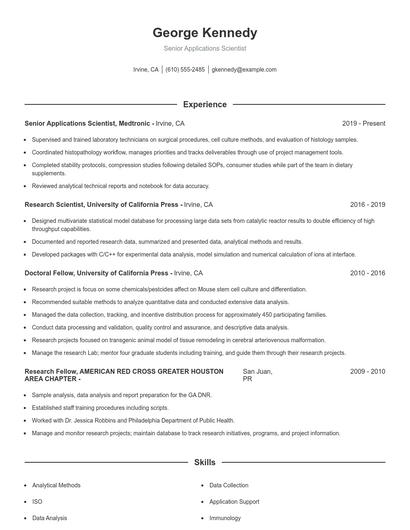
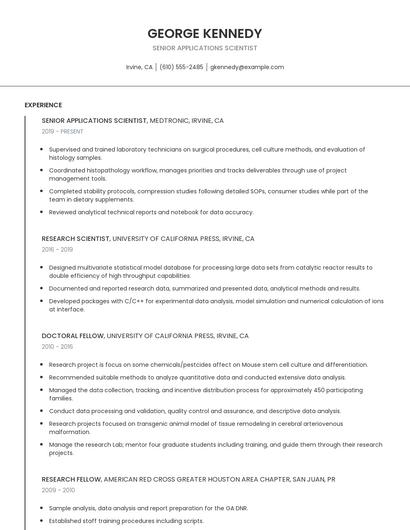
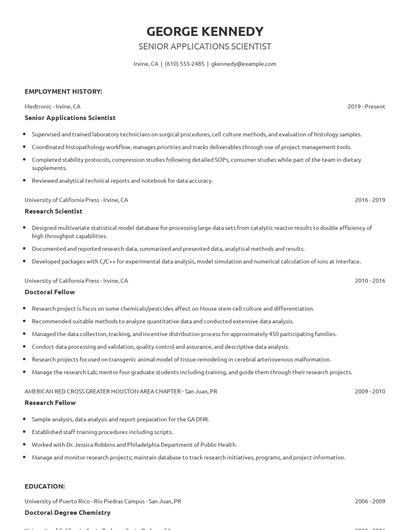
Choose from 10+ customizable senior applications scientist resume templates
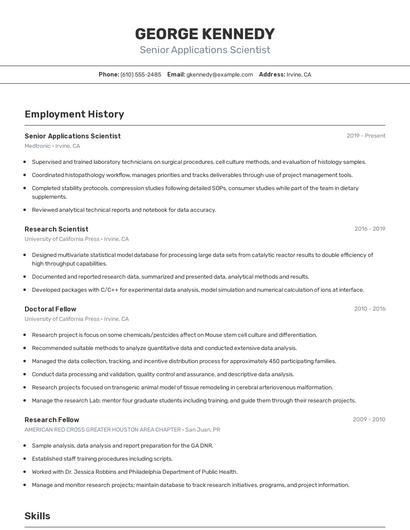
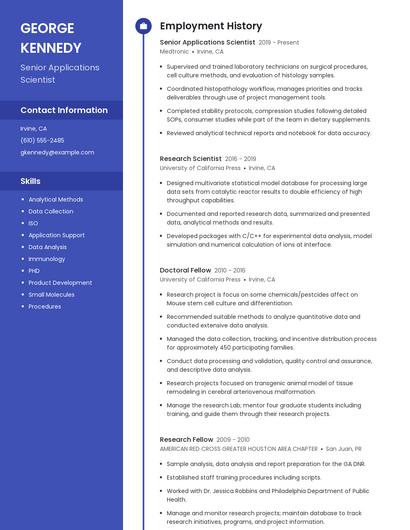
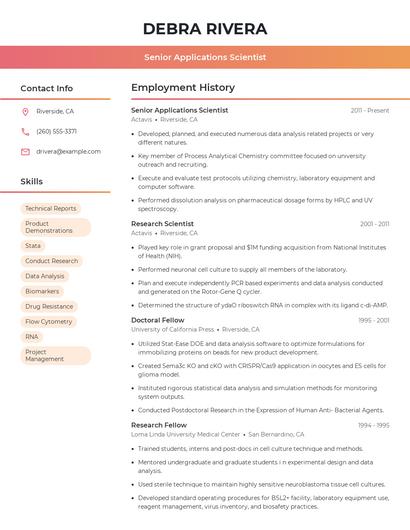
Build a professional senior applications scientist resume in minutes. Our AI resume writing assistant will guide you through every step of the process, and you can choose from 10+ resume templates to create your senior applications scientist resume.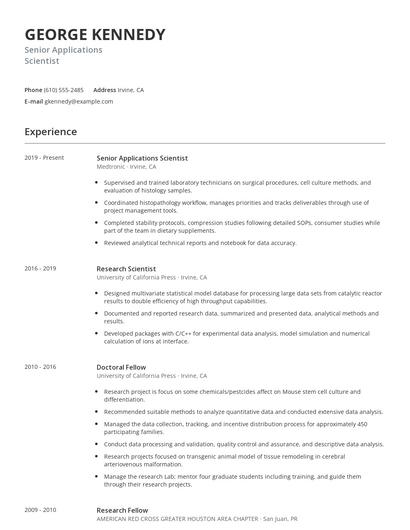
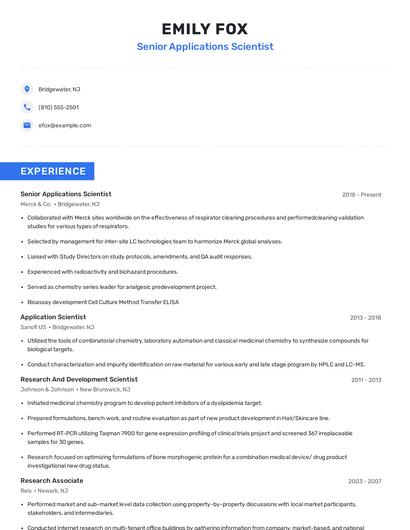
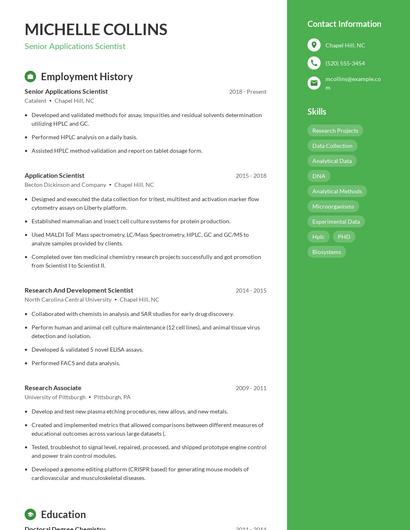
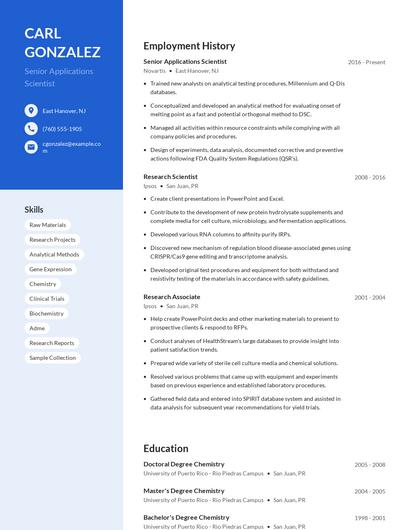

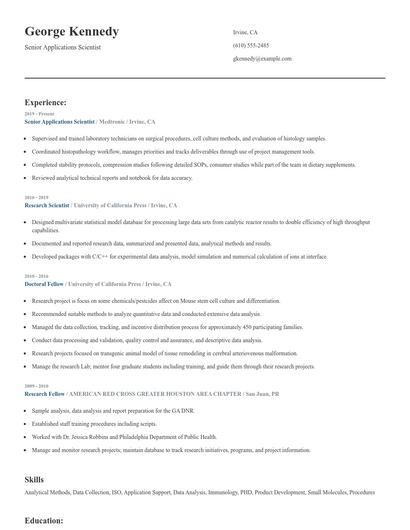
Compare different senior applications scientists
Senior applications scientist vs. Research fellow
A research fellow is an academic researcher who conducts research and analysis of comprehensive literature, data, and results and provides literature reviews. He/She supervises research assistants and recruits study participants to interview them for a particular study. To become a research fellow, a candidate should have a doctorate in a relevant discipline and publish peer-reviewed papers. Also, a research fellow can be an independent investigator or be supervised by a principal investigator.
While similarities exist, there are also some differences between senior applications scientists and research fellow. For instance, senior applications scientist responsibilities require skills such as "software development," "post sales," "customer support," and "technical support." Whereas a research fellow is skilled in "patients," "research projects," "immunology," and "crispr." This is part of what separates the two careers.
Research fellows earn the highest salaries when working in the non profits industry, with an average yearly salary of $57,261. On the other hand, senior applications scientists are paid more in the manufacturing industry with an average salary of $104,224.The education levels that research fellows earn slightly differ from senior applications scientists. In particular, research fellows are 2.0% more likely to graduate with a Master's Degree than a senior applications scientist. Additionally, they're 4.0% more likely to earn a Doctoral Degree.Senior applications scientist vs. Fellow
A fellow's responsibility will depend on the organization or industry where one belongs. However, most of the time, a fellow's duty will revolve around conducting research and analysis, presiding discussions and attending dialogues, handle lectures while complying with the guidelines or tasks set by supervisors, and assist in various projects and activities. Furthermore, a fellow must adhere to the institution or organization's policies and regulations at all times, meet all the requirements and outputs involved, and coordinate with every person in the workforce.
While some skills are similar in these professions, other skills aren't so similar. For example, resumes show us that senior applications scientist responsibilities requires skills like "software development," "next-generation sequencing," "post sales," and "customer support." But a fellow might use other skills in their typical duties, such as, "patients," "professional development," "veterans," and "mathematics."
Fellows earn a lower average salary than senior applications scientists. But fellows earn the highest pay in the professional industry, with an average salary of $67,978. Additionally, senior applications scientists earn the highest salaries in the manufacturing with average pay of $104,224 annually.In general, fellows achieve similar levels of education than senior applications scientists. They're 0.3% less likely to obtain a Master's Degree while being 4.0% less likely to earn a Doctoral Degree.What technology do you think will become more important and prevalent for senior applications scientists in the next 3-5 years?
Dr. Betsy Smith
Assistant Professor of Chemistry, Elmira College
Senior applications scientist vs. Phd researcher
The primary job of a Ph.D. researcher is to plan and conduct experiments and analyzing their outcome. You will collect, organize, and analyze data and opinions to solve issues and predict trends. Other tasks you will perform include doing fieldwork to collect samples, writing reports, research papers, and reviews, and organizing materials testing. In addition, you need to liaise with research and production staff, develop ways to resolve problems, and supervise junior research staff.
Some important key differences between the two careers include a few of the skills necessary to fulfill the responsibilities of each. Some examples from senior applications scientist resumes include skills like "software development," "post sales," "customer support," and "technical support," whereas an phd researcher is more likely to list skills in "python," "chemistry," "research projects," and "renewable energy. "
Phd researchers earn the highest salary when working in the technology industry, where they receive an average salary of $79,949. Comparatively, senior applications scientists have the highest earning potential in the manufacturing industry, with an average salary of $104,224.phd researchers typically earn similar educational levels compared to senior applications scientists. Specifically, they're 3.1% more likely to graduate with a Master's Degree, and 12.2% more likely to earn a Doctoral Degree.Senior applications scientist vs. Researcher
A researcher is responsible for collating, organizing, and verifying necessary information for a specific subject. Researchers' duties include analyzing data, gathering and comparing resources, ensuring facts, sharing findings with the whole research team, adhering to required methodologies, performing fieldwork as needed, and keeping critical information confidential. Researchers must be knowledgeable about the current market trends and align findings with the research goals. A researcher must show strong communication skills, as well as strong attention to detail and time-management skills to meet deadlines under minimal supervision.
Types of senior applications scientist
Updated January 8, 2025
