What does a senior, computer system analyst do?
Senior, computer system analyst responsibilities
Here are examples of responsibilities from real senior, computer system analyst resumes:
- Manage business requirements gathering for functionality development and interface definition from the legacy systems to the CRM and SA management applications.
- Maintain software servers and product licenses for all PC software running on multiple UNIX and PC platforms.
- Work with UNIX and WindowsNT operating systems.
- Perform QA for application enhancements and modifications.
- Identify and implement java class components for use of organization-specific information management.
- Develop documentation in support of SDLC requirements utilize by future outsourcing group.
- Select to design and incorporate a waterfall orient SDLC specific to the Verizon testing organization.
- Gather business requirements and perform gap analysis on SharePoint 2013 and SharePoint 2010 training and help documentation.
- Document technical solutions and infrastructure designs/improvements.
- Update applications and new applications using SCCM.
- Document technical solutions and infrastructure designs/improvements.
Senior, computer system analyst skills and personality traits
We calculated that 20% of Seniors, Computer System Analyst are proficient in Computer System, DOD, and Linux. They’re also known for soft skills such as Analytical skills, Communication skills, and Creativity.
We break down the percentage of Seniors, Computer System Analyst that have these skills listed on their resume here:
- Computer System, 20%
Analyzed requirements and established database processes to effectively test computer system.
- DOD, 8%
Tested and certified all IT equipment and software for compliance with DoD requirements and regulations.
- Linux, 7%
Supported Linux Enterprise servers in run/maintained environment.
- Unix, 4%
Analyzed Configuration Management Database (CMDB) shell scripts for functionality and enhancements to retrieve statistical information on 1000+ UNIX servers.
- OS, 4%
Performed systems analysis/troubleshooting on OS as related to messaging issues.
- Windows Server, 3%
Migrate and administer HP-UX 11x and Windows Server 2003/XP Pro systems.
Common skills that a senior, computer system analyst uses to do their job include "computer system," "dod," and "linux." You can find details on the most important senior, computer system analyst responsibilities below.
Analytical skills. The most essential soft skill for a senior, computer system analyst to carry out their responsibilities is analytical skills. This skill is important for the role because "analysts must interpret complex information from various sources and decide the best way to move forward on a project." Additionally, a senior, computer system analyst resume shows how their duties depend on analytical skills: "configured and installed software and drivers for database servers and conversion server including sos java scheduler and its database. "
Communication skills. Another soft skill that's essential for fulfilling senior, computer system analyst duties is communication skills. The role rewards competence in this skill because "analysts work as a go-between with management and the it department and must explain complex issues in a way that both will understand." According to a senior, computer system analyst resume, here's how seniors, computer system analyst can utilize communication skills in their job responsibilities: "project included complete audits of each site's telecommunications infrastructure, documenting existing pbx connectivity. "
Creativity. seniors, computer system analyst are also known for creativity, which are critical to their duties. You can see how this skill relates to senior, computer system analyst responsibilities, because "because analysts are tasked with finding innovative solutions to computer problems, an ability to “think outside the box” is important." A senior, computer system analyst resume example shows how creativity is used in the workplace: "inventory backup tapes and ran test restores for data integrity. "
The three companies that hire the most senior, computer system analysts are:
- Northrop Grumman5 seniors, computer system analyst jobs
- Prescient Edge5 seniors, computer system analyst jobs
- OneMain3 seniors, computer system analyst jobs
Choose from 10+ customizable senior, computer system analyst resume templates
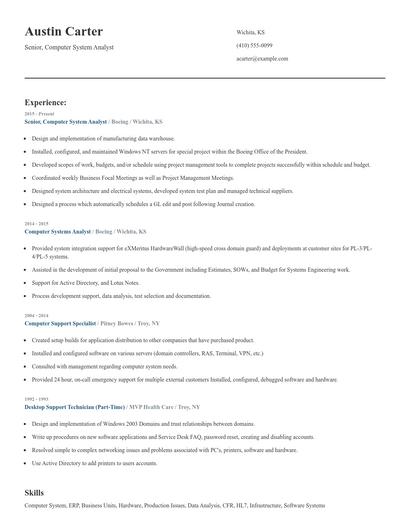
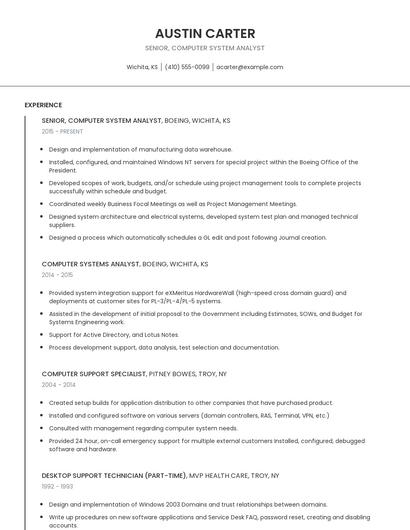
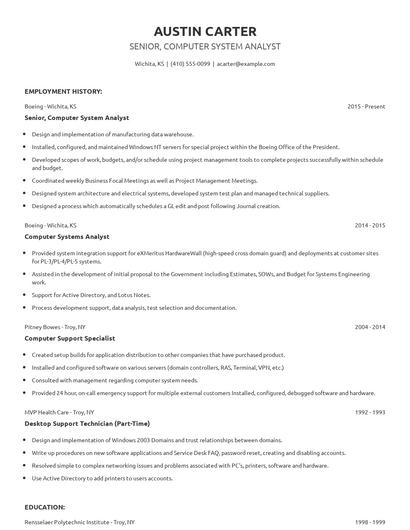
Build a professional senior, computer system analyst resume in minutes. Our AI resume writing assistant will guide you through every step of the process, and you can choose from 10+ resume templates to create your senior, computer system analyst resume.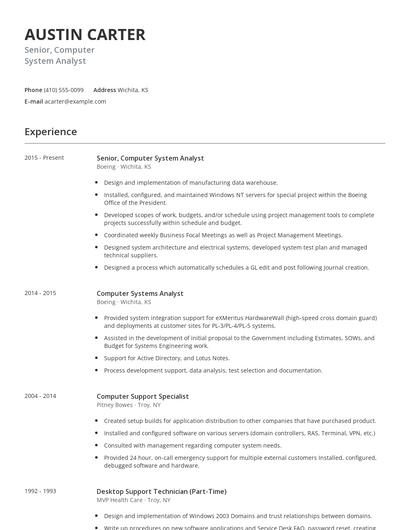



Compare different seniors, computer system analyst
Senior, computer system analyst vs. Analyst lead
The duties of an analyst lead depend on one's line of work or industry of employment. Typically, their responsibilities revolve around performing research and analysis, coordinating with different departments to gather leads and data, reviewing findings, and producing reports and presentations for the stakeholders and other higher-ranking officials. Through the results, an analyst lead can provide advice, devise strategies for business optimization, spearhead the development of processes, identify strengths and weaknesses, and offer recommendations on areas in need of improvement. All of this is done while in adherence to the company's vision and mission.
These skill sets are where the common ground ends though. The responsibilities of a senior, computer system analyst are more likely to require skills like "computer system," "os," "windows server," and "technical support." On the other hand, a job as an analyst lead requires skills like "analytics," "data analysis," "project management," and "customer service." As you can see, what employees do in each career varies considerably.
Analyst leads earn the highest salaries when working in the finance industry, with an average yearly salary of $110,488. On the other hand, seniors, computer system analyst are paid more in the energy industry with an average salary of $124,508.On average, analyst leads reach similar levels of education than seniors, computer system analyst. Analyst leads are 4.8% more likely to earn a Master's Degree and 0.5% more likely to graduate with a Doctoral Degree.Senior, computer system analyst vs. Computer engineer
A computer engineer is someone who examines, designs, and manages computer hardware and software systems. He/She or she helps in solving issues or any concerns that may occur with the computer's hardware and software as well as assists in the innovation of computer technology. Computer engineers are responsible for computer hardware design, development, research, and test computer systems. They examine components like circuit boards, processors, memory devices, routers, and networks. While, those working with the computer software are in charge of the development, design, and administration of software programs.
While some skills are similar in these professions, other skills aren't so similar. For example, resumes show us that senior, computer system analyst responsibilities requires skills like "cycle management," "configuration management," "data integrity," and "cots." But a computer engineer might use other skills in their typical duties, such as, "c #," "python," "software development," and "c."
On average, computer engineers earn a higher salary than seniors, computer system analyst. Some industries support higher salaries in each profession. Interestingly enough, computer engineers earn the most pay in the finance industry with an average salary of $117,704. Whereas seniors, computer system analyst have higher pay in the energy industry, with an average salary of $124,508.computer engineers earn similar levels of education than seniors, computer system analyst in general. They're 1.0% more likely to graduate with a Master's Degree and 0.5% more likely to earn a Doctoral Degree.Senior, computer system analyst vs. Software analyst
A software analyst is responsible for creating and designing software programs and applications, as well as modifying existing ones for optimization according to business requirements. Software analysts work with the technical team to draw system codes, analyze programming languages, and ensure the stability and efficiency of software navigation by running multiple quality checks to the system. They inspect the application's performance, configure servers, and improve software infrastructure according to quality findings. A software analyst records resolution reports and provides progress updates, ensuring that the project adheres to budget limitations and set timetables.
There are many key differences between these two careers, including some of the skills required to perform responsibilities within each role. For example, a senior, computer system analyst is likely to be skilled in "computer system," "dod," "windows server," and "system administration," while a typical software analyst is skilled in "software development," "troubleshoot," "test data," and "scrum."
Software analysts earn the highest salary when working in the manufacturing industry, where they receive an average salary of $86,986. Comparatively, seniors, computer system analyst have the highest earning potential in the energy industry, with an average salary of $124,508.When it comes to education, software analysts tend to earn similar degree levels compared to seniors, computer system analyst. In fact, they're 0.2% more likely to earn a Master's Degree, and 0.1% more likely to graduate with a Doctoral Degree.Senior, computer system analyst vs. Gis analyst
A GIS Analyst is responsible for the development and implementation of geographic information systems. They provide expertise, support, assistance, and guidance to various geographic variables in a specific area.
Types of senior, computer system analyst
Updated January 8, 2025
