What does a solderer-assembler do?
Solderer-assembler responsibilities
Here are examples of responsibilities from real solderer-assembler resumes:
- Insert and solder components, resistors, and capactors to circuit board per drawings .perform assembly under a magnifying device.
- Certify on IPC-A-610 and IPC-J-STD-001.
- Perform wiring and ECO's according to blue print and schematics.
- Clean tip of soldering iron, using chemical solution or cleaning compound.
- Administer hourly uses of 2dx x-ray to insure proper placement of BGA components.
- Certify in soldering of fine pitch and BGA assemblies using pace and air vac.
- Select torch tips, flux, and brazing alloys from data charts or work orders.
- Perform high-reel soldering, repairing, loading and wiring on SMT and PTH terminal boards.
- Rework SMT components using Yesvision computer program.
- Perform electro-mechanical assembly including point-to-point wiring, wring-out and cable harness layout, and basic mechanical assembly.
- Train extensively in advance soldering, wire harness, reel verification, AOI, and machine operation.
- Inspect all surface of mount boards from the Mydata and Fuji machine.
Solderer-assembler skills and personality traits
We calculated that 11% of Solderer-Assemblers are proficient in Dexterity, Mechanical Assembly, and PCB. They’re also known for soft skills such as Detail oriented, Manual dexterity, and Physical strength.
We break down the percentage of Solderer-Assemblers that have these skills listed on their resume here:
- Dexterity, 11%
Demonstrated manual dexterity as it relates to detailed assembly processes.
- Mechanical Assembly, 7%
Performed mechanical assembly of units for aerospace industry.
- PCB, 6%
Assembled Fiber Optics sub-assemblies, inspected PCB's and did touch up soldering when required.
- Circuit Board Assembly, 6%
Performed post soldering circuit board assembly inspection using IPC standards as reference.
- Hand Tools, 6%
Utilized connector and wire lug crimping tools, hand tools, terminal presses and soldering equipment for assembly.
- Through-Hole, 5%
Soldered SMT and through-hole components into circuit boards.
Common skills that a solderer-assembler uses to do their job include "dexterity," "mechanical assembly," and "pcb." You can find details on the most important solderer-assembler responsibilities below.
Detail oriented. The most essential soft skill for a solderer-assembler to carry out their responsibilities is detail oriented. This skill is important for the role because "welders, cutters, solderers, and brazers perform precision work, often with straight edges." Additionally, a solderer-assembler resume shows how their duties depend on detail oriented: "worked from detailed wiring diagrams to assemble wire harnesses. "
Manual dexterity. Another essential skill to perform solderer-assembler duties is manual dexterity. Solderer-assemblers responsibilities require that "welders, cutters, solderers, and brazers must have a steady hand to hold a torch in place." Solderer-assemblers also use manual dexterity in their role according to a real resume snippet: "applied manual dexterity to preform various job functions. "
Physical strength. Another skill that relates to the job responsibilities of solderer-assemblers is physical strength. This skill is critical to many everyday solderer-assembler duties, as "welders, cutters, solderers, and brazers must be able to lift heavy pieces of metal and move welding or cutting equipment." This example from a resume shows how this skill is used: "performed mechanical assembly, physical inspection, cleaning and packaging of final assemblies, accomplishments ability to work 12 hour shift. "
The three companies that hire the most solderer-assemblers are:
- Randstad North America, Inc.3 solderer-assemblers jobs
- Fortive2 solderer-assemblers jobs
- Honeywell2 solderer-assemblers jobs
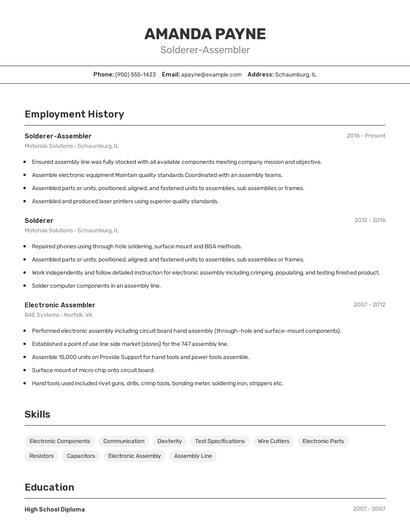
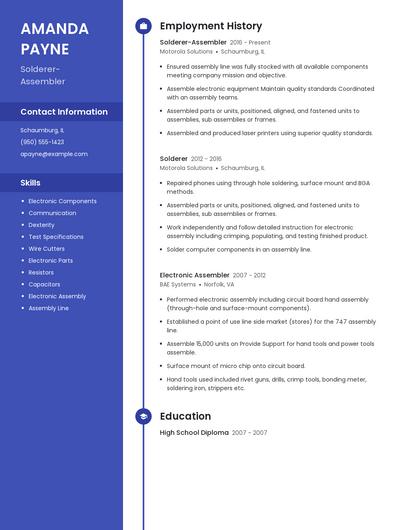
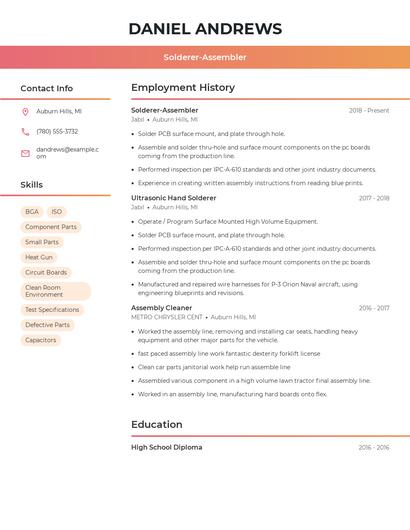
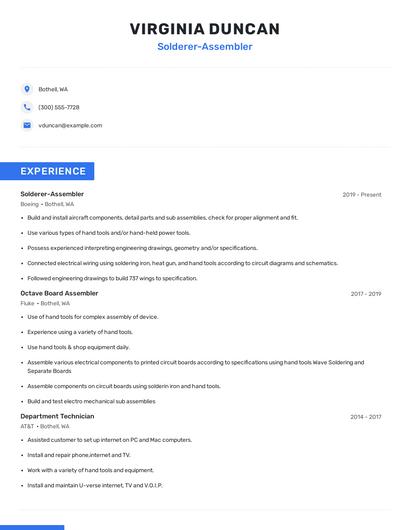
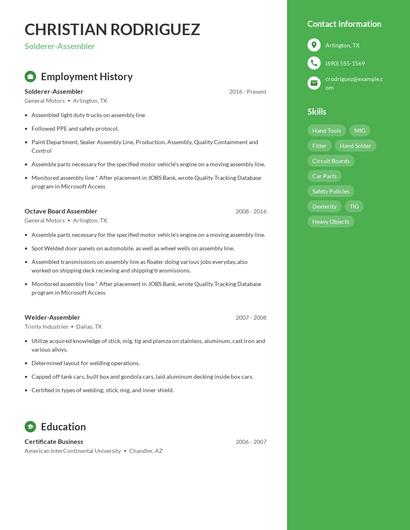
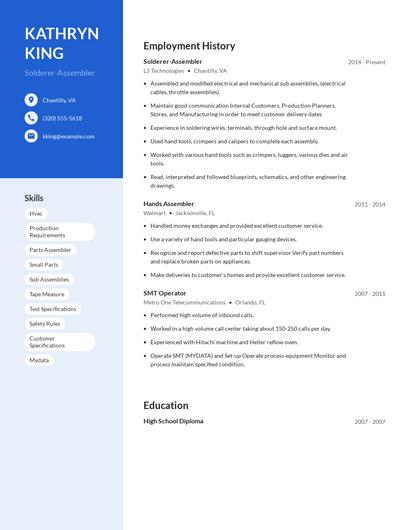
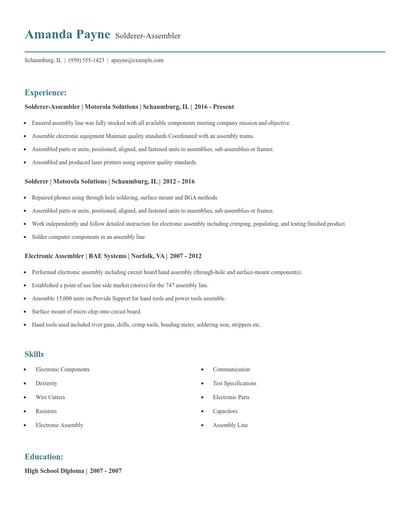
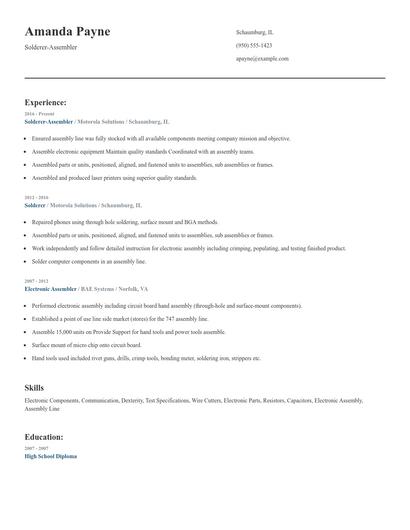
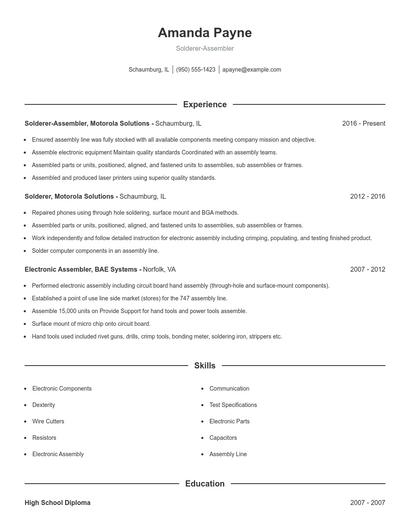
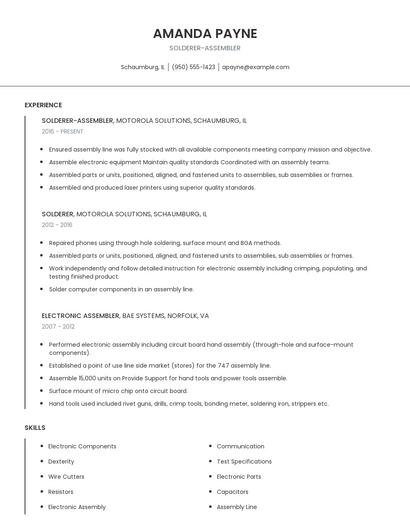
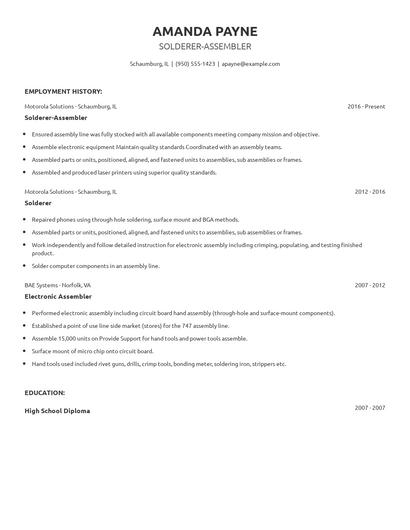
Choose from 10+ customizable solderer-assembler resume templates
Build a professional solderer-assembler resume in minutes. Our AI resume writing assistant will guide you through every step of the process, and you can choose from 10+ resume templates to create your solderer-assembler resume.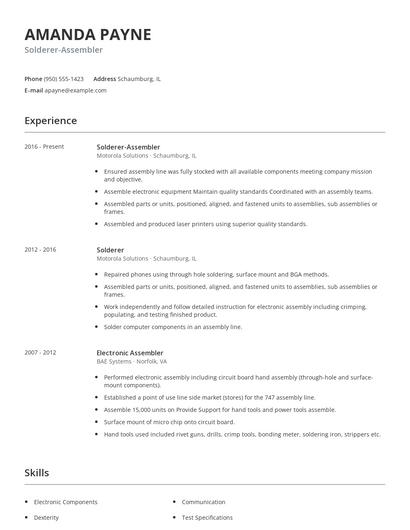
Compare different solderer-assemblers
Solderer-assembler vs. Electronic assembly technician
Assembly technicians are responsible for constructing small parts and components to create a new product according to the specifications of a client or a supervisor. An assembly technician performs diagnostic tests on the assembled product to ensure efficiency and conduct adjustments as needed. An assembly technician also provides manual instructional guides for product use and troubleshooting procedures. Assembly technicians must be knowledgeable about the technology and mechanical industry, as well as have the ability to analyze designs as a guide for creating high-quality products.
These skill sets are where the common ground ends though. The responsibilities of a solderer-assembler are more likely to require skills like "dexterity," "through-hole," "ipc-a-610," and "manual dexterity." On the other hand, a job as an electronic assembly technician requires skills like "mechanical drawings," "lean manufacturing," "drill press," and "ipc." As you can see, what employees do in each career varies considerably.
Electronic assembly technicians earn the highest salaries when working in the technology industry, with an average yearly salary of $35,468. On the other hand, solderer-assemblers are paid more in the automotive industry with an average salary of $33,104.The education levels that electronic assembly technicians earn slightly differ from solderer-assemblers. In particular, electronic assembly technicians are 0.3% more likely to graduate with a Master's Degree than a solderer-assembler. Additionally, they're 0.0% less likely to earn a Doctoral Degree.Solderer-assembler vs. Assembler & quality control
In addition to the difference in salary, there are some other key differences worth noting. For example, solderer-assembler responsibilities are more likely to require skills like "dexterity," "mechanical assembly," "circuit board assembly," and "hand tools." Meanwhile, an assembler & quality control has duties that require skills in areas such as "part numbers," "quality checks," "safety guidelines," and "control panels." These differences highlight just how different the day-to-day in each role looks.
Assemblers & quality control earn a lower average salary than solderer-assemblers. But assemblers & quality control earn the highest pay in the automotive industry, with an average salary of $34,668. Additionally, solderer-assemblers earn the highest salaries in the automotive with average pay of $33,104 annually.assemblers & quality control earn similar levels of education than solderer-assemblers in general. They're 1.1% more likely to graduate with a Master's Degree and 0.0% less likely to earn a Doctoral Degree.Solderer-assembler vs. Solder technician
Some important key differences between the two careers include a few of the skills necessary to fulfill the responsibilities of each. Some examples from solderer-assembler resumes include skills like "manual dexterity," "aerospace," "electronic components," and "assembly drawings," whereas a solder technician is more likely to list skills in "quality standards," "troubleshoot," "tin," and "component replacement. "
When it comes to education, solder technicians tend to earn similar degree levels compared to solderer-assemblers. In fact, they're 1.1% more likely to earn a Master's Degree, and 0.4% more likely to graduate with a Doctoral Degree.Solderer-assembler vs. Assembly technician
Even though a few skill sets overlap between solderer-assemblers and assembly technicians, there are some differences that are important to note. For one, a solderer-assembler might have more use for skills like "circuit board assembly," "through-hole," "ipc-a-610," and "manual dexterity." Meanwhile, some responsibilities of assembly technicians require skills like "customer service," "lean manufacturing," "safety procedures," and "basic math. "
In general, assembly technicians earn the most working in the finance industry, with an average salary of $37,725. The highest-paying industry for a solderer-assembler is the automotive industry.The average resume of assembly technicians showed that they earn similar levels of education compared to solderer-assemblers. So much so that theyacirc;euro;trade;re 0.7% more likely to earn a Master's Degree and more likely to earn a Doctoral Degree by 0.2%.Types of solderer-assembler
Updated January 8, 2025
