What does a strings teacher do?
Strings teacher responsibilities
Here are examples of responsibilities from real strings teacher resumes:
- Lead classroom management activities including attendance while coordinating lesson plan delivery for consumer science, physics and mathematics classes.
- Collaborate with AAL administrators and other departments in developing and implementing IEP annual goals and subsequent objectives.
- Collaborate with teacher and other interdisciplinary team members on IEP goals for high school students with severe/profound disabilities.
- Assume full responsibility for general, special education, and ESL classrooms, providing support and facilitating any require student accommodations.
- Create curriculum, syllabus and lesson plans for each class.
Strings teacher skills and personality traits
We calculated that 42% of Strings Teachers are proficient in Public Schools, String Instruments, and Private Lessons. They’re also known for soft skills such as Critical-thinking skills, Interpersonal skills, and Speaking skills.
We break down the percentage of Strings Teachers that have these skills listed on their resume here:
- Public Schools, 42%
Directed orchestras in four public schools.
- String Instruments, 38%
Provided small group and large group instruction for 3-5 grade students on string instruments.
- Private Lessons, 20%
Teach private lessons to students on a scheduledbasis.
"public schools," "string instruments," and "private lessons" are among the most common skills that strings teachers use at work. You can find even more strings teacher responsibilities below, including:
Critical-thinking skills. One of the key soft skills for a strings teacher to have is critical-thinking skills. You can see how this relates to what strings teachers do because "to conduct original research and design experiments, postsecondary teachers need to analyze information logically." Additionally, a strings teacher resume shows how strings teachers use critical-thinking skills: "administered classroom lessons to students in grades k-12 encouraged critical-thinking and creative problem-solving skills in classroom maintained classroom control and discipline"
Interpersonal skills. Many strings teacher duties rely on interpersonal skills. "postsecondary teachers need to work well with others for tasks such as instructing students and serving on committees.," so a strings teacher will need this skill often in their role. This resume example is just one of many ways strings teacher responsibilities rely on interpersonal skills: "attained valuable interpersonal experience with younger children, especial early childhood development. "
Speaking skills. Another skill that relates to the job responsibilities of strings teachers is speaking skills. This skill is critical to many everyday strings teacher duties, as "postsecondary teachers need good communication skills to present lectures and provide feedback to students." This example from a resume shows how this skill is used: "presented learning material pertaining to mathematics, social studies, english language arts, science, and writing. "
Writing skills. For certain strings teacher responsibilities to be completed, the job requires competence in "writing skills." The day-to-day duties of a strings teacher rely on this skill, as "postsecondary teachers need strong writing ability to publish original research and analysis." For example, this snippet was taken directly from a resume about how this skill applies to what strings teachers do: "teach a variety of classes; math, language arts, reading, writing, physical education. "
The three companies that hire the most strings teachers are:
- Paradise Valley Unified School District2 strings teachers jobs
Choose from 10+ customizable strings teacher resume templates
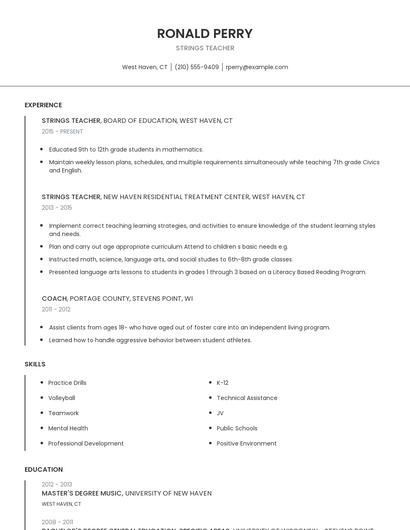
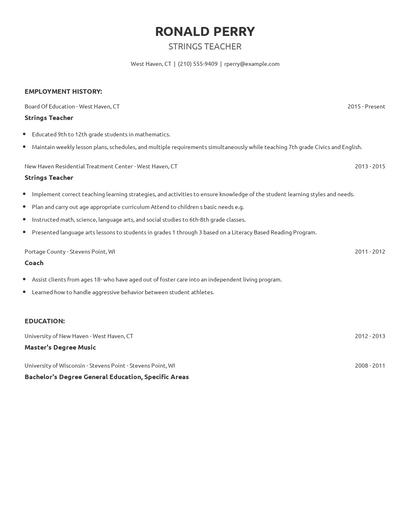
Build a professional strings teacher resume in minutes. Our AI resume writing assistant will guide you through every step of the process, and you can choose from 10+ resume templates to create your strings teacher resume.


Compare different strings teachers
Strings teacher vs. Music educator
Art Educators are hired to enhance humanities subjects and give students different ways to appreciate art in various forms. In museums, Art Educators work as both curators, guides for visitors and art lovers. They shape a community's culture, and it is their job to enrich the minds of people and enjoy the sheer beauty of art.
There are some key differences in the responsibilities of each position. For example, strings teacher responsibilities require skills like "string instruments," "sound recordings," "memorization," and "tone quality." Meanwhile a typical music educator has skills in areas such as "music education," "k-12," "music curriculum," and "music program." This difference in skills reveals the differences in what each career does.
The education levels that music educators earn slightly differ from strings teachers. In particular, music educators are 3.2% more likely to graduate with a Master's Degree than a strings teacher. Additionally, they're 1.7% more likely to earn a Doctoral Degree.Strings teacher vs. Art educator
Music Internship is a work experience offered by employers for students or graduates to gain exposure in the music industry's vast segments, such as from a media conglomerate, a music platform, or a music production company. For instance, a music production internship at Tik Tok entails assessing audio and music quality, composing different music styles, designing sounds for various applications, cross collaborating with engineers to produce musical products, and assisting the production team in music cataloging.
While some skills are similar in these professions, other skills aren't so similar. For example, resumes show us that strings teacher responsibilities requires skills like "string instruments," "private lessons," "group lessons," and "sound recordings." But an art educator might use other skills in their typical duties, such as, "curriculum development," "k-12," "art history," and "google drive."
Art educators earn higher levels of education than strings teachers in general. They're 6.2% more likely to graduate with a Master's Degree and 1.7% more likely to earn a Doctoral Degree.Strings teacher vs. College professor
The required skills of the two careers differ considerably. For example, strings teachers are more likely to have skills like "public schools," "string instruments," "private lessons," and "elementary schools." But a college professor is more likely to have skills like "curriculum development," "classes taught," "mathematics," and "syllabus."
Most college professors achieve a higher degree level compared to strings teachers. For example, they're 17.6% more likely to graduate with a Master's Degree, and 9.3% more likely to earn a Doctoral Degree.Strings teacher vs. Music internship
Types of strings teacher
Updated January 8, 2025
