What does a system integration analyst do?
The job of a system integration analyst is to ensure that an organization's information systems work together as a cooperative and connected system. You will perform a variety of tasks, including conducting application testing, creating and maintaining documentation for security and operational audits, and providing database management support. In addition, you will be responsible for establishing new users, resetting passwords, and managing access levels. You will also be responsible for devising or altering procedures to resolve computer issues relating to limitations and capacity.
System integration analyst responsibilities
Here are examples of responsibilities from real system integration analyst resumes:
- Enable users and systems administrators to more effectively manage and troubleshoot the messaging and directory components.
- Manage inbound and outbound feeds containing client product information and finished/outbound video products, including JavaScript delivery of products.
- Design and code ETL programs and prepare test cases including expect results.
- Utilize CDISC and XML formats to transmit EDI data to Merck and other medical companies.
- Work largely using XML and JSON.
- Programme in Java and .NET development environments.
- Help setup the eclipse environment for development.
- Prepare Extract/Transform/Load (ETL) specifications and document data flows.
- Train internal staff on multiple Unix and Intel platforms and client server environment.
- Create Unix application policy settings for applications to comply with GE's security standards and specifications.
- Create proper installation, operational, and testing documentation for fda-validate servers as dictated by the PRD QA department.
- Gather requirements, develop template and train UK SharePoint administrator.
- Create document library in SharePoint, upload documents to SharePoint.
- Direct QA verification of platform/server conversions for application porting and web interfacing.
- Create network interconnectivity drawings utilizing Microsoft Visio and rack elevation drawings using AutoCAD.
System integration analyst skills and personality traits
We calculated that 8% of System Integration Analysts are proficient in System Integration, Java, and Troubleshoot. They’re also known for soft skills such as Analytical skills, Communication skills, and Creativity.
We break down the percentage of System Integration Analysts that have these skills listed on their resume here:
- System Integration, 8%
Release Management (Operations) Conducted system integration and release management support for large engineering and operations teams utilizing ITSM/ITIL methodology.
- Java, 5%
Maintain and develop Enterprise Authorization System modules in Java.
- Troubleshoot, 5%
Enabled users and systems administrators to more effectively manage and troubleshoot the messaging and directory components.
- Business Process, 4%
Analyzed functional, technical and business processes through information-gathering sessions with clients to gain understanding of business needs.
- XML, 4%
Worked largely using XML and JSON.
- Data Analysis, 4%
Performed data analysis, tracked and managed deliverable documents and data for large hardware systems and enterprise systems management.
"system integration," "java," and "troubleshoot" are among the most common skills that system integration analysts use at work. You can find even more system integration analyst responsibilities below, including:
Analytical skills. To carry out their duties, the most important skill for a system integration analyst to have is analytical skills. Their role and responsibilities require that "analysts must interpret complex information from various sources and decide the best way to move forward on a project." System integration analysts often use analytical skills in their day-to-day job, as shown by this real resume: "analyze and modify data to meet hl7 and outside vendor requirements/specifications. "
Communication skills. Many system integration analyst duties rely on communication skills. "analysts work as a go-between with management and the it department and must explain complex issues in a way that both will understand.," so a system integration analyst will need this skill often in their role. This resume example is just one of many ways system integration analyst responsibilities rely on communication skills: "achieved $60k / year savings by connecting legacy manufacturing network with enterprise wan, enabling direct erp communication. "
Creativity. Another skill that relates to the job responsibilities of system integration analysts is creativity. This skill is critical to many everyday system integration analyst duties, as "because analysts are tasked with finding innovative solutions to computer problems, an ability to “think outside the box” is important." This example from a resume shows how this skill is used: "developed and maintained test cases for inventory software. "
The three companies that hire the most system integration analysts are:
- Guidehouse7 system integration analysts jobs
- Lockheed Martin5 system integration analysts jobs
- ENGIE North America4 system integration analysts jobs
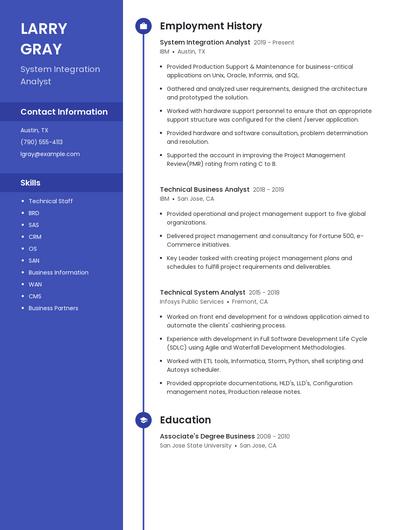
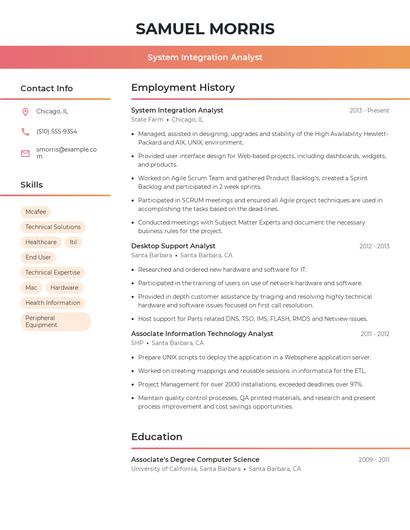
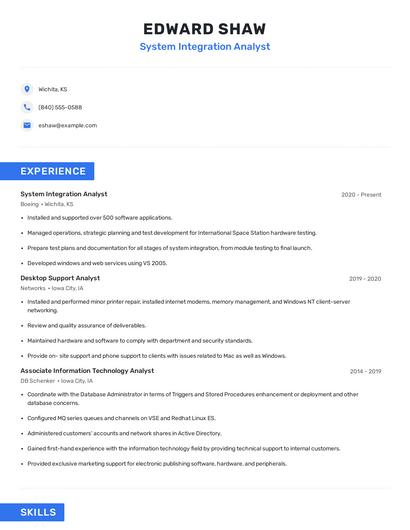
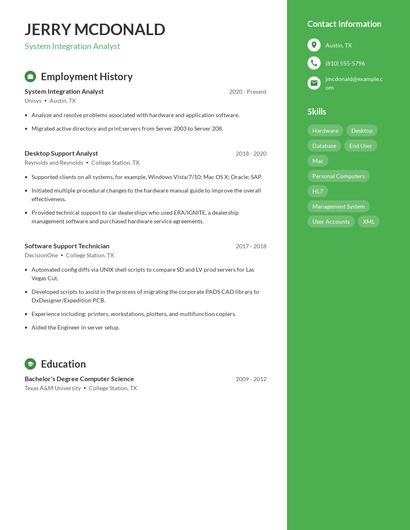
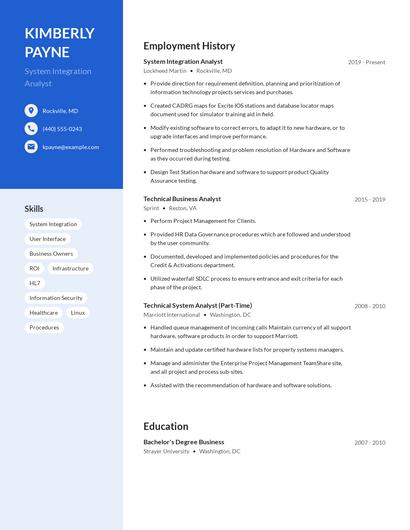
Choose from 10+ customizable system integration analyst resume templates
Build a professional system integration analyst resume in minutes. Our AI resume writing assistant will guide you through every step of the process, and you can choose from 10+ resume templates to create your system integration analyst resume.



Compare different system integration analysts
System integration analyst vs. Analyst lead
The duties of an analyst lead depend on one's line of work or industry of employment. Typically, their responsibilities revolve around performing research and analysis, coordinating with different departments to gather leads and data, reviewing findings, and producing reports and presentations for the stakeholders and other higher-ranking officials. Through the results, an analyst lead can provide advice, devise strategies for business optimization, spearhead the development of processes, identify strengths and weaknesses, and offer recommendations on areas in need of improvement. All of this is done while in adherence to the company's vision and mission.
There are some key differences in the responsibilities of each position. For example, system integration analyst responsibilities require skills like "system integration," "hl7," "technical support," and "erp." Meanwhile a typical analyst lead has skills in areas such as "analytics," "project management," "customer service," and "excellent interpersonal." This difference in skills reveals the differences in what each career does.
Analyst leads earn the highest salaries when working in the finance industry, with an average yearly salary of $110,488. On the other hand, system integration analysts are paid more in the hospitality industry with an average salary of $100,896.analyst leads tend to reach similar levels of education than system integration analysts. In fact, analyst leads are 2.2% more likely to graduate with a Master's Degree and 0.8% more likely to have a Doctoral Degree.System integration analyst vs. Analyst
Analysts are employees or individual contributors with a vast experience in a particular field that help the organization address challenges. They help the organization improve processes, policies, and other operations protocol by studying the current processes in place and determining the effectiveness of those processes. They also research industry trends and data to make sound inferences and recommendations on what the company should do to improve their numbers. Analysts recommend business solutions and often help the organization roll out these solutions. They ensure that the proposed action plans are effective and produce the desired results.
While some skills are similar in these professions, other skills aren't so similar. For example, resumes show us that system integration analyst responsibilities requires skills like "system integration," "business process," "hl7," and "technical support." But an analyst might use other skills in their typical duties, such as, "customer service," "project management," "strong analytical," and "digital transformation."
On average, analysts earn a lower salary than system integration analysts. Some industries support higher salaries in each profession. Interestingly enough, analysts earn the most pay in the technology industry with an average salary of $79,330. Whereas system integration analysts have higher pay in the hospitality industry, with an average salary of $100,896.Average education levels between the two professions vary. Analysts tend to reach similar levels of education than system integration analysts. In fact, they're 3.1% less likely to graduate with a Master's Degree and 0.8% more likely to earn a Doctoral Degree.What technology do you think will become more important and prevalent for system integration analysts in the next 3-5 years?
Rebecca Sarver
Lecturer in Human Services Studies, Elmira College
System integration analyst vs. Business analyst
Business analysts are employees who are responsible for interpreting business data and coming up with business solutions. They are well-versed in whatever business the company is in, and they have strong business acumen. They collect data related to the business and then interpret and analyze the data. Business analysts should be able to conduct different levels of analyses and must also be able to create a sound study. Once the analysis is done, they provide recommendations or strategic direction to decision-makers that will help the business become sustainable and grow.
Some important key differences between the two careers include a few of the skills necessary to fulfill the responsibilities of each. Some examples from system integration analyst resumes include skills like "system integration," "troubleshoot," "business process," and "hl7," whereas a business analyst is more likely to list skills in "project management," "business analysis," "user stories," and "strong analytical. "
Business analysts earn the highest salary when working in the finance industry, where they receive an average salary of $91,354. Comparatively, system integration analysts have the highest earning potential in the hospitality industry, with an average salary of $100,896.business analysts typically earn similar educational levels compared to system integration analysts. Specifically, they're 2.7% more likely to graduate with a Master's Degree, and 0.0% more likely to earn a Doctoral Degree.System integration analyst vs. Gis analyst
A GIS Analyst is responsible for the development and implementation of geographic information systems. They provide expertise, support, assistance, and guidance to various geographic variables in a specific area.
Even though a few skill sets overlap between system integration analysts and gis analysts, there are some differences that are important to note. For one, a system integration analyst might have more use for skills like "system integration," "java," "troubleshoot," and "business process." Meanwhile, some responsibilities of gis analysts require skills like "gps," "spatial data," "data collection," and "esri arcgis. "
Gis analysts enjoy the best pay in the utilities industry, with an average salary of $79,998. For comparison, system integration analysts earn the highest salary in the hospitality industry.gis analysts reach similar levels of education compared to system integration analysts, in general. The difference is that they're 0.2% more likely to earn a Master's Degree, and 0.0% less likely to graduate with a Doctoral Degree.Types of system integration analyst
Updated January 8, 2025
