What does a systems engineer/architect do?
A systems engineer/architect is responsible for creating and designing computer systems and applications to support business operations and enhance the efficiency of staff performance. Systems engineers/architects evaluate the structures and features of the servers and ensure stability and smooth navigation according to requirements and specifications. They also handle the improvement and enhancement of existing systems by upgrading the network infrastructure and configuring the interface. A systems engineer/architect recommends strategic technical solutions to maximize productivity and prevent operational delays.
Systems engineer/architect responsibilities
Here are examples of responsibilities from real systems engineer/architect resumes:
- Manage DNS configuration as a sub-domain of MILNET web.
- Write script to create Veritas vxfs volumes and to automate backup of all Unix filesystems on all systems.
- Develop and integrate software that drives flight control system hardware and achieves product requirements for an international avionics customer base.
- Standardize patch levels and updates for all Linux environments, coordinating OS and third-party applications.
- Serve as Microsoft ecosystem service architect and project management, responsible for providing technical infrastructure solutions and services.
- Integrate high speed SCSI SAN and NAS resources.
- Provide UNIX scripts for deploying and building the system.
- Project work in upgrading and maintaining SAN switches and arrays.
- Perform client side and sever side evaluation using JavaScript and VBScript.
- Perform government witness testing of DoD relate systems for compliance and performance.
- Utilize SNMP, perl, shell and other tools for proxy and Linux management.
- Provide training to team on virtualization, blade management, and rapid system development.
- Provide hardening scripts and other OS level programs to assist in getting the system accredit.
- Perform data migrations, OS upgrades, core software installations, tuning and server hardening.
- Provide ESQL and Java proof-of-concept coding samples to demonstrate best practices including legacy data format handling.
Systems engineer/architect skills and personality traits
We calculated that 9% of Systems Engineers/Architects are proficient in C++, C #, and Database. They’re also known for soft skills such as Analytical skills, Communication skills, and Problem-solving skills.
We break down the percentage of Systems Engineers/Architects that have these skills listed on their resume here:
- C++, 9%
NET and Java Platforms C++ and Java languages SOAP Messaging.
- C #, 9%
Used WPF, WCF, and VB.Net and C # extensively.
- Database, 8%
Created and presented training and database provisioning documentation used for the introduction of new operator services features.
- Cloud, 7%
Lead Cloud Architecture Development effort that worked toward integrating a Cisco UCS with IBM Hardware into a complete IaaS foundation.
- AWS, 7%
Developed business model for engineering companies to migrate storage and high compute intensive tasks to AWS.
- Azure, 6%
Deployed and monitored Azure-based rights management services; coordinated participation in Azure SCOM Monitoring Pilot project.
Most systems engineers/architects use their skills in "c++," "c #," and "database" to do their jobs. You can find more detail on essential systems engineer/architect responsibilities here:
Analytical skills. To carry out their duties, the most important skill for a systems engineer/architect to have is analytical skills. Their role and responsibilities require that "administrators need to evaluate networks and systems to make sure that they perform reliably and to anticipate new requirements as customers’ needs change." Systems engineers/architects often use analytical skills in their day-to-day job, as shown by this real resume: "provided esql and java proof-of-concept coding samples to demonstrate best practices including legacy data format handling. "
Communication skills. Another essential skill to perform systems engineer/architect duties is communication skills. Systems engineers/architects responsibilities require that "administrators must describe problems and their solutions to non-it workers." Systems engineers/architects also use communication skills in their role according to a real resume snippet: "defined air-to-ground communications and system architecture requirements. "
Problem-solving skills. systems engineers/architects are also known for problem-solving skills, which are critical to their duties. You can see how this skill relates to systems engineer/architect responsibilities, because "administrators must quickly resolve problems that arise with computer networks." A systems engineer/architect resume example shows how problem-solving skills is used in the workplace: "design hierarchical storage solutions using hitachi, emc and 3 par solutions. "
The three companies that hire the most systems engineer/architects are:
- SMX Convention Center51 systems engineers/architects jobs
- Oracle28 systems engineers/architects jobs
- Northrop Grumman25 systems engineers/architects jobs
Choose from 10+ customizable systems engineer/architect resume templates
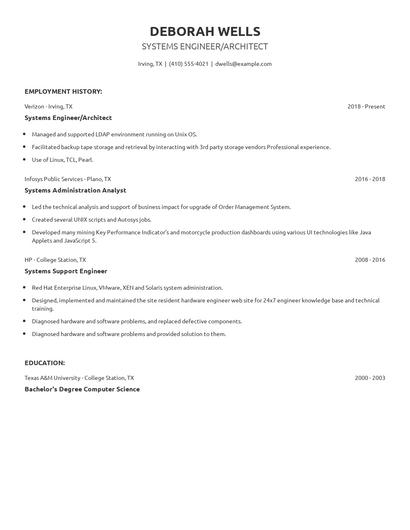
Build a professional systems engineer/architect resume in minutes. Our AI resume writing assistant will guide you through every step of the process, and you can choose from 10+ resume templates to create your systems engineer/architect resume.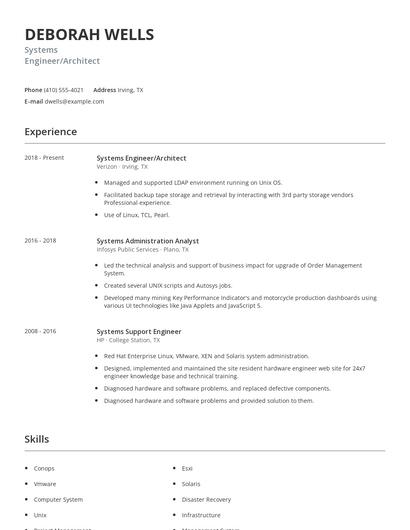
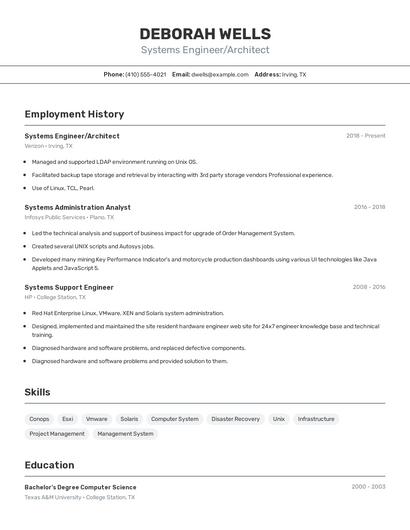


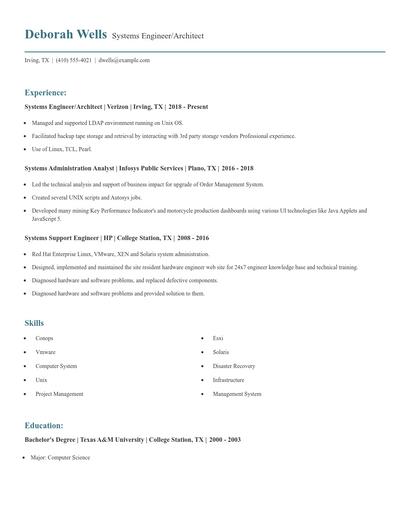

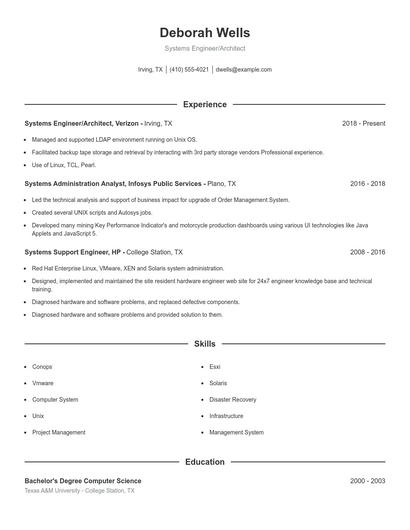

Compare different systems engineers/architects
Systems engineer/architect vs. Senior infrastructure engineer
A senior infrastructure engineer specializes in designing and developing systems and infrastructures based on client preferences and industry standards. They have the duty to identify and understand the project's needs, streamline project requirements, produce drafts, create prototypes and models, and establish tests to identify potential issues and ensure the projects' quality. Additionally, a senior infrastructure engineer has the authority to make decisions, train and supervise junior engineers, establish goals and timelines, provide technical support, and implement policies and guidelines.
There are some key differences in the responsibilities of each position. For example, systems engineer/architect responsibilities require skills like "c++," "c #," "database," and "infrastructure." Meanwhile a typical senior infrastructure engineer has skills in areas such as "customer service," "dhcp," "terraform," and "system administration." This difference in skills reveals the differences in what each career does.
Senior infrastructure engineers really shine in the hospitality industry with an average salary of $123,360. Comparatively, systems engineers/architects tend to make the most money in the technology industry with an average salary of $104,773.The education levels that senior infrastructure engineers earn slightly differ from systems engineers/architects. In particular, senior infrastructure engineers are 5.8% less likely to graduate with a Master's Degree than a systems engineer/architect. Additionally, they're 1.5% less likely to earn a Doctoral Degree.Systems engineer/architect vs. Systems analyst
A systems analyst is responsible for monitoring the effectiveness of technology systems and analyzing its efficiency for business operations and clients' needs. Systems analysts create specific modifications to operating systems and help design solutions and processes. Other tasks include managing the system's workflow, diagnosing and detecting malfunctions, performing troubleshooting, and assisting clients' with their concerns. A systems analyst must have excellent command with programming languages and the knowledge with the technology industry to understand systems' complexities and processes.
Each career also uses different skills, according to real systems engineer/architect resumes. While systems engineer/architect responsibilities can utilize skills like "database," "cloud," "aws," and "azure," systems analysts use skills like "customer service," "data analysis," "business processes," and "sql server."
On average, systems analysts earn a lower salary than systems engineers/architects. Some industries support higher salaries in each profession. Interestingly enough, systems analysts earn the most pay in the finance industry with an average salary of $86,904. Whereas systems engineers/architects have higher pay in the technology industry, with an average salary of $104,773.systems analysts earn similar levels of education than systems engineers/architects in general. They're 2.5% less likely to graduate with a Master's Degree and 1.5% less likely to earn a Doctoral Degree.What technology do you think will become more important and prevalent for systems engineer/architects in the next 3-5 years?
Christy Graves
Professor/Program Manager, Seminole State College of Florida
Systems engineer/architect vs. Senior solutions architect
Senior Solutions Architects are responsible for creating programs or systems that would address the clients' needs. They are expected to be familiar with different tools and systems. This would help them create the best solutions for their clients. Senior Solutions Architects are technologically-savvy. They are expected to be updated with the current trends and innovations in technology. They should also be familiar with these innovations in case these innovations are needed in the company. Senior Solutions Architects are expected to have experience in solving different technical and technological challenges. They should have a solutions-driven mindset.
There are many key differences between these two careers, including some of the skills required to perform responsibilities within each role. For example, a systems engineer/architect is likely to be skilled in "c++," "database," "python," and "dod," while a typical senior solutions architect is skilled in "digital transformation," "analytics," "client facing," and "business development."
Senior solutions architects earn the highest salary when working in the start-up industry, where they receive an average salary of $139,751. Comparatively, systems engineers/architects have the highest earning potential in the technology industry, with an average salary of $104,773.When it comes to education, senior solutions architects tend to earn higher degree levels compared to systems engineers/architects. In fact, they're 7.6% more likely to earn a Master's Degree, and 1.0% more likely to graduate with a Doctoral Degree.Systems engineer/architect vs. Service engineer
A service engineer is responsible for assisting the customers' concerns regarding the products and services offered by the company through technical support solutions. Service engineers conduct preventive maintenance, upgrade systems to boost optimal performance, create product manuals, record the occurring issues, perform adjustments on the systems infrastructure, identify business opportunities to generate more revenues, and analyze current market trends to meet client demands. A service engineer must have excellent communication skills, including extensive knowledge of the technology industry and network systems.
Types of systems engineer/architect
Updated January 8, 2025
