What does a tool analyst do?
Tool analyst responsibilities
Here are examples of responsibilities from real tool analyst resumes:
- Plan and manage projects to implement online degree programs for educational institutions, utilizing SDLC and Agile/SCRUM methodologies.
- Design, develop, test, implement, and support SQL base ETL solutions.
- Implement the group's SharePoint site improving communication and documentation efficiencies significantly over previous methods.
- Develop business/functional requirement documents using UML, use-case and activity diagrams, and project plans base on client-specific requirements.
- Perform research on potentially suspicious transactions/activities through analysis of internal systems, AML databases and communication with bank personnel.
- Increase payer reimbursements by monitoring compliance of the electronic health record (EHR) initiative.
- Implement EHR software for outpatient Oncology/Hematology practices.
- Examine applications to determine Medicaid eligibility or ineligibility.
Tool analyst skills and personality traits
We calculated that 24% of Tool Analysts are proficient in SharePoint, Data Quality, and HTML. They’re also known for soft skills such as Creativity, Analytical skills, and Communication skills.
We break down the percentage of Tool Analysts that have these skills listed on their resume here:
- SharePoint, 24%
Gained fundamental training on SharePoint 2010, Windows Server 2008r2 completing comprehensive work assignments.
- Data Quality, 14%
Developed data quality metrics for space-based and airborne Radar GMTI platforms.
- HTML, 13%
Developed system and user documentation for in-house corporate systems and system HTML documentation for Internet/Intranet.
- Training Materials, 11%
Developed training materials and led training classes for the use of customized tools.
- Sigma, 9%
Utilize LEAN/Six Sigma methodologies to streamline underwriting processes across the enterprise.
- Data Entry, 7%
Provide reports/tracking data entry for VTE to verify/validate work in progressing and targets are being met.
"sharepoint," "data quality," and "html" are among the most common skills that tool analysts use at work. You can find even more tool analyst responsibilities below, including:
Creativity. To carry out their duties, the most important skill for a tool analyst to have is creativity. Their role and responsibilities require that "because analysts are tasked with finding innovative solutions to computer problems, an ability to “think outside the box” is important." Tool analysts often use creativity in their day-to-day job, as shown by this real resume: "participate in assessing inventory variances, damaged tooling, missing materials, engineering changes, and production machinery. "
Analytical skills. Another essential skill to perform tool analyst duties is analytical skills. Tool analysts responsibilities require that "analysts must interpret complex information from various sources and decide the best way to move forward on a project." Tool analysts also use analytical skills in their role according to a real resume snippet: "developed data quality metrics for space-based and airborne radar gmti platforms. "
Communication skills. tool analysts are also known for communication skills, which are critical to their duties. You can see how this skill relates to tool analyst responsibilities, because "analysts work as a go-between with management and the it department and must explain complex issues in a way that both will understand." A tool analyst resume example shows how communication skills is used in the workplace: "implemented the group's sharepoint site improving communication and documentation efficiencies significantly over previous methods. "
The three companies that hire the most tool analysts are:
- Cyient3 tool analysts jobs
- Allison Transmission2 tool analysts jobs
- ADP2 tool analysts jobs
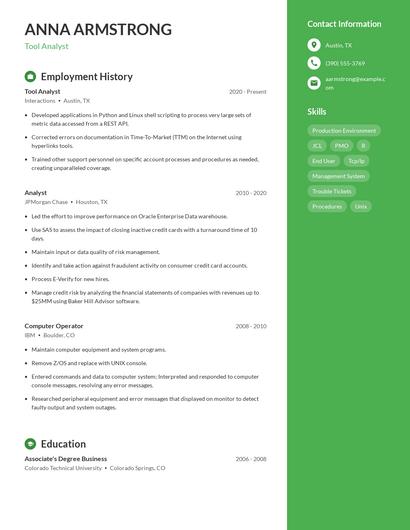
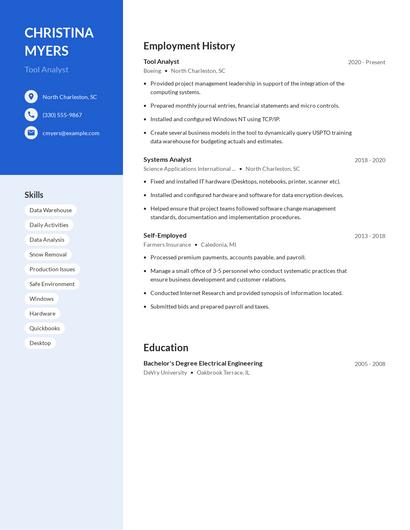
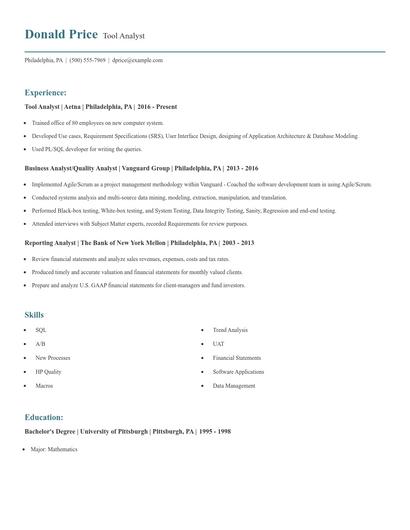
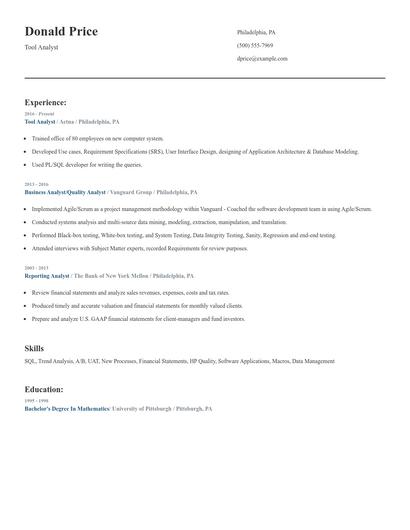
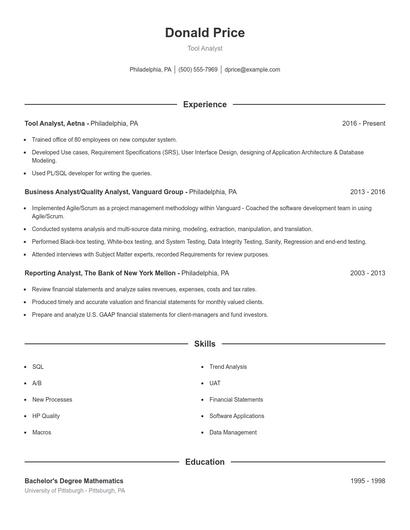
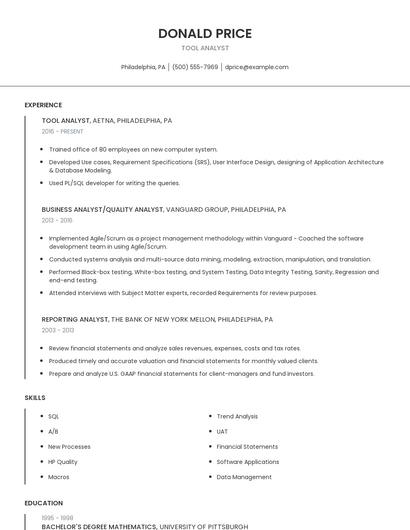
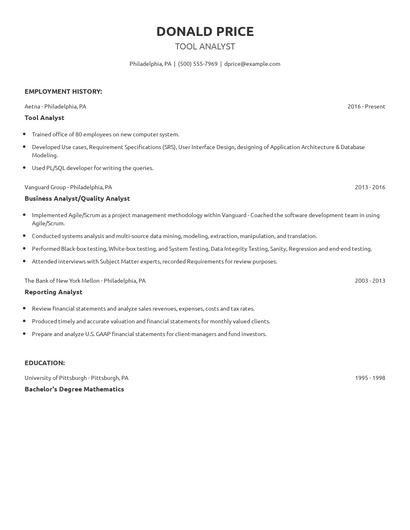
Choose from 10+ customizable tool analyst resume templates
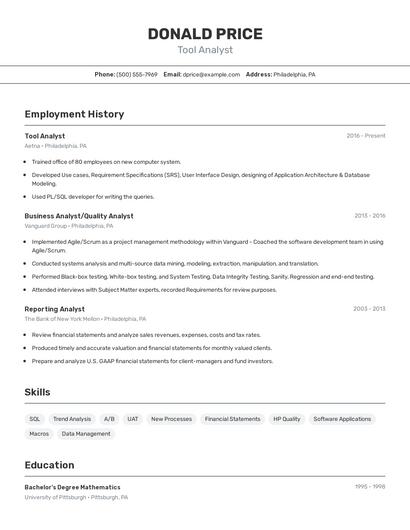
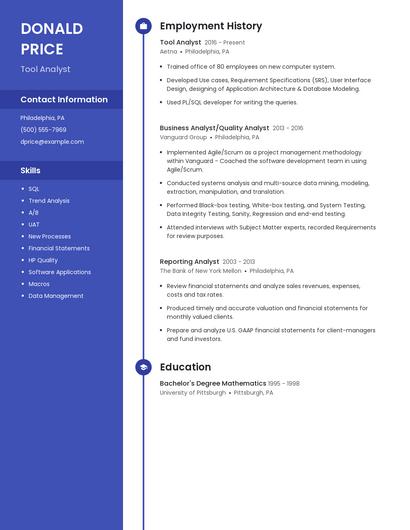
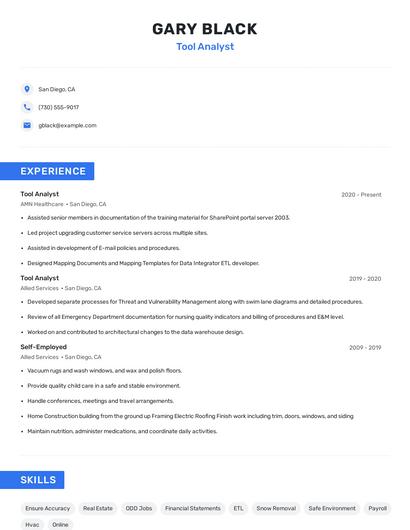
Build a professional tool analyst resume in minutes. Our AI resume writing assistant will guide you through every step of the process, and you can choose from 10+ resume templates to create your tool analyst resume.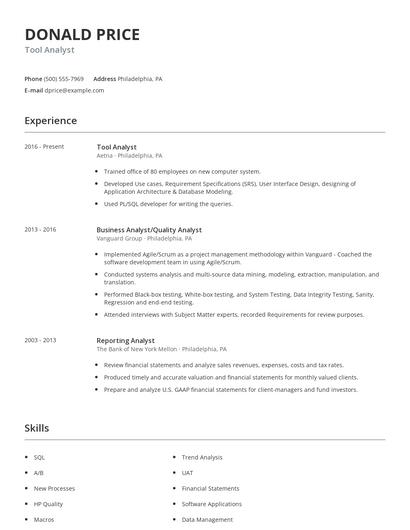

Compare different tool analysts
Tool analyst vs. Business analyst/quality analyst
A business analyst/quality analyst is responsible for evaluating business outputs and operational processes to ensure that everything adheres to the quality standards and business regulations. Business analysts/quality analysts support senior management in determining solutions to improve the company's services and provide the highest satisfaction for the customers and clients. They also conduct data and statistical analysis by assessing the market trends to identify opportunities that would generate more revenue resources and increase profitability for the business.
While similarities exist, there are also some differences between tool analysts and business analyst/quality analyst. For instance, tool analyst responsibilities require skills such as "iso," "data quality," "training materials," and "sigma." Whereas a business analyst/quality analyst is skilled in "test cases," "qa," "uat," and "microsoft visio." This is part of what separates the two careers.
Business analysts/quality analysts tend to reach higher levels of education than tool analysts. In fact, business analysts/quality analysts are 6.8% more likely to graduate with a Master's Degree and 0.5% more likely to have a Doctoral Degree.Tool analyst vs. Systems analyst programmer
A Systems Analyst Programmer provides technical expertise and recommendations in evaluating new IT software projects. They also indentify solutions and opportunities that can enhance the efficiency of business processes.
While some skills are similar in these professions, other skills aren't so similar. For example, resumes show us that tool analyst responsibilities requires skills like "iso," "data quality," "training materials," and "sigma." But a systems analyst programmer might use other skills in their typical duties, such as, "c++," "c #," "java," and "database design."
Average education levels between the two professions vary. Systems analyst programmers tend to reach lower levels of education than tool analysts. In fact, they're 5.5% less likely to graduate with a Master's Degree and 0.5% more likely to earn a Doctoral Degree.Tool analyst vs. Finance systems analyst
A finance systems analyst specializes in overseeing the financial systems in a company or business. Their responsibilities revolve around producing reports and presentations, liaising with the information technology team, maintaining information on databases, and monitoring and updating the financial systems. One must also handle spreadsheets and other files, modify menus, troubleshoot errors, and teach the finance staff how to use all courses for a smooth workflow. Furthermore, it is essential to implement all policies and regulations, ensuring all files' security within the database.
The required skills of the two careers differ considerably. For example, tool analysts are more likely to have skills like "iso," "data quality," "html," and "sigma." But a finance systems analyst is more likely to have skills like "financial systems," "hyperion," "customer service," and "project management."
Finance systems analysts typically earn similar educational levels compared to tool analysts. Specifically, they're 0.8% less likely to graduate with a Master's Degree, and 0.2% less likely to earn a Doctoral Degree.Tool analyst vs. Computer systems analyst
A computer systems analyst is responsible for creating and designing computer applications and network solutions to support business functions and requirements. Computer systems analysts evaluate the systems' efficiency and performance to perform configuration and improve infrastructure for smooth navigation and controls. They also assist end-users in resolving network issues, perform troubleshooting, and write resolution reports for reference and failure prevention. A computer systems analyst must have excellent technical and computer skills, especially in installing new upgrades and developing features for existing applications.
Types of tool analyst
Updated January 8, 2025
