What does a training and quality assurance manager do?
As a Quality Assurance Manager, one of your duties will be ensuring that all workers employed in the production unit do their work with quality in mind. In addition to that, you will have the responsibility of providing training in best practices, ensuring that all employees working in production are aware of and responsible for managing their quality standards, and training staff members on quality control processes and policies. In essence, your job will be to ensure that products are safe to use and uniform, following all specifications.
Training and quality assurance manager responsibilities
Here are examples of responsibilities from real training and quality assurance manager resumes:
- Manage complex development programs consisting of multiple geographically separate teams supporting automation, regression, feature test and system test.
- Play an intricate part in the plant approval by the FDA.
- Review and approve GMP and GLP job curricula assignments and modifications for employees.
- Prepare other managers and associates for annual ISO audits and all other external and internal audits.
- Ensure that site policies and procedures are in compliance with current FDA and ICH guidelines and regulations.
- Delegate QA responsibilities and design time schedules
- Review all regulatory and oversight audits conduct by external parties and assure that all deficiencies and/or recommendations are addressed and implement.
- Process FMEA and overall process validation for new product manufacturing lines.
- Visit programs to verify Medicaid billing information and perform quarterly site and case record audits.
- Develop database to maximize Medicare and Medicaid reimbursement through close follow-up, staff education and appropriate documentation.
- Develop and implement first training program for new payroll representatives at remote offices.
Training and quality assurance manager skills and personality traits
We calculated that 15% of Training And Quality Assurance Managers are proficient in QA, Training Materials, and Training Programs. They’re also known for soft skills such as Analytical skills, Communication skills, and Creativity.
We break down the percentage of Training And Quality Assurance Managers that have these skills listed on their resume here:
- QA, 15%
Determine QA Specialist training delivery assignments.
- Training Materials, 7%
Develop training materials and directives for company Trainers and Quality Analysts, identify trends and implement corrective measures.
- Training Programs, 7%
Implemented training laboratory equipped with production machinery in simulated work environment and developed basic and advanced job skills training programs.
- Management System, 5%
Ensured dispositions of non-conforming products were carried out in accordance with approved Quality Management Systems procedures.
- Performance Improvement, 5%
Created and administer training appropriate to the client and for team/individual performance improvements.
- Quality Metrics, 5%
Developed quality audits to provide quality metrics and support performance management.
"qa," "training materials," and "training programs" are among the most common skills that training and quality assurance managers use at work. You can find even more training and quality assurance manager responsibilities below, including:
Analytical skills. To carry out their duties, the most important skill for a training and quality assurance manager to have is analytical skills. Their role and responsibilities require that "training and development specialists must evaluate training programs, methods, and materials and choose those that best fit each situation." Training and quality assurance managers often use analytical skills in their day-to-day job, as shown by this real resume: "communicated directly with team managers, hr and our client gather data and ran monthly quality assurance variance metric reports. "
Communication skills. Many training and quality assurance manager duties rely on communication skills. "training and development specialists must convey information clearly and facilitate learning to diverse audiences.," so a training and quality assurance manager will need this skill often in their role. This resume example is just one of many ways training and quality assurance manager responsibilities rely on communication skills: "created field communications, planograms, project instructions, and training materials. "
Creativity. This is an important skill for training and quality assurance managers to perform their duties. For an example of how training and quality assurance manager responsibilities depend on this skill, consider that "specialists should be resourceful when developing training materials." This excerpt from a resume also shows how vital it is to everyday roles and responsibilities of a training and quality assurance manager: "manage all inventory, sales, portfolios, and finances for five separate institutions through the use of excel. ".
Instructional skills. training and quality assurance manager responsibilities often require "instructional skills." The duties that rely on this skill are shown by the fact that "training and development specialists deliver employee training programs." This resume example shows what training and quality assurance managers do with instructional skills on a typical day: "designed and maintained training courses, instructional material, web-based training and reference guides. "
See the full list of training and quality assurance manager skills
The three companies that hire the most training and quality assurance managers are:
- GC Services Limited Partnership2 training and quality assurance managers jobs
- Loma Linda University Health2 training and quality assurance managers jobs
- Marsh & McLennan Companies1 training and quality assurance managers jobs
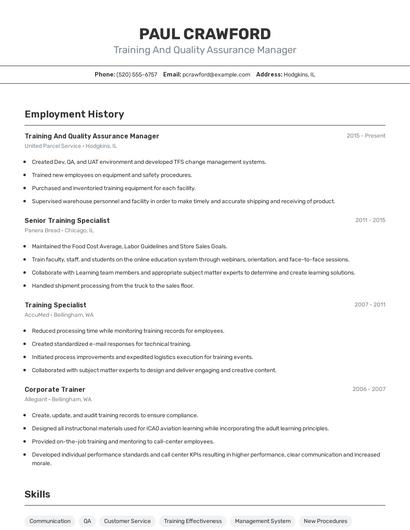
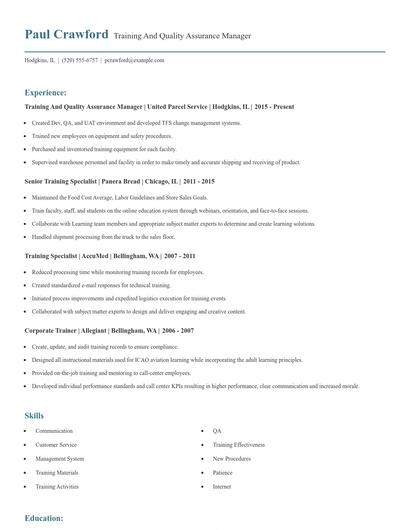
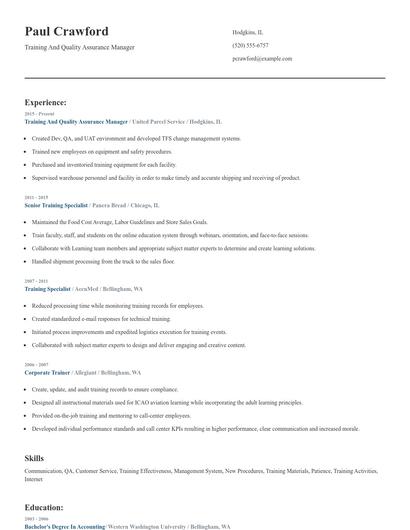
Choose from 10+ customizable training and quality assurance manager resume templates
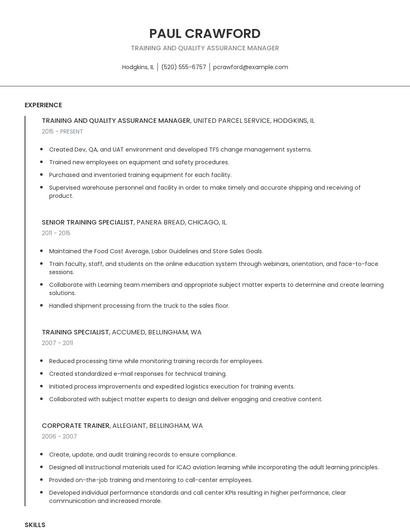
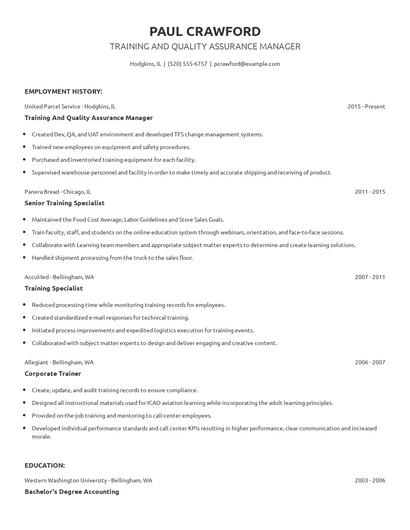
Build a professional training and quality assurance manager resume in minutes. Our AI resume writing assistant will guide you through every step of the process, and you can choose from 10+ resume templates to create your training and quality assurance manager resume.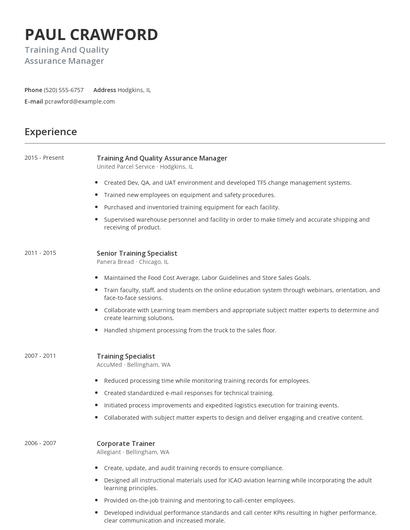



Compare different training and quality assurance managers
Training and quality assurance manager vs. Development specialist
A development specialist is responsible for monitoring career training and programs for the employees, improving their capabilities and maximum potential to contribute to the company's growth and success. Development specialists also assist in assessing departmental operations, evaluating training needs, and facilitate skill development discussions and exercises. A development specialist helps identify business opportunities to generate more revenues for the organization and improve profitability status. A development specialist must have excellent communication and organization skills and comprehensive knowledge of human management to assist employees with their inquiries and concerns.
While similarities exist, there are also some differences between training and quality assurance managers and development specialist. For instance, training and quality assurance manager responsibilities require skills such as "qa," "management system," "performance improvement," and "quality metrics." Whereas a development specialist is skilled in "customer satisfaction," "patients," "excellent interpersonal," and "project management." This is part of what separates the two careers.
Development specialists tend to reach similar levels of education than training and quality assurance managers. In fact, development specialists are 4.3% more likely to graduate with a Master's Degree and 0.5% less likely to have a Doctoral Degree.Training and quality assurance manager vs. Senior technician specialist
Senior technician specialists are technicians in the office who specialize in a specific activity or task. They are more tenured than entry-level employees and, at times, given bigger responsibilities than their junior counterparts. They may even be asked to lead specific projects. Senior technician specialists are usually involved in the technical or technological needs of the organization. As such, they should be familiar with the different equipment, fixtures, and infrastructure in the office. They are expected to perform installations, repairs, updates, and maintenance. Senior technician specialists should also be able to provide support to office employees on technical and technological aspects.
While some skills are similar in these professions, other skills aren't so similar. For example, resumes show us that training and quality assurance manager responsibilities requires skills like "training materials," "training programs," "management system," and "performance improvement." But a senior technician specialist might use other skills in their typical duties, such as, "patients," "c #," "project management," and "java."
Senior technician specialists may earn a higher salary than training and quality assurance managers, but senior technician specialists earn the most pay in the technology industry with an average salary of $101,461. On the other hand, training and quality assurance managers receive higher pay in the insurance industry, where they earn an average salary of $64,977.Average education levels between the two professions vary. Senior technician specialists tend to reach similar levels of education than training and quality assurance managers. In fact, they're 0.5% more likely to graduate with a Master's Degree and 0.5% less likely to earn a Doctoral Degree.Training and quality assurance manager vs. Facilitator
A facilitator is responsible for assisting a group event or program, ensuring that the participants coordinate well. Facilitators also monitor that the objectives of the event are smoothly delivered and organized. An effective facilitator requires having strong communication and leadership skills to manage the participants' concerns and inquiries, including active participation in group discussions and designing engaging activities and processes. Facilitators also assist with planning and finalizing the timetable and setting the specific house rules and regulations for everyone's compliance.
There are many key differences between these two careers, including some of the skills required to perform responsibilities within each role. For example, a training and quality assurance manager is likely to be skilled in "qa," "management system," "performance improvement," and "quality metrics," while a typical facilitator is skilled in "patients," "facilitators," "social work," and "mental health."
Facilitators earn the best pay in the manufacturing industry, where they command an average salary of $45,516. Training and quality assurance managers earn the highest pay from the insurance industry, with an average salary of $64,977.facilitators typically earn higher educational levels compared to training and quality assurance managers. Specifically, they're 5.1% more likely to graduate with a Master's Degree, and 0.3% more likely to earn a Doctoral Degree.Training and quality assurance manager vs. Corporate trainer
A corporate trainer is someone who essentially works as a teacher in a corporate setting. Daily duties include training employees with new company systems, skills, and strategies. They monitor the engagement levels and performance of the training participants. Also, they collaborate with project stakeholders to create training content and design. Corporate trainers must have high interpersonal skills to connect with trainers easily and to get them to participate actively in the training sessions. Preferred candidates for the job are those with a bachelor's degree in human resources or those with relevant job experience in the same field.
Types of training and quality assurance manager
Updated January 8, 2025
