What does a unix engineer do?
Unix engineer responsibilities
Here are examples of responsibilities from real unix engineer resumes:
- Implement and manage EMC XtremIO flash SAN environment.
- Manage NAS mounts for NAS filers configure by storage team.
- Configure and manage storage volumes such as LVM and VERITAS on RHEL/centos systems.
- Experience managing NFS shares and file systems from NetApp filers and EMC NAS devices.
- Manage and utilize EMC storage space for SUN/ORACLE systems as system administrator and storage administrator.
- Manage installation and integration of system fixes, updates, and provides configuration and enhancements in support of the OS environments.
- Involve in implementing security on Solaris and Linux servers.
- Shell (bourne, ksh, bash, some perl) scripting for various admin relate jobs.
- Experience in automation using scripts in Perl and also shell (bash and korn).
- Decommission hundreds of legacy Solaris and Linux physical servers.
- Design/Implement Hitachi shadow imaging technology for disaster recovery procedures for the SAN.
- Develop cloud computing architecture utilizing share storage, cluster database, and container base virtualization technology.
- Integrate VNX arrays for LDAP authentication for CIFS access.
- Work on troubleshooting Java applications using logs, traces.
- Maintain LVM, VxVM and SVM filesystems along with NFS.
Unix engineer skills and personality traits
We calculated that 8% of Unix Engineers are proficient in Infrastructure, Python, and Solaris. They’re also known for soft skills such as Analytical skills, Communication skills, and Problem-solving skills.
We break down the percentage of Unix Engineers that have these skills listed on their resume here:
- Infrastructure, 8%
Developed methodologies and best practice solutions designed to maximize service availability, enhance manageability and integrity of FDIC IT infrastructure.
- Python, 6%
Developed a fault-tolerant, Python based Identity Management (IDM) System handling 5K+ users.
- Solaris, 5%
Provided Architectural and Engineering guidance for creating additional Solaris Zones for the database teams Golden Gate database replication software.
- Linux Servers, 5%
Administered a physical Linux environment of 300+ as well as another 300 of virtual Linux servers through ESX 4.0 and 4.1.
- AWS, 4%
Experience working with AWS Cloud computing and involved in creating AWS instances and deployed Linux and Ubuntu on AWS environment.
- Azure, 4%
Implemented Microsoft Azure and Office 365 E4 to manage the environment without needing to hire a replacement Network administrator.
"infrastructure," "python," and "solaris" are among the most common skills that unix engineers use at work. You can find even more unix engineer responsibilities below, including:
Analytical skills. One of the key soft skills for a unix engineer to have is analytical skills. You can see how this relates to what unix engineers do because "administrators need to evaluate networks and systems to make sure that they perform reliably and to anticipate new requirements as customers’ needs change." Additionally, a unix engineer resume shows how unix engineers use analytical skills: "involved in mass migration of data form old emc storage subsystems to new subsystems. "
Communication skills. Another essential skill to perform unix engineer duties is communication skills. Unix engineers responsibilities require that "administrators must describe problems and their solutions to non-it workers." Unix engineers also use communication skills in their role according to a real resume snippet: "provided help desk support for issues related to unix: communications, windows client, x-windows, client report archives. "
Problem-solving skills. unix engineers are also known for problem-solving skills, which are critical to their duties. You can see how this skill relates to unix engineer responsibilities, because "administrators must quickly resolve problems that arise with computer networks." A unix engineer resume example shows how problem-solving skills is used in the workplace: "resolved san issues on the emc dmx storage array. "
The three companies that hire the most unix engineers are:
- Randstad North America, Inc.3 unix engineers jobs
- Northrop Grumman2 unix engineers jobs
- Broadridge1 unix engineers jobs
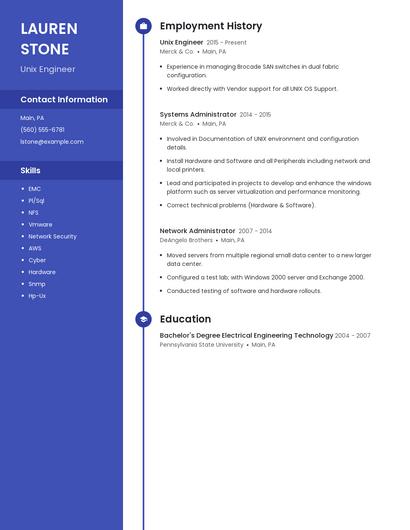
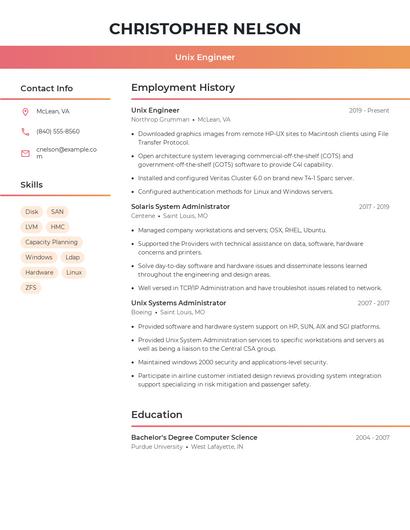
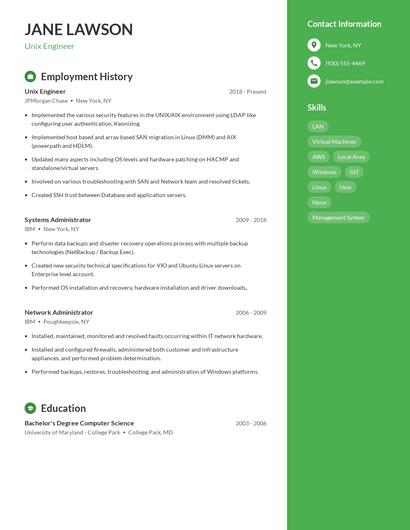
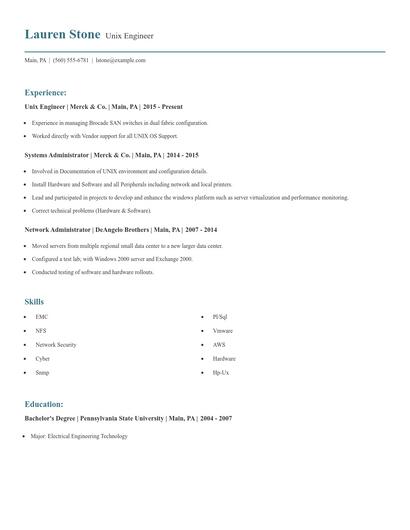
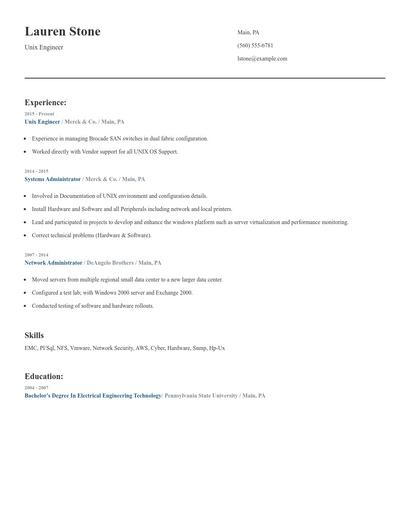
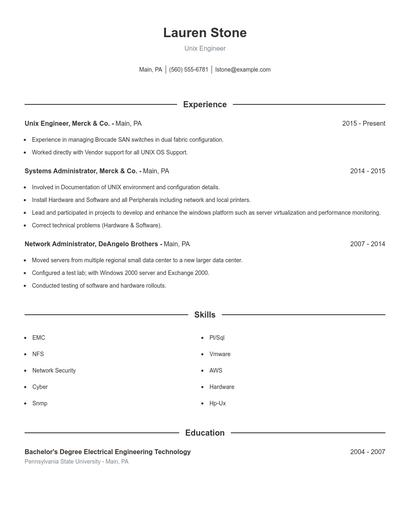
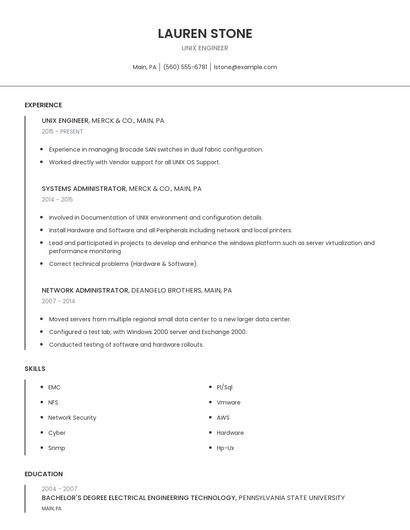
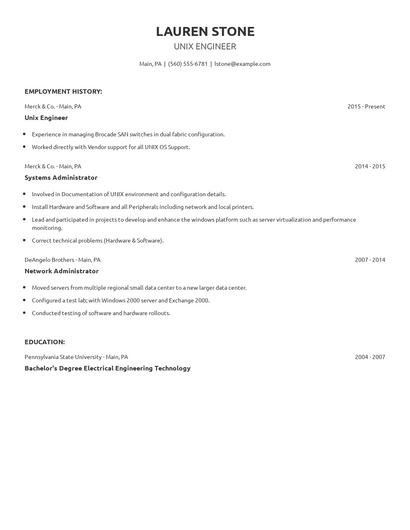
Choose from 10+ customizable unix engineer resume templates
Build a professional unix engineer resume in minutes. Our AI resume writing assistant will guide you through every step of the process, and you can choose from 10+ resume templates to create your unix engineer resume.



Compare different unix engineers
Unix engineer vs. Linux administrator
A Linux administrator is responsible for monitoring the efficiency of Linux operating systems to support business operations and high-quality deliverables. Linux administrators handle the resolution of Linux network issues, maintaining its stability and ensuring its safety and security from unauthorized access and malware threats. They also conduct regular maintenance to configure the system navigation and infrastructure, running multiple diagnostic tests to identify defects, and recommending strategic procedures for system enhancement. A Linux administrator must have excellent communication and technical skills, especially in providing technical support on faulty servers.
There are some key differences in the responsibilities of each position. For example, unix engineer responsibilities require skills like "infrastructure," "linux," "system administration," and "ibm aix." Meanwhile a typical linux administrator has skills in areas such as "troubleshoot," "database," "san," and "http." This difference in skills reveals the differences in what each career does.
Linux administrators really shine in the technology industry with an average salary of $82,498. Comparatively, unix engineers tend to make the most money in the professional industry with an average salary of $107,421.linux administrators tend to reach similar levels of education than unix engineers. In fact, linux administrators are 0.9% more likely to graduate with a Master's Degree and 0.3% more likely to have a Doctoral Degree.Unix engineer vs. Senior unix systems administrator
UNIX system administrators install, configure, and maintain the UNIX systems of organizations. The administrators are in charge of the troubleshooting of server errors. They install new system hardware for their respective organizations and respond to the issues raised by the users. It is part of their job to monitor the network's performance. Usually, they are working in an office using UNIX multiuser operating system. They supervise the execution of data conversion projects such as database hardware replacements.
Each career also uses different skills, according to real unix engineer resumes. While unix engineer responsibilities can utilize skills like "infrastructure," "python," "linux servers," and "aws," senior unix systems administrators use skills like "production servers," "troubleshoot," "vmware," and "disaster recovery."
Senior unix systems administrators may earn a higher salary than unix engineers, but senior unix systems administrators earn the most pay in the finance industry with an average salary of $126,771. On the other hand, unix engineers receive higher pay in the professional industry, where they earn an average salary of $107,421.Average education levels between the two professions vary. Senior unix systems administrators tend to reach similar levels of education than unix engineers. In fact, they're 0.6% less likely to graduate with a Master's Degree and 0.3% more likely to earn a Doctoral Degree.Unix engineer vs. Unix systems administrator
Systems support engineers are information technology professionals who are responsible for building and maintaining the IT infrastructure of an organization. They are required to provide network administration and technical support to identify complex problem issues and come up with solutions to solve them. They must assist the system support engineers in accomplishing any projects they are working with. They must troubleshoot servers, personal computers, and peripheral equipment while liaising with their customers. They must also create and maintain user accounts and implement group policy management through an active directory.
There are many key differences between these two careers, including some of the skills required to perform responsibilities within each role. For example, a unix engineer is likely to be skilled in "infrastructure," "python," "linux servers," and "aws," while a typical unix systems administrator is skilled in "production servers," "database," "san," and "troubleshoot."
Unix systems administrators make a very good living in the finance industry with an average annual salary of $110,380. On the other hand, unix engineers are paid the highest salary in the professional industry, with average annual pay of $107,421.unix systems administrators typically earn similar educational levels compared to unix engineers. Specifically, they're 2.8% less likely to graduate with a Master's Degree, and 0.5% less likely to earn a Doctoral Degree.Unix engineer vs. Systems support engineer
Even though a few skill sets overlap between unix engineers and systems support engineers, there are some differences that are important to note. For one, a unix engineer might have more use for skills like "infrastructure," "python," "linux servers," and "aws." Meanwhile, some responsibilities of systems support engineers require skills like "troubleshoot," "database," "windows server," and "customer satisfaction. "
The finance industry tends to pay the highest salaries for systems support engineers, with average annual pay of $92,061. Comparatively, the highest unix engineer annual salary comes from the professional industry.In general, systems support engineers hold similar degree levels compared to unix engineers. Systems support engineers are 3.4% less likely to earn their Master's Degree and 0.6% more likely to graduate with a Doctoral Degree.Types of unix engineer
Updated January 8, 2025
