What does a utility technician do?

A utility technician performs various duties and responsibilities for an organization. These include inspecting utility infrastructure and reporting any deficiencies, auditing utility services and ensuring current standards are complied with, and updating and maintaining the utility information database. As a utility technician, you are responsible for coordinating projects and communicating results of finished projects, performing preventive maintenance, and diagnosing and troubleshooting equipment and system malfunctions. You are also responsible for conducting training and mentoring new utility technicians.
Utility technician responsibilities
Here are examples of responsibilities from real utility technician resumes:
- Maintain numerous automate scripts to assist in managing Linux systems.
- Assist engineers in daily duties such as lighting and HVAC.
- Process includes both mechanical and electronic integration-programming of settings, PLC linking power settings, etc.
- Collect, compact and bail cardboard, transport cardboard pallets to pickup area with a pallet jack.
- Experience in/with electric motors, diesel motors, gasoline engines, pumps, plumbing systems, isolation valves.
- General landscape maintenance including mowing lawns, blowing walkway surfaces, as well as tree and branch removal.
- Maintain and monitor critical production systems such as the PLC control main air compressor using ladder logic programming.
- Maintain grounds and cleaning equipment such as mowing equipment, weed eaters, floor scrubbers, and burnishing equipment.
- Take corrective action for unsatisfactory cleanliness, promptly.
- Gather samples of elevate temperature materials, primarily asphalt.
- Complete DCS computer monitoring, personal computer training and programming.
- Prepare and present at PowerPoint presentations quality gate meetings.Terminated- health issues
- Provide on-net connectivity for various customers utilizing SONET and IP applications.
- Maintain exterior of hospital by planting/pruning flowers/bushes and mowing grass on a weekly basis
- Pull logs for fail hardware using Linux to create tickets to RMA hardware for new hardware.
Utility technician skills and personality traits
We calculated that 13% of Utility Technicians are proficient in Customer Service, Ladders, and Safety Procedures. They’re also known for soft skills such as Customer-service skills, Dexterity, and Troubleshooting skills.
We break down the percentage of Utility Technicians that have these skills listed on their resume here:
- Customer Service, 13%
Demonstrated superior seamless customer service, integrity and commitment to innovation, efficiency and fiscally responsible activity.
- Ladders, 6%
Utilize safety practices relating to aerial lift vehicles, ladders and potentially hazardous environments.
- Safety Procedures, 4%
Followed safety procedures during excavation of trenches and underground utilities repair.
- HVAC, 3%
Remodel facility HVAC, domestic and chilled water, fire suppression systems as required.
- Cranes, 3%
Operate class F and C in cab overhead cranes carrying coils weighing up to 35 tons.
- Preventive Maintenance, 3%
Assisted in performing preventive maintenance and repaired aircraft audio/video systems to ensure proper operation.
"customer service," "ladders," and "safety procedures" are among the most common skills that utility technicians use at work. You can find even more utility technician responsibilities below, including:
Customer-service skills. One of the key soft skills for a utility technician to have is customer-service skills. You can see how this relates to what utility technicians do because "these workers interact with customers on a regular basis." Additionally, a utility technician resume shows how utility technicians use customer-service skills: "maintained stock areas to keep manufacturing from halting) operated overhead bridge crane operated ram truck loaded/unloaded customers trucks"
Dexterity. Another essential skill to perform utility technician duties is dexterity. Utility technicians responsibilities require that "many repair and maintenance tasks, such as repairing small devices, connecting or attaching components, and using hand tools, require a steady hand and good hand–eye coordination." Utility technicians also use dexterity in their role according to a real resume snippet: "operate equipment including but not limited to :fork lift, skid loader, bridge crane, pallet jack. "
Troubleshooting skills. Another skill that relates to the job responsibilities of utility technicians is troubleshooting skills. This skill is critical to many everyday utility technician duties, as "workers find, diagnose, and repair problems." This example from a resume shows how this skill is used: "experience with allen bradley plc's and components, including troubleshooting, software uploads and fault clearing. "
The three companies that hire the most utility technicians are:
- Crossroads Diversified Services14 utility technicians jobs
- Cargill13 utility technicians jobs
- AmeriHealth Caritas12 utility technicians jobs
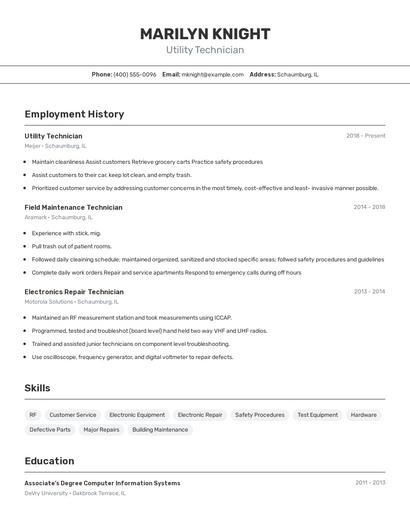
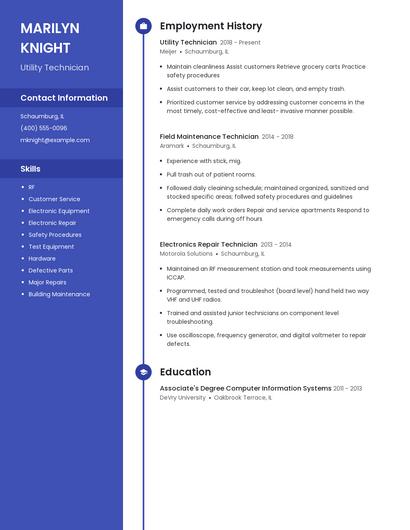
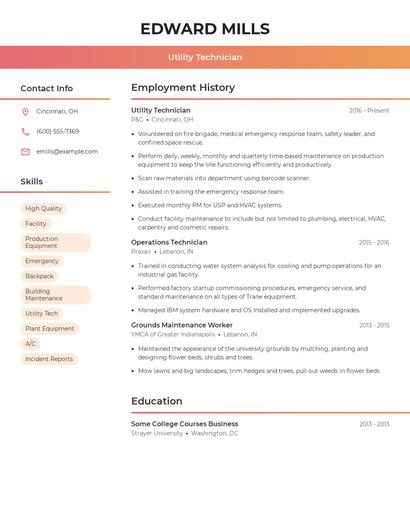
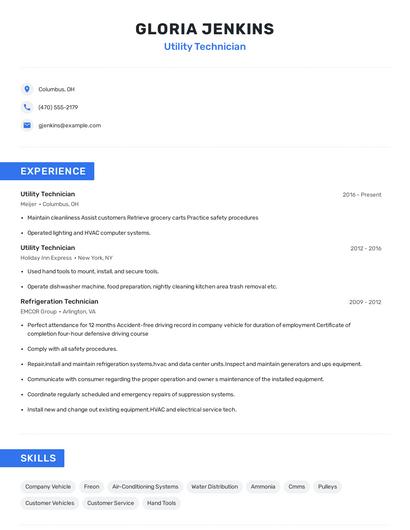
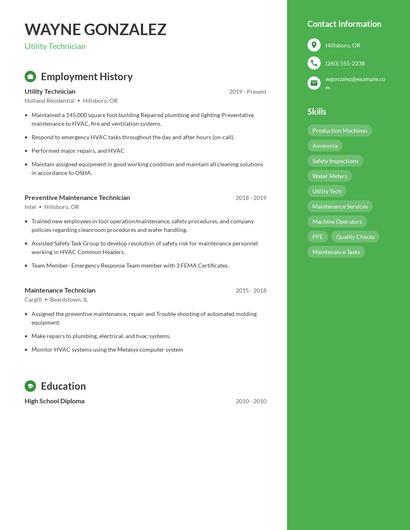
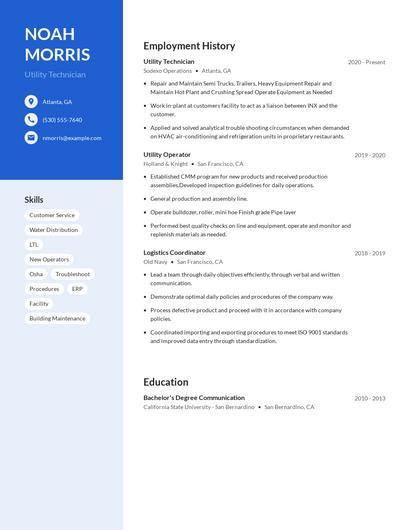
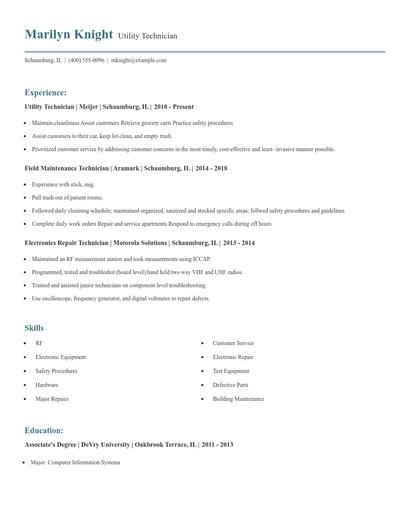
Choose from 10+ customizable utility technician resume templates
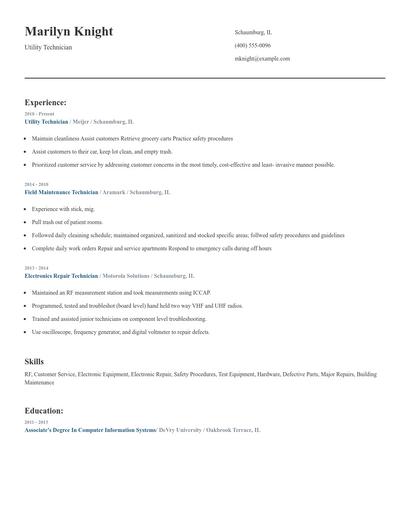
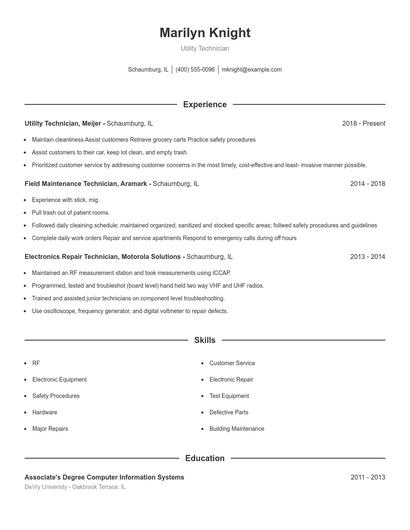
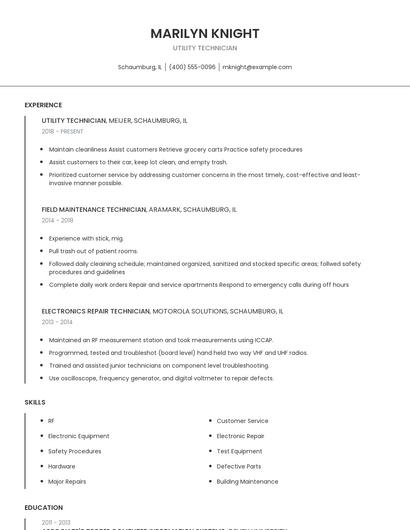
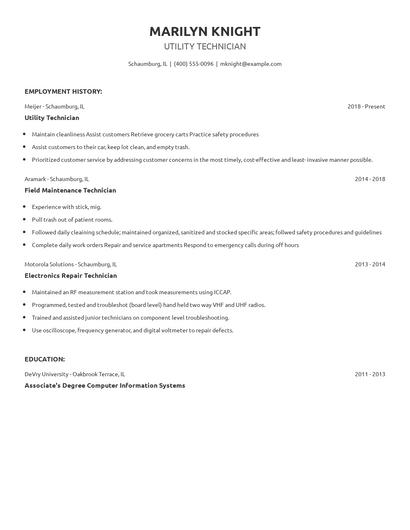
Build a professional utility technician resume in minutes. Our AI resume writing assistant will guide you through every step of the process, and you can choose from 10+ resume templates to create your utility technician resume.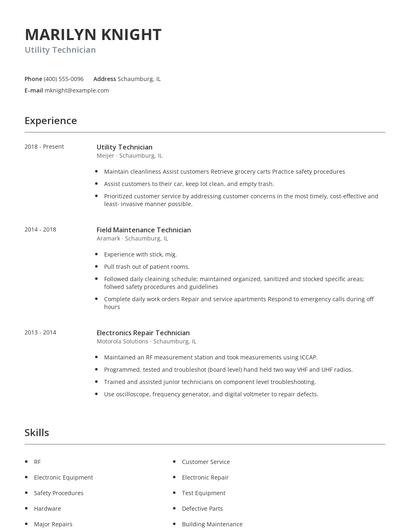
Compare different utility technicians
Utility technician vs. Senior maintenance technician
A senior maintenance technician is responsible for the maintenance and repairs of an establishment or household's electrical and mechanical systems. Senior maintenance technicians handle the installation of ventilation systems, as well as the inspection of equipment and machinery, to ensure optimal performance and efficiency for business operations. They also monitor the adequacy of inventories needed to set up systems and other functionalities. A senior maintenance technician must have excellent organizational and mechanical skills and the ability to follow safety procedures and processes during operations.
There are some key differences in the responsibilities of each position. For example, utility technician responsibilities require skills like "cranes," "cleanliness," "cdl," and "water distribution." Meanwhile a typical senior maintenance technician has skills in areas such as "cmms," "mechanical equipment," "pet," and "maintenance procedures." This difference in skills reveals the differences in what each career does.
Senior maintenance technicians tend to make the most money working in the technology industry, where they earn an average salary of $62,681. In contrast, utility technicians make the biggest average salary, $44,562, in the finance industry.The education levels that senior maintenance technicians earn slightly differ from utility technicians. In particular, senior maintenance technicians are 1.2% more likely to graduate with a Master's Degree than a utility technician. Additionally, they're 0.1% more likely to earn a Doctoral Degree.Utility technician vs. Maintenance lead technician
A maintenance lead technician oversees the daily maintenance operations of a department or establishment. Their duties revolve around conducting inspections and regular maintenance checks on facilities and equipment, performing repairs as necessary. They are also responsible for troubleshooting issues, fixing and replacing components, cleaning different areas, installing fixtures, and providing technical support to employees. Additionally, a maintenance lead technician guides and trains junior technicians while implementing the company's policies and safety standards for a smooth and efficient workflow.
Each career also uses different skills, according to real utility technician resumes. While utility technician responsibilities can utilize skills like "cranes," "preventive maintenance," "cleanliness," and "safety regulations," maintenance lead technicians use skills like "preventative maintenance," "cmms," "maintenance procedures," and "conveyor systems."
Maintenance lead technicians earn a higher average salary than utility technicians. But maintenance lead technicians earn the highest pay in the manufacturing industry, with an average salary of $54,994. Additionally, utility technicians earn the highest salaries in the finance with average pay of $44,562 annually.Average education levels between the two professions vary. Maintenance lead technicians tend to reach similar levels of education than utility technicians. In fact, they're 0.4% more likely to graduate with a Master's Degree and 0.1% more likely to earn a Doctoral Degree.Utility technician vs. Operations and maintenance technician
Operations and maintenance technicians are skilled professionals who are responsible for conducting preventive maintenance of all equipment used in the operation of an organization. These technicians are required to ensure that their facilities are always operational by performing inspections and documenting the operating conditions of their equipment. They must utilize numerous power and hand tools so that they can perform all preventive maintenance and diagnose mechanical problems. Operations and maintenance technicians must also monitor the operation of plan equipment to ensure that employees are following the proper maintenance and safety procedures.
The required skills of the two careers differ considerably. For example, utility technicians are more likely to have skills like "customer service," "cranes," "preventive maintenance," and "safety regulations." But a operations and maintenance technician is more likely to have skills like "preventative maintenance," "maintenance tasks," "windows," and "control systems."
Operations and maintenance technicians earn the best pay in the energy industry, where they command an average salary of $60,926. Utility technicians earn the highest pay from the finance industry, with an average salary of $44,562.operations and maintenance technicians typically earn similar educational levels compared to utility technicians. Specifically, they're 0.3% more likely to graduate with a Master's Degree, and 0.0% more likely to earn a Doctoral Degree.Utility technician vs. Service and repair technician
Service and repair technicians install, maintains, or repair equipment and often travel to customer's location to provide service and maintenance. They are also known as field service technicians who have technical knowledge and skills to be able to install and conduct product testing or demo to properly instruct customers on the proper usage of the product. Also, they provide preventive maintenance procedures to prevent damage to the equipment, diagnose problems and make repairs. The job involves various services depending on the area of experience and expertise.
Even though a few skill sets overlap between utility technicians and service and repair technicians, there are some differences that are important to note. For one, a utility technician might have more use for skills like "ladders," "safety procedures," "cranes," and "preventive maintenance." Meanwhile, some responsibilities of service and repair technicians require skills like "working independently," "dishwashers," "test equipment," and "stoves. "
Service and repair technicians enjoy the best pay in the transportation industry, with an average salary of $42,616. For comparison, utility technicians earn the highest salary in the finance industry.service and repair technicians reach similar levels of education compared to utility technicians, in general. The difference is that they're 0.2% more likely to earn a Master's Degree, and 0.2% more likely to graduate with a Doctoral Degree.Types of utility technician
Updated January 8, 2025
