- Parts Of A Resume
- How To Write A Resume
- Resume Skills Section
- Resume Objective Section
- Career Objective Section
- Resume Reference Section
- Resume Summary Section
- Resume Summary Example
- Resume Interests Section
- Address On Resume
- Relevant Work Experience
- Anticipated Graduation Date On Resume
- Education Section On Resume
- Contact Information On Resume
- Statement Of Qualifications
- How To List Publications On Resume
- Accomplishments On Resumes
- Awards On Resume
- Dean's List On Resume
- Study Abroad On Resume
Summary. If you have authored publications, showcasing them on your resume or CV can significantly enhance your appeal to employers. The decision to include them often depends on your professional or academic background.
In 2026, incorporating publications into your resume is increasingly viewed as an asset, particularly for roles in academia, research, marketing, and communications. Including relevant publications can set you apart from other candidates, demonstrating both expertise and initiative.
However, if your publications do not relate to the position you’re applying for, it’s advisable to omit them, as irrelevant information can detract from your overall presentation.
Key Takeaways
-
Listing publications is a specialized practice primarily beneficial for academia, marketing, or writing roles.
-
Organize publications in reverse chronological order, excluding outdated or irrelevant works while adhering to proper formatting standards.
-
Consider including various types of published works, such as books, research papers, scholarly articles, trade magazine articles, and conference presentations.
- What Publications Should You Include on a CV?
- Why Is It Important to List Publications on a CV?
- How to List Publications on Your CV or Resume
- What Should a Publication List Look Like?
- Publication List Examples
- What Is a Curriculum Vitae (CV)?
- Update Your Resume Now to Accelerate Your Job Search
- Publications on Resume FAQs
- Final Thoughts
- References
- Sign Up For More Advice and Jobs
What Publications Should You Include on a CV?
When considering which publications to include on your CV, prioritize authoritative works, whether they are published or in the process of publication. Key types to include are:
-
Academic books. These can vary widely, especially with the rise of digital formats. Typically, an academic book represents a substantial contribution to a field based on extensive research.
-
Journal published research papers. These works present original research findings or reviews of existing literature, often appearing in peer-reviewed journals, and are available in both print and digital formats.
-
In-progress research papers. Even if a research paper is still being developed, it’s valuable to include it on your CV to highlight ongoing work and expertise.
-
Scholarly articles. These undergo peer review and can significantly enhance your credentials, showcasing the depth of your research capabilities.
-
Conference papers. These contributions are typically part of academic gatherings, reflecting collaborative research efforts.
For your CV, avoid including informal publications such as blog posts or personal websites. Focus on works that fall into the following categories:
-
Conference presentations. Being asked to present at industry conferences signifies recognition as a thought leader, making these presentations valuable additions to your resume.
-
Books. Published works, including chapters relevant to your prospective role, demonstrate significant writing and analytical skills.
-
Trade association magazine articles. If you’ve written for a trade publication, it reflects your expertise and industry engagement.
-
Industry journal publications. These are critical for establishing credibility in scientific and technical fields.
Why Is It Important to List Publications on a CV?
Listing publications on a CV enhances your credibility as a candidate, showcasing your expertise when applying for jobs. It signals to potential employers that you possess relevant knowledge and experience in specific areas.
Moreover, it reflects your proactive approach and resilience in the face of challenges, showcasing your writing and analytical skills—qualities that are particularly valuable in academic and research roles.
Having your publications listed allows you to engage in a more focused discussion during interviews, as potential employers can reference specific works to develop tailored questions.
Organizing your achievements in one section also helps you reflect on your professional journey, giving you a competitive edge over other candidates.
How to List Publications on Your CV or Resume
When listing publications, ensure to include the title and publication source, giving potential employers insight into your topics of expertise and the ability to access your work if desired.
For effective formatting on your resume, consider the following:
-
Do you have a dedicated publications section? Just as you do for work experience or education, creating a distinct section for your publications can be beneficial.
-
Are your publications in reverse chronological order? List your most recent publications first, ensuring relevance to the job application.
-
Have you styled your list appropriately? A resume can be less formal than a CV; therefore, simply listing the title, publication name, and date should suffice, maintaining consistency across sections.
For CVs, which are typically more detailed, consider these additional questions:
-
Is your list formatted correctly? Use bullet points under a clear heading such as “Publications” for clarity.
-
Are you using a consistent citation style? Employing MLA or APA styles throughout your CV will reflect professionalism.
-
Are your publications listed in reverse chronological order? Ensure your most recent work appears first.
-
Have you omitted outdated publications? Exclude any works that are no longer relevant to your field or potential job.
-
Have you included in-progress work? Feel free to list works that are under review or in preparation, omitting the journal name if necessary.
-
Have you highlighted your contributions? If your publications have co-authors, ensure your name stands out clearly.
Consider updating your resume to improve your job prospects.
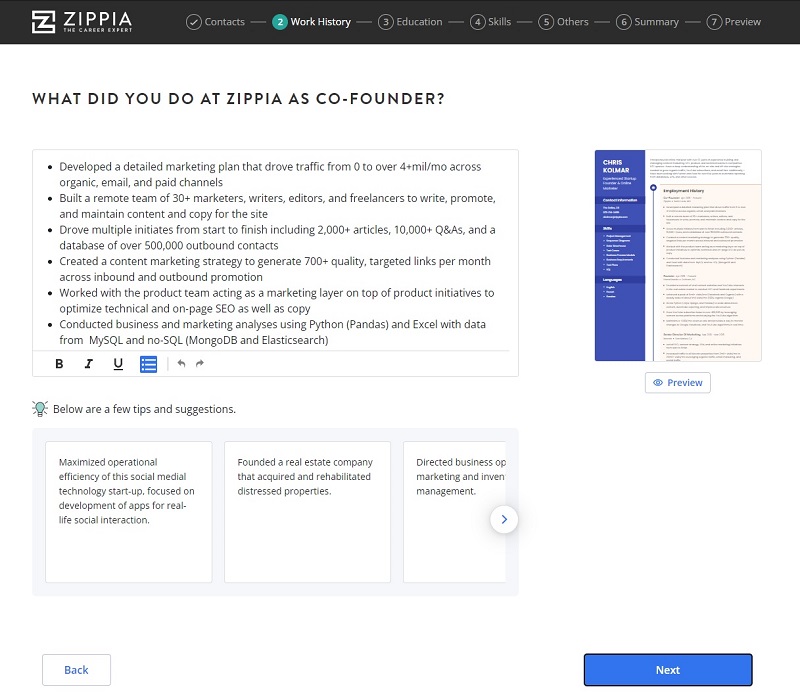
A polished resume can help you get ahead in your job search. Use our resume builder to create a standout document. Here’s a sample of what it could look like:
What Should a Publication List Look Like?
Here are essential elements to consider when listing publications on your CV or resume based on your preferred style or industry standards:
For written publications, ensure to include:
Author’s last and first names or initials
Title of article/chapter and the name of journal, magazine, or website
Publication year
Publisher or issue number, volume number, and page numbers (if applicable)
Include the URL for online publications
For presentations/conferences, ensure to include:
Publication List Examples
Here are examples of how your publications might appear on your resume:
Journal Article (Print)
Jacoby, W. G. (1994). Public attitudes toward government spending. American Journal of Political Science, 38(2), 336-361. https://doi.org/10.2307/2111407Chapter in Printed or Online Book
Ray, R.B. (1985). A certain tendency of the Hollywood cinema, 1930-1980. Princeton University Press.Magazine Article
Luckerson, V. (2014, January). Tech’s Biggest Promises for 2014. TIME. https://content.time.com/time/magazine/article/0,9171,2161683,00.htmlArticle with Multiple Authors
Kafer, Julien, and Walker, Marcella. ‘Native fungi of Colorado.’ Denver Nature Journal. Volume 3: pages 5-8. 2019.
What Is a Curriculum Vitae (CV)?
A curriculum vitae, commonly referred to as a CV, is a comprehensive document that provides a detailed overview of your skills and expertise. Unlike a resume, which is typically concise, a CV includes extensive information about your achievements, awards, honors, and publications.
CVs are particularly valuable in academic and scientific fields, where including published work is critical. However, they are also beneficial across various industries, including education, healthcare, and research.
The main distinction between a CV and a resume lies in length and detail. A CV is a static document that outlines all your accomplishments without tailoring it for specific job applications, whereas a resume is customized for each position.
Update Your Resume Now to Accelerate Your Job Search
Publications on Resume FAQs
-
Can listing publications on a resume help me get a job?
Yes, listing publications on a resume can significantly enhance your job prospects. Particularly for academic roles, including publications can differentiate you from other candidates. Even in non-academic positions, they demonstrate accomplishments and enhance your credibility.
-
Should I include every publication I have on my resume?
No, you should selectively include publications on your resume. Similar to other sections, focus on listing only relevant works tailored to the job you are applying for.
Final Thoughts
These examples illustrate how to effectively present your publications. Depending on the nature of your work, your presentation may vary slightly. Reviewing industry-specific guidelines can provide valuable insights.
Consider asking colleagues or peers for feedback on their publication lists, as this can be an excellent starting point for refining your resume or CV.
References
- Parts Of A Resume
- How To Write A Resume
- Resume Skills Section
- Resume Objective Section
- Career Objective Section
- Resume Reference Section
- Resume Summary Section
- Resume Summary Example
- Resume Interests Section
- Address On Resume
- Relevant Work Experience
- Anticipated Graduation Date On Resume
- Education Section On Resume
- Contact Information On Resume
- Statement Of Qualifications
- How To List Publications On Resume
- Accomplishments On Resumes
- Awards On Resume
- Dean's List On Resume
- Study Abroad On Resume

Author

Caitlin Mazur is a freelance writer at Zippia. Caitlin is passionate about helping Zippia’s readers land the jobs of their dreams by offering content that discusses job-seeking advice based on experience and extensive research. Caitlin holds a degree in English from Saint Joseph’s University in Philadelphia, PA.
Expert
Don Pippin is an executive and HR leader for Fortune 50 and 500 companies and startups. In 2008, Don launched area|Talent with a focus on helping clients identify their brand. As a Certified Professional Resume Writer, Certified Digital Career Strategist, and Certified Personal Branding Strategist, Don guides clients through career transitions.