- HR Statistics
- Average Labor Cost Percent Of Sales
- Average Time to Reach Profitability At A Startup
- Office Space Per Employee
- Recruitment Statistics
- Employee Engagement Statistics
- Work-Life Balance Statistics
- BYOD Statistics
- Paternity Leave Statistics
- Onboarding Statistics
- Average Paid Maternity Leave In Us
- Average Cost Of A Bad Hire
- Employee Theft Statistics
- Paid Family Leave Statistics
- Cost Of Hiring Statistics
- Employee Turnover Statistics
- Average Cost Of Employer Sponsored Health Insurance Statistics
- Sexual Harassment In The Workplace Statistics
- HR Statistics
- PTO Statistics
- Social Media Recruitment Statistics
- Hiring Statistics
- Out Of Prison Employment Statistics
Research Summary. Employee turnover remains a significant challenge and expense for companies in 2026. Our research team investigated the reasons behind employee turnover, its impact on organizations, and the trends observed over recent years. Here’s what we found:
-
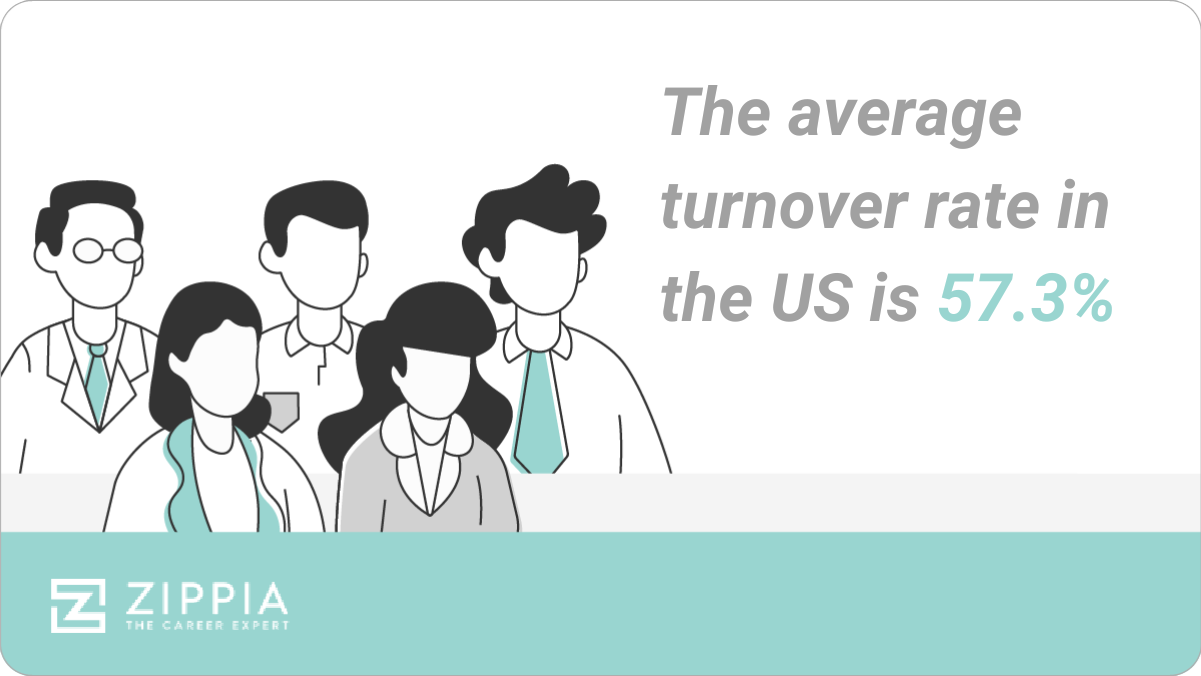
As of 2025, the national average annual turnover rate has risen to 57.3%.
-
In December, the number of employees who left their jobs due to various reasons reached 6.5 million.
-
On average, companies lose 20% of their workforce to turnover annually, with 13% attributed to voluntary departures and 7% to involuntary separations (like layoffs and terminations).
-
In 2025, the financial impact of voluntary employee turnover exceeded $1.2 trillion.
-
Employees who are highly engaged are 85% less likely to leave their positions.
-
29% of employees reported quitting within the first six months of employment.
For deeper insights, we have categorized the data as follows:
Industry | Region | Trends | Reasons | Effects
General Employee Turnover Statistics:
-
Approximately 60-70% of all turnover is voluntary.
This statistic continues to hold true across most industries, where voluntary turnover results from employee choices, making it challenging to predict.
-
30% of surveyed employees quit their jobs within the first 90 days.
A survey of 1,500 workers in 2023 revealed that about 450 individuals left their jobs within the initial three months of employment. Almost half of these respondents cited a mismatch between the job role and their expectations set during the interview process.
-
As of December 2025, there are 12 million job openings in the United States.
This figure has remained consistent throughout 2025, reflecting an increase of 4.5 million job openings since December 2023.
-
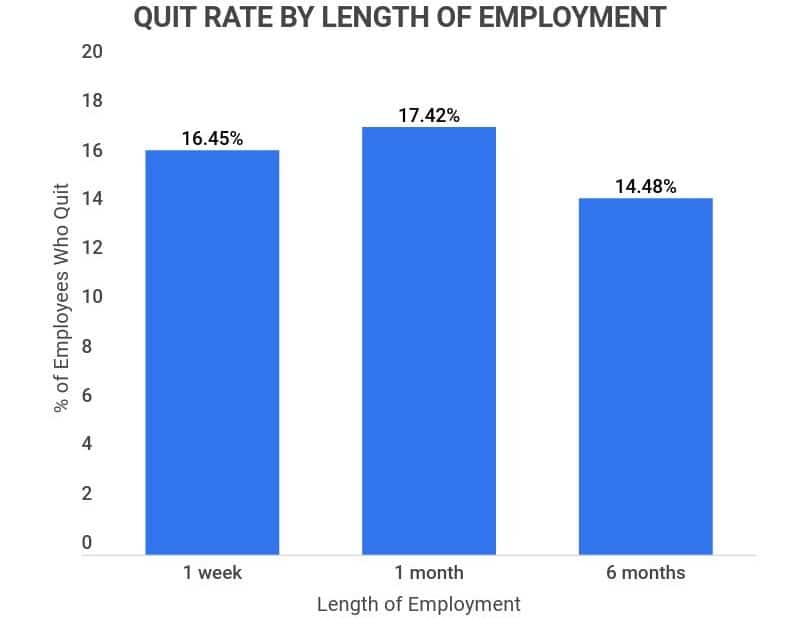
18% of employees who quit do so within their first month of employment.
Another 15% leave within their first week, and 13% exit after six months.
Employee Turnover Statistics by Industry
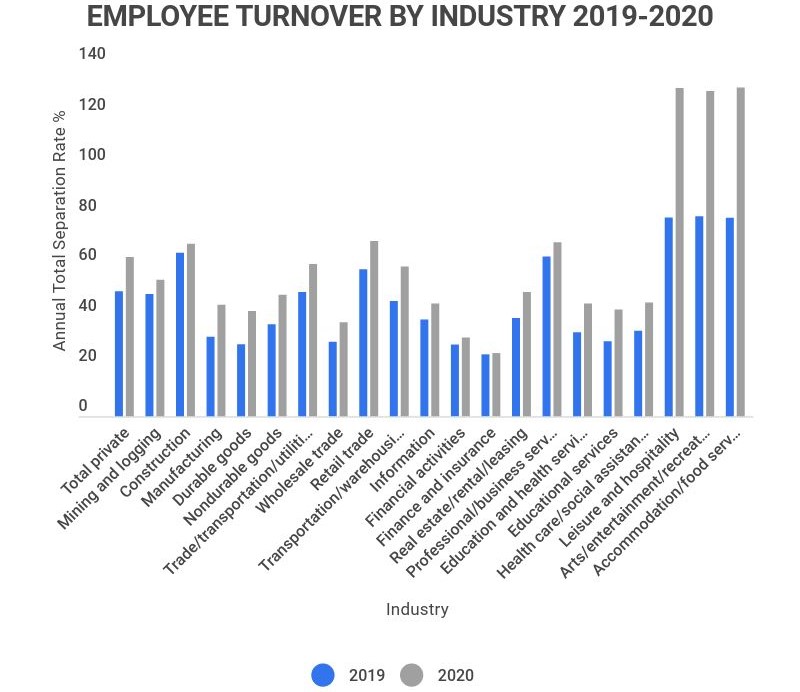
| Industry | 2017 | 2018 | 2019 | 2020 | 2021 |
|---|---|---|---|---|---|
| Total | 43% | 44% | 45% | 57% | 57% |
| Total private | 47% | 49% | 49% | 63% | 52% |
| Mining and logging | 48% | 54% | 48% | 54% | 36% |
| Construction | 61% | 57% | 65% | 68% | 57% |
| Manufacturing | 30% | 32% | 31% | 44% | 40% |
| Durable goods | 27% | 28% | 28% | 41% | 35% |
| Nondurable goods | 36% | 38% | 36% | 48% | 47% |
| Trade, transportation, and utilities | 45% | 48% | 49% | 60% | 55% |
| Wholesale trade | 27% | 29% | 29% | 37% | 34% |
| Retail trade | 53% | 58% | 58% | 69% | 65% |
| Transportation, warehousing, and utilities | 40% | 44% | 45% | 59% | 49% |
| Information | 35% | 37% | 38% | 44% | 39% |
| Financial activities | 28% | 27% | 28% | 31% | 29% |
| Finance and insurance | 25% | 24% | 24% | 25% | 26% |
| Real estate and rental and leasing | 37% | 35% | 39% | 49% | 35% |
| Professional and business services | 63% | 63% | 63% | 69% | 64% |
| Education and health services | 32% | 34% | 33% | 44% | 37% |
| Educational services | 29% | 30% | 29% | 42% | 26% |
| Health care and social assistance | 33% | 34% | 34% | 45% | 39% |
| Leisure and hospitality | 74% | 77% | 79% | 130% | 85% |
| Arts, entertainment, and recreation | 84% | 88% | 79% | 129% | 76% |
| Accommodation and food services | 72% | 75% | 78% | 130% | 86% |
| Other services | 45% | 44% | 43% | 67% | 72% |
| Government | 18% | 18% | 18% | 24% | 18% |
-
In 2021, the accommodation and food service industry had the highest turnover rate at 86%.
Other sectors exhibiting high turnover rates included arts and entertainment (76%), retail trade (65%), and construction (57%).
-
Conversely, the government sector recorded the lowest turnover rate at 18% in 2021.
Wholesale trade (34%) and finance and insurance (26%) were also among the industries with lower turnover rates.
-
The education and health services sector had an average turnover rate of 37% in 2021.
Real estate and rental industries averaged 35%, while manufacturing turnover was at 40%.
-
Retention rates in 2021 can be calculated by subtracting the turnover rate from 100%. For instance, the retention rate for manufacturing in 2021 is 60%.
Employee Turnover Regional Statistics
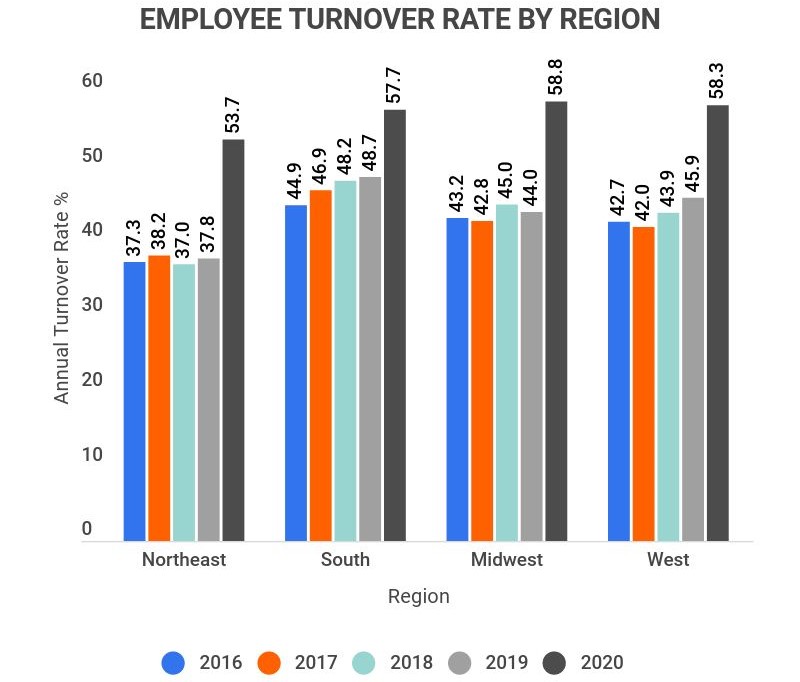
| Region | 2017 | 2018 | 2019 | 2020 | 2021 |
|---|---|---|---|---|---|
| Northeast | 38% | 37% | 37% | 53% | 39% |
| South | 46% | 48% | 48% | 57% | 52% |
| Midwest | 42% | 45% | 44% | 58% | 48% |
| West | 42% | 43% | 45% | 58% | 45% |
-
The highest turnover rate in the U.S. in 2021 was in the South at 52%.
-
The Northeast had the lowest turnover rate at 39% in the same year.
Employee Turnover Statistics Trends and Predictions
-
The U.S. employee turnover rate has fluctuated, dropping from 56.8% in 2020 to 47.2% in 2021, and rising again to 57.3% by 2025.
While there was a significant drop in turnover during the pandemic, the rate has since increased again as the labor market stabilizes.
-
6.5 million employees quit their jobs in December 2025.
This reflects a consistent trend where industries like transportation, warehousing, and utilities showed considerable changes.
-
The quit rate stood at 2.8% in December 2025.
Quitting accounted for 70% of job separations in early 2021, marking unprecedented levels of voluntary departures.
-
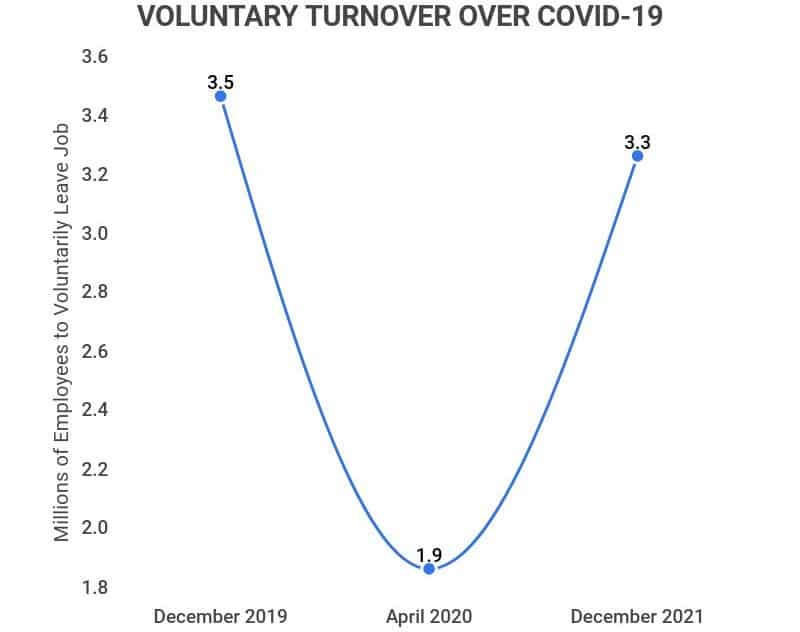
During the pandemic, voluntary turnover reached a low of 1.9 million monthly in April 2020.
Prior to the pandemic, approximately 3.5 million individuals were leaving their jobs every month, indicating that turnover is recovering as the economy rebounds.
Reasons for High Employee Turnover and Retention Rates
-
The primary reason employees leave their jobs is compensation.
In addition to seeking higher pay, other factors such as toxic coworkers or ineffective management contribute to employee departures.
-
62% of employees would consider changing jobs for greater pay transparency.
This sentiment is particularly strong among Gen-Z workers, with over 75% expressing this desire, highlighting the importance of transparency in improving retention.
-
42% of office employees plan to leave their jobs within the next year due to dissatisfaction with management.
This survey of 1,500 office workers indicated a growing discontent among employees.
-
70% of employees feel disengaged or disconnected at work.
The 2022 Gallup ‘State of the American Workplace’ survey revealed that only 30% of employees feel connected to their jobs, a trend that has worsened in recent years.
-
The key factors driving high employee retention include flexible work environments, fair compensation, and recognition of achievements.
Additional elements that enhance retention rates include meaningful benefits, career development opportunities, and a healthy work-life balance.
-
Organizations that improve employee engagement can reduce turnover by 24%.
In companies with low turnover rates, enhanced engagement can lead to a 59% reduction in turnover and a 41% decrease in absenteeism, along with a 17% boost in productivity.
-
Companies with effective onboarding processes retain 91% of their first-year employees.
Despite this, only a small percentage (around 12%) of employees feel their onboarding experience was exceptional.
-
As of 2020, 56.9% of employees reported being satisfied with their jobs, marking the highest satisfaction rate in two decades.
Effects of Employee Turnover
-
The average cost of replacing a salaried employee is estimated at six to nine months of their salary.
For instance, an employee with a $60,000 salary may cost a company between $30,000 and $45,000 to replace due to hiring, onboarding, and lost productivity costs.
-
As of 2021, 92% of HR leaders identified employee experience as their top priority.
This underscores the growing recognition that employee satisfaction is critical to organizational success.
-
A business with 100 employees earning an average salary of $50,000 could incur turnover costs ranging from $660,000 to $2.6 million annually.
According to Gallup, this translates to an estimated annual loss of $1 trillion across U.S. businesses due to turnover.
Employee Turnover FAQ
-
Employee turnover refers to the number of employees who leave a company for any reason within a specified timeframe. The term describes the transition of one employee leaving and another being hired in their place.
Employee turnover is crucial for organizations since replacing trained staff is often costly. The hiring process and onboarding can cost upwards of $40,000 for an average salary employee.
Conversely, a company’s retention rate indicates how many employees remain over a set period. High retention is a positive sign, while high turnover signals potential issues.
-
What are the different types of employee turnover?
Employee turnover can be classified into healthy, regrettable, and avoidable turnover. Each type impacts a business differently. There are also two primary categories: voluntary and involuntary turnover.
Voluntary turnover occurs when employees choose to leave, whether through quitting or retirement. Involuntary turnover happens when employers part ways with employees due to performance issues or layoffs.
-
Healthy turnover: When an employee’s departure is beneficial for all involved.
-
Regrettable turnover: When a high-performing employee leaves, and their retention would have been preferable.
-
Avoidable turnover: When an employee departs for reasons that could have been mitigated by the organization.
-
-
How long does it take for an employee to be fully productive?
It takes around eight months for a new employee to achieve full productivity. This duration is significant considering that approximately 29% of employees seek new roles within their first six months.
Thus, over a quarter of employees pursue other opportunities before reaching their full potential in their current roles.
-
Who is responsible for a company’s employee turnover?
Management is often a key factor influencing employee turnover. Common reasons for employee departures include ineffective management or a hostile work environment driven by management practices.
Responsibility for turnover can also extend to senior management and human resources professionals.
Conclusion
Employee turnover and retention rates significantly impact a company’s long-term success. While losing employees may seem inevitable, organizations forfeit millions annually in hiring and training costs for replacement staff.
It is estimated that U.S. businesses lose one trillion dollars each year due to employee turnover, with rates rising sharply since before the pandemic.
Common causes for high turnover include limited opportunities for growth and engagement. Employee satisfaction and engagement are vital for productivity, yet many workplaces fall short in these areas.
Currently, only 30% of employees feel engaged in their roles, contributing to higher turnover rates. The cost of replacing an unsatisfied employee making $50,000 annually can reach $30,000-$45,000, emphasizing the financial implications of turnover.
Ultimately, HR leaders recognize that employee satisfaction and retention are pivotal. As of 2021, 92% of HR professionals prioritize enhancing the employee experience. If this focus does not persist, turnover rates may continue to climb.
References
-
BLS. “Annual total separations rates by industry and region, not seasonally adjusted”. Accessed on August 23, 2021
-
BLS. “JOB OPENINGS AND LABOR TURNOVER – JUNE 2021”. Accessed on August 23, 2021
-
Conference Board. “Job Satisfaction 2021: Job satisfaction remains high even in the midst of the pandemic and economic chaos”. Accessed on August 23, 2021
-
Catalyst. “Turnover and Retention (Quick Take).” Accessed on August 23, 2021
-
ADP. “Revelations From Workforce Turnover A Closer Look Through Predictive Analytics.” Accessed on August 23, 2021
-
Psychology Today. “Why 33 Percent of New Employees Quit in 90 Days”. Accessed on August 23, 2021
-
Vultus. “Why do 33% of the new hires quit within six months?”. Accessed on August 23, 2021
-
Yahoo Finance. “A Record 3.8 Million Workers Quit Their Jobs in April 2021: Who Are They?”. Accessed on August 23, 2021
-
SHRM. “Turnover ‘Tsunami’ Expected Once Pandemic Ends.” Accessed on August 23, 2021Accessed on August 23, 2021
-
Zippia. “SURVEY: WHY DO PEOPLE QUIT THEIR JOBS?” Accessed on August 23, 2021
-
INC. “New Report: Pay Transparency May Be the Key to Keeping Your Employees in 2021”. Accessed on August 23, 2021
-
Business Wire. “2 out of 5 Office Workers Plan to Resign Based on How Their Company Handled the Pandemic, SilkRoad Technology and OnePoll Survey Reveals”. Accessed on August 23, 2021
-
INC. “How to Tell If Employees Really Feel Connected and Engaged.” Accessed on August 23, 2021
-
Rise. “8 essential employee retention factors modern employers ignore”. Accessed on August 23, 2021
-
Gallup. “The Right Culture: Not Just About Employee Satisfaction.” Accessed on August 23, 2021
-
Hireology. “How Your Onboarding Process Affects Employee Retention.” Accessed on August 23, 2021
-
USI. “Cost of employee turnover”..Accessed on August 23, 2021
-
Forbes. “92% Of HR Leaders Set Employee Experience As Top Priority In 2021”. Accessed on August 23, 2021
-
Gallup. “This Fixable Problem Costs U.S. Businesses $1 Trillion”. Accessed on August 23, 2021
-
Harvard Business Review. “Technology Can Save Onboarding from Itself.” Accessed on August 23, 2021
- HR Statistics
- Average Labor Cost Percent Of Sales
- Average Time to Reach Profitability At A Startup
- Office Space Per Employee
- Recruitment Statistics
- Employee Engagement Statistics
- Work-Life Balance Statistics
- BYOD Statistics
- Paternity Leave Statistics
- Onboarding Statistics
- Average Paid Maternity Leave In Us
- Average Cost Of A Bad Hire
- Employee Theft Statistics
- Paid Family Leave Statistics
- Cost Of Hiring Statistics
- Employee Turnover Statistics
- Average Cost Of Employer Sponsored Health Insurance Statistics
- Sexual Harassment In The Workplace Statistics
- HR Statistics
- PTO Statistics
- Social Media Recruitment Statistics
- Hiring Statistics
- Out Of Prison Employment Statistics

Author

Sky Ariella is a professional freelance writer, originally from New York. She has been featured on websites and online magazines covering topics in career, travel, and lifestyle. She received her BA in psychology from Hunter College.