23+ Essential Gig Economy Statistics [2026]: Definitions, Facts, and Trends on Gig Work
Research Summary. Interest in gig work has surged in recent years, significantly driven by changes in work preferences and advancements in technology. As we move into 2026, the popularity of gig work continues to rise, becoming a crucial component of the modern labor market.
To explore the evolution of the gig economy in the U.S., we’ve compiled the most essential statistics. Based on our comprehensive research:
-
At least 59 million American adults engaged in the gig economy by 2021, representing approximately 36% of the U.S. workforce.
-
16% of U.S. adults have earned income through an online gig platform at some point, with 9% having done so in 2021.
-
Wages and participation for gig workers grew by 33% in 2021.
-
Gig workers contributed around $1.21 trillion to the U.S. economy in 2021, accounting for roughly 5.7% of the total U.S. GDP.
-
By 2026, projections indicate that 52% of the American workforce will have participated in the gig economy at some point.
For further insights, we detailed the data in the following categories:
Gig Workers | Gig Worker Demographics | Industry Use of Gig Workers | Gig Economy Trends
General Gig Economy Statistics
The gig economy constitutes a significant segment of the U.S. economy. Since the onset of the pandemic, an increasing number of workers are transitioning to gig employment. The importance of gig work continues to escalate. Here are some key insights from our research:
-
The number of companies operating entirely on gig work increased by 554% from 2014-2018.
In 2014, there were only 26 digital companies reliant solely on gig work. This number surged to approximately 170 companies. Over 30% of Fortune 500 companies reported using freelancers.
-
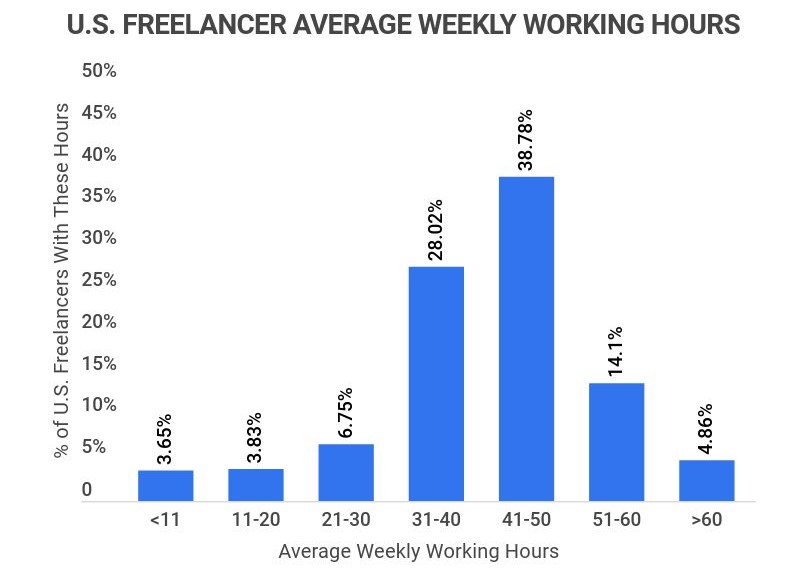
As of 2021, the average full-time freelance worker puts in 43 hours per week.
While 70% of freelancers choose gig work for better work-life balance, nearly 58% actually work over 40 hours weekly. The most common range is 41-50 hours, although 28% work 31-40 hours weekly.
-
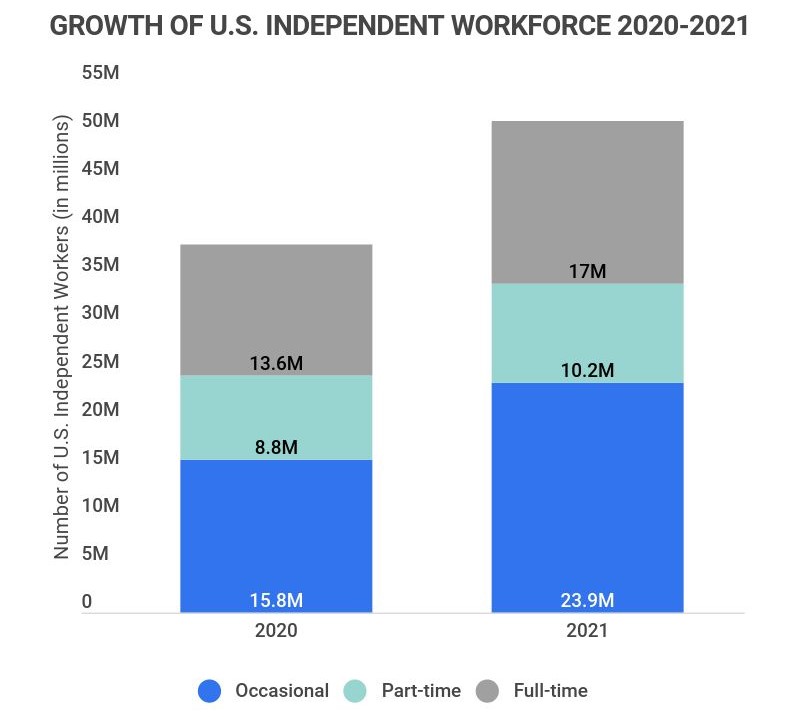
Independent workers in the U.S. grew by 34% from 2020 to 2021.
This translates to over 13 million new workers joining the gig economy, largely influenced by the shift towards remote work. Among those considering leaving their jobs, 52% are exploring freelance careers.
-
Occasional independent workers increased by 51% from 2020 to 2021.
This growth is most pronounced among occasional workers, defined as those engaged in irregular independent work without set hours.
Growth of Independent Workers in the U.S. 2020-2021
Occasional Part-Time Full-Time 2020 15.8 million 8.8 million 13.6 million 2021 23.9 million 10.2 million 17 million Y-o-Y growth 51% 16% 25% -
As of 2021, there are at least 59 million gig workers in the U.S.
This figure is considerable, given there were only 38.2 million in 2020, indicating that gig workers now represent over a third of the U.S. workforce.

Gig Economy Statistics by Workers
Now that we’ve outlined the size of the U.S. gig economy, let’s explore the gig workers themselves. Many gig workers find satisfaction in their roles, yet challenges remain. Here are the facts:
-
The average gig worker’s salary is only $29,050.
This is approximately 20% less than the average salary of an American taxpayer, which is $35,977. However, this average masks significant pay disparities among gig workers, with the bottom 75% earning considerably less than the top 10%.
-
84% of gig workers find purpose in their jobs.
Overall, gig workers tend to view their work positively and foresee a bright future. A remarkable 97% of contractors report greater happiness compared to traditional employees, and 94% believe their work contributes meaningfully to society.
-
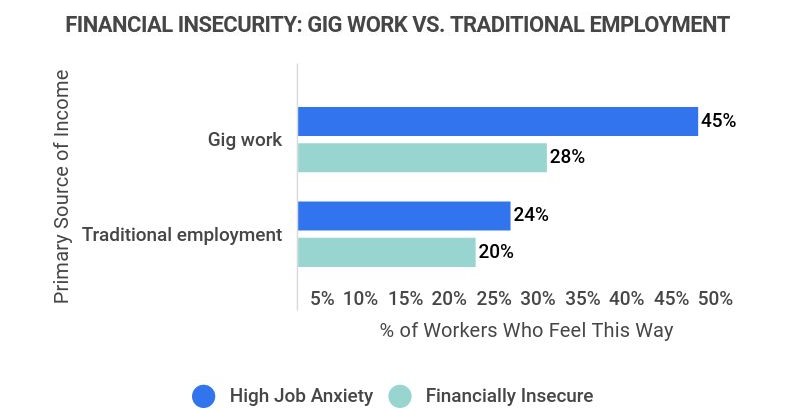
44% of gig workers rely on gig work as their primary income source.
Among this group, 45% experience high economic anxiety, reflected in an Economy Anxiety Index score over 50, indicating significant financial stress.
Gig Worker Statistics by Demographics
The gig economy exhibits notable disparities among different demographic groups. These discrepancies can vary from pay to economic anxiety. Here are the insights:
-
Women in the gig economy earn 10.5% less than their male counterparts.
This equates to 82 cents for every dollar a man earns, indicating that the gig economy mirrors gender inequality found in traditional jobs.
-
Men are 72% more likely to engage in the gig economy.
About 31% of men have earned money through gig work, compared to 18% of women.
-
53% of gig workers aged 18 to 34 depend on gig work as their primary income source.
This aligns with the demographic trend, as 38% of gig workers fall within the 18-34 age range, 25% are aged 35-54, and only 11% are 55 and older.
-
Only 16% of gig workers have access to retirement plans.
This starkly contrasts with the 52% of traditional employees who have such access. Furthermore, 38% of gig workers report being unable to save for retirement due to insufficient income.
-
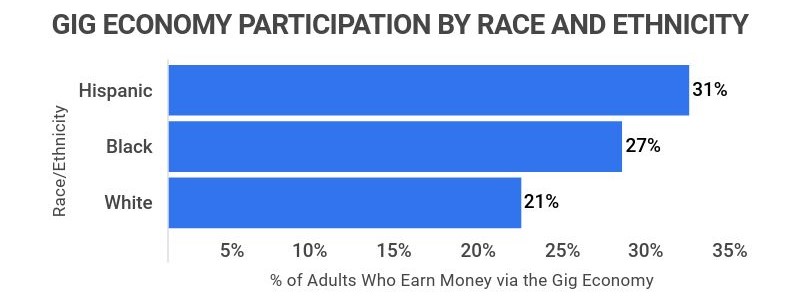
31% of Hispanic adults rely on the gig economy, the highest among demographic groups.
In comparison, 27% of African Americans and 21% of White adults depend on gig roles.
Gig Economy Statistics by Industry
Some industries are more impacted by the growth of the gig economy than others. For example, digital design roles are more likely to be freelance compared to those in healthcare. Here are some noteworthy statistics:
-
The arts and design sector boasts the highest proportion of gig workers, with 77% being freelancers.
While the majority in this industry are gig workers, the entertainment and construction sectors follow closely at 55% and 52% respectively.
-
Only five out of 15 industries surveyed have over 40% gig workers.
This suggests that gig work’s prevalence is unevenly distributed, with certain industries heavily relying on freelancers while others do not. However, this dynamic may shift in the coming years.
Gig Economy Statistics: Trends and Projections
The gig economy has experienced remarkable growth in recent years. Experts anticipate continued expansion into the late 2020s. Here’s what we discovered:
-
As of 2021, 52% of workers planning to leave their jobs are considering a freelance career.
This rising interest in gig work contributes to the gig economy’s 15% growth over the past decade.
-
The gig economy has expanded 15 times faster than the traditional job market.
Job growth in the U.S. from 2010 to 2020 was only 1.1%, while the gig economy’s growth surged by 15%.
-
23 million new gig workers emerged in the U.S. in 2020.
This rise reflects a global trend towards first-time freelancers and gig workers.
-
At least 48% of businesses now hire freelancers.
This trend aligns with 90% of companies recognizing a mixed model of gig and remote work as essential for maintaining a competitive edge.
-
The U.S. gig economy is projected to achieve a Compound Annual Growth Rate (CAGR) of 17.4%.
In 2018, the gig economy was valued at approximately $204 billion, expected to reach at least $455 billion in 2023.
-
By 2027, there are projections for 86.5 million freelancers in the U.S.
This could represent 50.9% of the workforce, increasing to 90.1 million by 2028.
Gig Economy Statistics FAQ
-
Is gig work beneficial for the economy?
Yes, gig work fosters economic growth by providing flexible and part-time job opportunities. Additionally, remote gig workers can be up to 47% more productive than traditional employees.
-
Who benefits from the gig economy?
Both employers and gig workers reap benefits from the gig economy, though there are downsides too. Employers enjoy increased productivity and savings on benefits, while gig workers benefit from a flexible schedule and heightened motivation.
However, gig workers often face challenges due to the lack of benefits, while employers may struggle with managing flexible work schedules.
-
How rapidly is the gig economy expanding?
The gig economy is experiencing significant growth. Over the last decade, it has expanded by 15% (15 times more than traditional job growth), and gig worker wages and participation increased by 33% in 2021.
-
What is the current value of the gig economy?
As of 2021, the gig economy was valued at around $350 billion. With a projected CAGR of 17.4%, it is expected to exceed $455 billion in 2023.
-
What are the main drawbacks of the gig economy?
Key disadvantages include high economic anxiety, lack of benefits, and tax burdens. About 45% of gig workers who rely on gig work for their primary income have a high Economy Anxiety Index score. Moreover, many gig jobs lack benefits, with workers responsible for their tax liabilities.
-
What percentage of the economy comprises gig workers?
Approximately 9% of the American workforce participated in gig work in 2021. In terms of economic contribution, gig workers represent about 5.7% of U.S. GDP, highlighting the gig economy’s significant role in the current and evolving landscape of work.
-
The term “gig” originates from musicians who were paid a fixed fee for a performance. “Gig work” refers to similar short-term contracts between an employer and a contractor engaged to fulfill a specific role.
Gig work encompasses a variety of job types, including online freelance writing, rideshare driving, tutoring, and personal training. If you are compensated per job, project, or specific instance of service, you are likely involved in gig work.
Conclusion
The gig economy has experienced a remarkable growth rate of 15% over the past decade, with an anticipated CAGR of 17.4% as we move into 2026.
While many gig workers, 70% of whom appreciate the flexibility it offers, face challenges such as economic anxiety—45% of those relying on gig work as their primary income report significant financial distress—there is hope for improvement. As the gig economy matures, it is increasingly recognized as a legitimate career path.
As we look ahead, the ongoing evolution of this sector holds promise for addressing existing challenges, as more people begin to view freelancing as a viable and respected career choice.
References
-
CNBC. “4 gig economy trends that are radically transforming the US job market.” Accessed on October 4th, 2021.
-
Freelancermap. “Freelancers also work long hours – 40+ hour working week.” Accessed on October 4th, 2021.
-
ValuePenguin. “The U.S. Independent Workforce Increased by 34% Since 2020.” Accessed on October 4th, 2021.
-
Anderson. “What is a Gig Worker?” Accessed on October 4th, 2021.
-
Inc. “Are Freelancers Happier Than Traditional Workers?” Accessed on October 4th, 2021.
-
Edison Research. “Americans and the gig economy.” Accessed on October 4th, 2021.
-
TheLily. “Women make less in the gig economy. A new study asked why.” Accessed on October 4th, 2021.
-
CNBC. “The gig economy is lacking in this one important respect.” Accessed on October 4th, 2021.
-
BLS. “Employment Projections — 2020–2030.” Accessed on October 5th, 2021.
-
Nasdaq. “How the Freelancing Boom is Driving Companies to New Business Models.” Accessed on October 5th, 2021.
-
Brodmin. “Gig Economy – The Economic Backbone of the Future?” Accessed on October 5th, 2021.
-
Statista. “Share of freelance workers in the United States in 2019, by industry.” Accessed on October 5th, 2021.
-
Pew Research. “The State of Gig Work in 2021.” Accessed on February 6th, 2022.
-
Statista. “Number of Freelancers in the United States From 2017 to 2028.” Accessed on February 16, 2023.

Author

Chris Kolmar is a co-founder of Zippia and the editor-in-chief of the Zippia career advice blog. He has hired over 50 people in his career, been hired five times, and wants to help you land your next job. His research has been featured on the New York Times, Thrillist, VOX, The Atlantic, and a host of local news. More recently, he's been quoted on USA Today, BusinessInsider, and CNBC.