- Resume Tips
- Resume Tips
- Best Resume Writing Services
- Things To Avoid On A Resume
- Resume Paper To Use
- What To Include In A Resume
- How To Write A Bio
- How To Write A Personal Statement
- Lied on Your Resume?
- Resume PDF
- Avoid Age Discrimination
- Words and Phrases You Shouldn't Include in Your Resume
- How Many Skills Should You List On A Resume
- Send A Resume As A Pdf
- Resume Critique
- Make A Resume Stand Out
- Resume Spelling
- Resume Past Or Present Tense
- How To List Projects On A resume
- Best Resume Action Words
- How To Quantify Your Resume
- Resume Bullet Points
- Are Resume Writers Worth It
- How Many Jobs To List On Resume
Should a Resume Be Written in Past or Present Tense?
Crafting your resume can feel overwhelming, especially when navigating the nuances of grammar. Yet, the details you choose to include can significantly impact your chances of making a strong impression. One of the most frequently asked questions pertains to the proper verb tense: Should you use past or present tense on your resume?
Want to save time and have your resume ready in just 5 minutes? Try our resume builder. It’s user-friendly and fast, offering ready-made content to enhance your resume with just one click. Explore over 10 resume templates and start creating your resume today.
One of our users, Diana, shared her experience:
Zippia guided me in creating a detailed and professional resume. I downloaded it with unlimited access to all the features!
- Understanding Past and Present Tense
- When to Use Past Tense in Your Resume
- Update Your Resume Today to Accelerate Your Job Search
- When to Use Present Tense in Your Resume
- Incorporating Both Tenses in Your Resume
- Key Tips for Choosing the Right Tense
- When to Use Future Tense
- Sign Up For More Advice and Jobs
Understanding Past and Present Tense
Here’s a quick refresher on the differences between past tense and present tense verbs:
-
Past tense verbs describe actions that have already occurred. Typically, they end in -ed, although some verbs, such as “sang” or “went,” do not.
When writing in past tense on your resume, use the verb alone without “have.” For example, write “Coordinated” instead of “Have coordinated.”
-
Present tense verbs describe ongoing actions. They can also indicate actions that occur routinely. These verbs usually have no endings, although some may end with -s.
For instance, “I manage” becomes simply “Manage” when written in the first person without pronouns.
When to Use Past Tense in Your Resume
Use past tense when discussing experiences that have already occurred. This includes accomplishments, degrees or certifications earned, training completed, previous responsibilities, and volunteer work performed.
Here are some examples:
-
Earned administrative assistant certification.
-
Exceeded sales goals by 25% in 2020.
-
Wrote and edited 25 memos weekly for corporate offices.
-
Handled over 30 customer service inquiries daily.
-
Recognized for excellence in innovation by the CEO.
Since most actions on your resume refer to previous experiences, use past tense for the majority of your content.
What are tips for listing experience on a resume?
Lexi N. Albrecht
JohnLeonard Employment Services
Three quick tips:
- Your resume should always be written in the first person, omitting pronouns like “I,” “me,” and “my.”
- Organize your responsibilities in a bulleted format.
- Use present tense action verbs for current positions and past tense for completed ones.
Update Your Resume Today to Accelerate Your Job Search
When to Use Present Tense in Your Resume
Present tense should be utilized for actions currently being performed. This applies to your present job responsibilities and any ongoing volunteer work.
Examples include:
-
Oversee projects for eight teams within the department.
-
Edit an average of 15 novella drafts weekly.
-
Create and manage social media advertising campaigns on multiple platforms.
-
Volunteer weekly with local charities.
-
Teach at a local tutoring center twice monthly.
Present tense is typically reserved for the section detailing your current role and for activities you are still involved in.
Incorporating Both Tenses in Your Resume
It’s entirely possible, and sometimes necessary, to use both past and present tense within the same section of your resume. This often occurs when describing both ongoing tasks in your current job and previous achievements.
For example, if you are listing your role as an elementary school teacher, your current work history section might look like this:
Third Grade Teacher
Ralston Creek Elementary School
August 2018 – Present
Teach a class of 25 third-grade students.
Meet with students’ parents and guardians every two months.
Implemented a new writing curriculum, resulting in a 5% increase in standardized test scores.
Received the Teacher of the Year award in 2019.
Provide feedback on lesson plans for fellow educators.
Initiated weekly meetings with third-grade instructors to share best practices, boosting student retention rates by 4%.
In contrast, your previous job might read like this:
Fourth Grade Teacher
Myers Elementary School
August 2015 – May 2018
Taught three classes of 30 students each.
Developed a parent communication system, improving satisfaction rates by 8%.
Joined the school event planning committee and assisted with organizing four annual events.
Selected and implemented a new math curriculum.
Now is the perfect time to refresh your resume and increase your interview opportunities.
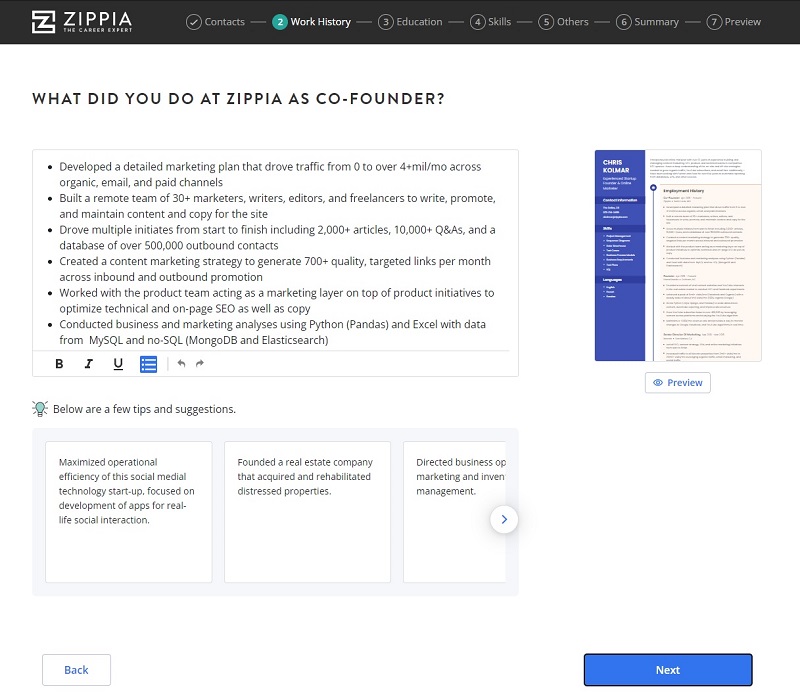
A standout resume can give you a competitive edge. Create yours using our resume builder. Here’s a preview of what it could look like:
Key Tips for Choosing the Right Tense
-
Maintain Consistency. Only use multiple tenses in a section when discussing your current job responsibilities or volunteer work. Avoid mixing tenses throughout your resume, especially under a single heading.
To ensure consistency, check the verbs at the beginning of each bullet point.
-
When in doubt, opt for past tense. This is the safest choice if you’re unsure which tense to use. Overusing present tense can confuse hiring managers regarding your employment status.
Using past tense demonstrates your focus on future opportunities and investment in the positions you’re applying for.
-
Avoid the present participle. Using verbs ending in -ing (the present participle) can weaken your resume. For example, instead of saying, “Am volunteering as a tutor,” you could say, “Volunteer as a tutor.” This keeps your resume strong and concise.
-
Match Keywords. Many companies now use automated applicant tracking systems to filter resumes based on keywords. Always review job descriptions to ensure your resume includes relevant keywords.
This is particularly crucial when applying to larger organizations. Tailor your verbs to match required keywords without sacrificing tense consistency.
When to Use Future Tense
Future tense is defined by the word “will” preceding the verb, as in “will receive” or “will implement.” Use future tense sparingly, primarily in goal statements or objective sections, or if you’re a student applying for a job or internship and wish to mention upcoming courses or activities.
For instance, if you’re applying for a summer internship in January, you might indicate that you will complete a relevant class in the spring semester.
Avoid future tense in most other contexts. Here are examples of how to frame future activities:
-
If you haven’t yet earned your degree but plan to, state, “Expected May 2026.”
-
If you’re elected to a position like student body president but won’t take office until the next school year, write, “Elected to serve as student body president beginning August 2026.”
- Resume Tips
- Resume Tips
- Best Resume Writing Services
- Things To Avoid On A Resume
- Resume Paper To Use
- What To Include In A Resume
- How To Write A Bio
- How To Write A Personal Statement
- Lied on Your Resume?
- Resume PDF
- Avoid Age Discrimination
- Words and Phrases You Shouldn't Include in Your Resume
- How Many Skills Should You List On A Resume
- Send A Resume As A Pdf
- Resume Critique
- Make A Resume Stand Out
- Resume Spelling
- Resume Past Or Present Tense
- How To List Projects On A resume
- Best Resume Action Words
- How To Quantify Your Resume
- Resume Bullet Points
- Are Resume Writers Worth It
- How Many Jobs To List On Resume

Author

Abby is a writer who is passionate about the power of story. Whether it’s communicating complicated topics in a clear way or helping readers connect with another person or place from the comfort of their couch. Abby attended Oral Roberts University in Tulsa, Oklahoma, where she earned a degree in writing with concentrations in journalism and business.