What does a collections director do?
Collections director responsibilities
Here are examples of responsibilities from real collections director resumes:
- Achieve goal a year ahead of schedule, reducing DSO's from a steady 59 days to 43 days.
- Manage team through budget/business plans with oversight responsibility to department objectives.
- Credit and collection duties to maintain appropriate DSO levels.
- Perform collections activities on delinquent loan accounts to include repossessions, foreclosures, bankruptcy proceedings, and disposition of repossess assets.
- Supervise the project to move the majority of vendors and customers to ACH transactions.
- Initial collections experience; develop communication and negotiation skills while quickly progressing through various departments specializing in different financial areas.
Collections director skills and personality traits
We calculated that 13% of Collections Directors are proficient in Oversight, Process Improvement, and Collection Process. They’re also known for soft skills such as Math skills, Organizational skills, and Analytical skills.
We break down the percentage of Collections Directors that have these skills listed on their resume here:
- Oversight, 13%
Direct oversight of the Accounts Receivable/Collection and Revenue Cycle process.
- Process Improvement, 8%
Developed time-saving quality tools for strengthening managers' work performance enabling successful tracking of process improvement and achievement of goals.
- Collection Process, 7%
Directed and coordinated the collection process administered by telephone representatives and field based Portfolio Managers.
- Customer Service, 6%
Work with business units to identify ways to improve customer service, identify and realize productivity improvements and reduce overall costs.
- Financial Statements, 5%
Managed all accounts receivables reporting for more accurate general ledger accruals, financial statements and recommendations to senior management.
- Cash Flow, 5%
Defined and executed aggressive recovery tactics to advance cash flow without negatively impacting sales targeting major contributors advertising agencies.
"oversight," "process improvement," and "collection process" are among the most common skills that collections directors use at work. You can find even more collections director responsibilities below, including:
Math skills. The most essential soft skill for a collections director to carry out their responsibilities is math skills. This skill is important for the role because "financial managers need strong skills in certain branches of mathematics, including algebra." Additionally, a collections director resume shows how their duties depend on math skills: "monitored all customer accounts to monitor a/r statistics. "
Organizational skills. Another essential skill to perform collections director duties is organizational skills. Collections directors responsibilities require that "because financial managers deal with a range of information and documents, they must have structures in place to be effective in their work." Collections directors also use organizational skills in their role according to a real resume snippet: "reduced organizational accounts receivables by 25% from 57 days to 41 days through new department procedures and efficiencies. "
Analytical skills. This is an important skill for collections directors to perform their duties. For an example of how collections director responsibilities depend on this skill, consider that "to assist executives in making decisions, financial managers need to evaluate data and information that affects their organization." This excerpt from a resume also shows how vital it is to everyday roles and responsibilities of a collections director: "analyzed hmocapitations for adherence to the contract and negotiation of hmo contracts. ".
Communication skills. collections director responsibilities often require "communication skills." The duties that rely on this skill are shown by the fact that "financial managers must be able to explain and justify complex financial transactions." This resume example shows what collections directors do with communication skills on a typical day: "increased interdepartmental communications by scheduling and planning daily meetings to discuss open action items and necessary next steps in collection process. "
Detail oriented. Another common skill required for collections director responsibilities is "detail oriented." This skill comes up in the duties of collections directors all the time, as "in preparing and analyzing reports, such as balance sheets and income statements, financial managers must be precise and attentive to their work in order to avoid errors." An excerpt from a real collections director resume shows how this skill is central to what a collections director does: "monitored representative's calls to insure that we were providing accurate and detailed information and adhering to the fdcpa guidelines. "
The three companies that hire the most collections directors are:
- Vail Resorts2 collections directors jobs
- Capital Services Corporation1 collections directors jobs
- Res-Care Premier1 collections directors jobs
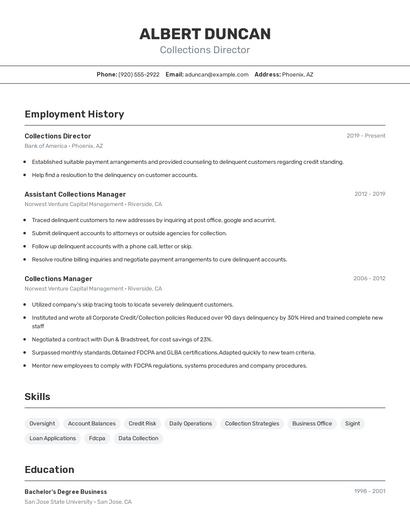
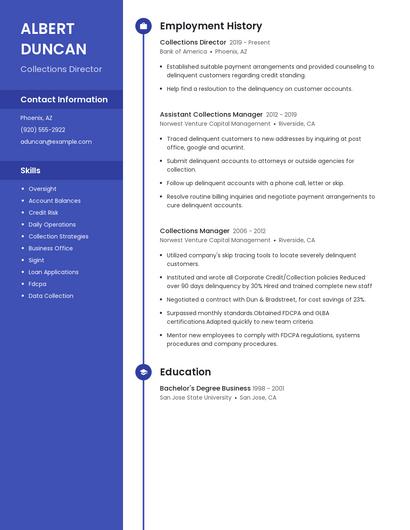
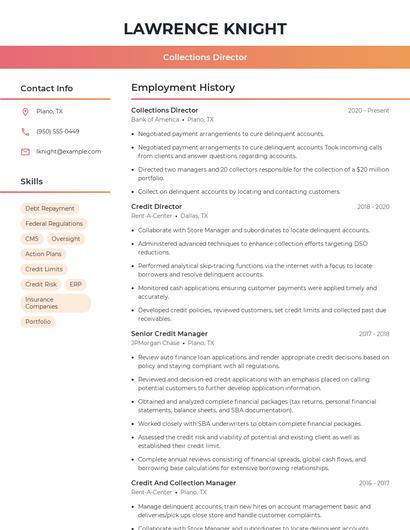
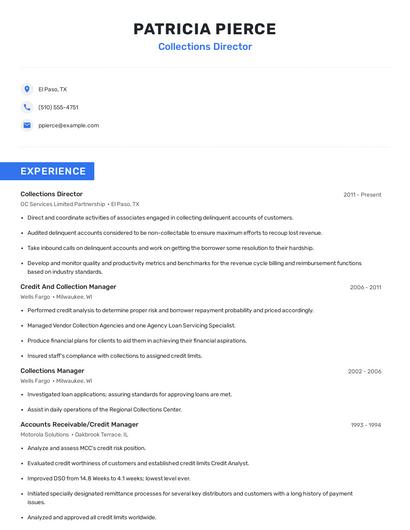
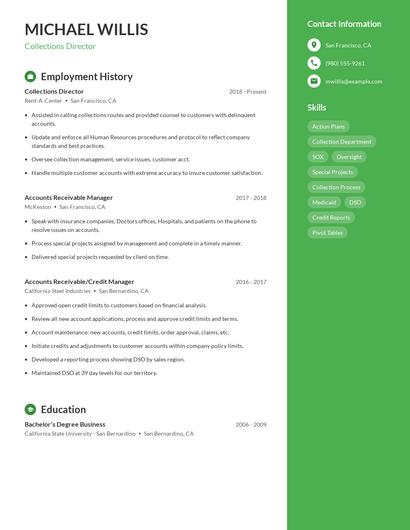
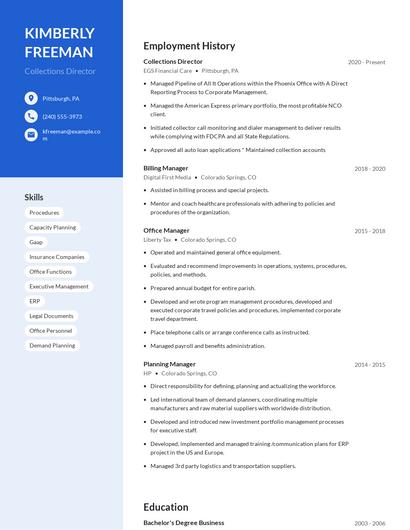
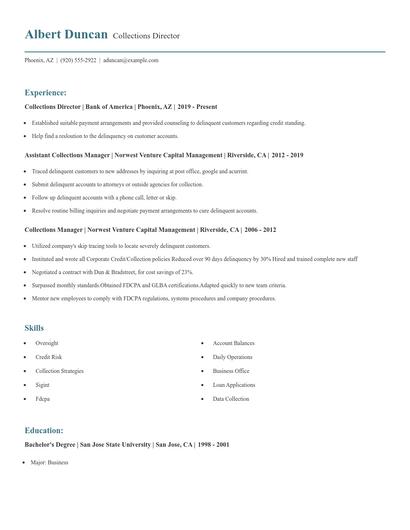
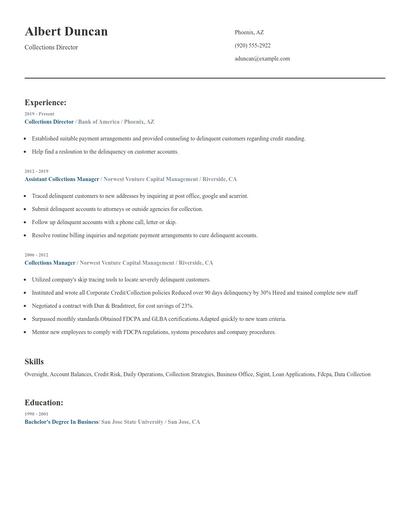
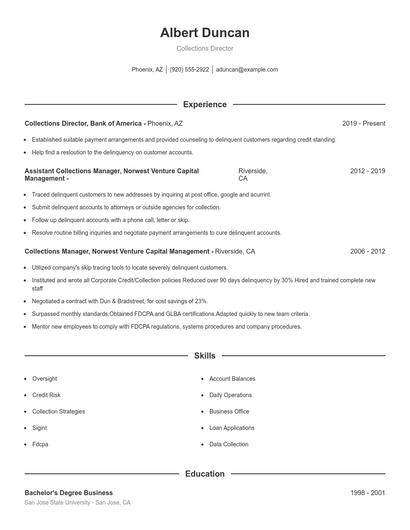
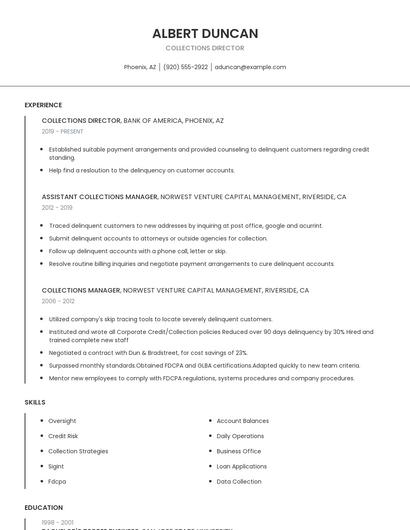
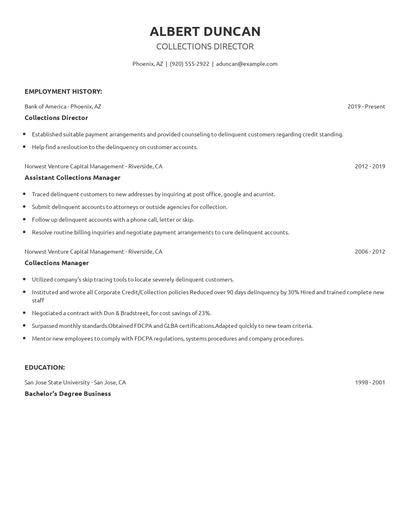
Choose from 10+ customizable collections director resume templates
Build a professional collections director resume in minutes. Our AI resume writing assistant will guide you through every step of the process, and you can choose from 10+ resume templates to create your collections director resume.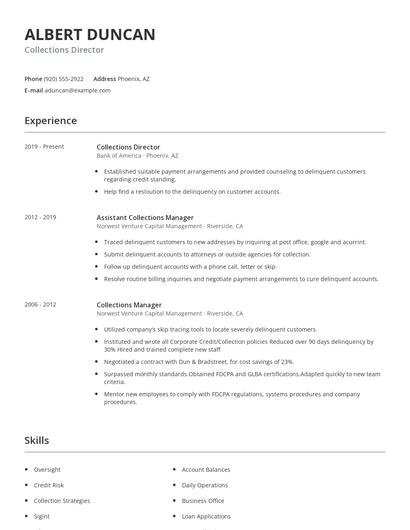
Compare different collections directors
Collections director vs. Assistant branch manager
An assistant branch manager's primary responsibility is to oversee the daily operations in their designated area, ensuring that everything is running smoothly from the workflow to the workforce. Although the tasks will vary depending on the organization or industry where one is involved, most of it will revolve around evaluating and monitoring employees' progress. Additional duties include responding to calls and inquiries, managing work schedules, and making sure that customers are satisfied with all services and transactions. Moreover, an assistant branch manager must also prioritize meeting the sales targets and staying within the allotted budget and deadlines.
There are some key differences in the responsibilities of each position. For example, collections director responsibilities require skills like "oversight," "process improvement," "collection process," and "cash flow." Meanwhile a typical assistant branch manager has skills in areas such as "quality customer service," "branch management," "excellent organizational," and "loan applications." This difference in skills reveals the differences in what each career does.
Assistant branch managers earn the highest salaries when working in the transportation industry, with an average yearly salary of $48,965. On the other hand, collections directors are paid more in the technology industry with an average salary of $93,767.assistant branch managers tend to reach lower levels of education than collections directors. In fact, assistant branch managers are 9.4% less likely to graduate with a Master's Degree and 1.9% less likely to have a Doctoral Degree.Collections director vs. Branch manager
Branch managers oversee the company's field office. This position is usually present in industries such as banking and food service. Branch managers are responsible for all aspects of the branch operations, including, but not limited to, finances, marketing, quality control, and human resources. They ensure that the goals of the branch are met in the most efficient way possible. They balance the needs of both the organization and the employees in the department. Branch managers are also expected to have a hand in training the employees to be useful members of the organization.
While some skills are similar in these professions, other skills aren't so similar. For example, resumes show us that collections director responsibilities requires skills like "oversight," "process improvement," "collection process," and "customer service." But a branch manager might use other skills in their typical duties, such as, "customer satisfaction," "business development," "branch management," and "excellent interpersonal."
On average, branch managers earn a lower salary than collections directors. Some industries support higher salaries in each profession. Interestingly enough, branch managers earn the most pay in the professional industry with an average salary of $55,380. Whereas collections directors have higher pay in the technology industry, with an average salary of $93,767.In general, branch managers achieve lower levels of education than collections directors. They're 8.2% less likely to obtain a Master's Degree while being 1.9% less likely to earn a Doctoral Degree.Collections director vs. Audit manager
An audit manager is responsible for the complete audit process of finances in an organization. They work for banks and report directly to the audit committee. Based on findings gathered, a financial institution can gain vision into their variance and overall performance. They are also responsible for scheduling audits, initiating departmental audits, consolidation, and analysis of audit reports, and reviewing accounting procedures. Moreover, part of their tasks is to create audit finding presentations to be presented to the audit committee. It requires a high amount of accountability to be an effective audit manager.
The required skills of the two careers differ considerably. For example, collections directors are more likely to have skills like "oversight," "collection process," "financial statements," and "cash flow." But a audit manager is more likely to have skills like "cpa," "internal audit," "audit reports," and "audit engagements."
Audit managers earn the best pay in the manufacturing industry, where they command an average salary of $122,875. Collections directors earn the highest pay from the technology industry, with an average salary of $93,767.audit managers typically earn similar educational levels compared to collections directors. Specifically, they're 1.0% more likely to graduate with a Master's Degree, and 1.7% more likely to earn a Doctoral Degree.Collections director vs. Risk manager
A risk manager is responsible for analyzing potential risks that may affect the organization's operations, reputation, and market credibility. Risk managers identify risk controls and discuss business contingency plans for unforeseen circumstances to prevent delays in operational services. They also develop compliance training and programs for all the employees to provide them the awareness of the safety and security regulations within the company premises. A risk manager must have excellent communication and leadership skills, especially on handling and investigating cases that might compromise the business stability and financial status.
Types of collections director
Updated January 8, 2025
