What does a director systems development do?
Director systems development responsibilities
Here are examples of responsibilities from real director systems development resumes:
- Manage the implementation of a SharePoint base project and portfolio management solution and team intranet portal.
- Coordinate the development and monitoring of the groups SDLC standards and practices.
- Act as the team leader in the implementation of new ERP system-SAP modules R/3 and CRM.
- Develop and implement proprietary SDLC process to improve quality
- Develop production web site architecture base on the Lutris Enhydra Java application server.
- Conduct a comprehensive analysis comparing on-premise and SaaS applications resulting in a shift to a predominant SaaS landscape of systems.
- Create and build relationships with key business stakeholders and develop agreeable SLA's.
- Implement procedures on profiling and performance stats as part of SLA including but not limit to vendors.
- Create mail merge web application using PHP and MySQL.
- Conduct a comprehensive analysis comparing on-premise and SaaS applications resulting in a shift to a predominant SaaS landscape of systems.
Director systems development skills and personality traits
We calculated that 8% of Directors Systems Development are proficient in Software Development, Systems Development, and Web Services. They’re also known for soft skills such as Analytical skills, Business skills, and Organizational skills.
We break down the percentage of Directors Systems Development that have these skills listed on their resume here:
- Software Development, 8%
Supervised and prepared merit appraisals for 13 employees consisting of programmers, database analysts and functional analysts performing Agile software development.
- Systems Development, 7%
Facilitate communications and serve as liaison between client and Systems Development team's internal business analysts and developers.
- Web Services, 5%
Managed all aspects of website solutions including external production hosting servers, internal production web services servers.
- Java, 5%
Developed production web site architecture based on the Lutris Enhydra Java application server.
- Data Warehouse, 4%
Directed the development, implementation and maintenance of a data warehouse and associated decision support and business intelligence systems.
- Application Development, 4%
Organized and prioritized application development initiatives applying the best mix of staff and facility resources to successfully complete each assignment.
"software development," "systems development," and "web services" are among the most common skills that directors systems development use at work. You can find even more director systems development responsibilities below, including:
Analytical skills. One of the key soft skills for a director systems development to have is analytical skills. You can see how this relates to what directors systems development do because "it managers must analyze problems and consider and select the best ways to solve them." Additionally, a director systems development resume shows how directors systems development use analytical skills: "directed erp needs analysis, guided the business team through erp product selection, and directed the package implementation. "
Business skills. Many director systems development duties rely on business skills. "it managers must develop and implement strategic plans to reach the goals of their organizations.," so a director systems development will need this skill often in their role. This resume example is just one of many ways director systems development responsibilities rely on business skills: "handled development, implementation and support of corporate erp and business systems (bpcs). "
Organizational skills. This is an important skill for directors systems development to perform their duties. For an example of how director systems development responsibilities depend on this skill, consider that "some it managers must coordinate the work of several different it departments to make the organization run efficiently." This excerpt from a resume also shows how vital it is to everyday roles and responsibilities of a director systems development: "devise and design business process requirements for all it-related business, financial, and operations systems critical to core organizational functions. ".
Communication skills. director systems development responsibilities often require "communication skills." The duties that rely on this skill are shown by the fact that "it managers must explain their work to top executives and give clear instructions to their subordinates." This resume example shows what directors systems development do with communication skills on a typical day: "frequent communication with business analysts, project managers, business leads, and executives. "
Leadership skills. A commonly-found skill in director systems development job descriptions, "leadership skills" is essential to what directors systems development do. Director systems development responsibilities rely on this skill because "it managers must lead and motivate it teams or departments so that workers are efficient and effective." You can also see how director systems development duties rely on leadership skills in this resume example: "play a leadership role in the product development process and participate in the product development management review board. "
The three companies that hire the most director systems developments are:
- Global Payments3 directors systems development jobs
- Regal Beloit3 directors systems development jobs
- Dell3 directors systems development jobs
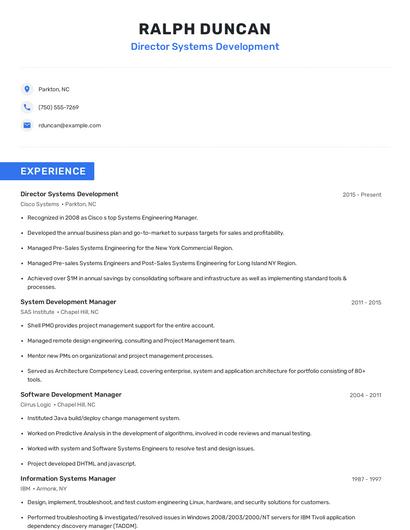
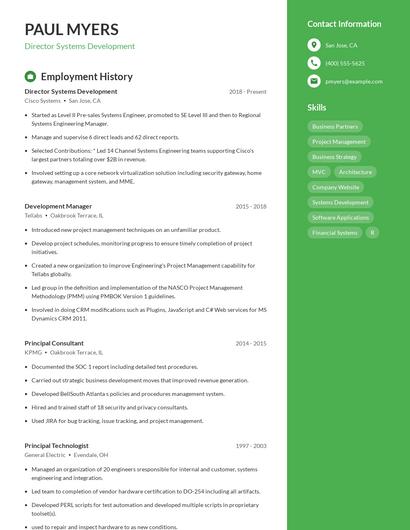
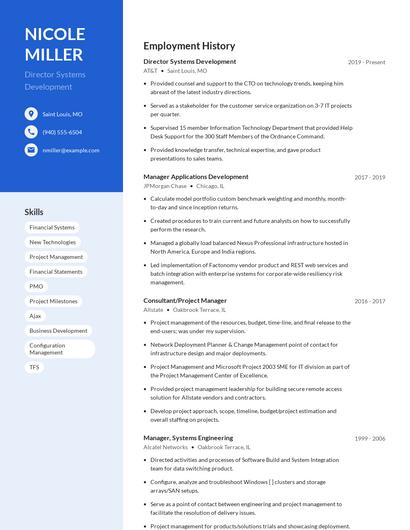
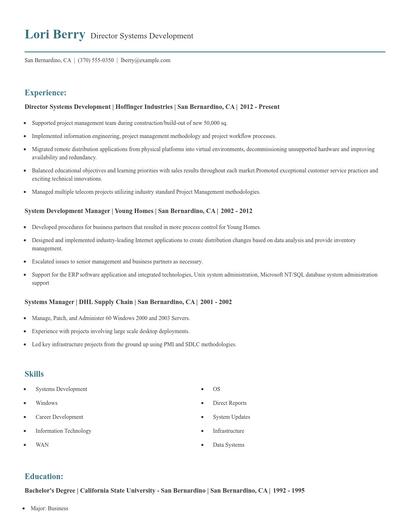
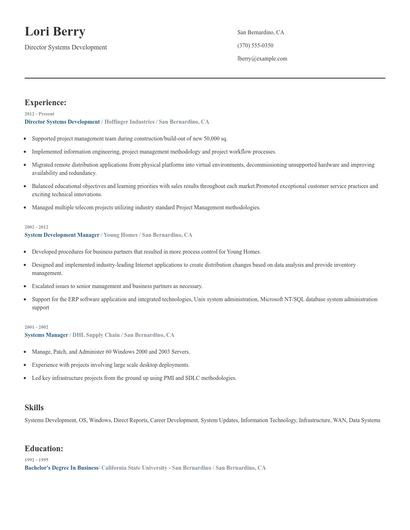
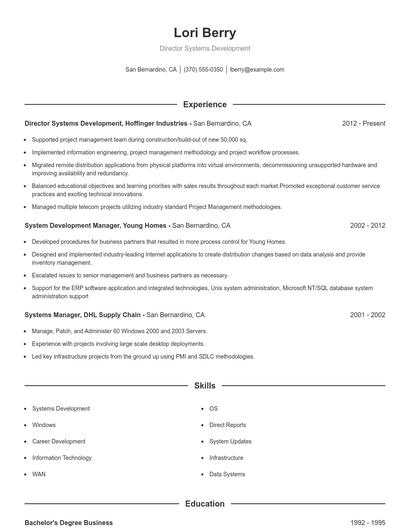
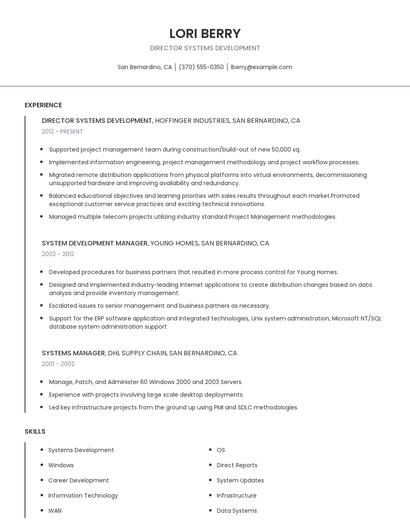
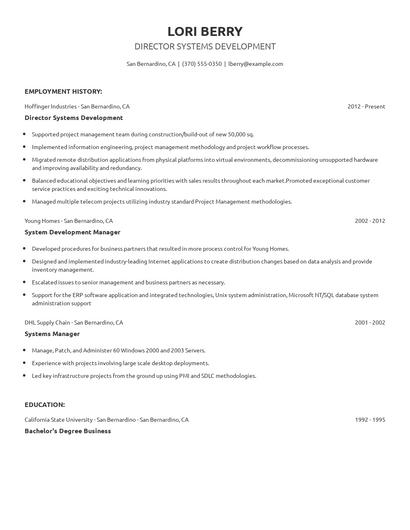
Choose from 10+ customizable director systems development resume templates
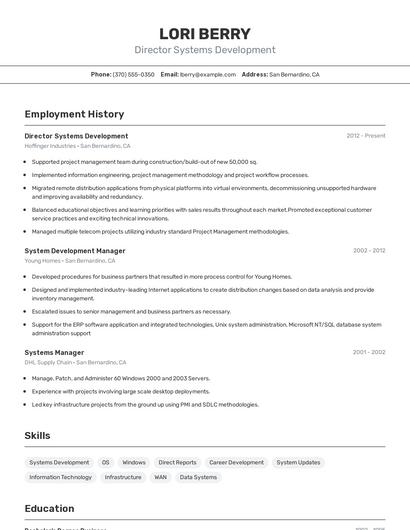
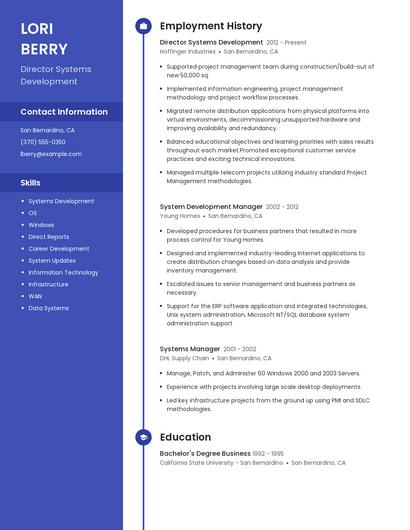
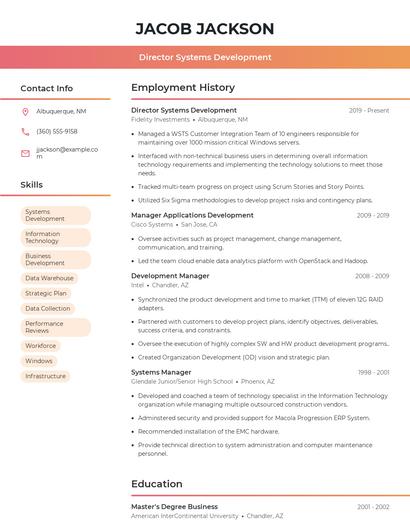
Build a professional director systems development resume in minutes. Our AI resume writing assistant will guide you through every step of the process, and you can choose from 10+ resume templates to create your director systems development resume.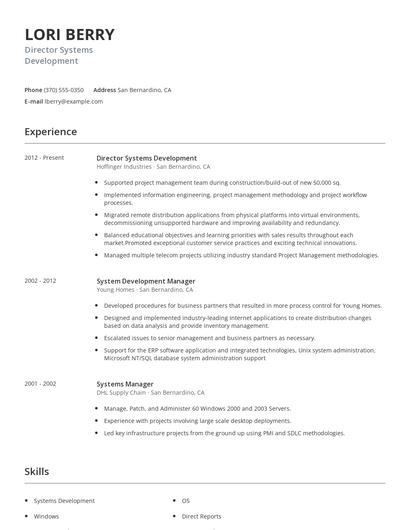
Compare different directors systems development
Director systems development vs. Application manager
An application manager is in charge of overseeing software applications and systems within a company, ensuring efficiency and quality. Typically, their responsibilities revolve around conducting research and analysis to identify company needs, assessing existing applications to determine their strengths and weaknesses, and implementing solutions to optimize the quality of services. They may also conduct regular maintenance checks to ensure the efficiency of applications, performing corrective measures when necessary. Furthermore, as an application manager, it is essential to coordinate with the information technology staff, encouraging them to reach goals and new heights.
While similarities exist, there are also some differences between directors systems development and application manager. For instance, director systems development responsibilities require skills such as "systems development," "web services," "strategic plan," and "product development." Whereas a application manager is skilled in "customer service," "architecture," "infrastructure," and "application support." This is part of what separates the two careers.
The education levels that application managers earn slightly differ from directors systems development. In particular, application managers are 1.8% less likely to graduate with a Master's Degree than a director systems development. Additionally, they're 0.8% less likely to earn a Doctoral Degree.Director systems development vs. Data manager
A data manager is responsible for monitoring the efficiency of the company's technology systems and network infrastructures. Data managers ensure the safety and security of the databases to avoid unauthorized access that may pose risks for business operations. They assist the technology team in developing data management protocols and smooth navigation of the network systems. A data manager must have excellent knowledge of the technology industry, as well as having a strong command on system codes and programming languages, to immediately identify inconsistencies, and perform troubleshooting to fix these discrepancies.
Each career also uses different skills, according to real director systems development resumes. While director systems development responsibilities can utilize skills like "software development," "systems development," "web services," and "application development," data managers use skills like "data analysis," "visualization," "data quality," and "data collection."
Average education levels between the two professions vary. Data managers tend to reach similar levels of education than directors systems development. In fact, they're 1.3% less likely to graduate with a Master's Degree and 0.8% less likely to earn a Doctoral Degree.Director systems development vs. Technical manager
A technical manager is responsible for maintaining the company's information systems database and analyzing technology system matters to ensure its efficiency and accuracy in supporting business operations. Technical managers perform network checks regularly to assess any possible malfunctions that might compromise the company's cybersecurity. They carefully analyze business and clients' specifications on working with systems integration, responding to end-users' concerns and inquiries. A technical manager must have excellent knowledge of the information technology systems industry, as well as a strong command on network codes to conduct adjustments and manage network infrastructure.
There are many key differences between these two careers, including some of the skills required to perform responsibilities within each role. For example, a director systems development is likely to be skilled in "systems development," "web services," "strategic plan," and "business process," while a typical technical manager is skilled in "infrastructure," "architecture," "customer service," and "emerging technologies."
Technical managers typically earn similar educational levels compared to directors systems development. Specifically, they're 2.4% less likely to graduate with a Master's Degree, and 0.3% less likely to earn a Doctoral Degree.Director systems development vs. Vice president of information technology
A Vice President Of Information Technology supervises an organization's technology initiatives, IT changes, and updates to all projects. They also identify and propose new information technologies and systems to improve business processes and decision-making.
Types of director systems development
Updated January 8, 2025
