What does a document processor do?

Document processors are professionals who are responsible for managing the documenting processes and systems of an organization. These processors are required to organize documents after they have received and processed incoming documents such as texts and audio-visual formats. They must follow the data program techniques and procedures so that they can maintain data entry requirements and ensure quality assurance with all work completed. Document processors must also adhere to companies when handling materials, especially those with confidential information.
Document processor responsibilities
Here are examples of responsibilities from real document processor resumes:
- Manage a monthly pipeline averaging 100 files from origination to funding per month as a Jr. processor.
- Summer internship, FHA loan processing
- Used WordPerfect in windows environment.
- Scan responses using an OPEX scanner.
- Enter vehicle data into the AS400 system.
- Prep, scan and index documents using OnBase.
- Use company software for scanning, printing and OCR.
- Scan checks and the appropriate backup into the OPEX scan system.
- Search for ICD-9 and CPT codes for patient s medical claims.
- Scan and index documents using OCR; verify to ensure accuracy.
- Enter transcript documentation into the TVS system for all high school students.
- Perform various administrative tasks such as mail, FedEx and processing checks.
- Assist sales reps and technicians with their questions regarding ADT policies and procedures.
- Prepare revised loan documents due to applicant's change request within RESPA guidelines.
- Use MACO as guide to perform QA process and identify policies and compliance exceptions.
Document processor skills and personality traits
We calculated that 51% of Document Processors are proficient in Data Entry, Quality Standards, and Real Estate. They’re also known for soft skills such as Integrity, Communication skills, and Organizational skills.
We break down the percentage of Document Processors that have these skills listed on their resume here:
- Data Entry, 51%
Utilize scanning or other automated data entry procedures, such as imaging devices and document imaging software.________________________________________
- Quality Standards, 7%
Established and maintained records, researched and resolved problems while meeting established daily deadlines and maintaining company quality standards.
- Real Estate, 5%
Maintained a personable re pore with Real Estate agents and homeowners, effectively communicating a sense of urgency while maintaining control.
- Computer System, 4%
Indexed information scanned into the computer system processing platform and made necessary corrections.
- Office Equipment, 4%
Maintain own office equipment and stationery supplies
- Clerical Tasks, 2%
Work successfully in a highly collaborative team environment * Other clerical tasks as needed
"data entry," "quality standards," and "real estate" are among the most common skills that document processors use at work. You can find even more document processor responsibilities below, including:
Integrity. One of the key soft skills for a document processor to have is integrity. You can see how this relates to what document processors do because "information clerks, particularly human resources assistants, have access to confidential information." Additionally, a document processor resume shows how document processors use integrity: "analyzed and handled data entry for bankruptcies, living trusts and affidavit of death. "
Communication skills. Many document processor duties rely on communication skills. "information clerks must be able to explain policies and procedures clearly to customers and the public.," so a document processor will need this skill often in their role. This resume example is just one of many ways document processor responsibilities rely on communication skills: "researched and developed standard operating procedures, wrote manual, and created reports to improve communications and consistency of output. "
Organizational skills. document processors are also known for organizational skills, which are critical to their duties. You can see how this skill relates to document processor responsibilities, because "information clerks must be able to retrieve files and other important information quickly and efficiently." A document processor resume example shows how organizational skills is used in the workplace: "general filing and record maintenance, and performed organizational clerical tasks. "
The three companies that hire the most document processors are:
- Interactive Brokers5 document processors jobs
- CSC Holdings LLC5 document processors jobs
- Randstad North America, Inc.5 document processors jobs
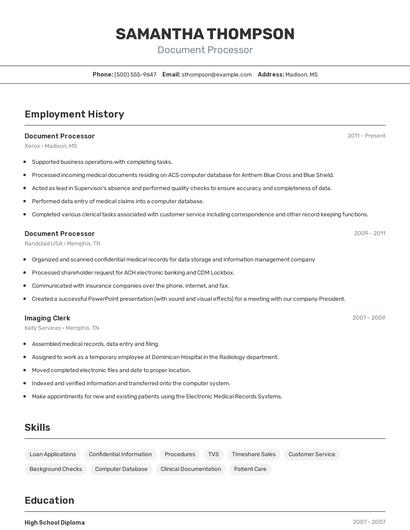
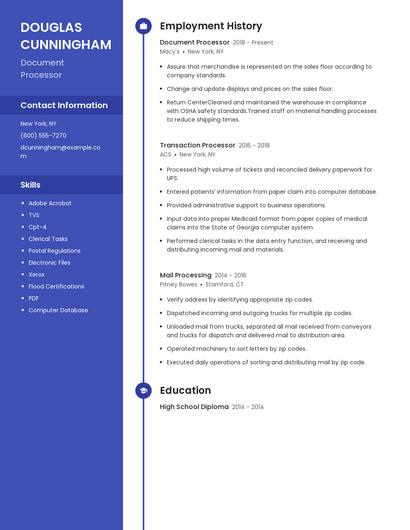
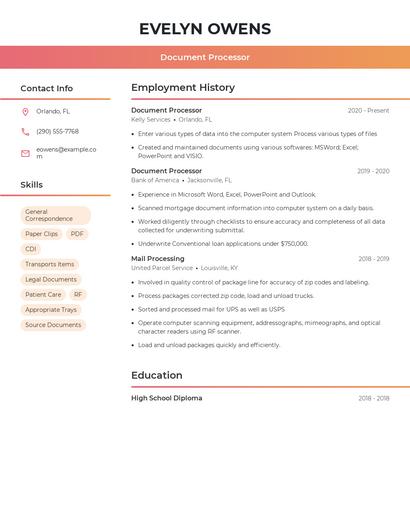
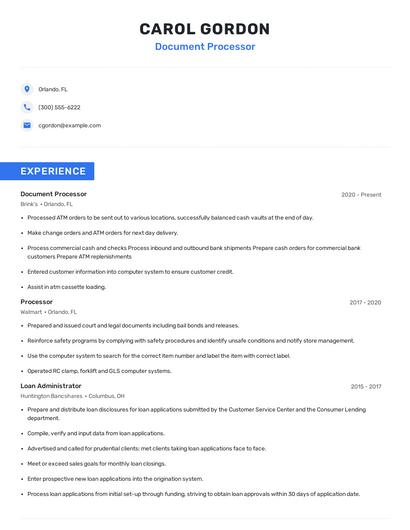
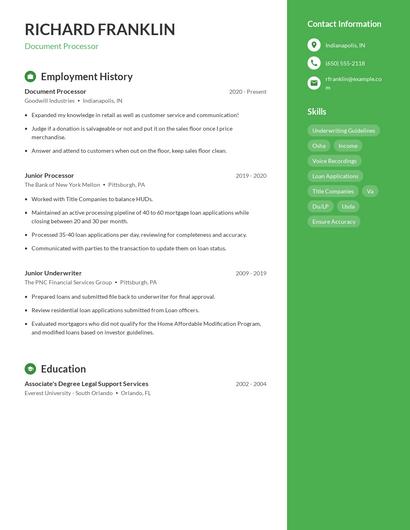
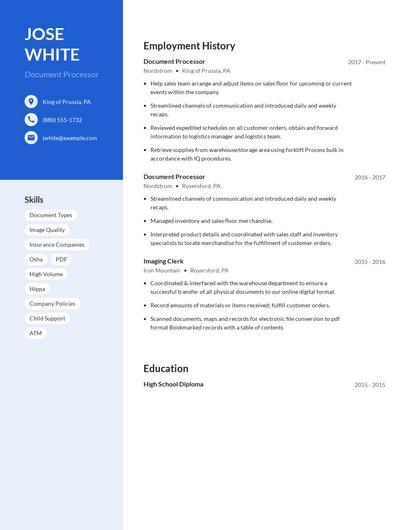
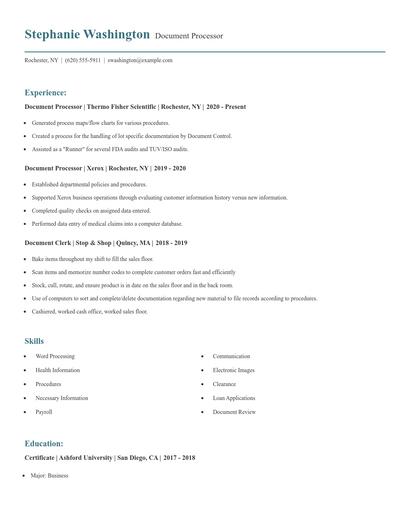
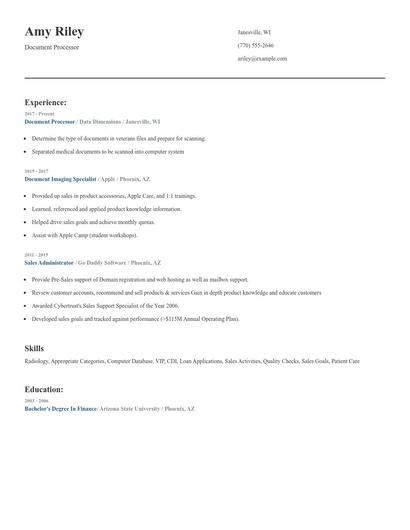
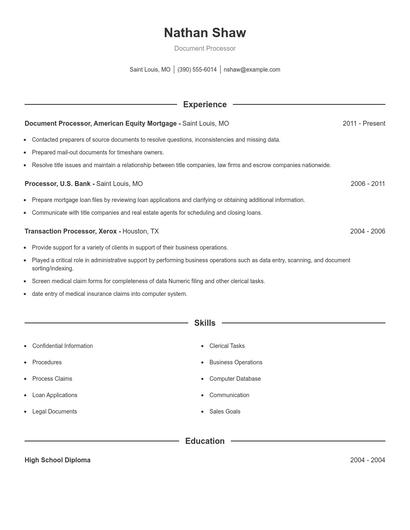
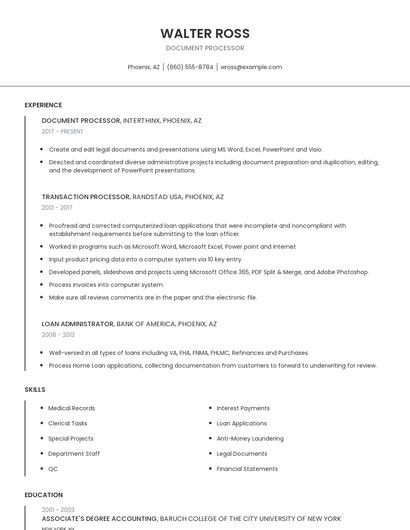
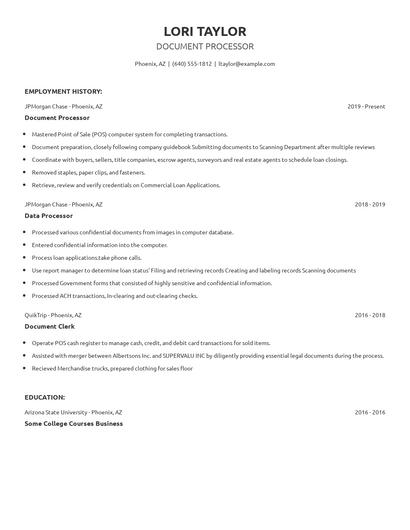
Choose from 10+ customizable document processor resume templates
Build a professional document processor resume in minutes. Our AI resume writing assistant will guide you through every step of the process, and you can choose from 10+ resume templates to create your document processor resume.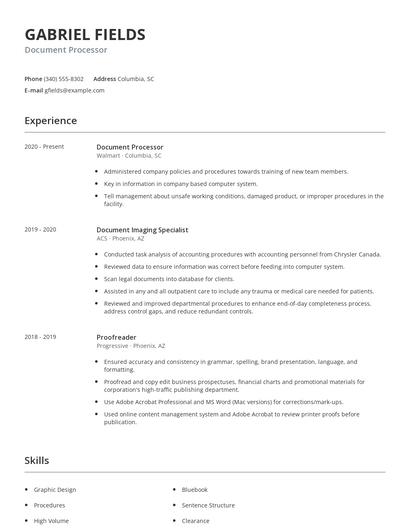
Compare different document processors
Document processor vs. Typist
A typist is responsible for typing all of a company's documents and materials, including reports, policies, and correspondence. A typist may also be known as a word processor or copy clerk. They are a professional who may work for companies or individuals. Their job responsibilities may include typing up letters, filling out forms, creating transcriptions of audio recordings, or organizing documents. They may also have to answer phones.
While similarities exist, there are also some differences between document processors and typist. For instance, document processor responsibilities require skills such as "quality standards," "clerical tasks," "pdf," and "loan applications." Whereas a typist is skilled in "wpm," "telephone calls," "computer database," and "escrow." This is part of what separates the two careers.
Typists really shine in the government industry with an average salary of $34,510. Comparatively, document processors tend to make the most money in the insurance industry with an average salary of $36,054.On average, typists reach similar levels of education than document processors. Typists are 0.2% more likely to earn a Master's Degree and 0.1% less likely to graduate with a Doctoral Degree.Document processor vs. Loan specialist
A loan specialist is in charge of processing loans to make transactions easier for the clients. They usually work in banks, lending firms, and other financial institutions. One of their primary responsibilities is to guide clients to understand what program works best for them, assist in filling out forms, gathering requirements, and verifying authenticity. There are also instances where a loan specialist must discern whether a client can uphold financial obligations using the information collected. Furthermore, it is also their responsibility to produce and submit reports to creditors or lenders.
In addition to the difference in salary, there are some other key differences worth noting. For example, document processor responsibilities are more likely to require skills like "data entry," "quality standards," "real estate," and "office equipment." Meanwhile, a loan specialist has duties that require skills in areas such as "customer service," "outbound calls," "mortgage loans," and "escrow." These differences highlight just how different the day-to-day in each role looks.
Loan specialists earn a higher average salary than document processors. But loan specialists earn the highest pay in the finance industry, with an average salary of $48,154. Additionally, document processors earn the highest salaries in the insurance with average pay of $36,054 annually.In general, loan specialists achieve similar levels of education than document processors. They're 2.5% more likely to obtain a Master's Degree while being 0.1% less likely to earn a Doctoral Degree.Document processor vs. Loan servicing specialist
A loan servicing specialist is an individual who reviews, authorizes, and recommends commercial and personal loans for approval. It is the loan officer who meets with their applicants to identify their creditworthiness. Typically, they work at credit unions, commercial banks, mortgage companies, and financial institutions. They ensure operational risk controls, regulatory policies and standards, and compliance. Among the skills necessary for the job include customer service and relations, leadership, analytical skills, and communication skills.
The required skills of the two careers differ considerably. For example, document processors are more likely to have skills like "data entry," "quality standards," "computer system," and "office equipment." But a loan servicing specialist is more likely to have skills like "loan modifications," "customer service," "foreclosure process," and "loss mitigation."
Loan servicing specialists earn the best pay in the finance industry, where they command an average salary of $59,466. Document processors earn the highest pay from the insurance industry, with an average salary of $36,054.When it comes to education, loan servicing specialists tend to earn similar degree levels compared to document processors. In fact, they're 1.6% more likely to earn a Master's Degree, and 0.1% more likely to graduate with a Doctoral Degree.Document processor vs. Loan closer
A loan closer is primarily in charge of handling and closing loan documentation, ensuring accuracy and smooth transactions. A loan closer's responsibilities revolve around liaising with clients to guarantee that they adhere to every term in the contract, preparing necessary reports and documents, monitoring payment progress, and ensuring that they have a deep understanding of the obligations under the contract. Furthermore, it is essential to maintain records of all transactions and assist clients, all while implementing the company's policies and regulations.
Even though a few skill sets overlap between document processors and loan closers, there are some differences that are important to note. For one, a document processor might have more use for skills like "quality standards," "real estate," "computer system," and "office equipment." Meanwhile, some responsibilities of loan closers require skills like "customer service," "excellent organizational," "trid," and "va."
Loan closers enjoy the best pay in the finance industry, with an average salary of $40,817. For comparison, document processors earn the highest salary in the insurance industry.The average resume of loan closers showed that they earn similar levels of education compared to document processors. So much so that theyacirc;euro;trade;re 2.4% more likely to earn a Master's Degree and more likely to earn a Doctoral Degree by 0.4%.Types of document processor
Updated January 8, 2025
