What does an educational programs coordinator do?

An educational programs coordinator acts as a liaison who coordinates, plans, and organize all regional educational activities, school operations, and implements policies among schools, administrators, counselors, community representative, parents, and local agencies. He/she has strong analytical and problem-solving skills and possesses excellent leadership and time management skills to fulfill his/her /her duties and responsibilities since the job involves a variety of campaigns, projects, or events. Also, his/her /her duties include supervision and assessment of the compliance of all performance standards and policies.
Educational programs coordinator responsibilities
Here are examples of responsibilities from real educational programs coordinator resumes:
- Manage operations and administer an outpatient diabetes management program for adults by MD referral.
- Coordinate instructions to patients in group and individual sessions with other diabetes team members that result in significantly improve clinical outcomes.
- Select and assist CPR instructors.
- Maintain all of the ACGME requirements, including website with fellowship information.
- Log all hours and data collect with government -Develop energy awareness less plans for grades k-12.
- Plan graduation of resident by tracking and submitting all requirements of ACGME throughout the residents' time in program.
- Contribute to the improvement of communication between patients and providers.
- Assist in creating PowerPoint presentations for upper level management meetings.
- Coordinate and facilitate a bi-weekly empowerment program design to provide pregnant teen mothers with career development opportunities and positive life skills.
- Provide group, as well as one-on-one tutoring, with a specialization in mathematics.
- Instruct through lectures, discussions, and demonstrations in the subjects of English, mathematics, science and social studies.
- Respond to complaints about instructors, investigating and taking appropriate remedial actions after consulting program leadership.
Educational programs coordinator skills and personality traits
We calculated that 11% of Educational Programs Coordinators are proficient in Patients, Professional Development, and PowerPoint. They’re also known for soft skills such as Compassion, Organizational skills, and Time-management skills.
We break down the percentage of Educational Programs Coordinators that have these skills listed on their resume here:
- Patients, 11%
Counseled pediatric patients on reducing risks of Childhood Obesity and raised awareness for healthy nutrition and family activities.
- Professional Development, 7%
Organized and developed partnerships with government agencies for speakers for Career Profile Sessions for undergraduate and graduate professional development sessions.
- PowerPoint, 6%
Assisted in creating PowerPoint presentations for upper level management meetings.
- Curriculum Development, 5%
Coordinated financial arrangements, curriculum development, and joint inter-institutional admission processes for incoming and current students to the Program.
- Medical Education, 4%
Track, update, and maintain provider's bibliography and continuing medical education information including completing all licensing and credentialing correspondence.
- Data Collection, 4%
Managed and developed frameworks for data collection.
Common skills that an educational programs coordinator uses to do their job include "patients," "professional development," and "powerpoint." You can find details on the most important educational programs coordinator responsibilities below.
Compassion. One of the key soft skills for an educational programs coordinator to have is compassion. You can see how this relates to what educational programs coordinators do because "social and human service assistants often work with people who are in stressful and difficult situations." Additionally, an educational programs coordinator resume shows how educational programs coordinators use compassion: "interact effectively and compassionately with patients, families, visitors and staff. "
Organizational skills. Many educational programs coordinator duties rely on organizational skills. "social and human service assistants must often complete lots of paperwork and work with many different clients," so an educational programs coordinator will need this skill often in their role. This resume example is just one of many ways educational programs coordinator responsibilities rely on organizational skills: "identify resource requirements to support organizational program operations by adhering to chdr protocol in relation to diabetes. "
Time-management skills. Another skill that relates to the job responsibilities of educational programs coordinators is time-management skills. This skill is critical to many everyday educational programs coordinator duties, as "social and human service assistants often work with many clients." This example from a resume shows how this skill is used: "set strategic plan goals & implemented deadlines. "
Communication skills. For certain educational programs coordinator responsibilities to be completed, the job requires competence in "communication skills." The day-to-day duties of an educational programs coordinator rely on this skill, as "social and human service assistants talk with clients about the challenges in their lives and assist them in getting help." For example, this snippet was taken directly from a resume about how this skill applies to what educational programs coordinators do: "edit, format and assemble program materials and communications. "
Problem-solving skills. Another common skill required for educational programs coordinator responsibilities is "problem-solving skills." This skill comes up in the duties of educational programs coordinators all the time, as "social and human service assistants help clients find solutions to their problems." An excerpt from a real educational programs coordinator resume shows how this skill is central to what an educational programs coordinator does: "communicated medical education departmental issues among numerous hospital committees and worked on cross-functional teams to develop and implement solutions. "
Interpersonal skills. Lastly, "interpersonal skills" is an important element of what an educational programs coordinator does. Educational programs coordinator responsibilities require this skill because "social and human service assistants must make their clients feel comfortable discussing sensitive issues." This resume example highlights how educational programs coordinator duties rely on this skill: "demonstrated excellent organizational, interpersonal, written and verbal communication skills with clients, supervisor, and command leadership. "
See the full list of educational programs coordinator skills
The three companies that hire the most educational programs coordinators are:
- University of Colorado11 educational programs coordinators jobs
- Cleveland Clinic7 educational programs coordinators jobs
- Emory Healthcare6 educational programs coordinators jobs
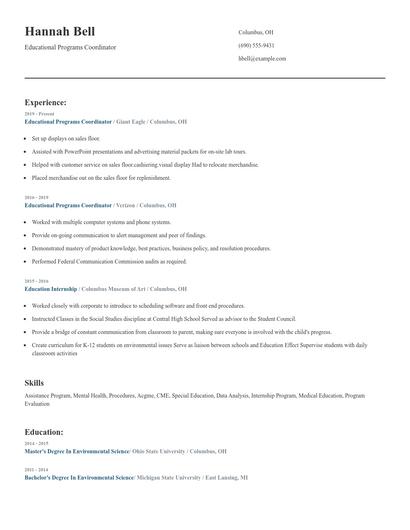
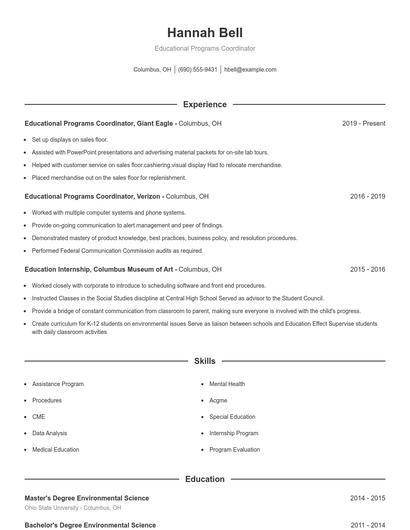
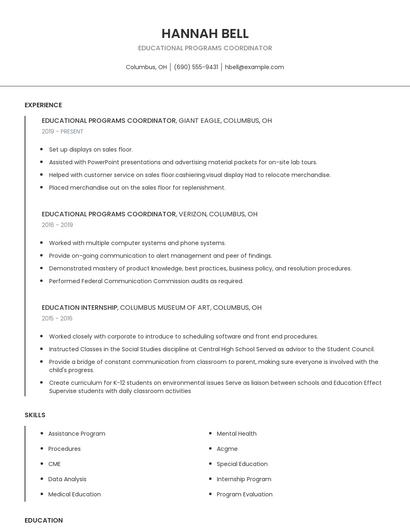
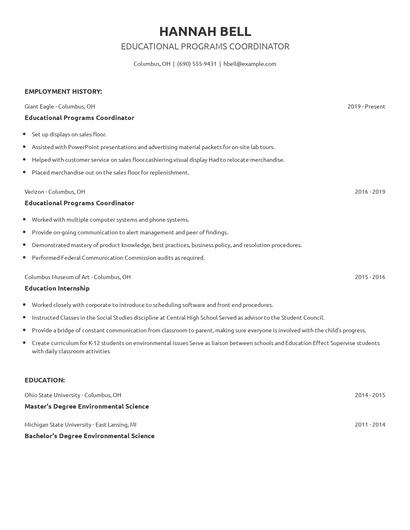
Choose from 10+ customizable educational programs coordinator resume templates
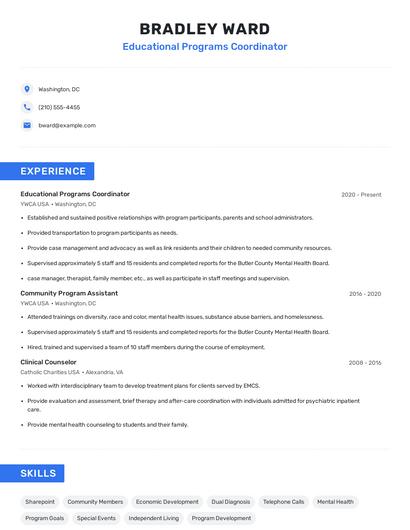
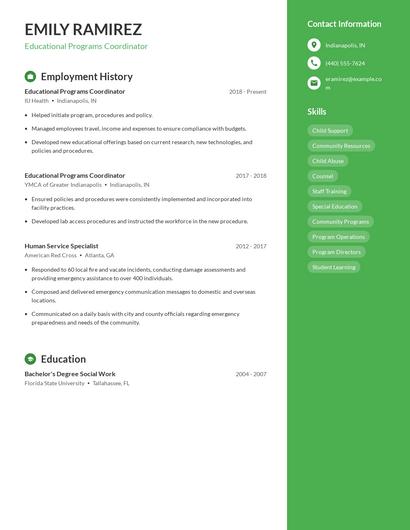
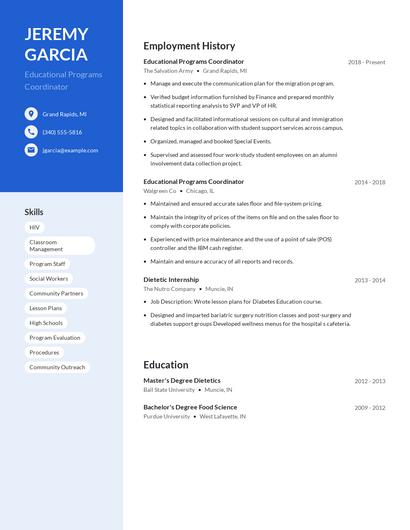
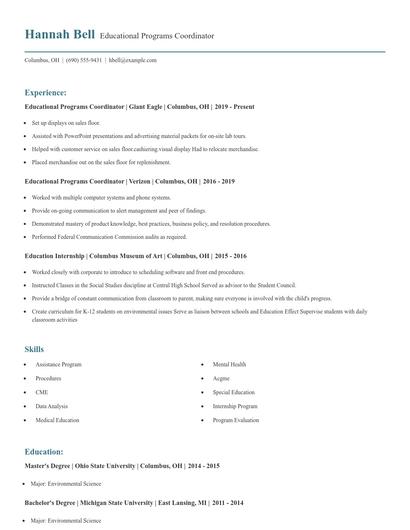
Build a professional educational programs coordinator resume in minutes. Our AI resume writing assistant will guide you through every step of the process, and you can choose from 10+ resume templates to create your educational programs coordinator resume.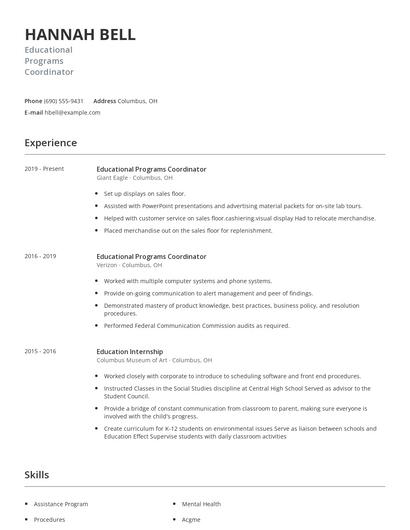
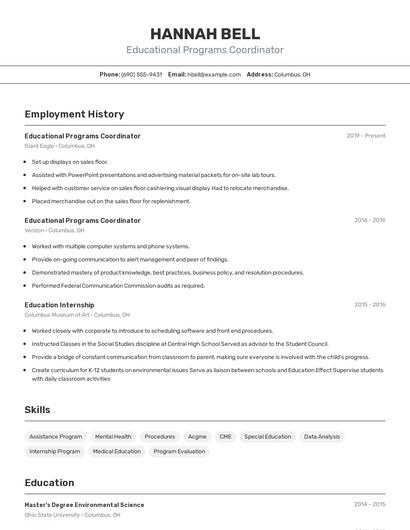
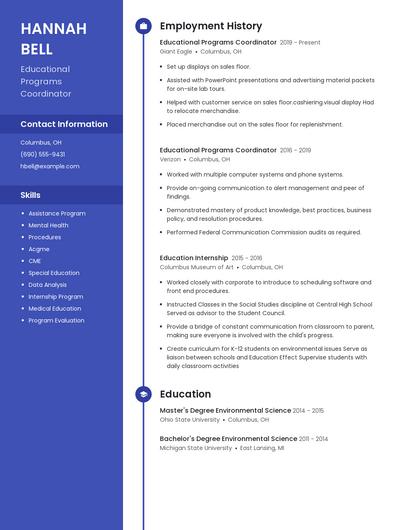
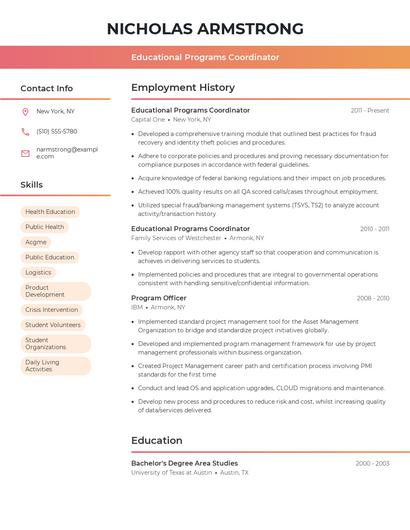
Compare different educational programs coordinators
Educational programs coordinator vs. Family services coordinator
A family services coordinator maintains quantitative quality and qualitative quality monitoring systems and improvement systems for the program strategies to get executed with quality, fidelity, and reliability. They coach and offer supervisory guidance services to the family service team to keep the staff capacity robust and move the staff members towards mastering the core competencies. Other duties performed by family services coordinators include supporting vulnerable families, promoting family self-sufficiency, and supporting families whose children have special needs and chronic health conditions.
While similarities exist, there are also some differences between educational programs coordinators and family services coordinator. For instance, educational programs coordinator responsibilities require skills such as "professional development," "powerpoint," "curriculum development," and "medical education." Whereas a family services coordinator is skilled in "social work," "child care," "substance abuse," and "crisis intervention." This is part of what separates the two careers.
Family services coordinators earn the highest salaries when working in the government industry, with an average yearly salary of $44,036. On the other hand, educational programs coordinators are paid more in the health care industry with an average salary of $49,904.family services coordinators tend to reach similar levels of education than educational programs coordinators. In fact, family services coordinators are 0.6% more likely to graduate with a Master's Degree and 1.6% less likely to have a Doctoral Degree.Educational programs coordinator vs. Service coordinator
A service coordinator is responsible for assisting the management team in providing the best services for the clients based on their specifications. Service coordinators' duties include managing clients' requests and inquiries, providing client updates, monitoring changes and plan adjustments, and recommending strategic procedures to improve services. Service coordinators must be highly-knowledgeable with the matters concerning the organization they work for, ensuring that they could explain their products and services well to meet clients' needs.
In addition to the difference in salary, there are some other key differences worth noting. For example, educational programs coordinator responsibilities are more likely to require skills like "professional development," "curriculum development," "medical education," and "data collection." Meanwhile, a service coordinator has duties that require skills in areas such as "customer service," "social work," "social services," and "service coordination." These differences highlight just how different the day-to-day in each role looks.
On average, service coordinators earn a lower salary than educational programs coordinators. Some industries support higher salaries in each profession. Interestingly enough, service coordinators earn the most pay in the government industry with an average salary of $43,853. Whereas educational programs coordinators have higher pay in the health care industry, with an average salary of $49,904.In general, service coordinators achieve lower levels of education than educational programs coordinators. They're 7.3% less likely to obtain a Master's Degree while being 1.6% less likely to earn a Doctoral Degree.What technology do you think will become more important and prevalent for educational programs coordinators in the next 3-5 years?
Dr. Sheying Chen Ph.D.
Professor of Public Administration/Social Policy, Pace University
Educational programs coordinator vs. Coordinator
Coordinators are responsible for liaising between the department they are assigned to and any other external party. They oversee projects or agreements. They are in charge of following through negotiations between the two parties regarding work. They see through the conduct of such contracts by ensuring that all terms are amenable to both parties. They maintain records and other necessary data and paperwork. They also ensure that office policy and guidelines are being followed. Coordinators also ensure that all projects are completed efficiently and effectively.
The required skills of the two careers differ considerably. For example, educational programs coordinators are more likely to have skills like "curriculum development," "medical education," "program evaluation," and "training programs." But a coordinator is more likely to have skills like "customer service," "excellent organizational," "data entry," and "excellent guest."
Coordinators earn the highest salary when working in the technology industry, where they receive an average salary of $51,731. Comparatively, educational programs coordinators have the highest earning potential in the health care industry, with an average salary of $49,904.When it comes to education, coordinators tend to earn lower degree levels compared to educational programs coordinators. In fact, they're 9.2% less likely to earn a Master's Degree, and 1.3% less likely to graduate with a Doctoral Degree.Educational programs coordinator vs. Residence coordinator
A residence coordinator is responsible for supporting and providing the needs of the residents, including move-in procedures and processing of papers for residency. Residence coordinators interact with organizations and community offices for housing projects and property lease, identifying locations according to clients' requirements and budget limitations. They also inspect the units, ensure the stability and safety of the foundation, and furnish areas that need renovations and repairs. A residence coordinator must have excellent communication and organizational skills, especially in explaining leasing agreements and accommodations with the clients.
Types of educational programs coordinator
Updated January 8, 2025
