What does an enterprise program manager do?
An enterprise program manager takes responsibility for managing all the projects within a company or organization. Enterprise program managers handle relationships and offer solutions or services to system engineers, directors, and account managers. It is their job to coordinate team agreements and oversee the performance of subcontractors. They design and enforce modules for analytics by consumers. Also, they direct products that support infrastructure management and data centers backing up naval fleet across the globe.
Enterprise program manager responsibilities
Here are examples of responsibilities from real enterprise program manager resumes:
- Manage regular system/service release processes for major cloud and on-prem systems.
- Handle intake process, obtain insurance authorizations, supervise utilization and management of Medicaid behavioral health manage care services.
- Develop key business metrics and KPIs to measure the achievement of business goals.
- Set up QRM infrastructure, methodologies, standard, processes, strategy and model review committee.
- Assemble and lead teams in all aspects of software development lifecycle (SDLC) and systems integration.
- Maintain metrics to ensure service levels and QoS targets are being meet and work to continuously improve on offer management KPIs.
- Ensure consistent adoption and utilization of PMO methodology and tools.
- Direct projects supporting data center and infrastructure management for mission-critical infrastructure supporting worldwide naval fleet.
- Supervise large system architecture projects, resulting in development of mobile and supporting web- base applications.
- Design and deploy the service orchestration architecture for integration of all external applications and third party partners.
- Develop security framework to support authentication, authorization, and account federation with SaaS applications and public/private internal applications.
- Develop strategy and objectives for integrating Linux into everyday operations so that customers would embrace the Linux system.
Enterprise program manager skills and personality traits
We calculated that 18% of Enterprise Program Managers are proficient in Project Management, Program Management, and Process Improvement. They’re also known for soft skills such as Analytical skills, Business skills, and Communication skills.
We break down the percentage of Enterprise Program Managers that have these skills listed on their resume here:
- Project Management, 18%
Established customer relationships resulting in over 50 new engagements, including requirement gathering, technical mentoring and project management.
- Program Management, 11%
Capitalized on industry expertise in providing program management for the SDLC methodology, designed for BSC's Legacy Modernization Project.
- Process Improvement, 6%
Manage staff and faculty along with process improvement opportunities within specific operational areas.
- Architecture, 5%
Served as Primary Lead in evaluating Architecture impacts to Transition/Re-hosting of Vector Applications back into GM environment.
- Infrastructure, 5%
Candle Corporation is a provider of software and consulting services to automate enterprise-wide proactive management of the business computing infrastructure.
- Risk Management, 5%
Developed plans and procedures for risk management and disaster recovery Received performance award and customer appreciation rewards for exceeding customer expectations
"project management," "program management," and "process improvement" are among the most common skills that enterprise program managers use at work. You can find even more enterprise program manager responsibilities below, including:
Analytical skills. The most essential soft skill for an enterprise program manager to carry out their responsibilities is analytical skills. This skill is important for the role because "it managers must analyze problems and consider and select the best ways to solve them." Additionally, an enterprise program manager resume shows how their duties depend on analytical skills: "integrated erp, performance-based lifecycle support, and product data strategies. "
Business skills. Many enterprise program manager duties rely on business skills. "it managers must develop and implement strategic plans to reach the goals of their organizations.," so an enterprise program manager will need this skill often in their role. This resume example is just one of many ways enterprise program manager responsibilities rely on business skills: "project and program management of applications across several business units providing saas. "
Communication skills. This is an important skill for enterprise program managers to perform their duties. For an example of how enterprise program manager responsibilities depend on this skill, consider that "it managers must explain their work to top executives and give clear instructions to their subordinates." This excerpt from a resume also shows how vital it is to everyday roles and responsibilities of an enterprise program manager: "key participant in the bi estimating best practices group and the communication team. ".
Leadership skills. enterprise program manager responsibilities often require "leadership skills." The duties that rely on this skill are shown by the fact that "it managers must lead and motivate it teams or departments so that workers are efficient and effective." This resume example shows what enterprise program managers do with leadership skills on a typical day: "commended by cio for strong leadership skills. "
Organizational skills. Another crucial skill for an enterprise program manager to carry out their responsibilities is "organizational skills." A big part of what enterprise program managers relies on this skill, since "some it managers must coordinate the work of several different it departments to make the organization run efficiently." How this skill relates to enterprise program manager duties can be seen in an example from an enterprise program manager resume snippet: "establish successful pmi project management standards in order to eliminate unstable and inconsistent work flows resulting in organizational savings. "
The three companies that hire the most enterprise program managers are:
- Meta52 enterprise program managers jobs
- Medtronic5 enterprise program managers jobs
- Fifth Third Bank4 enterprise program managers jobs
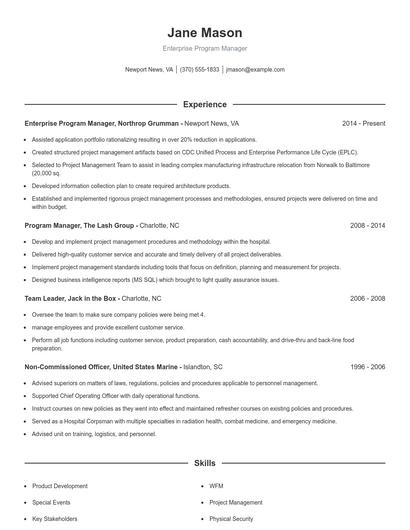
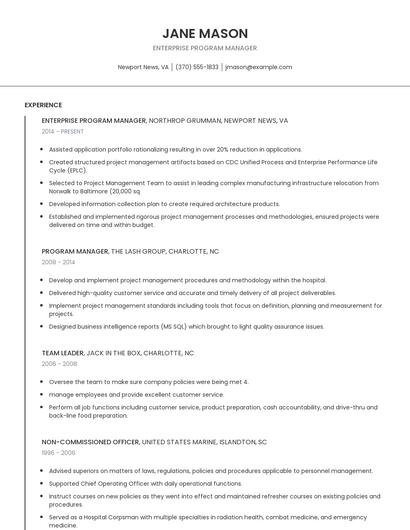
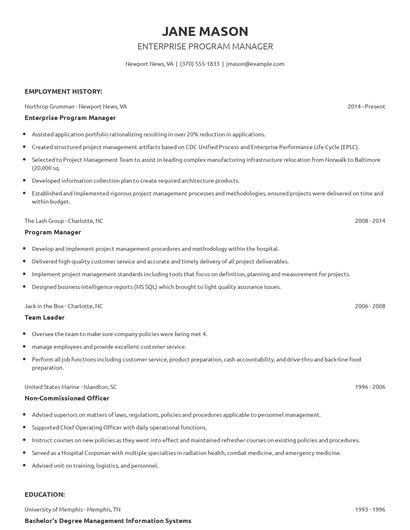
Choose from 10+ customizable enterprise program manager resume templates
Build a professional enterprise program manager resume in minutes. Our AI resume writing assistant will guide you through every step of the process, and you can choose from 10+ resume templates to create your enterprise program manager resume.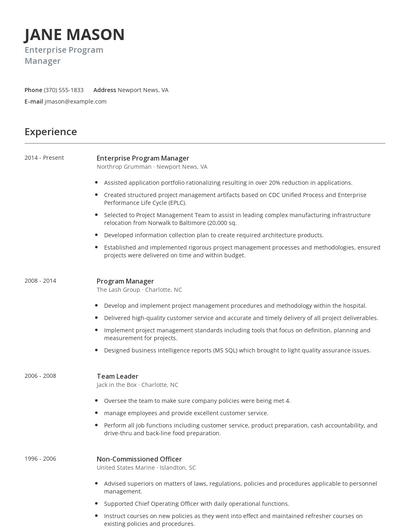
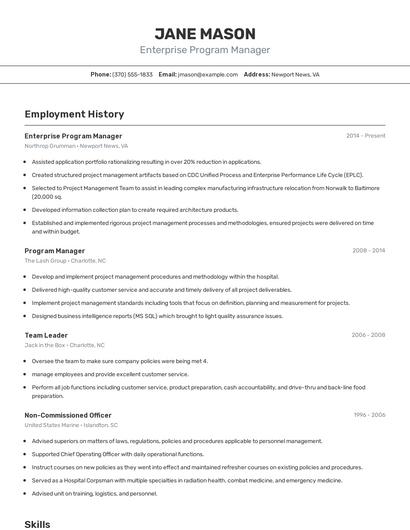


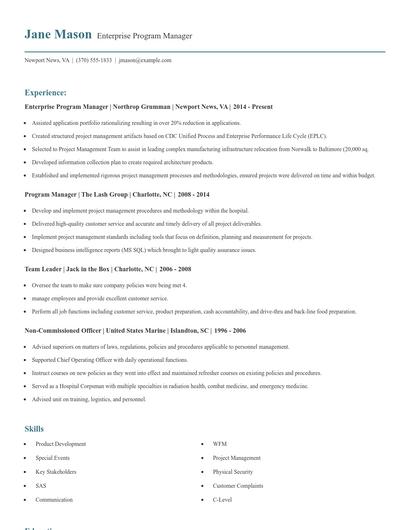
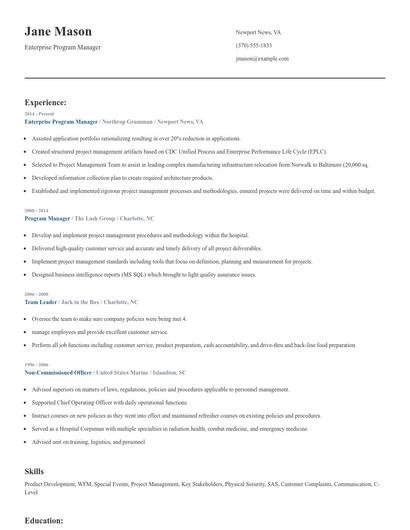
Compare different enterprise program managers
Enterprise program manager vs. Senior information technology manager
A senior information technology manager is responsible for monitoring the efficiency and performance of the company's technology and network systems. Senior information technology managers oversee technology infrastructures and operations, ensuring the processes adhere to the company policies and regulations. They analyze the schematics and specifications of computer systems, maintaining the safety and security across all networks to prevent unauthorized access. A senior information technology manager must have extensive knowledge of the technology industry, as well as a strong command of programming languages.
These skill sets are where the common ground ends though. The responsibilities of an enterprise program manager are more likely to require skills like "program management," "infrastructure," "risk management," and "lean six sigma." On the other hand, a job as a senior information technology manager requires skills like "strong problem-solving," "customer service," "sr," and "emerging technologies." As you can see, what employees do in each career varies considerably.
Senior information technology managers earn the highest salaries when working in the professional industry, with an average yearly salary of $143,891. On the other hand, enterprise program managers are paid more in the technology industry with an average salary of $133,949.On average, senior information technology managers reach similar levels of education than enterprise program managers. Senior information technology managers are 2.8% more likely to earn a Master's Degree and 0.0% more likely to graduate with a Doctoral Degree.Enterprise program manager vs. Manager
Managers are responsible for a specific department, function, or employee group. They oversee their assigned departments and all the employees under the department. Managers are responsible that the department they are handling is functioning well. They set the department goals and the steps they must take to achieve the goals. They are also in charge of assessing the performance of their departments and their employees. Additionally, managers are responsible for interviewing prospective candidates for department vacancies and assessing their fit to the needs of the department. Managers also set the general working environment in the department, and they are expected to ensure that their employees remain motivated.
In addition to the difference in salary, there are some other key differences worth noting. For example, enterprise program manager responsibilities are more likely to require skills like "project management," "program management," "process improvement," and "stakeholder relationships." Meanwhile, a manager has duties that require skills in areas such as "customer service," "payroll," "food safety," and "financial statements." These differences highlight just how different the day-to-day in each role looks.
Managers earn a lower average salary than enterprise program managers. But managers earn the highest pay in the finance industry, with an average salary of $71,781. Additionally, enterprise program managers earn the highest salaries in the technology with average pay of $133,949 annually.managers earn lower levels of education than enterprise program managers in general. They're 9.1% less likely to graduate with a Master's Degree and 0.0% less likely to earn a Doctoral Degree.Enterprise program manager vs. Project manager & leader
A project manager & leader is responsible for monitoring the overall project management and staff operations, ensuring the efficiency and accuracy of project deliverables to meet the client's requirements, and achieving the highest customer satisfaction. Project managers/leaders implement strategic procedures to minimize costs while maximizing operational productivity. They identify business opportunities by analyzing the current market trends to develop services that would meet the clients' demands and the public's interests. A project manager & leader also handles the department budget, allocating adequate resources, and maintaining an organized delegation of tasks for the employees.
The required skills of the two careers differ considerably. For example, enterprise program managers are more likely to have skills like "program management," "cloud," "lean six sigma," and "strategic plan." But a project manager & leader is more likely to have skills like "strong problem-solving," "project scope," "project plan," and "status reports."
Project managers & leader earn the highest salary when working in the health care industry, where they receive an average salary of $104,848. Comparatively, enterprise program managers have the highest earning potential in the technology industry, with an average salary of $133,949.project managers & leader typically earn similar educational levels compared to enterprise program managers. Specifically, they're 2.3% more likely to graduate with a Master's Degree, and 0.1% more likely to earn a Doctoral Degree.Enterprise program manager vs. Delivery manager
A delivery manager oversees the delivery process and workforce in a company, ensuring accuracy and timeliness. Their responsibilities primarily revolve around coordinating all personnel, managing budgets and schedules, and monitoring all shipments and logistics. A delivery manager must also review orders, address issues and concerns to provide corrective measures quickly, evaluate team members' performance, and train new employees. They may also serve as the point of contact among clients and offer products or services. Furthermore, as a manager, it is essential to lead and encourage the team while implementing the company's policies and guidelines.
Types of enterprise program manager
Updated January 8, 2025
