What does a field administrator do?
A Field Administrator works for the social and community management industry. In this career, you will work with community service programs and ensure they are functioning properly. Skills you need include the ability to increase participant involvement in programs, strong organizational skills, and interpersonal skills. Qualifications include experience working with probation officers or social workers, along with the general community. Although city and county needs vary, you may find yourself conducting daily duties, including helping incoming city guests or traveling to assist community service programs.
Field administrator responsibilities
Here are examples of responsibilities from real field administrator resumes:
- Manage patient records ensuring confidentiality and compliance with all HIPAA regulations.
- Deliver payroll to all locations and run parts as needed.
- Schedule and prepare monthly team meetings and prepare PowerPoint presentations and topics to be discuss.
- Draft, outline, and edit peer-reviewed manuscripts, presentation proposals, PowerPoint slides, and newsletter articles.
- Interact with children by promoting a positive youth development experience and supervise children closely while maintaining ODJFS state guidelines.
- Make travel plans for DM and district employees when necessary.
- Create current and future state process maps using VISIO, identify gaps and opportunity areas to improve processes.
- Arrange prior approvals and billing for Medicaid clients.
- Update organizational charts utilizing Visio.
- Draft boundary and topographic maps using Autocad software.
- Achieve JCAHO accreditation for ambulatory care facilities.
Field administrator skills and personality traits
We calculated that 13% of Field Administrators are proficient in Office Equipment, Phone Calls, and Meeting Minutes. They’re also known for soft skills such as Customer-service skills, Detail oriented, and Organizational skills.
We break down the percentage of Field Administrators that have these skills listed on their resume here:
- Office Equipment, 13%
Provide technical assistance with office equipment, fixing and maintaining whenever necessary.
- Phone Calls, 12%
Screen telephone calls and visitors; answers most questions involving established policy or routine matters referring to DPS.
- Meeting Minutes, 8%
Tracked meeting minutes regarding departmental responsibilities.
- Technical Support, 7%
Supported Branch Service Manager and numerous technical support engineers.
- Contract Administration, 7%
Promoted and drove compliance with Housing policy and procedures for contract administration.
- Purchase Orders, 6%
Create and monitor monthly billing documentation for our clients on anticipated monthly billing expectations against purchase orders.
Most field administrators use their skills in "office equipment," "phone calls," and "meeting minutes" to do their jobs. You can find more detail on essential field administrator responsibilities here:
Customer-service skills. The most essential soft skill for a field administrator to carry out their responsibilities is customer-service skills. This skill is important for the role because "general office clerks often provide general information to company staff, customers, or the public." Additionally, a field administrator resume shows how their duties depend on customer-service skills: "improved vendor relations, customer service, and cycle counts by centralizing inventory control for kentucky and tennessee to one warehouse. "
Detail oriented. Many field administrator duties rely on detail oriented. "general office clerks perform many clerical tasks that require attention to detail, such as preparing bills.," so a field administrator will need this skill often in their role. This resume example is just one of many ways field administrator responsibilities rely on detail oriented: "communicate details of upcoming packages to desktop management team for release. "
Organizational skills. Another skill that relates to the job responsibilities of field administrators is organizational skills. This skill is critical to many everyday field administrator duties, as "general office clerks file and retrieve records." This example from a resume shows how this skill is used: "developed and updated organizational charts consisting of over 900 employees worldwide. "
The three companies that hire the most field administrators are:
- Packers Sanitation Services12 field administrators jobs
- Targa Resources3 field administrators jobs
- Skanska3 field administrators jobs
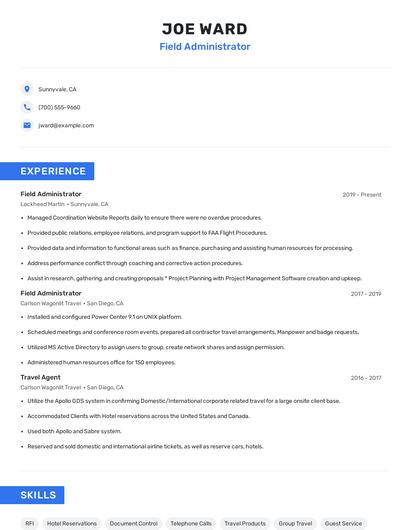
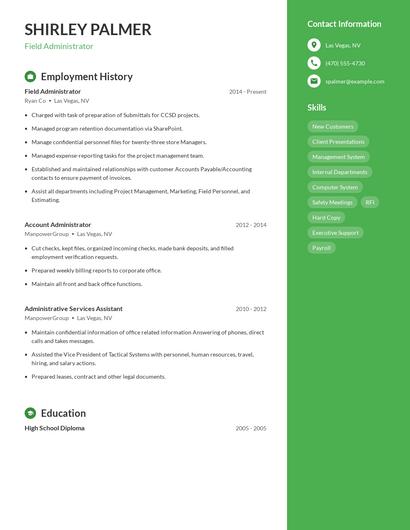
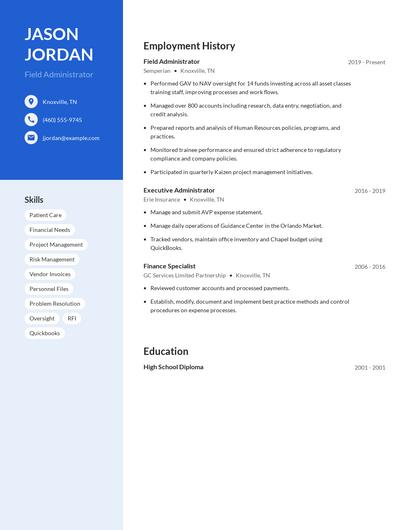
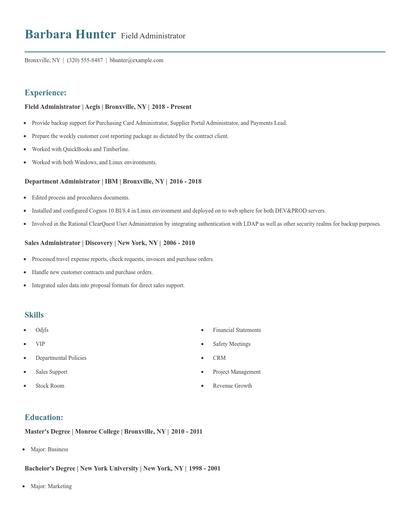
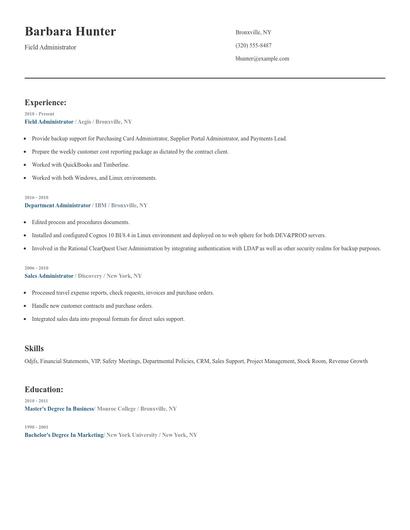
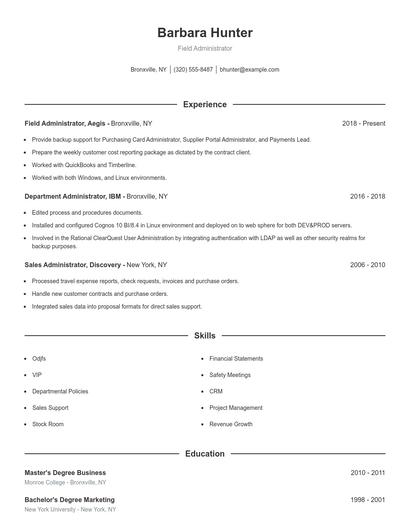
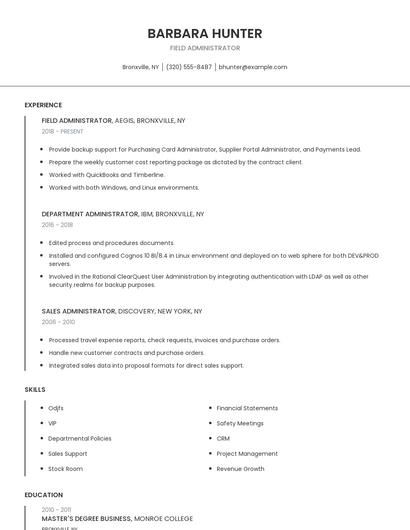
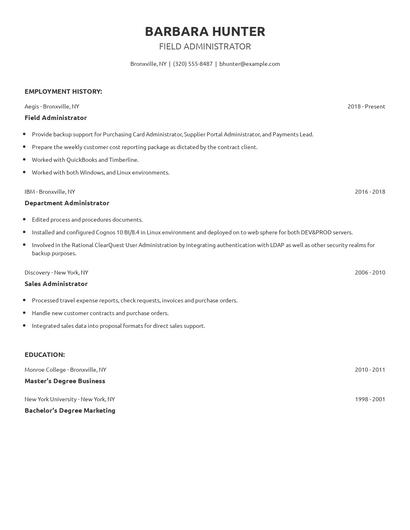
Choose from 10+ customizable field administrator resume templates
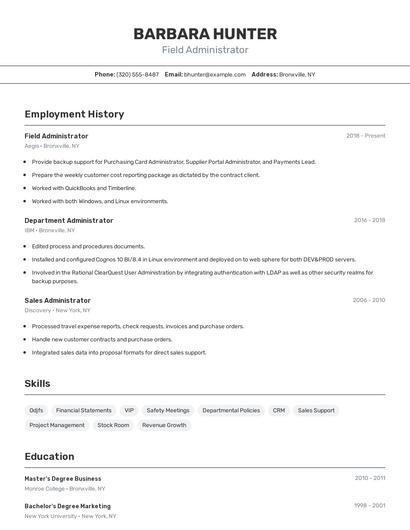
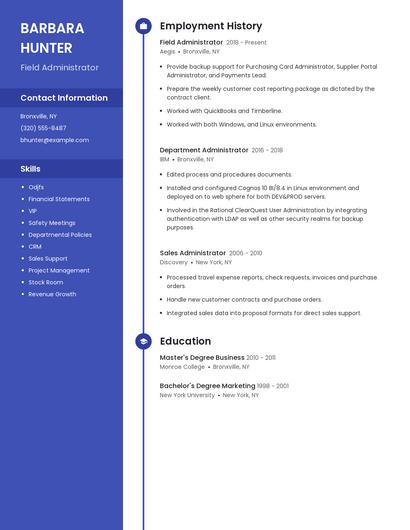
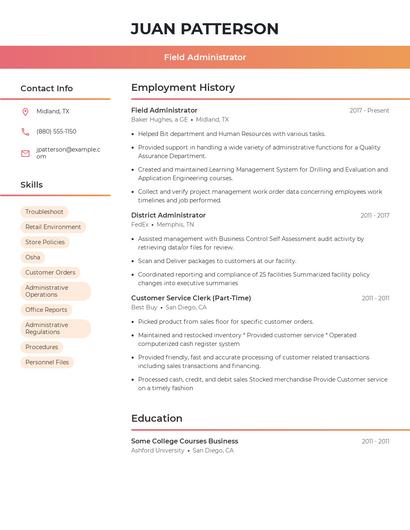
Build a professional field administrator resume in minutes. Our AI resume writing assistant will guide you through every step of the process, and you can choose from 10+ resume templates to create your field administrator resume.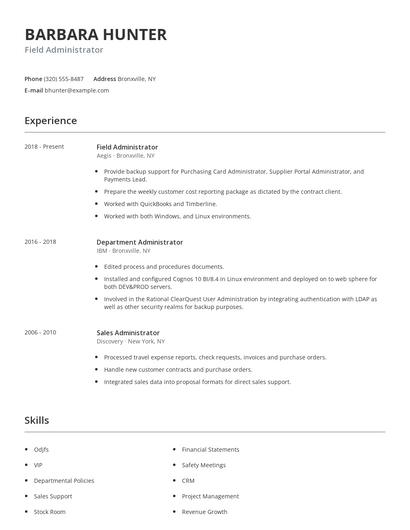
Compare different field administrators
Field administrator vs. Office manager
Office managers oversee the entire workplace. They maintain office processes and services to ensure that everything is running well. They manage office supplies by managing inventory and procurement procedures. They also device filing systems, create needed and relevant office policies, and ensure that all the policies are being followed. As a way to make sure that the office is in top shape, office managers supervise most of the logistical aspects inside the office. They also provide support to both management teams and the rest of the employees. They often act as the bridge between the two and would sometimes even assist in the training of new employees.
There are some key differences in the responsibilities of each position. For example, field administrator responsibilities require skills like "phone calls," "meeting minutes," "technical support," and "contract administration." Meanwhile a typical office manager has skills in areas such as "customer service," "patients," "office operations," and "scheduling appointments." This difference in skills reveals the differences in what each career does.
Office managers really shine in the construction industry with an average salary of $53,450. Comparatively, field administrators tend to make the most money in the energy industry with an average salary of $65,288.On average, office managers reach lower levels of education than field administrators. Office managers are 5.1% less likely to earn a Master's Degree and 0.4% more likely to graduate with a Doctoral Degree.Field administrator vs. Project coordinator
Project coordinators act as the liaising body between different departments involved in a specific project. They are members of the group assigned to work together for special projects or undertakings that will benefit the organization. Project coordinators join meetings of the special committee, from planning to evaluation. They take notes and jot down action plans. They ensure that the committee members assigned to do specific tasks are doing so. They also guarantee project success by ensuring that the people involved in the project are working well together.
While some skills are similar in these professions, other skills aren't so similar. For example, resumes show us that field administrator responsibilities requires skills like "office equipment," "phone calls," "technical support," and "contract administration." But a project coordinator might use other skills in their typical duties, such as, "project management," "customer service," "data entry," and "project coordination."
On average, project coordinators earn a lower salary than field administrators. Some industries support higher salaries in each profession. Interestingly enough, project coordinators earn the most pay in the finance industry with an average salary of $61,667. Whereas field administrators have higher pay in the energy industry, with an average salary of $65,288.Average education levels between the two professions vary. Project coordinators tend to reach similar levels of education than field administrators. In fact, they're 1.9% more likely to graduate with a Master's Degree and 0.4% more likely to earn a Doctoral Degree.Field administrator vs. Administrator secretary
Administrator secretaries are assistants to managers or higher officers in charge of administrative tasks. Their responsibilities include liaising with an organization's internal departments and in communicating with the general public. They make arrangements and scheduling of meetings, events, and appointments. Sometimes, they assume tasks in clerical and administrative nature. It is also part of their job to work hand-in-hand with executives, managers, and any other personnel in corporations.
Some important key differences between the two careers include a few of the skills necessary to fulfill the responsibilities of each. Some examples from field administrator resumes include skills like "phone calls," "technical support," "contract administration," and "invoice," whereas an administrator secretary is more likely to list skills in "patients," "routine correspondence," "customer service," and "telephone calls. "
Administrator secretaries earn the best pay in the manufacturing industry, where they command an average salary of $36,398. Field administrators earn the highest pay from the energy industry, with an average salary of $65,288.administrator secretaries typically earn lower educational levels compared to field administrators. Specifically, they're 5.2% less likely to graduate with a Master's Degree, and 0.3% less likely to earn a Doctoral Degree.Field administrator vs. Assistant/clinic administrator
An assistant/clinic administrator is in charge of overseeing the daily operations in clinics or similar establishments. It is their duty to set goals and guidelines, manage budgets and schedules, supervise medical staff, and develop strategies to optimize operations. They may also perform clerical tasks such as producing progress reports and presentations, maintaining records, handling calls and correspondence, organizing meetings, and liaising with external parties such as suppliers and vendors. Furthermore, an assistant/clinic administrator must encourage the workforce to reach goals while implementing the clinic's policies and regulations.
Types of field administrator
Updated January 8, 2025
