What does an implementations lead do?
The main job of a project implementation lead is to manage client projects from end-to-end. Project implementation leads to oversee team members in an organization. They offer support and leadership to high-quality implementation, assessment, and evaluation within the programs. Their job involves raising issues to operations managers for escalation or resolution. They support extensive team goals through duties identified by the organization or program director. Also, they develop and nurture key clients.
Implementations lead responsibilities
Here are examples of responsibilities from real implementations lead resumes:
- Manage BI7 Bex analyzer, Java and PDF printing issues and stability of the BW solution.
- Train and prepare the client to process payroll and effectively set proper expectations to achieve total client satisfaction.
- Manage and coordinate SaaS virtual configuration of secure VPN setup connectivity.
- Gather configuration requirements, advise clients on configuring server environments and validating system requirements, lead UAT testing sessions.
- Project and client relationship management for cloud base SaaS healthcare workforce management solutions company.
- Create and maintain SDLC artifacts and specifications throughout all project phases.
- Work with the client SME s in developing solution designs that ensure business requirements are met.
- Assist in moving the company toward the SaaS business model by providing offerings to the customer base.
- Participate in full cycle testing efforts, integrate systems testing, unit testing, cycle testing and UAT.
- Facilitate round table discussions about the scope and the real impact of the integration aspects of the ERP project.
- Develop a system to organize contacts in order to maintain data accuracy and integrity while CRM is in use.
- Train co-workers on CRM system, its many functions, and how it will increase sales and improve time management.
- Perform PeopleSoft demonstrations and client presentations.
- Provide ERP support during large-scale factory consolidation.
- Maintain all localize training material in Sharepoint.
Implementations lead skills and personality traits
We calculated that 16% of Implementations Leads are proficient in SME, Saas, and Oracle Ebs. They’re also known for soft skills such as Analytical skills, Communication skills, and Creativity.
We break down the percentage of Implementations Leads that have these skills listed on their resume here:
- SME, 16%
Worked as a test lead and Subject Matter Expert (SME) for delivering a fully tested and bug free portal.
- Saas, 10%
Represent the voice of the user in product meetings and am the internal ombudsman for our SaaS platform customers.
- Oracle Ebs, 9%
Worked throughout the Oracle EBS project cycle.
- PeopleSoft, 9%
Involved as PeopleSoft Payroll functional Analyst for fit/gap analysis for new functionality of PeopleSoft 9.1 and decision matrix for implementation.
- Project Management, 6%
Provided high quality and cost effective project management, analytic support services and technical expertise.
- HCM, 5%
Provided support in maintaining assignment for Role and User-Based Security for employees and/or positions in of the HCM system.
"sme," "saas," and "oracle ebs" are among the most common skills that implementations leads use at work. You can find even more implementations lead responsibilities below, including:
Analytical skills. To carry out their duties, the most important skill for an implementations lead to have is analytical skills. Their role and responsibilities require that "analysts must interpret complex information from various sources and decide the best way to move forward on a project." Implementations leads often use analytical skills in their day-to-day job, as shown by this real resume: "utilized, and coded, xml to automatically import data from various website. "
Communication skills. Another soft skill that's essential for fulfilling implementations lead duties is communication skills. The role rewards competence in this skill because "analysts work as a go-between with management and the it department and must explain complex issues in a way that both will understand." According to an implementations lead resume, here's how implementations leads can utilize communication skills in their job responsibilities: "developed external and internal communications strategy plans to keep appropriate stakeholders informed of strategy and any changes to the project plan. "
Creativity. This is an important skill for implementations leads to perform their duties. For an example of how implementations lead responsibilities depend on this skill, consider that "because analysts are tasked with finding innovative solutions to computer problems, an ability to “think outside the box” is important." This excerpt from a resume also shows how vital it is to everyday roles and responsibilities of an implementations lead: "led business process integration sessions and served as inventory lead for passport 6.0 and portal 97 implementation. ".
The three companies that hire the most implementations leads are:
- Deloitte82 implementations leads jobs
- Accenture56 implementations leads jobs
- Oracle48 implementations leads jobs
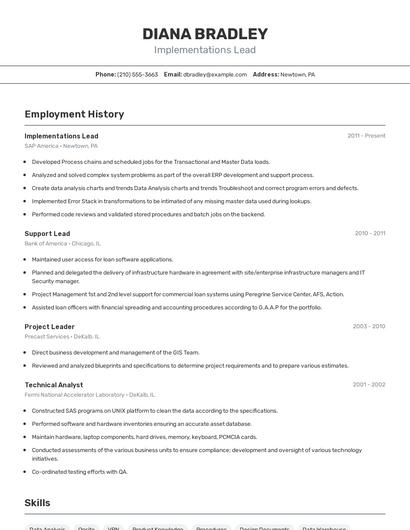
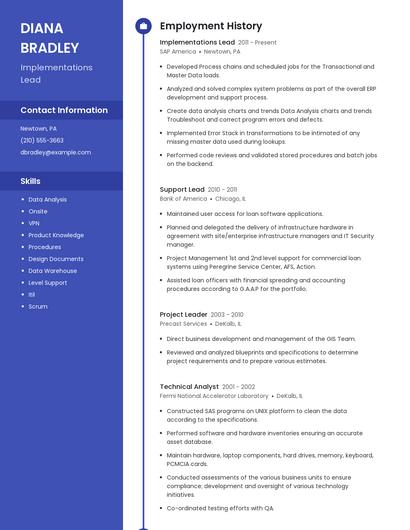
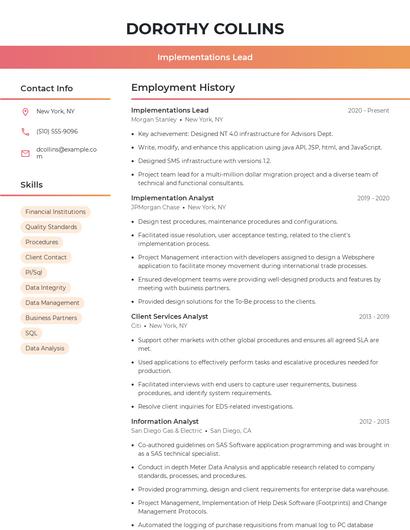
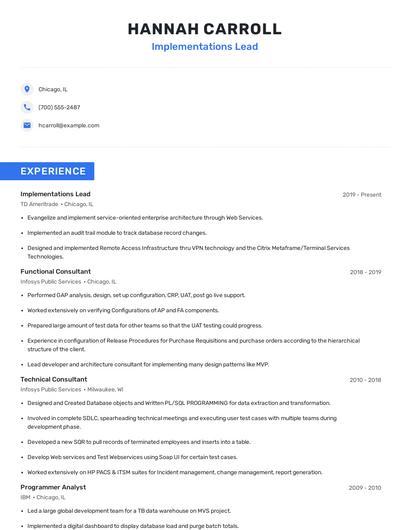
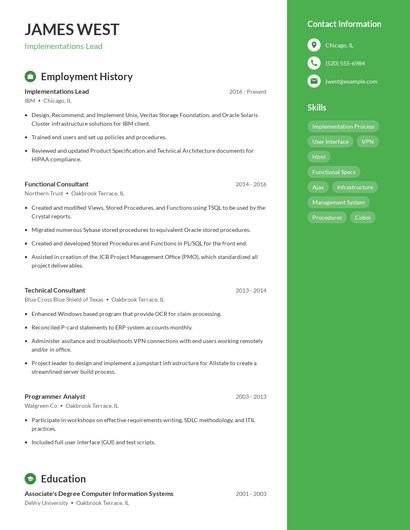
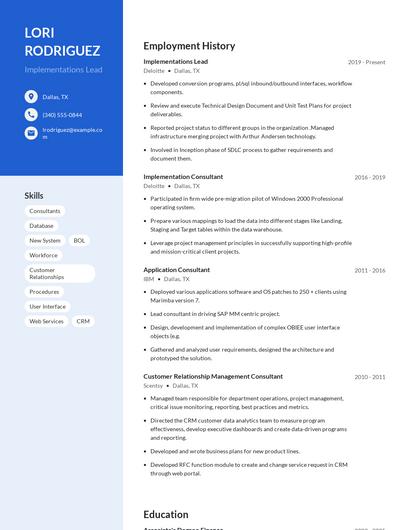
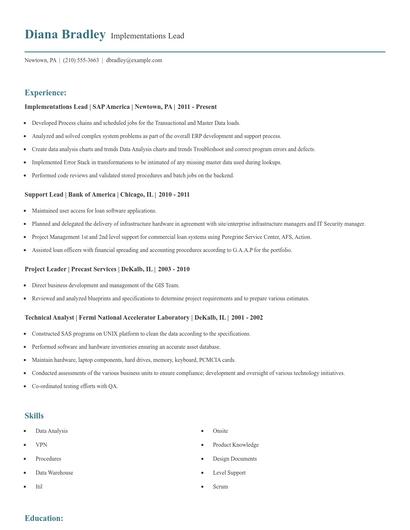
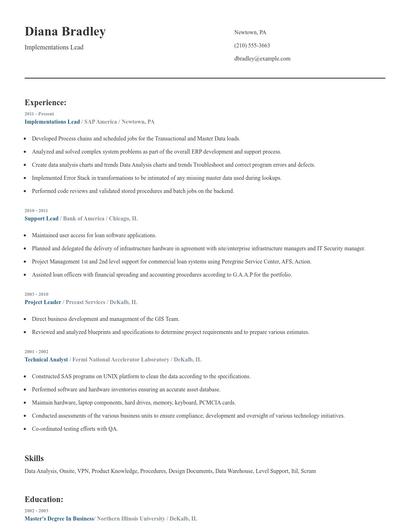
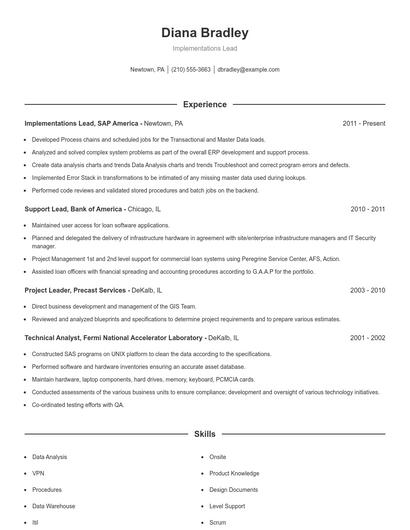
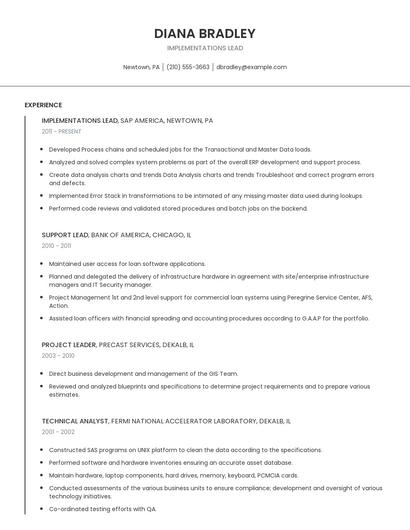
Choose from 10+ customizable implementations lead resume templates
Build a professional implementations lead resume in minutes. Our AI resume writing assistant will guide you through every step of the process, and you can choose from 10+ resume templates to create your implementations lead resume.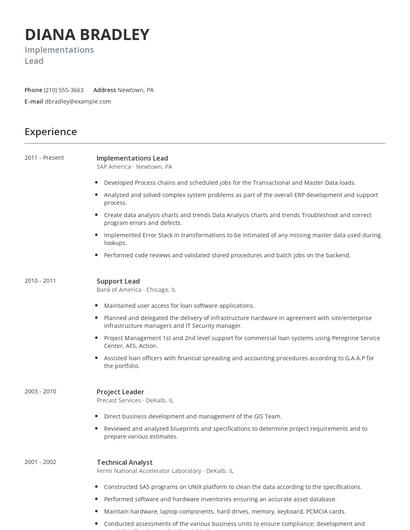

Compare different implementations leads
Implementations lead vs. Technical analyst
A technical analyst is responsible for analyzing technical information and aligning it to the business strategies and procedures in meeting project goals. Technical analysts monitor technical system errors and provide immediate resolutions to ensure an efficient and smooth flow of operations. They comply with the business requirements and clients' specifications to facilitate the technical team with the best techniques to get the job done. A technical analyst should have excellent critical-thinking and communication skills, as well as having a broad knowledge of the technology industry and disciplines.
There are some key differences in the responsibilities of each position. For example, implementations lead responsibilities require skills like "saas," "project management," "hcm," and "client facing." Meanwhile a typical technical analyst has skills in areas such as "digital transformation," "customer service," "strong analytical," and "c #." This difference in skills reveals the differences in what each career does.
Technical analysts tend to make the most money working in the retail industry, where they earn an average salary of $88,568. In contrast, implementations leads make the biggest average salary, $110,176, in the finance industry.The education levels that technical analysts earn slightly differ from implementations leads. In particular, technical analysts are 7.7% less likely to graduate with a Master's Degree than an implementations lead. Additionally, they're 0.1% less likely to earn a Doctoral Degree.Implementations lead vs. Senior programmer analyst
A senior programmer/analyst is responsible for developing and sustaining databases and software applications to achieve business requirements. The professional performs development duties such as coding and testing these applications. The core skills that the job requires include familiarity with applicable data privacy practices and laws, a keen eye for details, and strong analytical and problem-solving skills. Also, the job requires a college diploma or university degree in the field of computer science, information systems, or software engineering.
Each career also uses different skills, according to real implementations lead resumes. While implementations lead responsibilities can utilize skills like "sme," "saas," "oracle ebs," and "project management," senior programmer analysts use skills like "c++," "javascript," "web services," and "data warehouse."
On average, senior programmer analysts earn a lower salary than implementations leads. Some industries support higher salaries in each profession. Interestingly enough, senior programmer analysts earn the most pay in the retail industry with an average salary of $103,581. Whereas implementations leads have higher pay in the finance industry, with an average salary of $110,176.Average education levels between the two professions vary. Senior programmer analysts tend to reach lower levels of education than implementations leads. In fact, they're 5.3% less likely to graduate with a Master's Degree and 0.1% more likely to earn a Doctoral Degree.Implementations lead vs. Lead consultant
The lead consultants oversee the work of a consultant team and are responsible for offering clients their advice and recommendations on the given project. They are multi-focus experts that assist the company in improving its business performance by acting as liaisons between clients and the consultancy team. Their main job is to ensure the daily management of client's projects. They help the client identify and understand their needs together with finding solutions to their difficulties. Additionally, they analyze and review proposals from the team and then provide relevant solutions to the problems.
There are many key differences between these two careers, including some of the skills required to perform responsibilities within each role. For example, an implementations lead is likely to be skilled in "saas," "hcm," "ongoing maintenance," and "project plan," while a typical lead consultant is skilled in "customer service," "digital transformation," "architecture," and "app development."
Lead consultants earn the highest salary when working in the technology industry, where they receive an average salary of $103,411. Comparatively, implementations leads have the highest earning potential in the finance industry, with an average salary of $110,176.Most lead consultants achieve a similar degree level compared to implementations leads. For example, they're 3.8% more likely to graduate with a Master's Degree, and 1.0% more likely to earn a Doctoral Degree.Implementations lead vs. Technical consultant
A technical consultant is an individual who provides technical support and performs troubleshooting functions for the company's product or application. A consultant should be highly knowledgeable about the product or application so that he/she can assist users and clients with whatever issues they may be facing. A bachelor's degree is required to work as a technical consultant, particularly a degree in Computer Science or Engineering. Also, a consultant should conduct training sessions and therefore, must possess excellent communication skills.
Even though a few skill sets overlap between implementations leads and technical consultants, there are some differences that are important to note. For one, an implementations lead might have more use for skills like "sme," "saas," "hcm," and "ongoing maintenance." Meanwhile, some responsibilities of technical consultants require skills like "database," "customer service," "c #," and "infrastructure. "
In general, technical consultants earn the most working in the professional industry, with an average salary of $99,121. The highest-paying industry for an implementations lead is the finance industry.The average resume of technical consultants showed that they earn similar levels of education compared to implementations leads. So much so that theyacirc;euro;trade;re 5.0% less likely to earn a Master's Degree and more likely to earn a Doctoral Degree by 1.0%.Types of implementations lead
Updated January 8, 2025
