What does an implementer do?
Implementer responsibilities
Here are examples of responsibilities from real implementer resumes:
- Manage the information systems architecture in relation to assign projects.
- Manage post-conversion support including team supervision, documentation, and issue resolution within SLA timeframes.
- Implement natural environment and discrete trial programming to individuals with autism.
- Learned XML for communicating client.
- Implement each IEP with each student.
- Involve in writing UNIX scripts for data cleansing/data masking.
- Work with support team to troubleshoot and fix client issues.
- Perform UAT for conversion and mapping files from existing systems.
- Document API reports and UT thickness surveys within the UltraPipe inspection database.
- Facilitate CRM tool training sessions with new users and provide on-site support.
- Involve in developing forms using HTML and performing client side validations using JavaScript.
- Project management: train users, follow up on issues, and troubleshoot.
- Perform requirements definition, planning, installation and configuration of CRM software suite.
- Migrate mission critical mainframe base applications to a cost effective UNIX base platform.
- Implement functionality rich user interfaces using HTML, CSS, JavaScript, AJAX and JSPs.
Implementer skills and personality traits
We calculated that 24% of Implementers are proficient in Autism, Applied Behavior Analysis, and Behavior Analysis. They’re also known for soft skills such as Analytical skills, Communication skills, and Creativity.
We break down the percentage of Implementers that have these skills listed on their resume here:
- Autism, 24%
Worked 1:1 to implement behavioral intervention services to children with Autism Spectrum Disorder while also implementing Individualized Education Plans.
- Applied Behavior Analysis, 21%
Provided one-on-one academic instruction using the principles of applied behavior analysis and positive behavior management for individuals with developmental disabilities.
- Behavior Analysis, 16%
Provide direct behavior analysis services.
- BCBA, 11%
Conducted therapy using best practices learned in training as well as through direct feedback from BCBA during supervision.
- Data Collection, 4%
Implemented and monitored individualized curricula, program protocols, behavior management plans, use of interventions, and data collection and graphing
- Discrete Trial, 4%
Trained new staff on client-specific target behaviors and behavior plans, including discrete trial training.
Most implementers use their skills in "autism," "applied behavior analysis," and "behavior analysis" to do their jobs. You can find more detail on essential implementer responsibilities here:
Analytical skills. One of the key soft skills for an implementer to have is analytical skills. You can see how this relates to what implementers do because "analysts must interpret complex information from various sources and decide the best way to move forward on a project." Additionally, an implementer resume shows how implementers use analytical skills: "track progress of each child using daily data collection and graphs. "
Communication skills. Many implementer duties rely on communication skills. "analysts work as a go-between with management and the it department and must explain complex issues in a way that both will understand.," so an implementer will need this skill often in their role. This resume example is just one of many ways implementer responsibilities rely on communication skills: "maintain regular communication with their assigned bcba, their assigned client's families and/or staff. "
Creativity. Another skill that relates to the job responsibilities of implementers is creativity. This skill is critical to many everyday implementer duties, as "because analysts are tasked with finding innovative solutions to computer problems, an ability to “think outside the box” is important." This example from a resume shows how this skill is used: "reduced inventory inaccuracies by 35% by utilizing six sigma methodologies. "
The three companies that hire the most implementers are:
- Deloitte19 implementers jobs
- Bank of America8 implementers jobs
- Johnson Controls4 implementers jobs
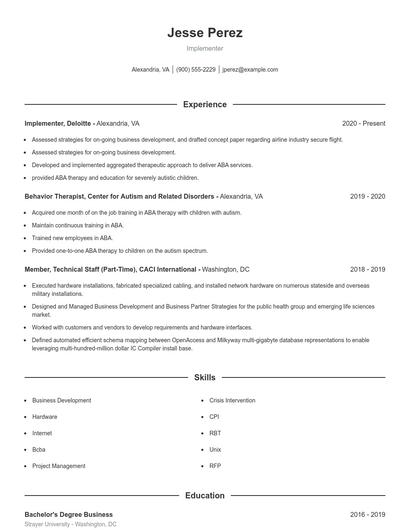
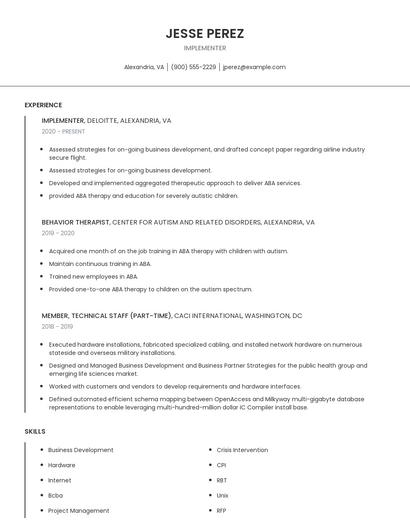
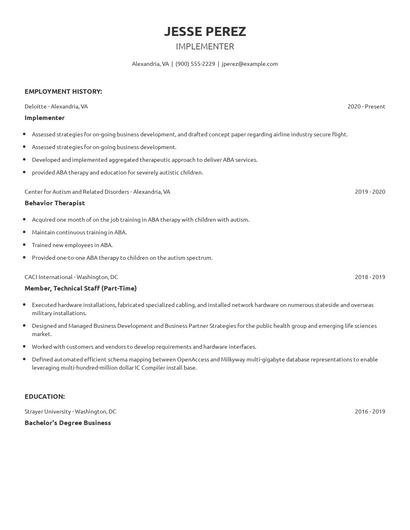
Choose from 10+ customizable implementer resume templates
Build a professional implementer resume in minutes. Our AI resume writing assistant will guide you through every step of the process, and you can choose from 10+ resume templates to create your implementer resume.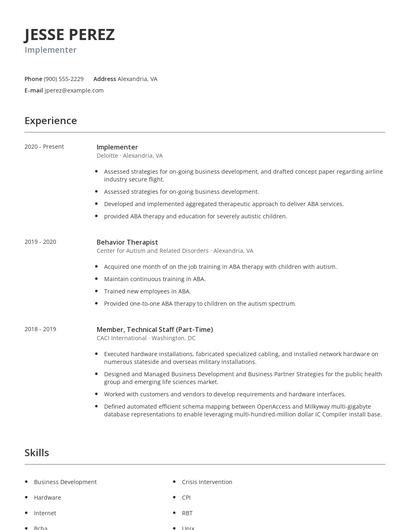
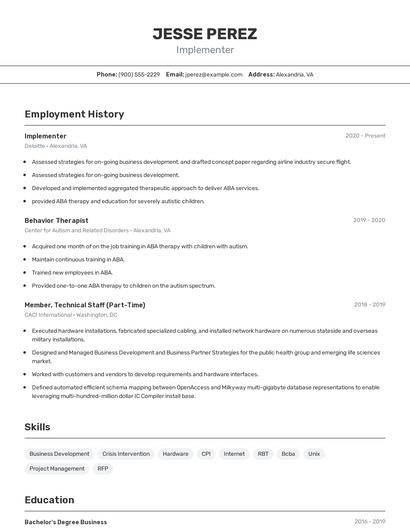


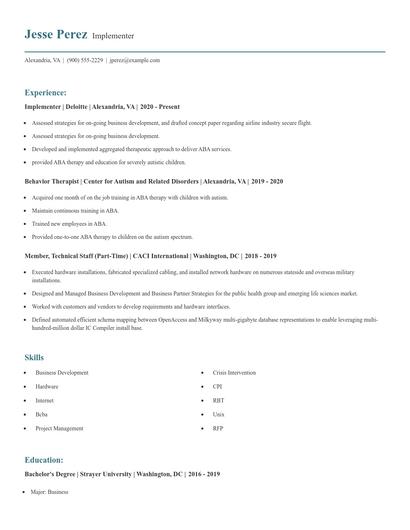
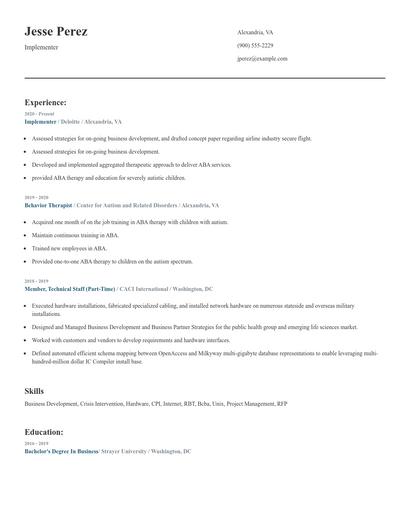
Compare different implementers
Implementer vs. Senior technical consultant
A Senior Technical Consultant helps solve various problems, and increase the efficiency of the company and its revenue. They can work in different areas such as financial, management, and technical.
There are some key differences in the responsibilities of each position. For example, implementer responsibilities require skills like "autism," "applied behavior analysis," "behavior analysis," and "bcba." Meanwhile a typical senior technical consultant has skills in areas such as "java," "client facing," "cloud," and "power bi." This difference in skills reveals the differences in what each career does.
Senior technical consultants really shine in the finance industry with an average salary of $119,321. Comparatively, implementers tend to make the most money in the finance industry with an average salary of $110,393.The education levels that senior technical consultants earn slightly differ from implementers. In particular, senior technical consultants are 5.3% more likely to graduate with a Master's Degree than an implementer. Additionally, they're 0.9% more likely to earn a Doctoral Degree.Implementer vs. Behavioral technician
A behavioral technician is responsible for supporting patients to overcome their behavior problems and difficulties. Behavioral technicians evaluate the patient's condition through counseling and administer behavioral treatment plans according to the patients' needs. They also coordinate with other physicians and mental health professionals for medications and more serious medical support as needed. A behavioral technician assists the patients in their daily activities, observe their social and personal behaviors, write progress reports, and develop engaging activities that would help them bring back a healthy lifestyle and growth.
In addition to the difference in salary, there are some other key differences worth noting. For example, implementer responsibilities are more likely to require skills like "post implementation," "lean manufacturing," "value stream," and "direct care." Meanwhile, a behavioral technician has duties that require skills in areas such as "cpr," "patients," "mental health," and "aba therapy." These differences highlight just how different the day-to-day in each role looks.
Behavioral technicians earn a lower average salary than implementers. But behavioral technicians earn the highest pay in the education industry, with an average salary of $34,731. Additionally, implementers earn the highest salaries in the finance with average pay of $110,393 annually.Average education levels between the two professions vary. Behavioral technicians tend to reach lower levels of education than implementers. In fact, they're 5.1% less likely to graduate with a Master's Degree and 0.9% more likely to earn a Doctoral Degree.Implementer vs. Functional consultant
A functional consultant is responsible for supporting a team of business analysts and software engineers in designing and creating a software system and related computer applications, following the specifications of a client on their software needs. Functional consultants analyze different technological approaches, evaluate technical solutions, and utilize the best system method to meet the requirements of a client efficiently. A functional consultant performs multiple diagnostic tests to ensure the optimal performance of the system. They should also have excellent communication skills, especially in coordinating with the clients on updates and adjustments as needed.
Some important key differences between the two careers include a few of the skills necessary to fulfill the responsibilities of each. Some examples from implementer resumes include skills like "autism," "applied behavior analysis," "behavior analysis," and "bcba," whereas a functional consultant is more likely to list skills in "prototyping," "crm," "test cases," and "payroll. "
Functional consultants earn the best pay in the manufacturing industry, where they command an average salary of $90,851. Implementers earn the highest pay from the finance industry, with an average salary of $110,393.When it comes to education, functional consultants tend to earn higher degree levels compared to implementers. In fact, they're 16.5% more likely to earn a Master's Degree, and 0.2% more likely to graduate with a Doctoral Degree.Implementer vs. Technical consultant
A technical consultant is an individual who provides technical support and performs troubleshooting functions for the company's product or application. A consultant should be highly knowledgeable about the product or application so that he/she can assist users and clients with whatever issues they may be facing. A bachelor's degree is required to work as a technical consultant, particularly a degree in Computer Science or Engineering. Also, a consultant should conduct training sessions and therefore, must possess excellent communication skills.
Even though a few skill sets overlap between implementers and technical consultants, there are some differences that are important to note. For one, an implementer might have more use for skills like "autism," "applied behavior analysis," "behavior analysis," and "bcba." Meanwhile, some responsibilities of technical consultants require skills like "java," "database," "customer service," and "project management. "
Technical consultants enjoy the best pay in the professional industry, with an average salary of $99,121. For comparison, implementers earn the highest salary in the finance industry.The average resume of technical consultants showed that they earn similar levels of education compared to implementers. So much so that theyacirc;euro;trade;re 1.8% more likely to earn a Master's Degree and more likely to earn a Doctoral Degree by 1.5%.Types of implementer
Updated January 8, 2025
