What does an information systems supervisor do?
Information systems supervisor responsibilities
Here are examples of responsibilities from real information systems supervisor resumes:
- Manage networking and telecommunication for this manufacturer of custom flat panel flexible displays and control panels with integrate membrane switches.
- Administer UNIX e-mail and database server.
- Train and assist the agencies with training of the VoIP phones.
- Craft plant-wide, monthly safety and good manufacturing practices (GMP) training program.
- Train employees in SSOP's and GMP's ensure training effectiveness in application of job skill.
- Engineer and implement antenna type, RF power requirements, and antenna location on newly erect antenna towers.
- Implement a major upgrade to company's NEC PBX system in preparation for eventual implementation of a VoIP solution.
- Practice and ensure compliance with OSHA safety policies and standards; proficient use of lock out/ tag out procedures.
- Host for all FDA, DEA, and state board inspections and primary regulatory contact for all compliance matters.
- Design and implement a continuous weighing system for a sugar refining company with data gathering features using Ethernet communications and SCADA.
- Develop and administer SharePoint site.
- Design and implement VMware infrastructure.
- Research, initiate, and implement a dedicate cloud server solution for database replication for backup accountability and increase I/O processing.
- Provide technical assistants for the physical plant activities and programs that include maintenance and construction, energy control systems and HVAC.
- Re-Engineer the distribution management process using RF terminals, OS/2 and AS/400 client/server technology.
Information systems supervisor skills and personality traits
We calculated that 8% of Information Systems Supervisors are proficient in PCS, SQL, and Customer Service. They’re also known for soft skills such as Business skills, Leadership skills, and Organizational skills.
We break down the percentage of Information Systems Supervisors that have these skills listed on their resume here:
- PCS, 8%
Provided support for employees and management with technical issues with PCs, laptops, registers, networks, printers, phones.
- SQL, 8%
Supervised in the planning, design, and development of several statistical databases using Access 97/2000/XP and SQL programming language.
- Customer Service, 7%
Provide exceptional customer service by effectively and efficiently managing the technical help desk utilizing TrackIT, an incident reporting system.
- Data Integrity, 7%
Communicated opportunities and enhancements to improve data integrity, database structures, data processing, and data retrieval tools.
- HIPAA, 4%
Created new HIPAA Security policy and supporting procedural documentation to comply with updated federal regulations covering health care organizations.
- Direct Reports, 4%
Supervised direct reports and oversight of the department as a whole.
Common skills that an information systems supervisor uses to do their job include "pcs," "sql," and "customer service." You can find details on the most important information systems supervisor responsibilities below.
Business skills. To carry out their duties, the most important skill for an information systems supervisor to have is business skills. Their role and responsibilities require that "it managers must develop and implement strategic plans to reach the goals of their organizations." Information systems supervisors often use business skills in their day-to-day job, as shown by this real resume: "executed superior end-user support and performed a comprehensive range of system maintenance activities to optimize business operations. "
Leadership skills. Another soft skill that's essential for fulfilling information systems supervisor duties is leadership skills. The role rewards competence in this skill because "it managers must lead and motivate it teams or departments so that workers are efficient and effective." According to an information systems supervisor resume, here's how information systems supervisors can utilize leadership skills in their job responsibilities: "provided technical and functional hris leadership across human resources disciplines. "
Organizational skills. This is an important skill for information systems supervisors to perform their duties. For an example of how information systems supervisor responsibilities depend on this skill, consider that "some it managers must coordinate the work of several different it departments to make the organization run efficiently." This excerpt from a resume also shows how vital it is to everyday roles and responsibilities of an information systems supervisor: "reviewed and recommended business processes to promote effective organizational change, efficiency and internal control integrity. ".
Analytical skills. For certain information systems supervisor responsibilities to be completed, the job requires competence in "analytical skills." The day-to-day duties of an information systems supervisor rely on this skill, as "it managers must analyze problems and consider and select the best ways to solve them." For example, this snippet was taken directly from a resume about how this skill applies to what information systems supervisors do: "supervised hris data team responsible for all nmsu employee erp banner system processes. "
Communication skills. Another crucial skill for an information systems supervisor to carry out their responsibilities is "communication skills." A big part of what information systems supervisors relies on this skill, since "it managers must explain their work to top executives and give clear instructions to their subordinates." How this skill relates to information systems supervisor duties can be seen in an example from an information systems supervisor resume snippet: "provided users with focal point of communication for problem resolution, customer support and a source of general computer information. "
The three companies that hire the most information systems supervisors are:
- Gwinnett County5 information systems supervisors jobs
- General Dynamics4 information systems supervisors jobs
- Nes Holdings3 information systems supervisors jobs
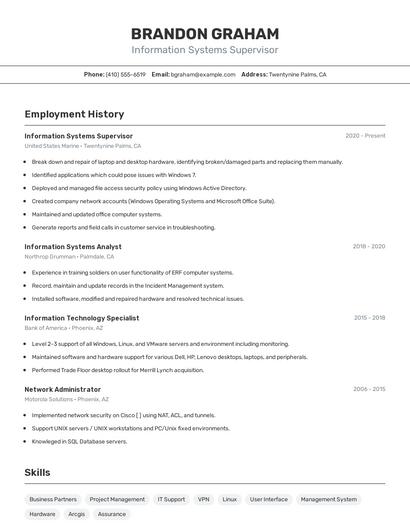
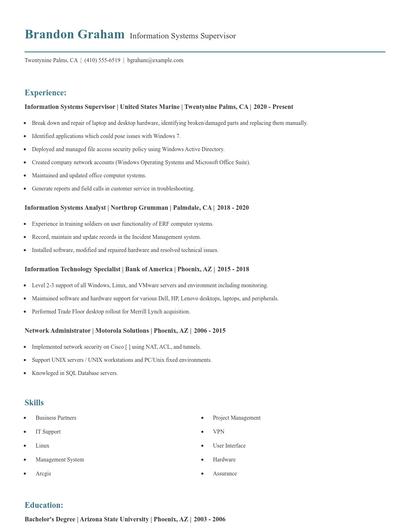
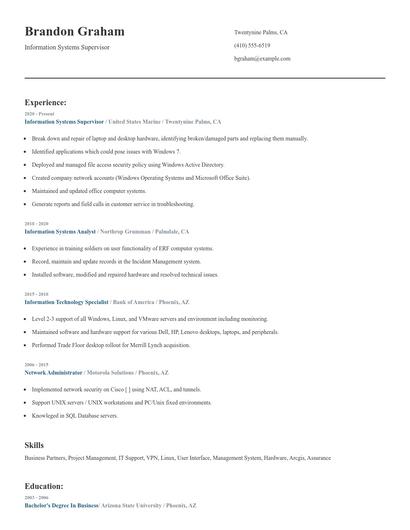
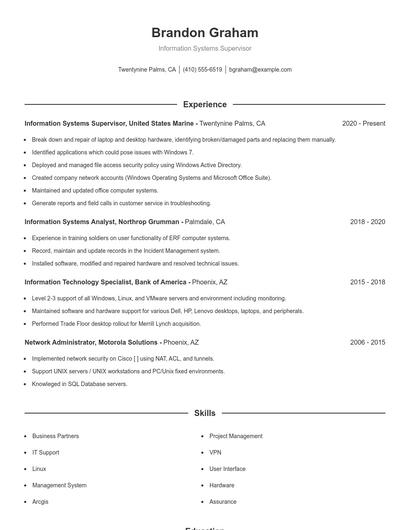
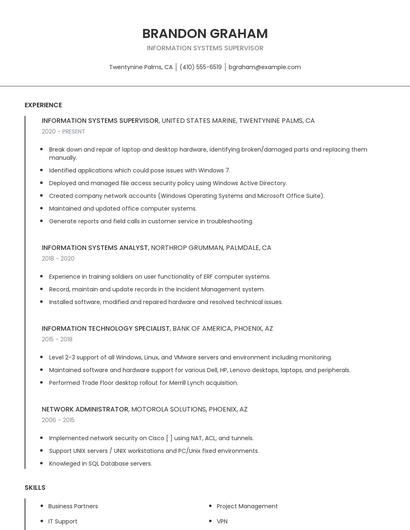
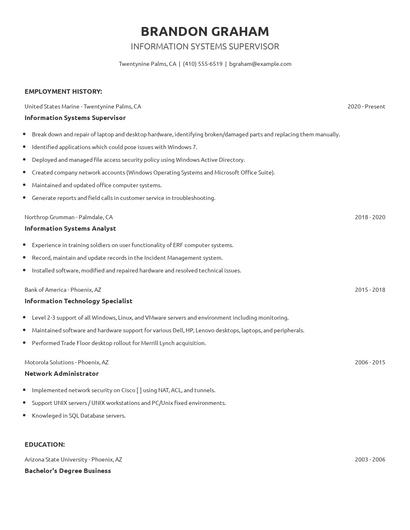
Choose from 10+ customizable information systems supervisor resume templates
Build a professional information systems supervisor resume in minutes. Our AI resume writing assistant will guide you through every step of the process, and you can choose from 10+ resume templates to create your information systems supervisor resume.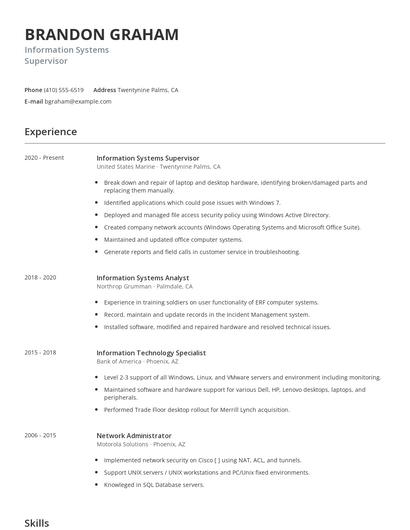


Compare different information systems supervisors
Information systems supervisor vs. Senior information technology specialist
A senior information technology specialist is responsible for handling technology systems and network issues, ensuring the efficiency and optimal performance of the database by configuration and improving network infrastructures. Senior information technology specialists also design computer systems and applications to support business functions and operations, depending on the requirements and budget limitations. They create resolution reports for reference and recommend strategic techniques to prevent the reoccurrence of defects and malfunctions. A senior information technology specialist must have excellent communication and technical skills, especially in responding to the end-users' inquiries and concerns about the servers.
While similarities exist, there are also some differences between information systems supervisors and senior information technology specialist. For instance, information systems supervisor responsibilities require skills such as "pcs," "sql," "data integrity," and "hipaa." Whereas a senior information technology specialist is skilled in "database," "technical support," "project management," and "lifecycle management." This is part of what separates the two careers.
On average, senior information technology specialists reach similar levels of education than information systems supervisors. Senior information technology specialists are 2.3% more likely to earn a Master's Degree and 0.1% more likely to graduate with a Doctoral Degree.Information systems supervisor vs. Systems manager
A systems manager is responsible for monitoring the operations of the information technology department, evaluating staff performance, developing strategic procedures to maximize productivity, and identifying business opportunities that would generate more revenues and profitability for the company. Systems managers inspect company networks to ensure the efficiency of the technology systems, conducting regular diagnostic tests, and installing upgrades to boost optimization. A systems manager must have excellent knowledge of the technology industry, as well as a strong command in programming languages and system codes to maintain the security of the company's database.
Each career also uses different skills, according to real information systems supervisor resumes. While information systems supervisor responsibilities can utilize skills like "pcs," "sql," "hipaa," and "lis," systems managers use skills like "project management," "patients," "data entry," and "client facing."
Systems managers earn similar levels of education than information systems supervisors in general. They're 2.2% more likely to graduate with a Master's Degree and 0.1% less likely to earn a Doctoral Degree.Information systems supervisor vs. Senior information technology manager
A senior information technology manager is responsible for monitoring the efficiency and performance of the company's technology and network systems. Senior information technology managers oversee technology infrastructures and operations, ensuring the processes adhere to the company policies and regulations. They analyze the schematics and specifications of computer systems, maintaining the safety and security across all networks to prevent unauthorized access. A senior information technology manager must have extensive knowledge of the technology industry, as well as a strong command of programming languages.
There are many key differences between these two careers, including some of the skills required to perform responsibilities within each role. For example, an information systems supervisor is likely to be skilled in "pcs," "sql," "data integrity," and "lis," while a typical senior information technology manager is skilled in "project management," "cloud," "architecture," and "strong problem-solving."
Senior information technology managers typically earn higher educational levels compared to information systems supervisors. Specifically, they're 8.7% more likely to graduate with a Master's Degree, and 0.5% more likely to earn a Doctoral Degree.Information systems supervisor vs. Information technology technical lead
An information technology technical lead is responsible for assisting the technology team in solving system issues, designing new application systems, improving existing network infrastructure, and maintaining the safety and security of the organization's database. Information technology technical leads inspect the technology system's performance, recommending strategic solutions for optimization and smooth navigations for end-users. They also perform configurations and modifications, adhering to business requirements to support production operations. An information technology technical lead must have excellent knowledge of the technology industry, as well as a strong command of programming languages and system codes to handle technical complexities for maximum efficiency.
Even though a few skill sets overlap between information systems supervisors and information technology technical leads, there are some differences that are important to note. For one, an information systems supervisor might have more use for skills like "pcs," "sql," "data integrity," and "direct reports." Meanwhile, some responsibilities of information technology technical leads require skills like "project management," "architecture," "governance," and "java. "
The average resume of information technology technical leads showed that they earn similar levels of education compared to information systems supervisors. So much so that theyacirc;euro;trade;re 3.4% more likely to earn a Master's Degree and less likely to earn a Doctoral Degree by 0.1%.Types of information systems supervisor
Updated January 8, 2025
