What does an integration developer do?
An integration developer is responsible for maintaining the accuracy and efficiency of data management processes on shared databases, ensuring its safety and security to avoid unauthorized access and unusual activities. Integration developers handle a broad scope of data integration procedures, identifying data analysis solutions for data system optimization by searching for effective instruments data gathering techniques to support business functions and production operations. They also perform statistical evaluation of best-operating systems for smooth navigation and transition of data according to business needs and clients' specifications.
Integration developer responsibilities
Here are examples of responsibilities from real integration developer resumes:
- Lead operations, deploy applications, addressed production application issues, which improve operational processes on Linux machines.
- Work in the configuration of ADB adapter to publish the data from UDB (DB2) database to JMS queues.
- Deploy data models and business processes with numerous ERP systems.
- Create queues, topics and bridges as per the team requirement in DEV environment.
- Configure the JDBC connection to connect to oracle database & used HTTP connection for request & response from the browser.
- Deploy the solution on DEV boxes.
- Deploy the application in DEV and STG environments.
- Create Jenkins user guide documentation and provide to users.
- Utilize connectors such as HTTP, payload and object to string.
- Create binding files using MQ that connects TIBCO to the mainframe.
- Configure MQ v.7 for message capture and publish and subscribe functionality.
- Develop various XSD schema objects as a part BW process development.
- Document the design of REST/HTTP API's along with JSON data formats.
- Create various common objects and common data elements in XSD schema language.
- Create function module to upload products and spare parts to CRM product master.
Integration developer skills and personality traits
We calculated that 13% of Integration Developers are proficient in Java, XML, and JSON. They’re also known for soft skills such as Detail oriented, Problem-solving skills, and Analytical skills.
We break down the percentage of Integration Developers that have these skills listed on their resume here:
- Java, 13%
Designed and developed features for Java/J2ee and Mule based integration applications for interface team.
- XML, 6%
Consume XML content at a regular interval from third party vendor in their own format, store in local MySQL database.
- JSON, 6%
Involved in developing object oriented JavaScript and experienced with HTML, AJAX, JSON, Angular JS and Bootstrap JS.
- JavaScript, 5%
Designed the user interface of the application with HTML, JavaScript, CSS.
- SQL Server, 5%
Used PowerExchange to read the changed data from the SQL server table and loaded the data in staging zone for POC.
- ETL, 4%
Created a standard ETL processes to extract data from flat files, relational data sources with error handling and notification.
Most integration developers use their skills in "java," "xml," and "json" to do their jobs. You can find more detail on essential integration developer responsibilities here:
Detail oriented. The most essential soft skill for an integration developer to carry out their responsibilities is detail oriented. This skill is important for the role because "developers often work on many parts of an application or system at the same time and must therefore be able to concentrate and pay attention to detail." Additionally, an integration developer resume shows how their duties depend on detail oriented: "used datapower as esb for integrating different software applications in service oriented architecture. "
Problem-solving skills. Another essential skill to perform integration developer duties is problem-solving skills. Integration developers responsibilities require that "because developers are in charge of software from beginning to end, they must be able to solve problems that arise throughout the design process." Integration developers also use problem-solving skills in their role according to a real resume snippet: "used mule filters & worked with java and groovy components to provide resilient solutions. "
Analytical skills. integration developers are also known for analytical skills, which are critical to their duties. You can see how this skill relates to integration developer responsibilities, because "developers must analyze users’ needs and then design software to meet those needs." An integration developer resume example shows how analytical skills is used in the workplace: "key parts include designing framework meta-data tables, java reflection based framework, built in restart-ability and database transaction management. "
Communication skills. integration developer responsibilities often require "communication skills." The duties that rely on this skill are shown by the fact that "developers must be able to give clear instructions to others working on a project." This resume example shows what integration developers do with communication skills on a typical day: "installed updates to communications software to enable encrypted communications using sftp and https. "
Creativity. Another crucial skill for an integration developer to carry out their responsibilities is "creativity." A big part of what integration developers relies on this skill, since "developers are the creative minds behind new computer software." How this skill relates to integration developer duties can be seen in an example from an integration developer resume snippet: "converted media from adobe indesign utilizing adobe creative suite to produce html and web compatible jpeg and gif images. "
The three companies that hire the most integration developers are:
- Deloitte253 integration developers jobs
- Concentrix52 integration developers jobs
- KPMG LLP47 integration developers jobs
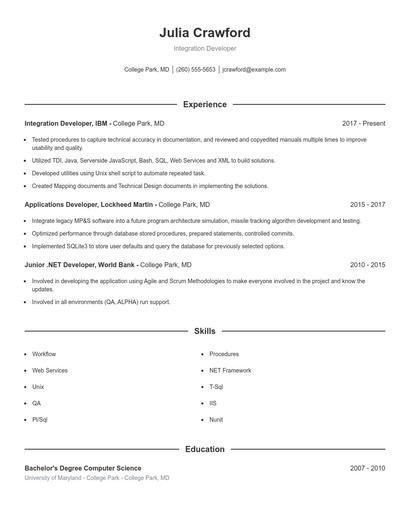
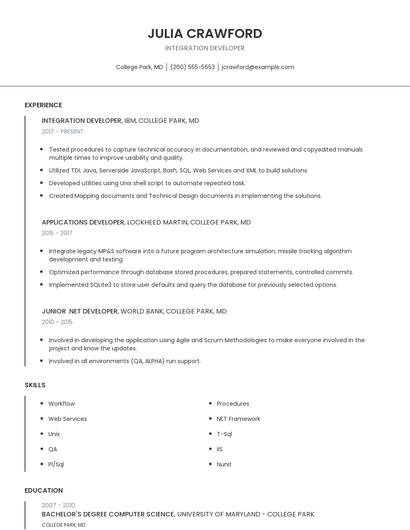
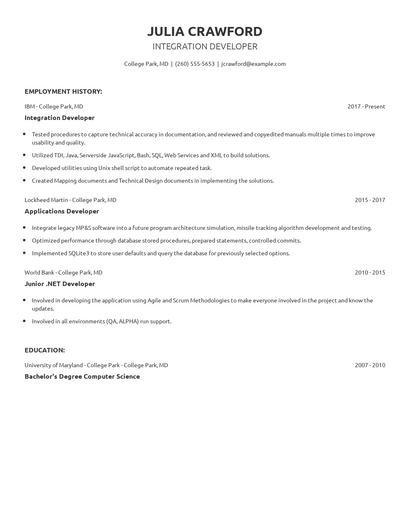
Choose from 10+ customizable integration developer resume templates
Build a professional integration developer resume in minutes. Our AI resume writing assistant will guide you through every step of the process, and you can choose from 10+ resume templates to create your integration developer resume.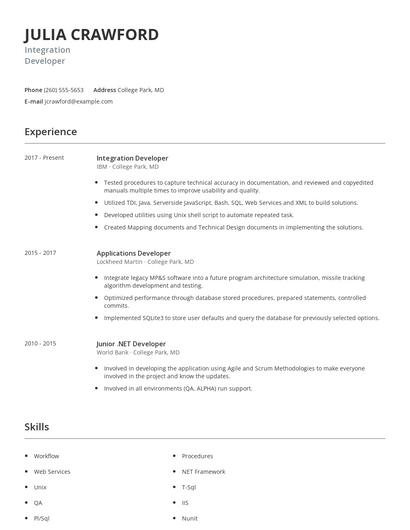
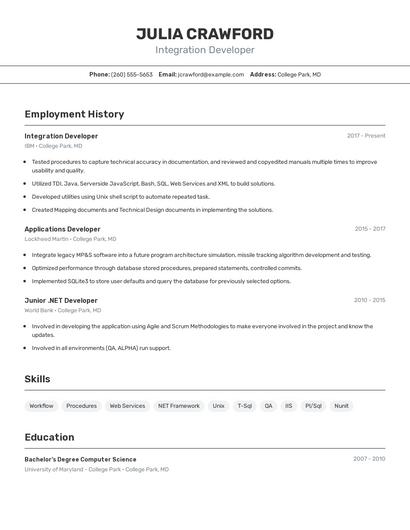


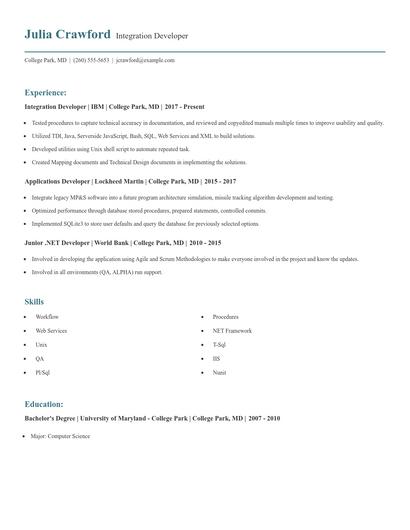
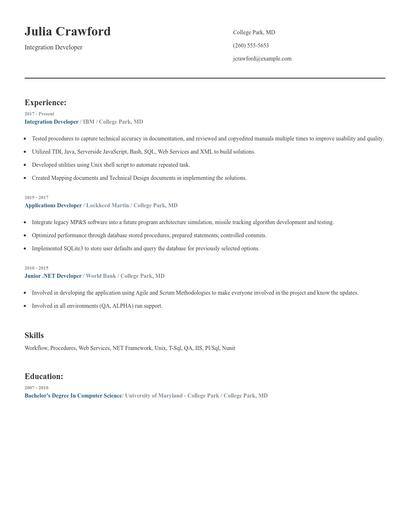
Compare different integration developers
Integration developer vs. Developer/consultant
A developer/consultant is responsible for developing system databases and applications, depending on the business' needs and clients' specifications. Developers/consultants design their services to manage optimal performance and maximize productivity for timely submission of projects, ensuring client satisfaction and loyalty. They also handle clients' inquiries and concerns, informing them about necessary adjustments to improve strategic procedures and processes. A developer/consultant must have excellent communication and analytical skills, as well as extensive experience with the technology industry.
While similarities exist, there are also some differences between integration developers and developer/consultant. For instance, integration developer responsibilities require skills such as "c #," "api management," "azure," and "salesforce." Whereas a developer/consultant is skilled in "project management," "hr," "microservices," and "jquery." This is part of what separates the two careers.
Developer/consultants earn the highest salaries when working in the technology industry, with an average yearly salary of $101,340. On the other hand, integration developers are paid more in the retail industry with an average salary of $122,088.developer/consultants tend to reach similar levels of education than integration developers. In fact, developer/consultants are 2.7% more likely to graduate with a Master's Degree and 1.8% more likely to have a Doctoral Degree.Integration developer vs. Team lead and developer
A team lead and developer is a person who handles a group of employees in a particular section, geared to accomplish daily specific goals. The team lead and developer ensures that the team works cohesively and efficiently to achieve its goals. It is the role of the team lead to ensure employees are well-equipped, trained properly, and capable. The team lead conducts regular assessments of teammates and offers support. Added to the role of the team lead is to request training, enhancement seminars, and submit accomplishment and activity reports to company management.
In addition to the difference in salary, there are some other key differences worth noting. For example, integration developer responsibilities are more likely to require skills like "c #," "api management," "azure," and "salesforce." Meanwhile, a team lead and developer has duties that require skills in areas such as "architecture," "c++," "object oriented programming," and "web application." These differences highlight just how different the day-to-day in each role looks.
On average, team lead and developers earn a lower salary than integration developers. Some industries support higher salaries in each profession. Interestingly enough, team lead and developers earn the most pay in the telecommunication industry with an average salary of $110,027. Whereas integration developers have higher pay in the retail industry, with an average salary of $122,088.In general, team lead and developers achieve similar levels of education than integration developers. They're 0.1% more likely to obtain a Master's Degree while being 1.8% more likely to earn a Doctoral Degree.Integration developer vs. Project developer
Project developers research aspects of each project to check that it follows all regulations and to complete the project on time and under the budget. They are responsible for overseeing various projects for their companies. They staff the project and make necessary purchases. Staffing could include hiring contractors and hiring new employees for the company. Their tasks are to report and resolve issues blocking work on project elements, develop project timeline and milestones with mitigation planning, and establish critical requirements of a project through stakeholder assessment.
The required skills of the two careers differ considerably. For example, integration developers are more likely to have skills like "c #," "api management," "azure," and "salesforce." But a project developer is more likely to have skills like "project development," "renewable energy," "project management," and "hvac."
Project developers earn the highest salary when working in the hospitality industry, where they receive an average salary of $92,232. Comparatively, integration developers have the highest earning potential in the retail industry, with an average salary of $122,088.When it comes to education, project developers tend to earn similar degree levels compared to integration developers. In fact, they're 0.8% less likely to earn a Master's Degree, and 0.6% less likely to graduate with a Doctoral Degree.Integration developer vs. Sql developer
An SQL developer is responsible for designing database systems for storing and accessing business information. SQL developers incorporate a high-level of data management and technical knowledge to ensure the safety and security of the systems, preventing unauthorized access that may put the company's reputation in jeopardy. They evaluate the network infrastructure, run multiple diagnostic tests, and update the information security systems for optimal performance and efficient navigation. An SQL developer must have excellent skills in programming languages, data engineering, and software management to handle the complexities of system commands and data validation.
Types of integration developer
Updated January 8, 2025
