What does a job development specialist do?
Job development specialist responsibilities
Here are examples of responsibilities from real job development specialist resumes:
- Manage payroll, benefits and insurance administration.
- Evaluate participant skill sets and job preparedness to assist veterans in transition from military to civilian employment.
- Work with TANF, DHS, and SPD case managers.
- Work with DHS clients to support work search efforts or to place in work experience situations.
- Present information about vocational rehabilitation to community.
Job development specialist skills and personality traits
We calculated that 31% of Job Development Specialists are proficient in Unemployment Claims, Employment Services, and Training Programs. They’re also known for soft skills such as Creativity, Instructional skills, and Communication skills.
We break down the percentage of Job Development Specialists that have these skills listed on their resume here:
- Unemployment Claims, 31%
Provided high-level customer service to individuals filing unemployment claims and registering for work in Indiana Career Connect.com
- Employment Services, 12%
Assisted in Coordinating and implementing rehabilitation services, case documentation, employment services, and administration.
- Training Programs, 9%
Referred program participants to established courses for technical and professional training programs provided by community schools and other agencies.
- Technical Assistance, 8%
Developed network and technical assistance to businesses on ADA accommodations.
- Employment Trends, 7%
Researched latest employment trends and information.
- Community Resources, 3%
Planned, organized and conducted activities related to community resources and partnership development.
Common skills that a job development specialist uses to do their job include "unemployment claims," "employment services," and "training programs." You can find details on the most important job development specialist responsibilities below.
Creativity. One of the key soft skills for a job development specialist to have is creativity. You can see how this relates to what job development specialists do because "specialists should be resourceful when developing training materials." Additionally, a job development specialist resume shows how job development specialists use creativity: "conduct individualized vocational assessments using the career thoughts inventory, the rehabilitation readiness assessment, and my next move career inventory. "
Instructional skills. Many job development specialist duties rely on instructional skills. "training and development specialists deliver employee training programs," so a job development specialist will need this skill often in their role. This resume example is just one of many ways job development specialist responsibilities rely on instructional skills: "deliver instruction on career development and assisted all students with academic inquiries and instructional assistance when needed. "
Communication skills. Another skill that relates to the job responsibilities of job development specialists is communication skills. This skill is critical to many everyday job development specialist duties, as "training and development specialists must convey information clearly and facilitate learning to diverse audiences." This example from a resume shows how this skill is used: "maintain open communication and be available for support to the hr or managers as needed. "
Analytical skills. Another crucial skill for a job development specialist to carry out their responsibilities is "analytical skills." A big part of what job development specialists relies on this skill, since "training and development specialists must evaluate training programs, methods, and materials and choose those that best fit each situation." How this skill relates to job development specialist duties can be seen in an example from a job development specialist resume snippet: "reviewed, confirmed, and tracked employee data changes through the automatic data processing (adp) enterprise hr system. "
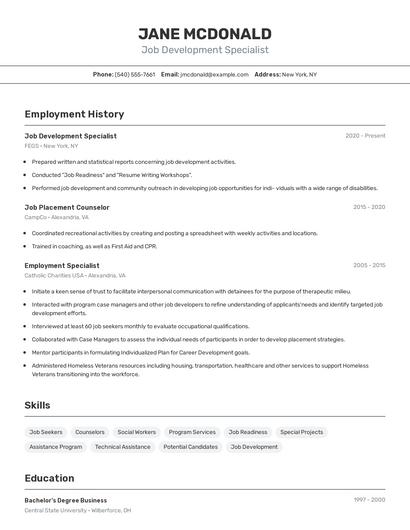
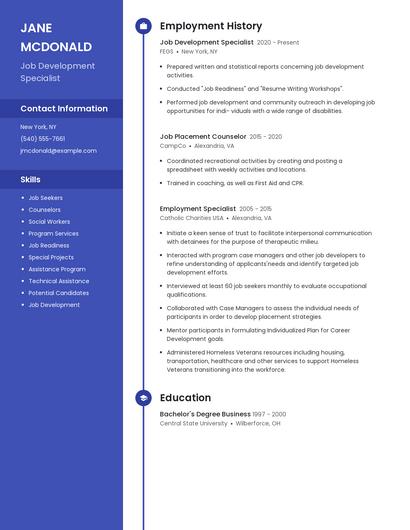
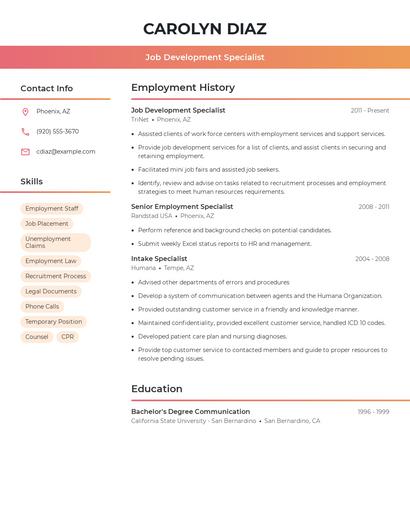
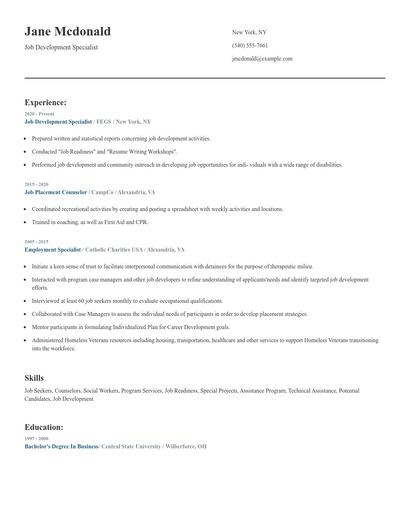
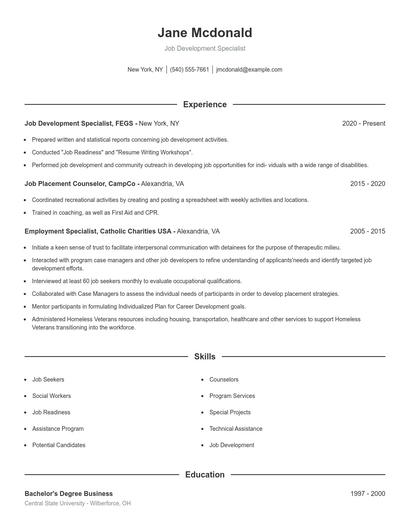
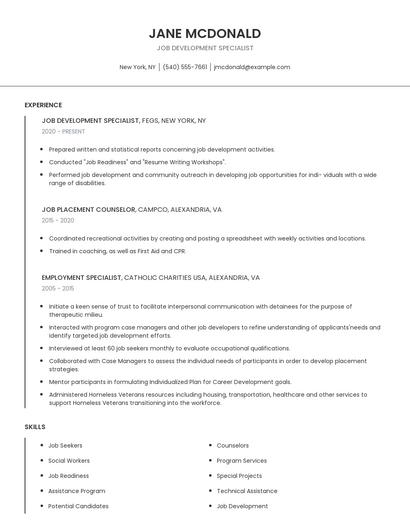
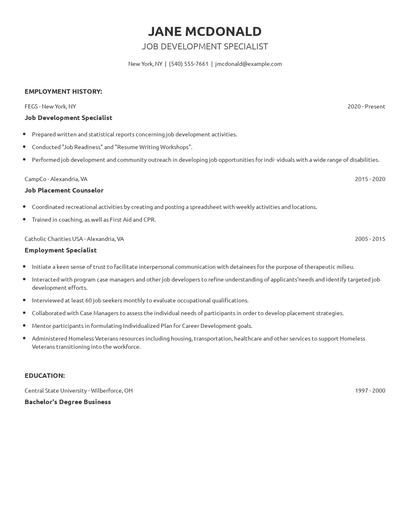
Choose from 10+ customizable job development specialist resume templates
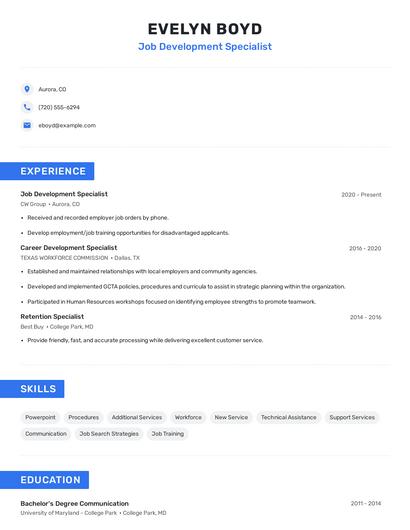
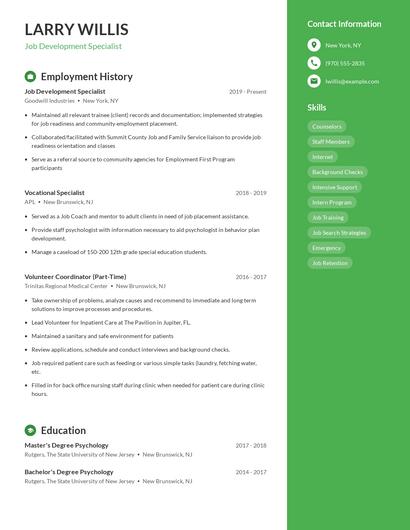
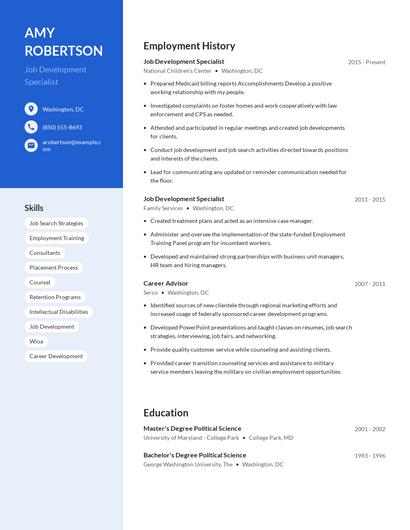
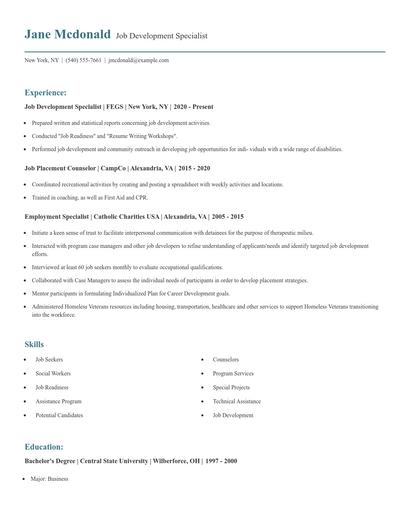
Build a professional job development specialist resume in minutes. Our AI resume writing assistant will guide you through every step of the process, and you can choose from 10+ resume templates to create your job development specialist resume.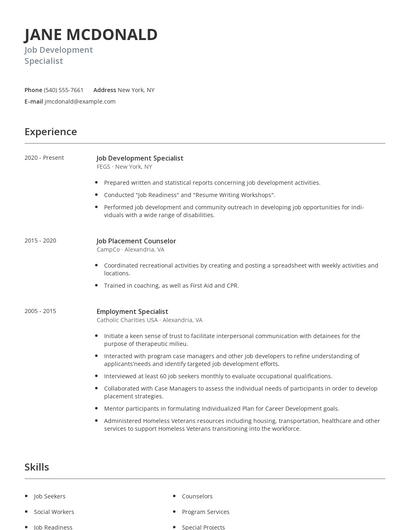
Compare different job development specialists
Job development specialist vs. Staffing coordinator
A staffing coordinator is responsible for assisting the staffing needs of an organization, organizing the hiring process, and monitoring the working schedule of staff to ensure smooth operations. Staffing coordinators often coordinate with recruiting agencies for staffing solutions to fill roles and process onboarding. They also manage payroll procedures and check timesheets, create staffing reports, and address the employees' inquiries and concerns. A staffing coordinator must be knowledgeable on human resources procedures, as well as have excellent organizational and communication skills to perform administrative tasks as needed and determine staffing strategies.
While similarities exist, there are also some differences between job development specialists and staffing coordinator. For instance, job development specialist responsibilities require skills such as "employment services," "training programs," "technical assistance," and "employment trends." Whereas a staffing coordinator is skilled in "patients," "customer service," "home health," and "patient care." This is part of what separates the two careers.
Staffing coordinators really shine in the finance industry with an average salary of $43,154. Comparatively, job development specialists tend to make the most money in the education industry with an average salary of $40,370.On average, staffing coordinators reach lower levels of education than job development specialists. Staffing coordinators are 7.8% less likely to earn a Master's Degree and 0.1% less likely to graduate with a Doctoral Degree.Job development specialist vs. Human resources coordinator
A human resources coordinator is responsible for cooperating with the company's human resources department, supporting its processes and procedures, and assisting with employees' concerns. Human resources coordinators' duties include maintaining business files and employees' records, processing documents and submitting required reports, administering background checks for the recruitment process, reviewing and referring to company's handbook for corrective action and performance review, scheduling meetings and facilitating events, and advising effective strategies to human resources management. A human resources coordinator requires excellent communication and employee-relation skills to support the company's daily operations.
While some skills are similar in these professions, other skills aren't so similar. For example, resumes show us that job development specialist responsibilities requires skills like "employment services," "technical assistance," "employment trends," and "community resources." But a human resources coordinator might use other skills in their typical duties, such as, "customer service," "hris," "process payroll," and "data entry."
On average, human resources coordinators earn a higher salary than job development specialists. Some industries support higher salaries in each profession. Interestingly enough, human resources coordinators earn the most pay in the finance industry with an average salary of $49,546. Whereas job development specialists have higher pay in the education industry, with an average salary of $40,370.Average education levels between the two professions vary. Human resources coordinators tend to reach similar levels of education than job development specialists. In fact, they're 3.0% less likely to graduate with a Master's Degree and 0.1% more likely to earn a Doctoral Degree.What technology do you think will become more important and prevalent for job development specialists in the next 3-5 years?
Dr. Phil Gardner Ph.D.
Director, Michigan State University
Automation - in animal care and food processing to lower demand for human labor because there are shortages.
Job development specialist vs. Self-employed
A self-employed person works without the supervision of a specific employer. Self-employed entrepreneurs decide their business plans to increase profitability and get involved with the current market trends. They also attend business orientations to improve their skills and strategies on driving their business' growth. A self-employed person must display exceptional decision-making and organizational skills to implement strategies, provide the best customer service with the clients, address their needs, manage complaints, and respond to the customer's inquiries.
Some important key differences between the two careers include a few of the skills necessary to fulfill the responsibilities of each. Some examples from job development specialist resumes include skills like "unemployment claims," "employment services," "training programs," and "technical assistance," whereas a self-employed is more likely to list skills in "windows," "mowing," "customer service," and "financial statements. "
When it comes to education, self-employeds tend to earn lower degree levels compared to job development specialists. In fact, they're 7.4% less likely to earn a Master's Degree, and 0.7% less likely to graduate with a Doctoral Degree.Job development specialist vs. Recruiting coordinator
A recruiting coordinator's tasks include posting job vacancies, coordinating candidate travel, setting up schedules for interviews and handling last-minute scheduling changes, preparing offer letters, and conducting background checks on aspirants. The coordinator assists in the company's recruiting and talent acquisition procedures and strategies by hiring job-seekers to fill in vacant positions and to supply the company's workforce needs and goals. To be effective, he/she should have excellent communication skills and intimate knowledge about hiring best practices to be able to attract aspirants.
Types of job development specialist
Updated January 8, 2025
