What does a lead systems specialists do?
Lead systems specialists responsibilities
Here are examples of responsibilities from real lead systems specialists resumes:
- Manage and lead mainframe Cobol/DB2 programmers.
- Manage teams of JCI engineers and techniciansworkload per project to meet project milestones.
- Reset, accredit, and manage AHLTA, CHCS, and Essentris credentials for end users.
- Manage and configure MRV terminal servers; confirm accurate serial communication between lab instruments and CHCS interfaces.
- Recruit to establish and manage Virtualization\Storage\Backup environments.
- Complete ongoing troubleshooting of HVAC and controls issues.
- Create and support the internal departmental website using HTML.
- Update management and JCI contractors or customers of job progress and issues.
- Well verse in more than 60 HVAC products, selection software & numerous sales strategies.
- Assist with running SCAPS and STIGGING RDIT and SCRO standalone machines to ensure DoD compliance.
- Interact with EDI and Java developers to track problems, discuss defects and resolve technical issues.
- Provide first tier and second-tier support to end-users for PC, server, mainframe applications, and hardware.
- Analyze, debug, fix various production defects and provide technical support to offshore and onsite developers for the CRM application.
- Perform in a lead engineering capacity for various SAN and UNIX/Windows consumer base wireless data/network deployments.
- Execute best-practice infrastructure automation and high availability configuration management.
Lead systems specialists skills and personality traits
We calculated that 16% of Lead Systems Specialists are proficient in Gross Margin, Customer Satisfaction, and HVAC. They’re also known for soft skills such as Analytical skills, Communication skills, and Creativity.
We break down the percentage of Lead Systems Specialists that have these skills listed on their resume here:
- Gross Margin, 16%
provide monthly forecasts of revenue, costs, and gross margin.
- Customer Satisfaction, 12%
Lead cross-functional initiatives to improve business operations leading to improved customer satisfaction, improved margins and organizational improvements.
- HVAC, 10%
Well versed in more than 60 HVAC products, selection software & numerous sales strategies.
- Billing Processes, 8%
Oversee subcontractor payment and billing processes.
- Technical Assistance, 7%
Provide technical assistance to subcontractors and communicate the status of projects to management.
- Site-Specific Training, 6%
Perform site-specific training for owner/operator on the total system in full or with assistance.
"gross margin," "customer satisfaction," and "hvac" are among the most common skills that lead systems specialists use at work. You can find even more lead systems specialists responsibilities below, including:
Analytical skills. The most essential soft skill for a lead systems specialists to carry out their responsibilities is analytical skills. This skill is important for the role because "analysts must interpret complex information from various sources and decide the best way to move forward on a project." Additionally, a lead systems specialists resume shows how their duties depend on analytical skills: "supported production life cycle on corporate enterprise financial data collection system. "
Communication skills. Many lead systems specialists duties rely on communication skills. "analysts work as a go-between with management and the it department and must explain complex issues in a way that both will understand.," so a lead systems specialists will need this skill often in their role. This resume example is just one of many ways lead systems specialists responsibilities rely on communication skills: "managed and configured mrv terminal servers; confirmed accurate serial communication between lab instruments and chcs interfaces. "
Creativity. This is an important skill for lead systems specialists to perform their duties. For an example of how lead systems specialists responsibilities depend on this skill, consider that "because analysts are tasked with finding innovative solutions to computer problems, an ability to “think outside the box” is important." This excerpt from a resume also shows how vital it is to everyday roles and responsibilities of a lead systems specialists: "lead the team to map eci's tolas system to medco inventory db2 data base. ".
The three companies that hire the most lead systems specialistss are:
- Johnson Controls31 lead systems specialists jobs
- Raytheon Technologies4 lead systems specialists jobs
- EPCO Holdings, Inc.3 lead systems specialists jobs
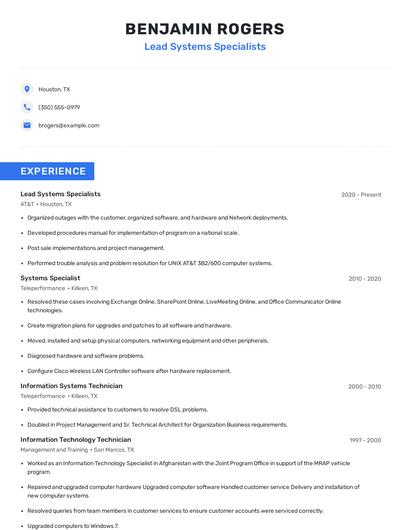
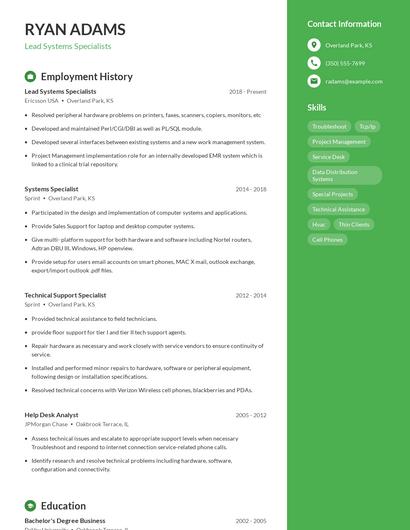
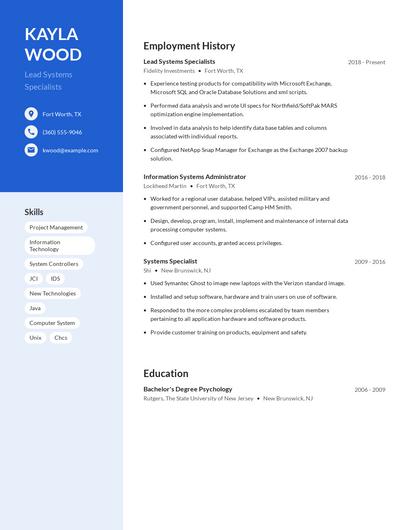
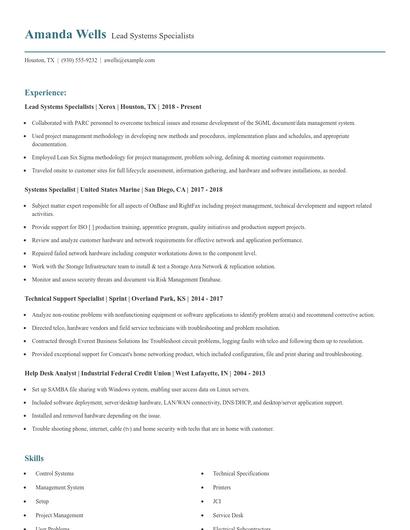
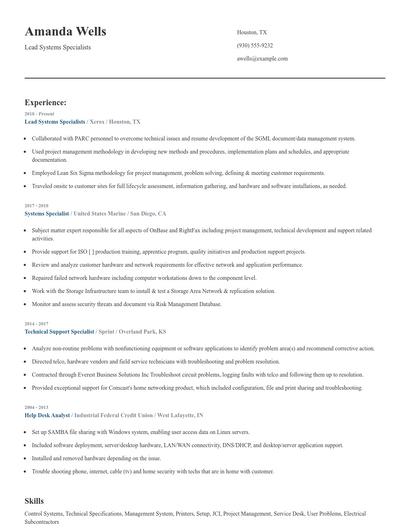
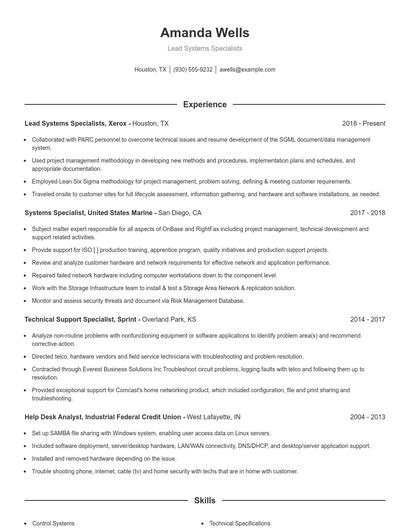
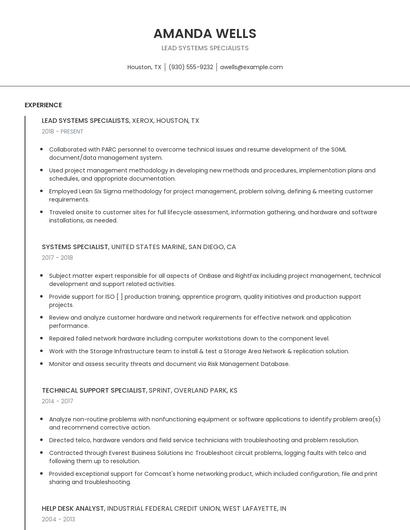
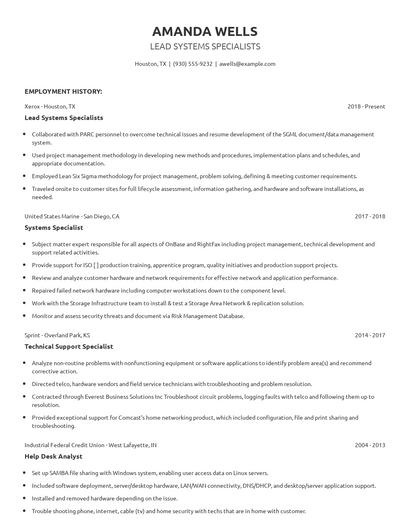
Choose from 10+ customizable lead systems specialists resume templates
Build a professional lead systems specialists resume in minutes. Our AI resume writing assistant will guide you through every step of the process, and you can choose from 10+ resume templates to create your lead systems specialists resume.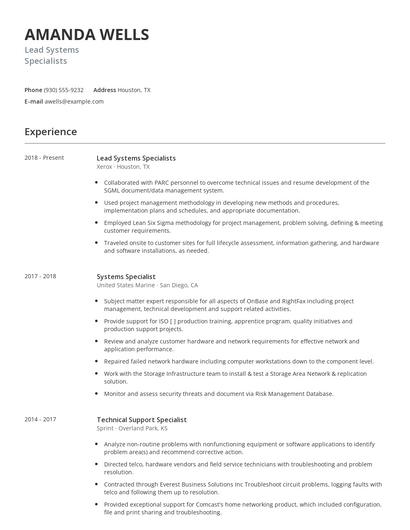
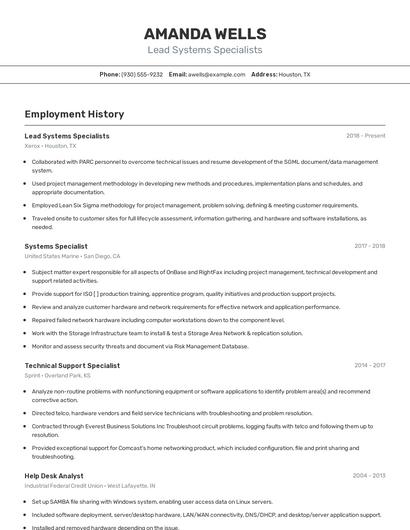
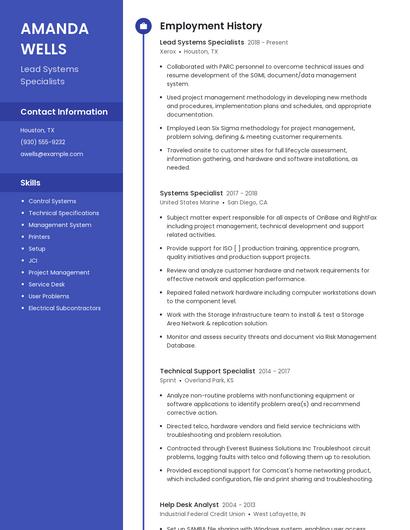
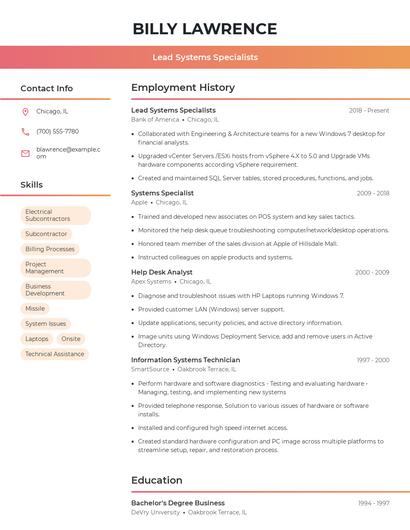
Compare different lead systems specialists
Lead systems specialists vs. Information technology analyst
An information technology analyst is responsible for identifying business opportunities by creating and designing technology systems that would help business operations perform efficiently and accurately. Information technology analysts manage systems maintenance, upgrade and install updates for better optimization, and perform feature revisions and adjustments based on the end-user experience. They analyze client and business specifications and research a multiple system approach to generate technology solutions. An information technology analyst must have excellent analytical skills, as well as broad knowledge of the technology industry.
While similarities exist, there are also some differences between lead systems specialists and information technology analyst. For instance, lead systems specialists responsibilities require skills such as "gross margin," "secures," "customer satisfaction," and "hvac." Whereas a information technology analyst is skilled in "infrastructure," "security policies," "switches," and "encryption." This is part of what separates the two careers.
Information technology analysts tend to make the most money working in the technology industry, where they earn an average salary of $94,506. In contrast, lead systems specialists make the biggest average salary, $105,294, in the government industry.The education levels that information technology analysts earn slightly differ from lead systems specialists. In particular, information technology analysts are 0.0% less likely to graduate with a Master's Degree than a lead systems specialists. Additionally, they're 0.2% less likely to earn a Doctoral Degree.Lead systems specialists vs. Information technology consultant
An Information Technology Consultant, also known as IT Consultant, is responsible for sharing extensive knowledge of Information Technology by providing suggestions and solving issues within the company. Among the duties include installing and maintaining the necessary software and hardware, designing new procedures, overseeing all implementations, and ensuring that all systems are running smoothly, employing methods to secure databases, and providing essential instructions when needed. Furthermore, an Information Technology Consultant needs to coordinate and report to management or supervisors at all times.
Each career also uses different skills, according to real lead systems specialists resumes. While lead systems specialists responsibilities can utilize skills like "gross margin," "secures," "customer satisfaction," and "hvac," information technology consultants use skills like "database," "cloud," "business processes," and "c #."
Information technology consultants may earn a lower salary than lead systems specialists, but information technology consultants earn the most pay in the finance industry with an average salary of $99,092. On the other hand, lead systems specialists receive higher pay in the government industry, where they earn an average salary of $105,294.information technology consultants earn similar levels of education than lead systems specialists in general. They're 0.1% less likely to graduate with a Master's Degree and 0.2% more likely to earn a Doctoral Degree.Lead systems specialists vs. Programmer analyst
A programmer analyst is responsible for monitoring database performance and software applications, performing basic troubleshooting, and improving program operations as needed. Programmer analysts' duties also include making adjustments on the system based on client's specifications, creating reports for any updates and new system procedures, designing specific technology solutions to improve the business operations, and performing necessary code adjustments. A programmer analyst must have extensive knowledge of computer systems and procedures, as well as critical-thinking skills to perform complex tasks under minimal supervision.
The required skills of the two careers differ considerably. For example, lead systems specialists are more likely to have skills like "gross margin," "secures," "customer satisfaction," and "hvac." But a programmer analyst is more likely to have skills like "c++," "javascript," "data warehouse," and "web services."
Programmer analysts earn the best pay in the finance industry, where they command an average salary of $76,037. Lead systems specialists earn the highest pay from the government industry, with an average salary of $105,294.programmer analysts typically earn similar educational levels compared to lead systems specialists. Specifically, they're 2.0% more likely to graduate with a Master's Degree, and 0.0% more likely to earn a Doctoral Degree.Lead systems specialists vs. Senior programmer analyst
A senior programmer/analyst is responsible for developing and sustaining databases and software applications to achieve business requirements. The professional performs development duties such as coding and testing these applications. The core skills that the job requires include familiarity with applicable data privacy practices and laws, a keen eye for details, and strong analytical and problem-solving skills. Also, the job requires a college diploma or university degree in the field of computer science, information systems, or software engineering.
Types of lead systems specialists
Updated January 8, 2025
