What does a personnel recruiter do?
Personnel recruiter responsibilities
Here are examples of responsibilities from real personnel recruiter resumes:
- Utilize ATS (applicant tracking software) for organizational recruiting efforts, reviewing applicant information and managing open requisitions.
- Present and prepare PowerPoint presentations on various topics to educate colleagues in the office and operate WebEx technology for conference calls.
- Manage employee's personnel files and maintain accurate up to date confidential client files to ensure compliance with HIPPA.
Personnel recruiter skills and personality traits
We calculated that 20% of Personnel Recruiters are proficient in Background Checks, Human Resources, and Career Fairs. They’re also known for soft skills such as Detail oriented, Communication skills, and Interpersonal skills.
We break down the percentage of Personnel Recruiters that have these skills listed on their resume here:
- Background Checks, 20%
Initiated background checks and requested investigations for prospects requiring an enlistment waiver.
- Human Resources, 12%
Maintain effective relationships with Managers of Operations and Human Resources department.
- Career Fairs, 10%
Conducted interviews in-house, by phone, web cam and on spot during Maritime Career Fairs at various Maritime Academies.
- Community Colleges, 9%
Conducted semiannual informational briefings/training at military community centers, universities, community colleges, and other community centers.
- Reference Checks, 9%
Conducted all reference checks; verified university/college degrees and/or certifications prior to hiring.
- Cold Calls, 7%
Attended job fairs; utilized media advertising, as well as cold calling job seekers from resume database.
Most personnel recruiters use their skills in "background checks," "human resources," and "career fairs" to do their jobs. You can find more detail on essential personnel recruiter responsibilities here:
Detail oriented. To carry out their duties, the most important skill for a personnel recruiter to have is detail oriented. Their role and responsibilities require that "specialists must pay attention to detail when evaluating applicants’ qualifications, doing background checks, maintaining records of an employee grievance, and ensuring that a workplace complies with labor standards." Personnel recruiters often use detail oriented in their day-to-day job, as shown by this real resume: "provide detailed and accurate sales forecasting, cold calling, outside sales, and networking. "
Communication skills. Another soft skill that's essential for fulfilling personnel recruiter duties is communication skills. The role rewards competence in this skill because "listening and speaking skills are essential for human resources specialists." According to a personnel recruiter resume, here's how personnel recruiters can utilize communication skills in their job responsibilities: "developed and presented recruiting materials for use by local communications media. "
Interpersonal skills. This is an important skill for personnel recruiters to perform their duties. For an example of how personnel recruiter responsibilities depend on this skill, consider that "specialists continually interact with others and must be able to converse and connect with people from varied backgrounds." This excerpt from a resume also shows how vital it is to everyday roles and responsibilities of a personnel recruiter: "conduct detailed reference checks on candidates to better understand their experience, strengths, weaknesses, management style, interpersonal skills. ".
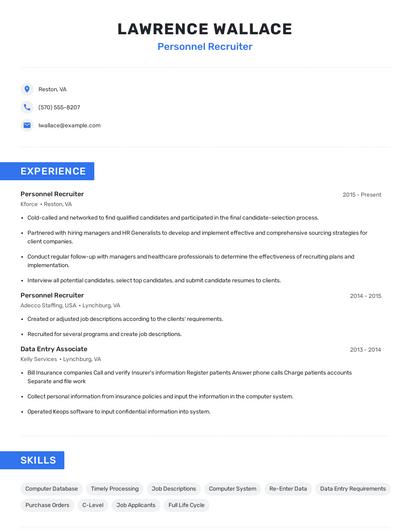
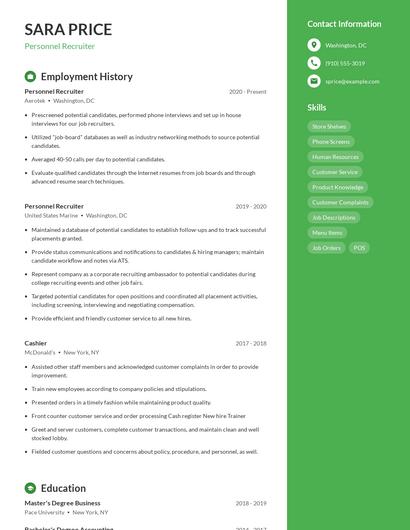
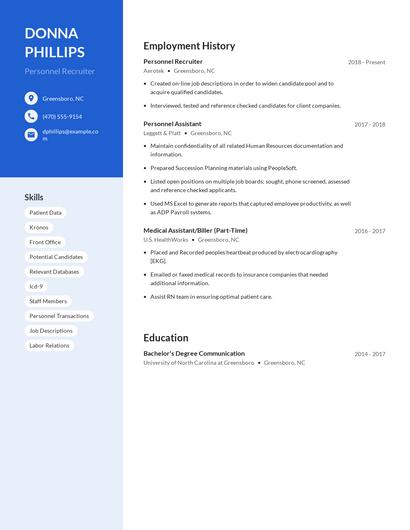
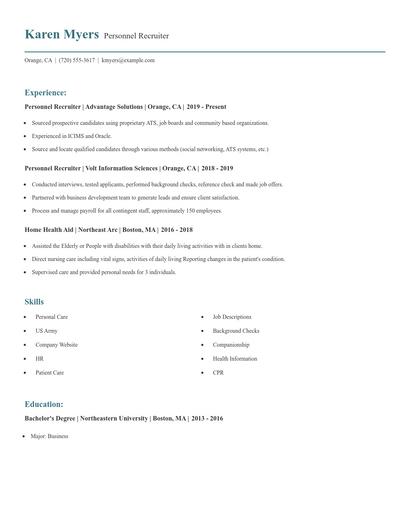
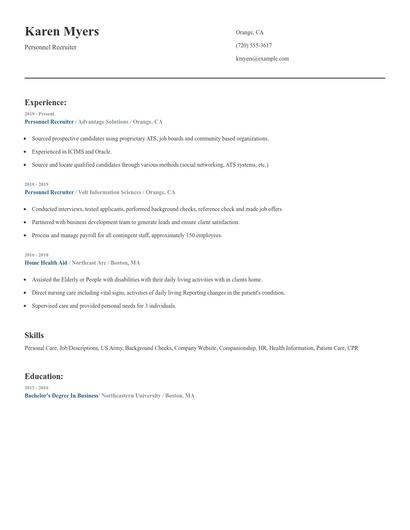
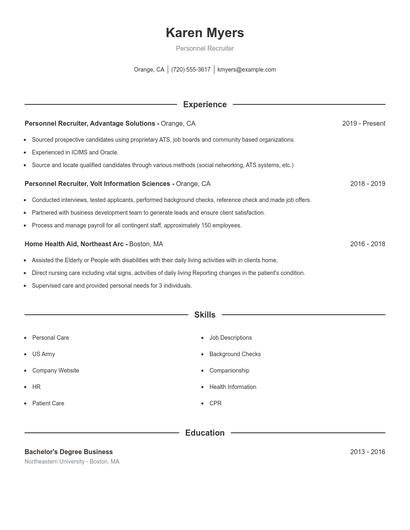
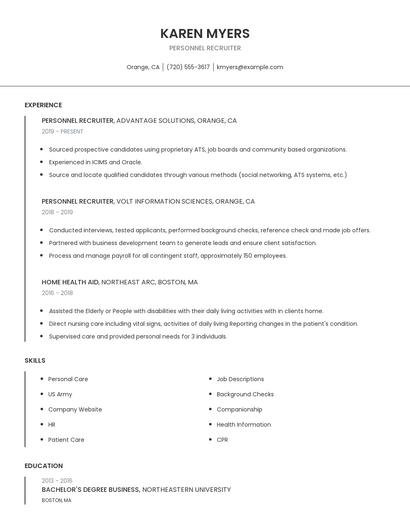
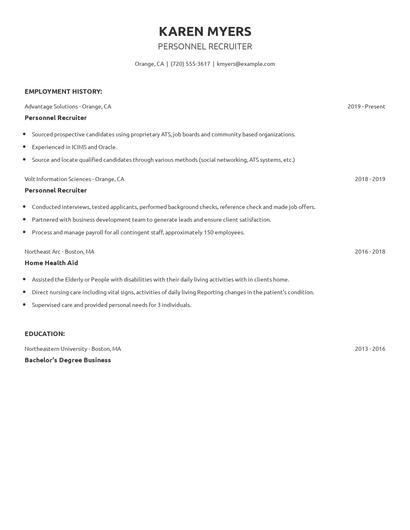
Choose from 10+ customizable personnel recruiter resume templates
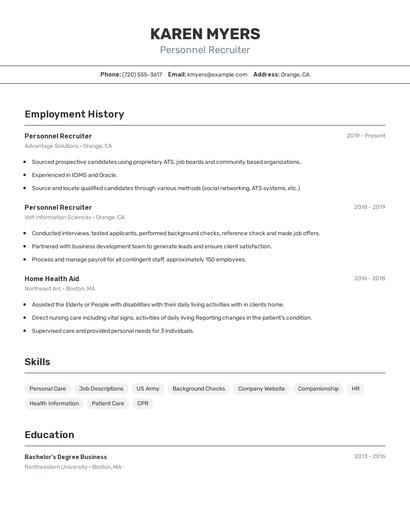
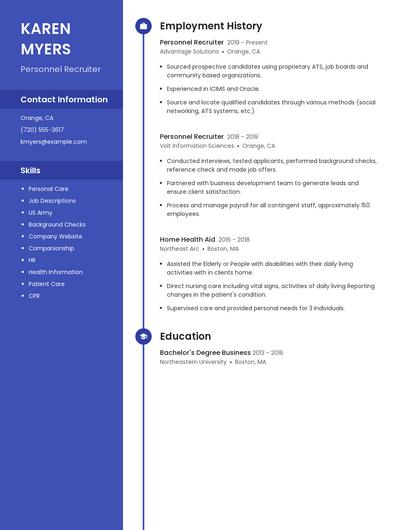
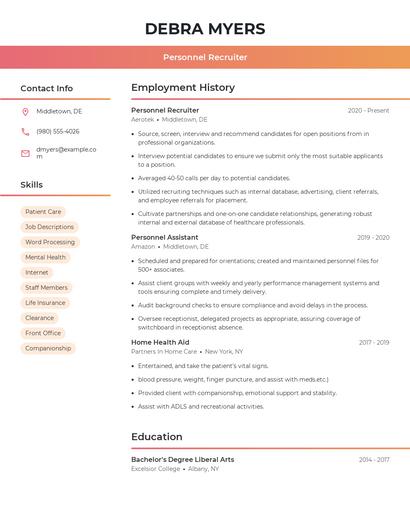
Build a professional personnel recruiter resume in minutes. Our AI resume writing assistant will guide you through every step of the process, and you can choose from 10+ resume templates to create your personnel recruiter resume.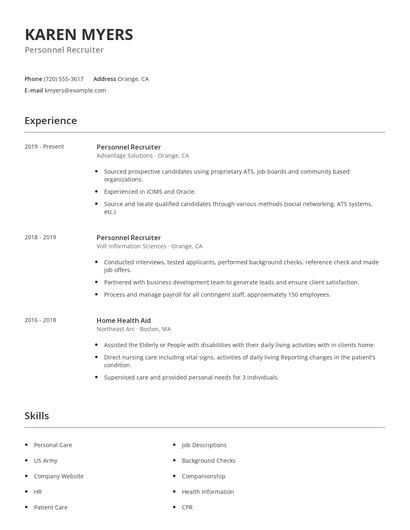
Compare different personnel recruiters
Personnel recruiter vs. Staffing coordinator
A staffing coordinator is responsible for assisting the staffing needs of an organization, organizing the hiring process, and monitoring the working schedule of staff to ensure smooth operations. Staffing coordinators often coordinate with recruiting agencies for staffing solutions to fill roles and process onboarding. They also manage payroll procedures and check timesheets, create staffing reports, and address the employees' inquiries and concerns. A staffing coordinator must be knowledgeable on human resources procedures, as well as have excellent organizational and communication skills to perform administrative tasks as needed and determine staffing strategies.
These skill sets are where the common ground ends though. The responsibilities of a personnel recruiter are more likely to require skills like "human resources," "career fairs," "community colleges," and "cold calls." On the other hand, a job as a staffing coordinator requires skills like "patients," "customer service," "home health," and "patient care." As you can see, what employees do in each career varies considerably.
Staffing coordinators really shine in the finance industry with an average salary of $43,154. Comparatively, personnel recruiters tend to make the most money in the retail industry with an average salary of $51,554.On average, staffing coordinators reach similar levels of education than personnel recruiters. Staffing coordinators are 1.6% less likely to earn a Master's Degree and 0.2% more likely to graduate with a Doctoral Degree.Personnel recruiter vs. Self-employed
A self-employed person works without the supervision of a specific employer. Self-employed entrepreneurs decide their business plans to increase profitability and get involved with the current market trends. They also attend business orientations to improve their skills and strategies on driving their business' growth. A self-employed person must display exceptional decision-making and organizational skills to implement strategies, provide the best customer service with the clients, address their needs, manage complaints, and respond to the customer's inquiries.
While some skills are similar in these professions, other skills aren't so similar. For example, resumes show us that personnel recruiter responsibilities requires skills like "background checks," "human resources," "career fairs," and "community colleges." But a self-employed might use other skills in their typical duties, such as, "windows," "mowing," "customer service," and "financial statements."
Average education levels between the two professions vary. Self-employeds tend to reach similar levels of education than personnel recruiters. In fact, they're 1.2% less likely to graduate with a Master's Degree and 0.2% more likely to earn a Doctoral Degree.Personnel recruiter vs. Human resources administrative assistant
A human resources administrative assistant is responsible for performing administrative tasks such as gathering and processing necessary documentation, preparing timely reports and evaluations, arranging schedules, maintaining and monitoring record databases, and responding to inquiries. Aside from assisting human resource officers in their tasks, they can also lend a hand in screening and training new workforce members. Furthermore, because a human resources administrative assistant holds the employee database, they need to coordinate with other departments and employees to ensure that everyone receives what is needed.
The required skills of the two careers differ considerably. For example, personnel recruiters are more likely to have skills like "human resources," "career fairs," "community colleges," and "cold calls." But a human resources administrative assistant is more likely to have skills like "customer service," "data entry," "powerpoint," and "administrative tasks."
Human resources administrative assistants earn the highest salary when working in the technology industry, where they receive an average salary of $39,077. Comparatively, personnel recruiters have the highest earning potential in the retail industry, with an average salary of $51,554.Most human resources administrative assistants achieve a similar degree level compared to personnel recruiters. For example, they're 1.1% less likely to graduate with a Master's Degree, and 0.2% less likely to earn a Doctoral Degree.Personnel recruiter vs. Human resources generalist
A human resources generalist is responsible for monitoring the human resources policies and procedures, making adjustments as needed to align with the company's goals and objectives. Duties of a human resources generalist also include improving employee relations system, organizing compliance and knowledge training, reviewing benefit plans, managing compensation inquiries, assisting in recruitment and staffing needs, communicating with department heads in employees' performance reviews, and storing employees' files for reference. A human resource generalist must have excellent communication and decision-making skills to address issues concerning the company and employees' welfare.
Types of personnel recruiter
Updated January 8, 2025
