What does a process controller do?
Process controller responsibilities
Here are examples of responsibilities from real process controller resumes:
- Manage distillation process to determine product specification compliance, and prepare unit for shutdown or turnaround process.
- Develop and maintain documentation in compliance with the ISO standard.
- Train new personnel in ISO procedures, and basic company rules.
- Make sure safety standards and GMP's are adhere to at all times.
- Design the automation profile for the evaporator area including start up, shutdown, and CIP of all evaporator equipment.
- Troubleshoot PLC issues and add new control logic to address safety concerns, improve production rates, and reduce reagent usage.
- Maintain databases and SharePoint with accuracy.
- Institute yearly calibration program for facility transmitters.
- Coordinate Medicare and Medicaid follow-ups to ensure maximum reimbursement.
- Challenge business performance regularly using standard and internal KPIs.
- Perform preventative maintenance and repair work and troubleshoot operating and maintenance problems.
- Produce and apply FDA approve labels for all radioactive pharmaceuticals manufacture in the facility.
- Utilize different methods for personnel to retain information and properly execute, troubleshoot and operate equipment.
- Maintain agency and individual provider credentialing with commercial insurance companies as well as Medicaid and Medicare.
- Evaluate and test administrative system changes to provide ongoing support to existing applications and newly implement PeopleSoft and Hyperion Essbase applications.
Process controller skills and personality traits
We calculated that 12% of Process Controllers are proficient in Process Control, SOX, and Continuous Improvement. They’re also known for soft skills such as Analytical skills, Communication skills, and Interpersonal skills.
We break down the percentage of Process Controllers that have these skills listed on their resume here:
- Process Control, 12%
Programmed and simulated process controller equipment on WEST controller software according to customer specifications.
- SOX, 10%
Developed simplified project requirement and implementation artifacts to support CMM Level 3 certification and SOX compliance requirements in preparation for outsourcing.
- Continuous Improvement, 9%
Performed internal audits and participated in continuous improvement activities.
- Data Entry, 8%
Perform data entry, data processing, updates and adjustments into a WMS database.
- Process Improvement, 5%
Performed quality analysis testing each hour and maintained high standard for process improvement and production prior to disbursement to packaging department.
- Sigma, 4%
Trained business leaders on new Six Sigma Outside-In initiative and conducted beta project analysis.
Common skills that a process controller uses to do their job include "process control," "sox," and "continuous improvement." You can find details on the most important process controller responsibilities below.
Analytical skills. To carry out their duties, the most important skill for a process controller to have is analytical skills. Their role and responsibilities require that "management analysts must be able to interpret information and use their findings to make proposals." Process controllers often use analytical skills in their day-to-day job, as shown by this real resume: "administered detailed data entry to accomplish accurate collection of product population. "
Communication skills. Another essential skill to perform process controller duties is communication skills. Process controllers responsibilities require that "management analysts must be able to convey information clearly in both writing and speaking." Process controllers also use communication skills in their role according to a real resume snippet: "demonstrated strong client relation skills in greeting and directing patients and managing incoming phone communications. "
Interpersonal skills. This is an important skill for process controllers to perform their duties. For an example of how process controller responsibilities depend on this skill, consider that "management analysts work with managers and other employees of the organizations for which they provide consulting services." This excerpt from a resume also shows how vital it is to everyday roles and responsibilities of a process controller: "promoted to processing based on excellent performance, good communication and strong interpersonal skills. ".
Problem-solving skills. A big part of what process controllers do relies on "problem-solving skills." You can see how essential it is to process controller responsibilities because "management analysts must be able to think creatively to solve clients’ problems." Here's an example of how this skill is used from a resume that represents typical process controller tasks: "be west's liaison in technical meeting to provide solutions for customer's process controlling needs. "
Time-management skills. Another common skill required for process controller responsibilities is "time-management skills." This skill comes up in the duties of process controllers all the time, as "management analysts often work under tight deadlines and must use their time efficiently to complete projects on schedule." An excerpt from a real process controller resume shows how this skill is central to what a process controller does: "worked closely with production to ensure product available to meet customer orders on time and in full. "
The three companies that hire the most process controllers are:
- Butterball4 process controllers jobs
- RRD3 process controllers jobs
- Raytheon Technologies2 process controllers jobs
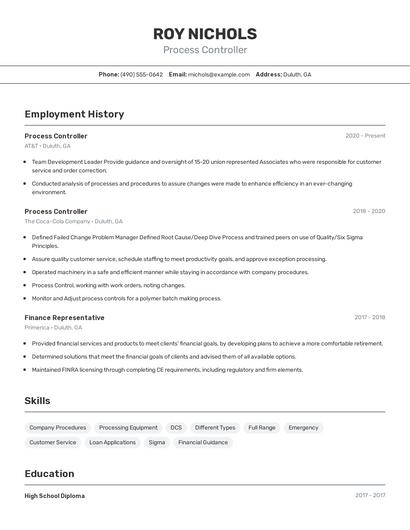
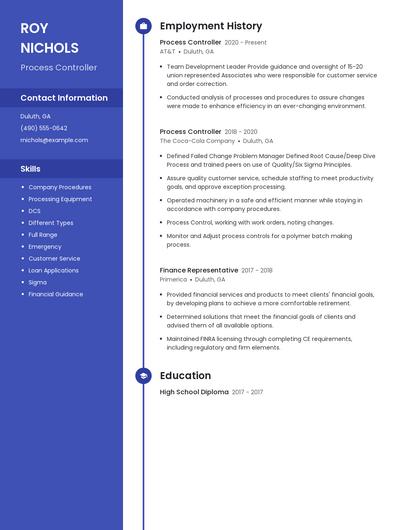
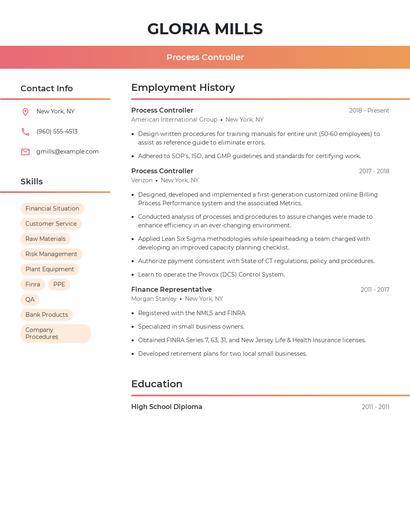
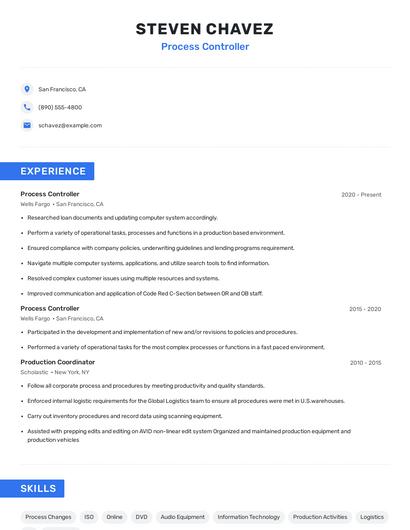
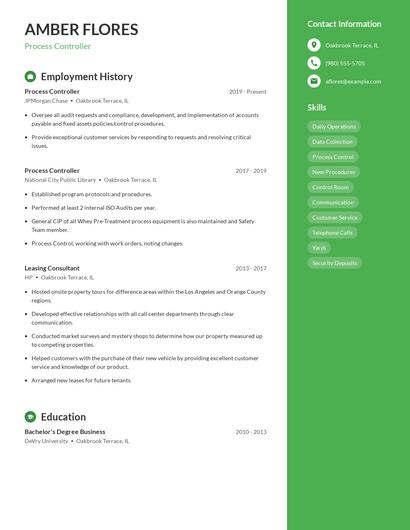
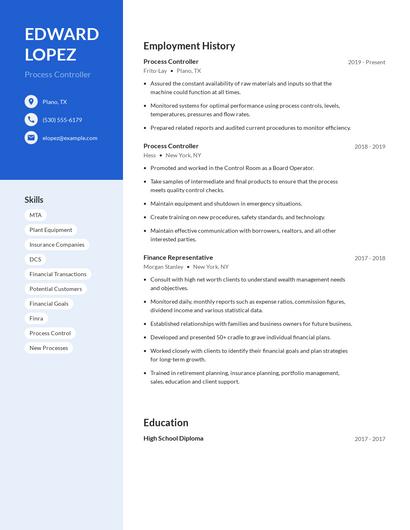
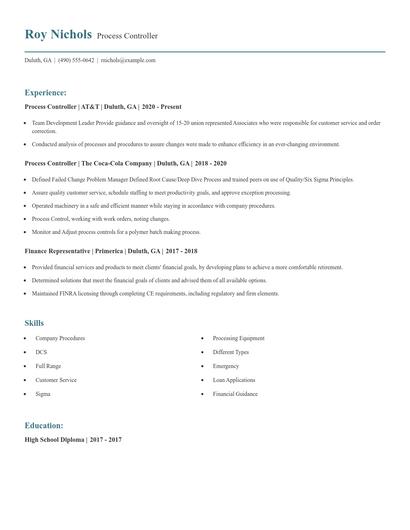
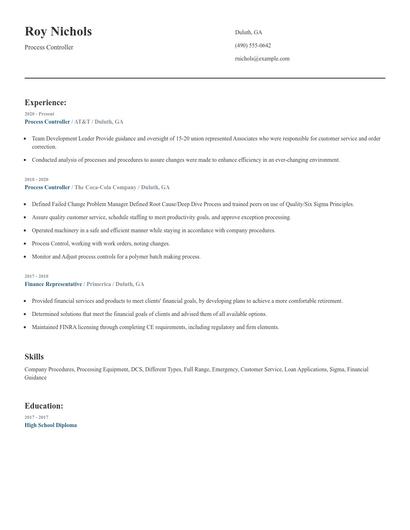
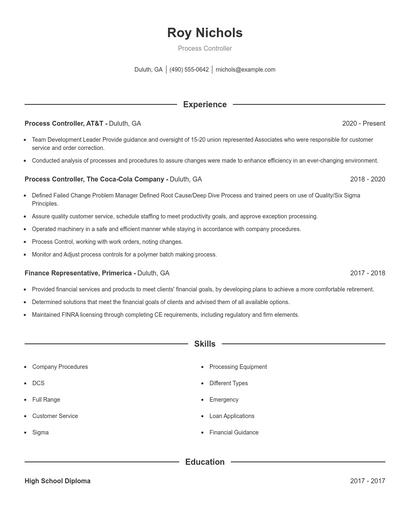
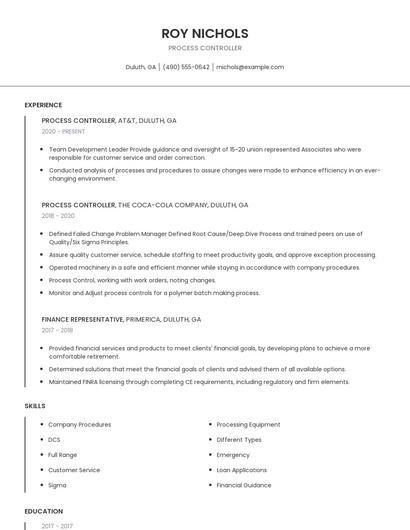
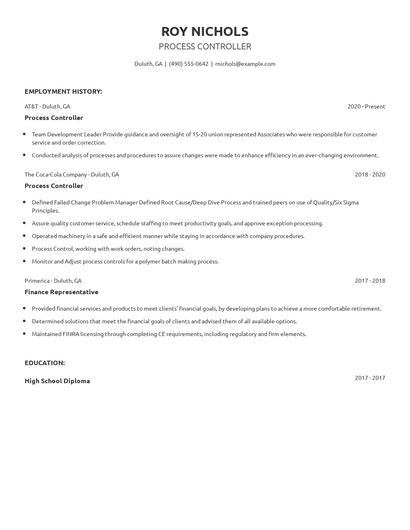
Choose from 10+ customizable process controller resume templates
Build a professional process controller resume in minutes. Our AI resume writing assistant will guide you through every step of the process, and you can choose from 10+ resume templates to create your process controller resume.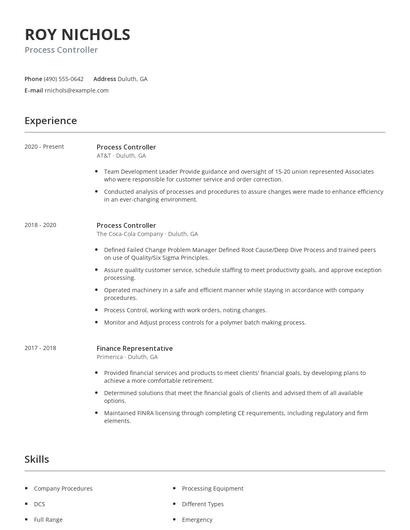
Compare different process controllers
Process controller vs. Supervisor
Supervisors are responsible for overseeing the daily functions of employees in a specific team, department, or even a work shift. They create work schedules, organize work processes and workflows, train new hires, provide necessary reports related to the team function and the employees, monitor and evaluate employee performance, and ensure that goals of the specific team or department are met. When needed, supervisors also provide guidance to employees in terms of their career or even personal challenges. They also help in fostering harmonious work relationships by resolving interpersonal conflicts at work. To be successful in their role, they must have leadership skills, time management skills, decision-making capabilities, analytical skills, and problem-solving skills.
There are some key differences in the responsibilities of each position. For example, process controller responsibilities require skills like "process control," "sox," "continuous improvement," and "data entry." Meanwhile a typical supervisor has skills in areas such as "customer service," "safety procedures," "sales floor," and "pos." This difference in skills reveals the differences in what each career does.
Supervisors earn the highest salaries when working in the health care industry, with an average yearly salary of $60,088. On the other hand, process controllers are paid more in the technology industry with an average salary of $85,429.On average, supervisors reach similar levels of education than process controllers. Supervisors are 0.5% less likely to earn a Master's Degree and 0.1% more likely to graduate with a Doctoral Degree.Process controller vs. Shop foreman
A shop foreman is responsible for monitoring the daily operations of a shop, ensuring that the staff members perform their duties to address customers' needs. A shop foreman manages staffing schedules, trains new employees, and distributes tasks. They often work in manufacturing, automotive, and warehouse industries, which require knowledge of operating equipment. A shop foreman must have excellent leadership and communication skills, especially on addressing customers' inquiries and complaints and performing clerical tasks as needed.
Each career also uses different skills, according to real process controller resumes. While process controller responsibilities can utilize skills like "process control," "sox," "continuous improvement," and "data entry," shop foremen use skills like "customer service," "preventative maintenance," "cdl," and "cnc."
Shop foremen earn a lower average salary than process controllers. But shop foremen earn the highest pay in the energy industry, with an average salary of $76,003. Additionally, process controllers earn the highest salaries in the technology with average pay of $85,429 annually.In general, shop foremen achieve similar levels of education than process controllers. They're 4.0% less likely to obtain a Master's Degree while being 0.1% less likely to earn a Doctoral Degree.Process controller vs. Lead supervisor
Lead supervisors are responsible for several duties within an organization. They are accountable for overseeing their members and making sure that the work they produce is of good quality. They mainly serve as role models for their staff members, who often seek guidance, leadership, and support from them. When issues arise between employees, lead supervisors should intervene by providing conflict management to ease the situation. They also have to delegate work to employees to get the job done efficiently.
The required skills of the two careers differ considerably. For example, process controllers are more likely to have skills like "process control," "sox," "data entry," and "process improvement." But a lead supervisor is more likely to have skills like "safety procedures," "pet," "payroll," and "customer service."
Lead supervisors earn the highest salary when working in the manufacturing industry, where they receive an average salary of $47,284. Comparatively, process controllers have the highest earning potential in the technology industry, with an average salary of $85,429.Most lead supervisors achieve a similar degree level compared to process controllers. For example, they're 2.3% less likely to graduate with a Master's Degree, and 0.1% less likely to earn a Doctoral Degree.Process controller vs. Leader
Leaders pave the way for a company to achieve certain goals. They are in charge of bringing the organization to greater heights. They set the direction of the organization, much like how a captain sets the sails of the ship. They are responsible for coming up with main strategies and alternatives should there be challenges along the way. Leaders ensure that the company is guided by its vision and mission and that the employees emulate company values. They do so through leading by example. Leaders should have strategic skills, decision-making skills, and interpersonal skills.
Types of process controller
Updated January 8, 2025
