What does a process engineer lead do?
A Process Engineer Lead is responsible for developing, maintaining, and operating materials and chemicals in the manufacturing process. They ensure continuous improvement in process, cost, quality, and production.
Process engineer lead responsibilities
Here are examples of responsibilities from real process engineer lead resumes:
- Define, manage, and maintain processes to improve KPI's: AHT, MTTR, NPS and FCR.
- Assure all project manage implementations meet standards for PMI, ISO and CMM.
- Implement DVFS technique on MIPS processor to achieve system level power optimization in Verilog.
- Manage implementation of improve paste compounding (including extrusion) process.
- Train plant engineers, maintenance personnel, distributors and OEMs on the maintenance, implementation and installation of Murzan equipment.
- Develop a method to get AutoCad isometric drawings relevant to relief valve transferred electronically to the relief valve sizing package.
- Simulate the water treatment, distribution and hydraulic systems using MATLAB.
- Draft plan to do signal processing on MATLAB to speed up processing time and improve accuracy.
- Create efficient alternate processes for less cost than original bid package, ultimately securing large volume OEM business for Tesco.
- Prepare IQ/OQ/PQ documentation for pharmaceutical product auditing.
Process engineer lead skills and personality traits
We calculated that 8% of Process Engineers Lead are proficient in Lean Six Sigma, Continuous Improvement, and Sigma. They’re also known for soft skills such as Listening skills, Speaking skills, and Writing skills.
We break down the percentage of Process Engineers Lead that have these skills listed on their resume here:
- Lean Six Sigma, 8%
Maintained daily planet operation, performed and analyze lean six sigma methodology.
- Continuous Improvement, 7%
Project included component standardization, modernization, continuous improvement, and renovations to existing processes and facilities.
- Sigma, 6%
Scrutinized current business processes for six sigma improvement opportunities and unmitigated business risks.
- Process Improvement, 6%
Lead design and implementation of corporate process improvements targeting standardization, best practices, efficiency and client services.
- Process Design, 5%
Collaborated with domestic industry experts and international technology partners to identify and mitigate risks in process design and safety.
- Project Management, 4%
Use project management to help ensure machine reliability and productivity
Most process engineers lead use their skills in "lean six sigma," "continuous improvement," and "sigma" to do their jobs. You can find more detail on essential process engineer lead responsibilities here:
Listening skills. One of the key soft skills for a process engineer lead to have is listening skills. You can see how this relates to what process engineers lead do because "these engineers often operate in teams, but they also must solicit feedback from customers, vendors, and production staff." Additionally, a process engineer lead resume shows how process engineers lead use listening skills: "communicated product quality to regulatory agencies. "
Speaking skills. Many process engineer lead duties rely on speaking skills. "industrial engineers sometimes have to explain their instructions to production staff or technicians before they can make written instructions available," so a process engineer lead will need this skill often in their role. This resume example is just one of many ways process engineer lead responsibilities rely on speaking skills: "presented savings initiatives to the client, based on several alternatives for equipment design to operate the plant optimally. "
Writing skills. process engineers lead are also known for writing skills, which are critical to their duties. You can see how this skill relates to process engineer lead responsibilities, because "industrial engineers must prepare documentation for other engineers or scientists, or for future reference." A process engineer lead resume example shows how writing skills is used in the workplace: "led a large interdisciplinary team writing and implementing an iso 9001 quality system. "
Creativity. process engineer lead responsibilities often require "creativity." The duties that rely on this skill are shown by the fact that "industrial engineers use creativity and ingenuity to design new production processes in many kinds of settings in order to reduce the use of material resources, time, or labor while accomplishing the same goal." This resume example shows what process engineers lead do with creativity on a typical day: "reduced manufacturing costs by inventing and qualifying new processes to implement lean manufacturing. "
Math skills. A commonly-found skill in process engineer lead job descriptions, "math skills" is essential to what process engineers lead do. Process engineer lead responsibilities rely on this skill because "industrial engineers use the principles of calculus, trigonometry, and other advanced topics in mathematics for analysis, design, and troubleshooting in their work." You can also see how process engineer lead duties rely on math skills in this resume example: "developed statistics software with native graphing, calculations, and scripting language that replaced rs/1 and jmp. "
Problem-solving skills. While "problem-solving skills" is last on this skills list, don't underestimate its importance to process engineer lead responsibilities. Much of what a process engineer lead does relies on this skill, seeing as "in designing facilities for manufacturing and processes for providing services, these engineers deal with several issues at once, from workers’ safety to quality assurance." Here is a resume example of how this skill is used in the everyday duties of process engineers lead: "investigate and analyze quality problems, recommend solutions and ensure corrections are made for continuous improvement. "
The three companies that hire the most process engineer leads are:
- Black & Veatch17 process engineers lead jobs
- General Electric11 process engineers lead jobs
- Kimberly-Clark8 process engineers lead jobs
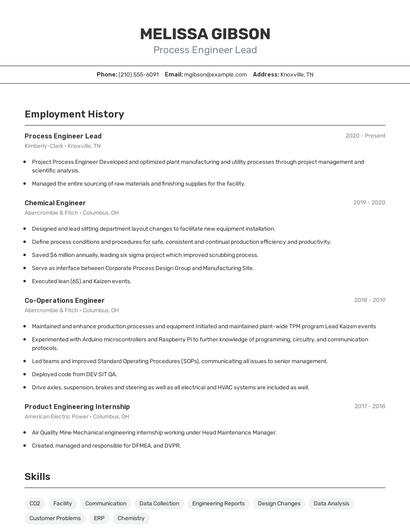
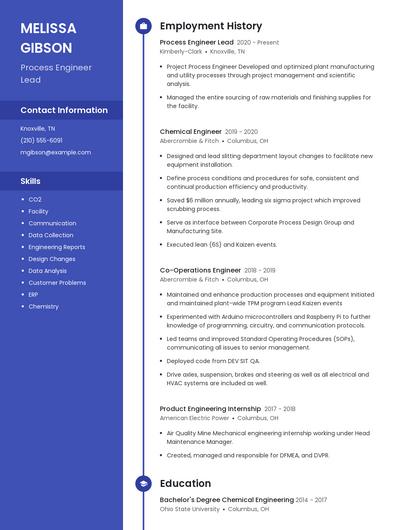
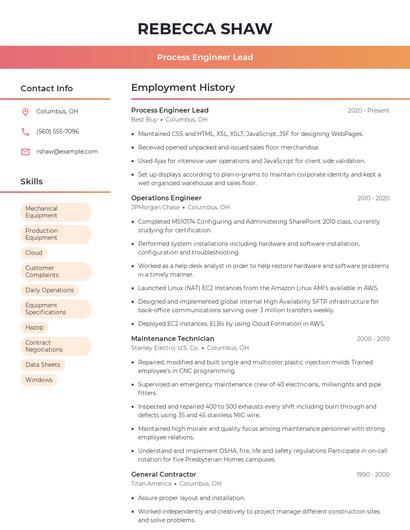
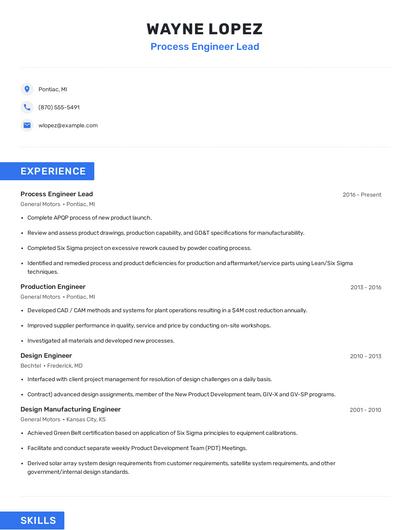
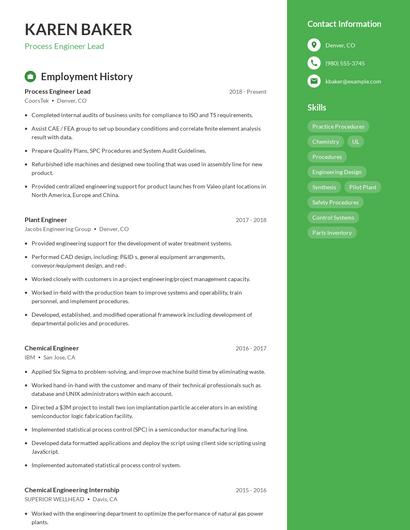
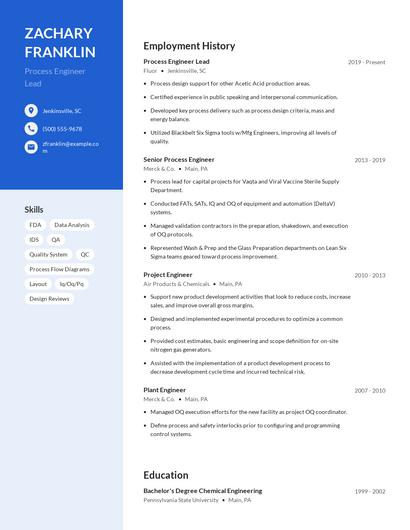
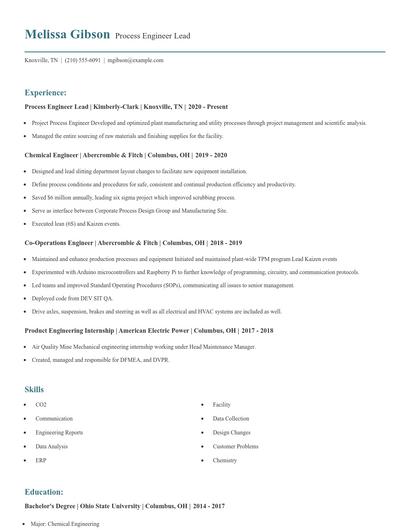
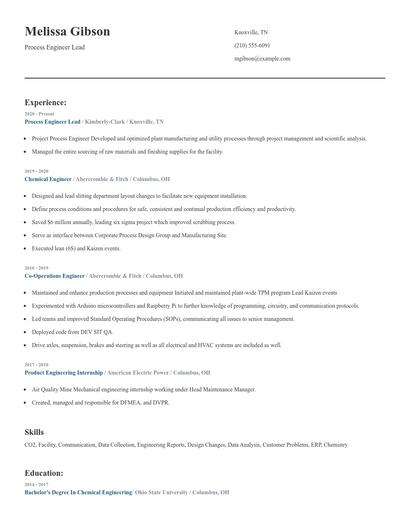
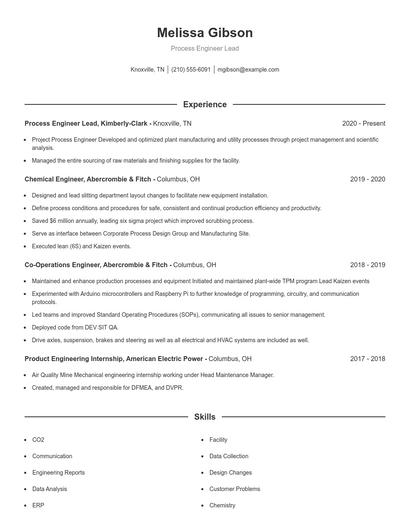
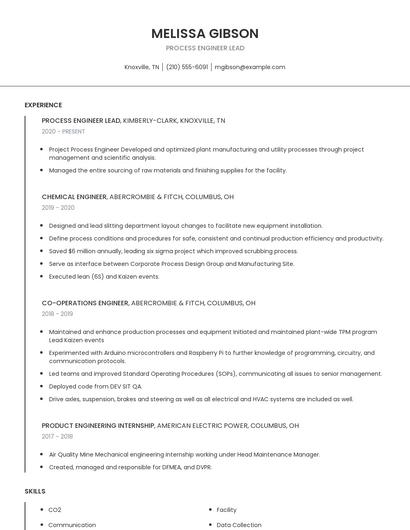
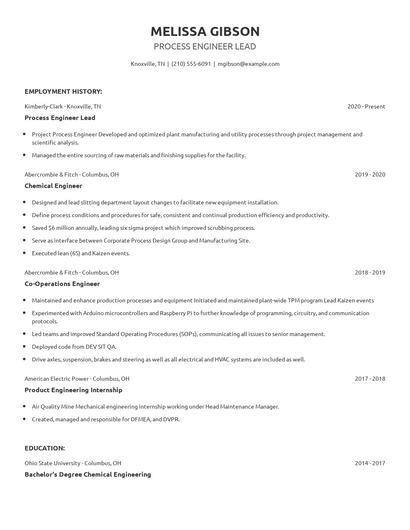
Choose from 10+ customizable process engineer lead resume templates
Build a professional process engineer lead resume in minutes. Our AI resume writing assistant will guide you through every step of the process, and you can choose from 10+ resume templates to create your process engineer lead resume.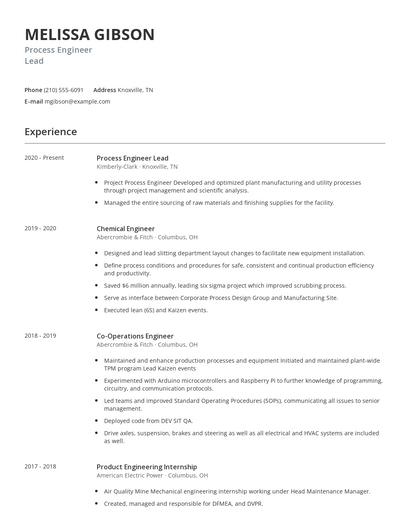
Compare different process engineers lead
Process engineer lead vs. Senior manufacturing engineer
A Senior Manufacturing Engineer works in a company's production operations and is responsible for developing and improving manufacturing processes. They analyze and propose solutions to engineering problems.
While similarities exist, there are also some differences between process engineers lead and senior manufacturing engineer. For instance, process engineer lead responsibilities require skills such as "process design," "oil gas," "ids," and "data sheets." Whereas a senior manufacturing engineer is skilled in "cad," "solidworks," "corrective action," and "cnc." This is part of what separates the two careers.
Senior manufacturing engineers earn the highest salaries when working in the automotive industry, with an average yearly salary of $97,567. On the other hand, process engineers lead are paid more in the energy industry with an average salary of $116,254.senior manufacturing engineers tend to reach similar levels of education than process engineers lead. In fact, senior manufacturing engineers are 4.3% less likely to graduate with a Master's Degree and 2.4% less likely to have a Doctoral Degree.Process engineer lead vs. Quality engineer
A quality engineer's responsibilities include ensuring that the manufacturing processes are efficient and accurate, documenting findings that would raise concerns, conducting quality tests while observing parameters, and implementing changes as necessary to meet the highest quality standards. Quality engineers need to have excellent problem-solving and observation skills to detect any irregularities and possible malfunctions. They also must be able to communicate effectively with the clients for feedbacks and corrective adjustments, address complaints, and immediately resolve any inconsistencies made.
While some skills are similar in these professions, other skills aren't so similar. For example, resumes show us that process engineer lead responsibilities requires skills like "process design," "project management," "oil gas," and "ids." But a quality engineer might use other skills in their typical duties, such as, "corrective action," "quality standards," "quality system," and "supplier quality."
On average, quality engineers earn a lower salary than process engineers lead. Some industries support higher salaries in each profession. Interestingly enough, quality engineers earn the most pay in the technology industry with an average salary of $84,890. Whereas process engineers lead have higher pay in the energy industry, with an average salary of $116,254.quality engineers earn similar levels of education than process engineers lead in general. They're 4.2% less likely to graduate with a Master's Degree and 2.4% less likely to earn a Doctoral Degree.Process engineer lead vs. Reliability engineer
A reliability engineer is in charge of determining and managing the asset reliability risks of businesses. Reliability engineers are professionals who solve problems related to engineering. They are equipped with a better understanding of the principles of performance evaluation and prediction for product safety. The job requires knowledge of the field of engineering, strong communication, interpersonal skills, management skills, attention to detail, and reliability. They are also expected to become experts in engineering systems.
There are many key differences between these two careers, including some of the skills required to perform responsibilities within each role. For example, a process engineer lead is likely to be skilled in "process improvement," "process design," "project management," and "process control," while a typical reliability engineer is skilled in "java," "ruby," "tcp ip," and "jenkins."
Reliability engineers earn the highest salary when working in the start-up industry, where they receive an average salary of $139,857. Comparatively, process engineers lead have the highest earning potential in the energy industry, with an average salary of $116,254.Most reliability engineers achieve a similar degree level compared to process engineers lead. For example, they're 4.0% less likely to graduate with a Master's Degree, and 1.3% less likely to earn a Doctoral Degree.Process engineer lead vs. Industrial engineer
An industrial engineer specializes in devising various systems to improve the workflow and the workforce in a manufacturing setting. One of their primary responsibilities is to understand all of the procedures in a manufacturing plant and develop strategies to resolve issues or improve production operations, such as designing a cost-efficient machine or system that will enhance the quality of goods and boost the productivity of workers. Moreover, it is also essential to adhere to all the company's policies and safety regulations to maintain a safe and productive work environment for all employees.
Types of process engineer lead
Updated January 8, 2025
