What does a product manager/analyst do?
Product manager/analyst responsibilities
Here are examples of responsibilities from real product manager/analyst resumes:
- Manage and control entire UAT process prior to production implementation.
- Create and manage inventory management database using SQL.
- Manage horizontal UX prototyping resource needs, implementing effective collaborative expectations and cross-product timeline allocation strategies.
- Work in JAVA, SQL environment, used UML base business process modeling, data modeliing.
- Provide insightful, actionable, and analytic base recommendations that consider better UI, risks & vulnerabilities.
- Communicate to the business user when implementation is delayed and update progress from time to time through JIRA.
- Assess technical feasibility/solutions with development team and produce hi-fidelity visual designs and product specs in collaboration with UI designers
- Maximize opportunities to secure client business through expert review and coordination of excel data and miscellaneous information into cohesive PowerPoint reports.
- Develop intelligent internet agents in Java.
- Manage horizontal UX prototyping resource needs, implementing effective collaborative expectations and cross-product timeline allocation strategies.
Product manager/analyst skills and personality traits
We calculated that 9% of Product Managers/Analyst are proficient in Project Management, Product Management, and Jira. They’re also known for soft skills such as Detail oriented, Analytical skills, and Communication skills.
We break down the percentage of Product Managers/Analyst that have these skills listed on their resume here:
- Project Management, 9%
Contributed to project management and scoping or reporting offerings for internal and external parties.
- Product Management, 7%
Implemented product road map based on business features needs through product increment planning participation and product management.
- Jira, 6%
Managed ticket tracking for Sirius enhancements/fixes using Agile methodology and Jira.
- User Stories, 5%
Documented requirements and user stories in Caliber.
- Product Line, 5%
Managed and Maintained Product Line Architecture for ultra-high purity semiconductor fabrication equipment parts restoration processes and services worldwide.
- Securities, 5%
Lead liaison to Human Resources Information Systems team for Institutional Securities division regarding system enhancements.
"project management," "product management," and "jira" are among the most common skills that product managers/analyst use at work. You can find even more product manager/analyst responsibilities below, including:
Detail oriented. One of the key soft skills for a product manager/analyst to have is detail oriented. You can see how this relates to what product managers/analyst do because "market research analysts must pay attention to minutiae to evaluate data." Additionally, a product manager/analyst resume shows how product managers/analyst use detail oriented: "experience in writing detailed technical documentation, specifically business requirements and functional specifications. "
Analytical skills. Many product manager/analyst duties rely on analytical skills. "market research analysts must evaluate large amounts of data and information related to market conditions.," so a product manager/analyst will need this skill often in their role. This resume example is just one of many ways product manager/analyst responsibilities rely on analytical skills: "conducted market research to collect the data needed to input into the model from various external and internal sources. "
Communication skills. This is an important skill for product managers/analyst to perform their duties. For an example of how product manager/analyst responsibilities depend on this skill, consider that "market research analysts must be able to clearly convey information when gathering material, interpreting data, and presenting results to clients." This excerpt from a resume also shows how vital it is to everyday roles and responsibilities of a product manager/analyst: "lead business analysis of and product definition for telecommunications provisioning and number porting saas applications. ".
The three companies that hire the most product manager/analysts are:
- KPMG LLP109 product managers/analyst jobs
- UnitedHealth Group27 product managers/analyst jobs
- JPMorgan Chase & Co.4 product managers/analyst jobs
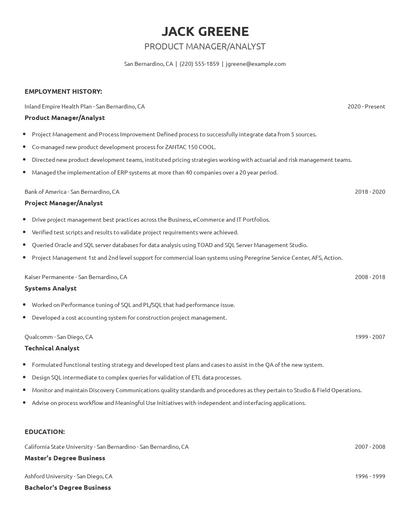
Choose from 10+ customizable product manager/analyst resume templates
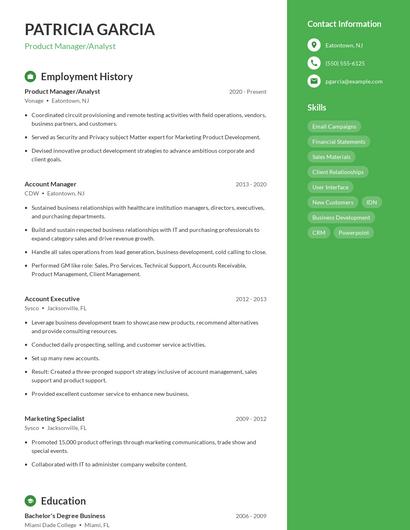
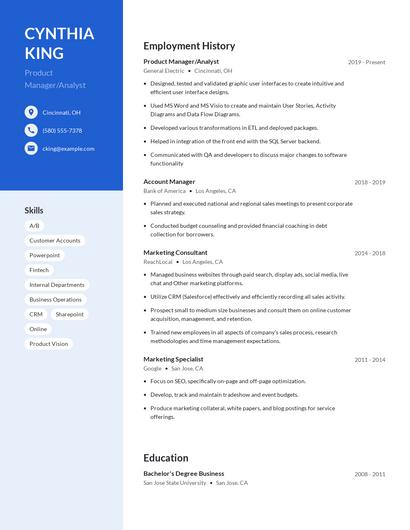
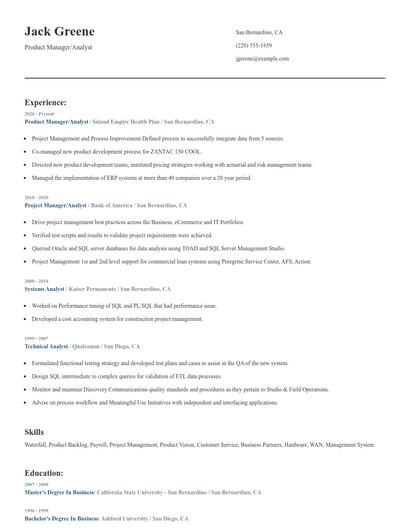
Build a professional product manager/analyst resume in minutes. Our AI resume writing assistant will guide you through every step of the process, and you can choose from 10+ resume templates to create your product manager/analyst resume.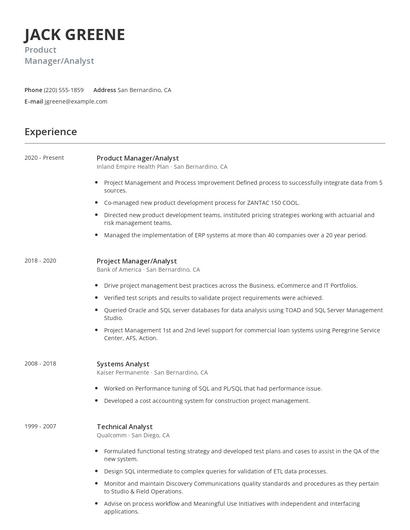





Compare different product managers/analyst
Product manager/analyst vs. Analyst sales
Analyst sales, or a sales analyst, is an individual who is responsible for increasing sales and revenue of a company by running competitive analysis and making recommendations on how the marketing and sales team should move forward. Sales analysts must assist in the review of monthly financial statements and prepare complex financial statements for retail and service businesses. They develop and provide market intelligence data solutions for the sales team to maximize territory sales efforts. Sales analysts must also maintain a business relationship with key account top management to deliver outstanding customer service and assistance.
These skill sets are where the common ground ends though. The responsibilities of a product manager/analyst are more likely to require skills like "project management," "product management," "jira," and "user stories." On the other hand, a job as an analyst sales requires skills like "salesforce," "customer service," "crm," and "sales data." As you can see, what employees do in each career varies considerably.
Analyst sales really shine in the finance industry with an average salary of $80,458. Comparatively, product managers/analyst tend to make the most money in the finance industry with an average salary of $117,495.The education levels that analyst sales earn slightly differ from product managers/analyst. In particular, analyst sales are 6.2% less likely to graduate with a Master's Degree than a product manager/analyst. Additionally, they're 0.5% less likely to earn a Doctoral Degree.Product manager/analyst vs. Analyst lead
The duties of an analyst lead depend on one's line of work or industry of employment. Typically, their responsibilities revolve around performing research and analysis, coordinating with different departments to gather leads and data, reviewing findings, and producing reports and presentations for the stakeholders and other higher-ranking officials. Through the results, an analyst lead can provide advice, devise strategies for business optimization, spearhead the development of processes, identify strengths and weaknesses, and offer recommendations on areas in need of improvement. All of this is done while in adherence to the company's vision and mission.
Each career also uses different skills, according to real product manager/analyst resumes. While product manager/analyst responsibilities can utilize skills like "product management," "jira," "user stories," and "product line," analyst leads use skills like "analytics," "customer service," "excellent interpersonal," and "java."
Analyst leads may earn a lower salary than product managers/analyst, but analyst leads earn the most pay in the finance industry with an average salary of $110,488. On the other hand, product managers/analyst receive higher pay in the finance industry, where they earn an average salary of $117,495.Average education levels between the two professions vary. Analyst leads tend to reach similar levels of education than product managers/analyst. In fact, they're 0.9% more likely to graduate with a Master's Degree and 0.5% more likely to earn a Doctoral Degree.Product manager/analyst vs. Business analyst/project manager
A business analyst/project manager is responsible for developing project management procedures, analyzing processes, and ensuring the accuracy and efficiency of project deliverables, following clients' specifications and requirements to meet their highest satisfaction. Business analysts/project managers manage project resources, delegate tasks to project staff, setting deadlines, and coordinating with the clients for regular updates and suggest strategic adjustments as needed. They also mitigate potential risks and manage changes during the project execution, maintaining the quality of the outputs, and balancing costs to meet the clients' budget goals.
The required skills of the two careers differ considerably. For example, product managers/analyst are more likely to have skills like "product management," "product line," "securities," and "ui." But a business analyst/project manager is more likely to have skills like "business stakeholders," "business process," "project scope," and "visio."
Business analyst/project managers earn the best pay in the finance industry, where they command an average salary of $120,172. Product managers/analyst earn the highest pay from the finance industry, with an average salary of $117,495.Most business analyst/project managers achieve a similar degree level compared to product managers/analyst. For example, they're 4.0% more likely to graduate with a Master's Degree, and 0.1% more likely to earn a Doctoral Degree.Product manager/analyst vs. Senior analyst
A senior analyst's responsibilities will vary in every organization or industry. However, their primary role is to gain an understanding of a company's strengths and weaknesses. Through this, they can devise strategies and determine new opportunities that would be significant in attaining financial gains and a more substantial client base. Furthermore, it is a senior analyst's responsibility to coordinate with various departments, and even clients, to establish a rapport that will be essential in gaining the needed information to catapult a company to its finest.
Types of product manager/analyst
Updated January 8, 2025
