What does a program technician do?

A program technician is responsible for resolving computer software and application issues and performing administrative duties for customer support. Program technicians keep a record of resolution reports and customer files, process payments for program installations and updates, and offer new services to the customers according to their needs and account eligibility. A program technician must have excellent communication and organizational skills, especially in navigating computer systems, to guide the clients with troubleshooting and improving the optimization of applications.
Program technician responsibilities
Here are examples of responsibilities from real program technician resumes:
- Assist in achieving and maintaining DoD certification and national accreditation where applicable.
- Prepare packets, prepare room for presentation with PowerPoint.
- Train in CPR, first aid, safety & emergency procedures, and physical intervention.
- Direct observation of psychiatric patients.
- Provide patients with individual attention.
- Used platforms like SharePoint and AccuTrack to facilitate appointment creation, appointment cancellations, and provide detail information about appointment availability.
- Provide leadership and direction to new and existing staff members; identify training development assuring that training/certification are obtained and maintain.
Program technician skills and personality traits
We calculated that 14% of Program Technicians are proficient in Customer Service, Math, and Technical Support. They’re also known for soft skills such as Compassion, Time-management skills, and Problem-solving skills.
We break down the percentage of Program Technicians that have these skills listed on their resume here:
- Customer Service, 14%
Developed customer satisfaction that increased customer service by 50%
- Math, 14%
Perform math computations associated with assigned duties.
- Technical Support, 12%
Provided technical support to higher graded specialist, independently accomplishing routine projects and assisting with portions of complete projects considered complex.
- FSA, 10%
Monitored, evaluated, and updated producer's eligibility information for participation in FSA programs.
- Program Regulations, 8%
Provide appropriate information to the public regarding program regulations, guidelines and eligibility requirements.
- Software Applications, 7%
Enter data into automated systems using a variety of software applications and retrieving data as required for program operations and reports.
Common skills that a program technician uses to do their job include "customer service," "math," and "technical support." You can find details on the most important program technician responsibilities below.
Compassion. To carry out their duties, the most important skill for a program technician to have is compassion. Their role and responsibilities require that "social and human service assistants often work with people who are in stressful and difficult situations." Program technicians often use compassion in their day-to-day job, as shown by this real resume: "awarded with an on-the-spot customer service award for compassionate patient care at veteran s affairs clinic"
Time-management skills. Another soft skill that's essential for fulfilling program technician duties is time-management skills. The role rewards competence in this skill because "social and human service assistants often work with many clients." According to a program technician resume, here's how program technicians can utilize time-management skills in their job responsibilities: "generated reports for assignments in the talent management system (tms) system for classifications while maintaining deadlines. "
Problem-solving skills. This is an important skill for program technicians to perform their duties. For an example of how program technician responsibilities depend on this skill, consider that "social and human service assistants help clients find solutions to their problems." This excerpt from a resume also shows how vital it is to everyday roles and responsibilities of a program technician: "interacted with customers and provided efficient technical support and solutions for technology based issues. ".
Organizational skills. For certain program technician responsibilities to be completed, the job requires competence in "organizational skills." The day-to-day duties of a program technician rely on this skill, as "social and human service assistants must often complete lots of paperwork and work with many different clients." For example, this snippet was taken directly from a resume about how this skill applies to what program technicians do: "provided coordination, organizational and clerical support to staff.maintained employee payroll. "
Communication skills. Another common skill required for program technician responsibilities is "communication skills." This skill comes up in the duties of program technicians all the time, as "social and human service assistants talk with clients about the challenges in their lives and assist them in getting help." An excerpt from a real program technician resume shows how this skill is central to what a program technician does: "front desk communications with public. "
Interpersonal skills. While "interpersonal skills" is last on this skills list, don't underestimate its importance to program technician responsibilities. Much of what a program technician does relies on this skill, seeing as "social and human service assistants must make their clients feel comfortable discussing sensitive issues." Here is a resume example of how this skill is used in the everyday duties of program technicians: "worked as part of a staff to build conflict resolution, time management, and interpersonal skills. "
The three companies that hire the most program technicians are:
- Caliber Collision100 program technicians jobs
- Cummins48 program technicians jobs
- Microsoft31 program technicians jobs
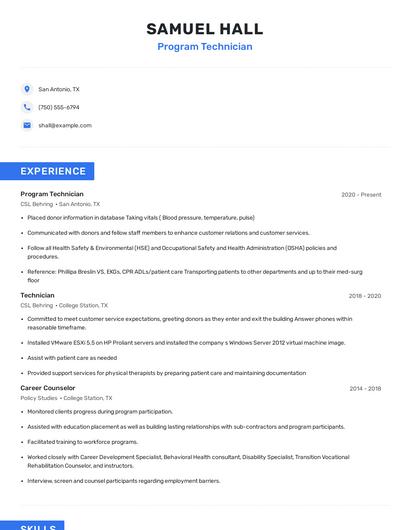
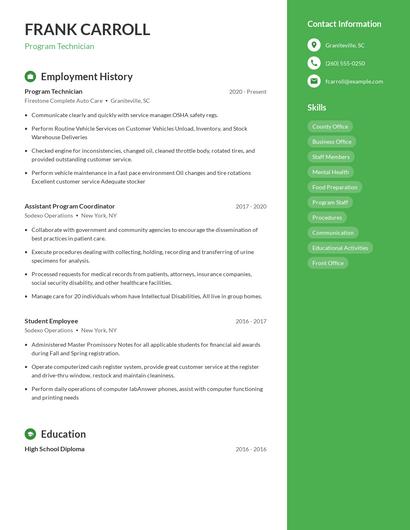
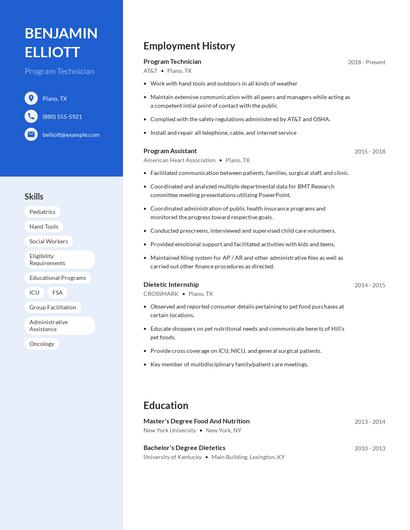
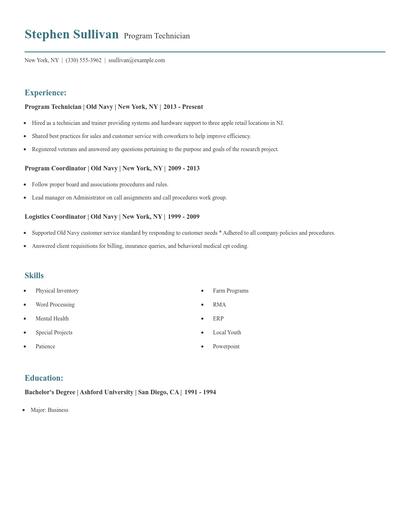
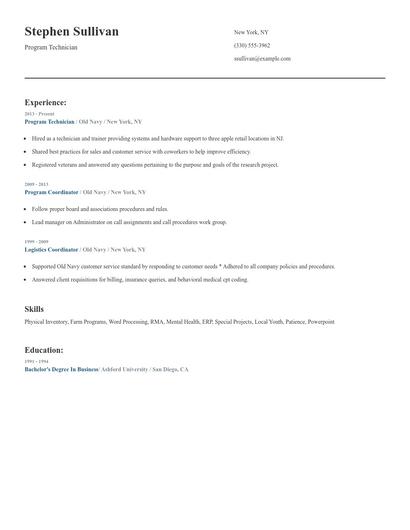
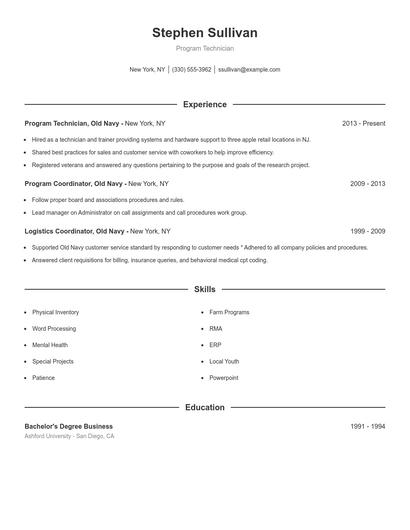
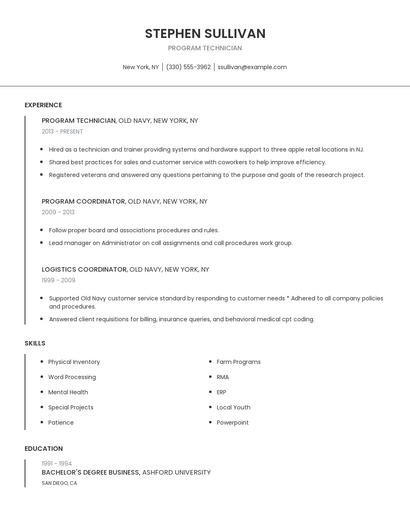
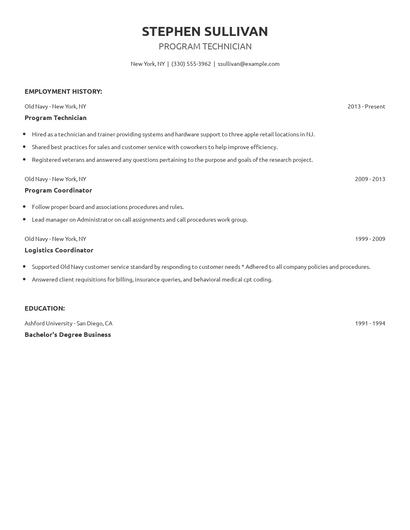
Choose from 10+ customizable program technician resume templates
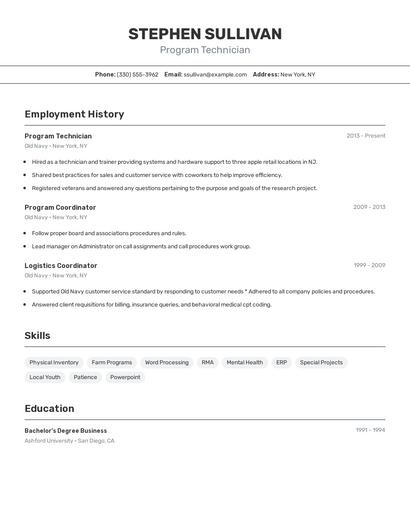
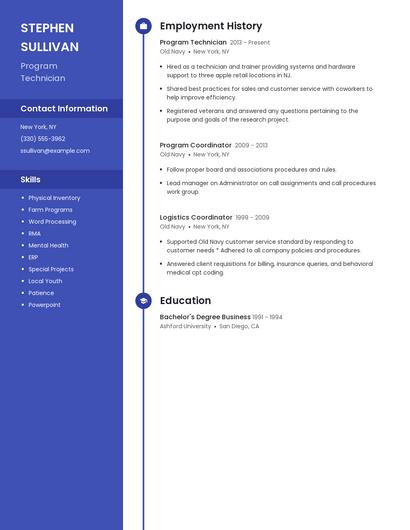
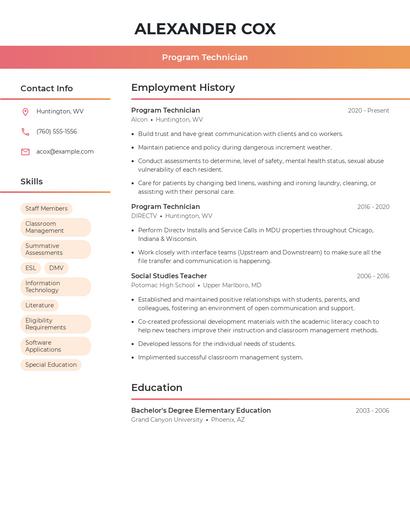
Build a professional program technician resume in minutes. Our AI resume writing assistant will guide you through every step of the process, and you can choose from 10+ resume templates to create your program technician resume.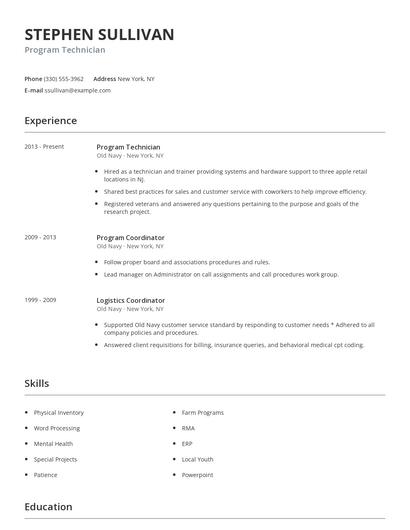
Compare different program technicians
Program technician vs. Volunteer
Volunteers are usually unpaid individuals who render their service to a company or organization. Most of the time, volunteers are skilled in specific areas needed by the organization but prefer to provide free service. They may be employed in another organization, but they lend their time and talent to another organization or company to give back to the community. They raise funds, create awareness, and work on the ground. Volunteers usually choose a cause or advocacy close to their heart, such as teaching children, taking care of the elderly, coaching sports teams, cleaning up communities, and caring for animals.
There are some key differences in the responsibilities of each position. For example, program technician responsibilities require skills like "customer service," "math," "technical support," and "fsa." Meanwhile a typical volunteer has skills in areas such as "child care," "patient charts," "patient care," and "community outreach." This difference in skills reveals the differences in what each career does.
Volunteers tend to reach similar levels of education than program technicians. In fact, volunteers are 2.3% more likely to graduate with a Master's Degree and 0.8% more likely to have a Doctoral Degree.Program technician vs. Resident
A resident, often known as a resident physician, is a medical doctor who just graduated from medical school and pursued the residency program for further training. Residents work with health care team members to provide direct medical care by diagnosing medical problems and devising appropriate treatment plans. Depending on their medical specialty and training, residents may assist in performing surgeries to patients but are supervised by senior residents and physicians. Residents must also have an in-depth understanding of ethical, socioeconomic, and medical-legal issues surrounding patient care.
In addition to the difference in salary, there are some other key differences worth noting. For example, program technician responsibilities are more likely to require skills like "math," "technical support," "fsa," and "program regulations." Meanwhile, a resident has duties that require skills in areas such as "home health," "residency program," "compassion," and "mental health." These differences highlight just how different the day-to-day in each role looks.
Residents earn a higher average salary than program technicians. But residents earn the highest pay in the non profits industry, with an average salary of $67,437. Additionally, program technicians earn the highest salaries in the government with average pay of $43,686 annually.residents earn similar levels of education than program technicians in general. They're 4.3% more likely to graduate with a Master's Degree and 0.8% more likely to earn a Doctoral Degree.Program technician vs. Intake coordinator
An intake coordinator is responsible for assisting patients with admissions to healthcare facilities. Intake coordinators help with the patients' registration process, record their health conditions and medical histories, verify their health insurance information, schedule consultation appointments, manage patients' charts, and respond to patients' inquiries and concerns. Intake coordinators perform administrative and clerical tasks as needed, such as entering patients' information on the database, filing necessary insurance documents, and creating reports. They must be detail-oriented, as well as have excellent communication and organization skills.
There are many key differences between these two careers, including some of the skills required to perform responsibilities within each role. For example, a program technician is likely to be skilled in "math," "technical support," "fsa," and "program regulations," while a typical intake coordinator is skilled in "home health," "patient referrals," "mental health," and "insurance verification."
Intake coordinators earn the best pay in the health care industry, where they command an average salary of $37,268. Program technicians earn the highest pay from the government industry, with an average salary of $43,686.intake coordinators typically earn higher educational levels compared to program technicians. Specifically, they're 6.7% more likely to graduate with a Master's Degree, and 0.2% more likely to earn a Doctoral Degree.Program technician vs. Service worker
A service worker is responsible for assisting the community welfare development by providing social services to an organization or specific individual groups, supporting their needs, and addressing their community concerns. Service workers also offer counseling services to their clients to guide them on how they manage their life crises, developing community activities and job opportunities to help citizens with their financial needs by consulting local organizations. A service worker must have strong leadership and communication skills, as well as deep engagement with the community to assess the client's situation properly.
Even though a few skill sets overlap between program technicians and service workers, there are some differences that are important to note. For one, a program technician might have more use for skills like "math," "technical support," "fsa," and "program regulations." Meanwhile, some responsibilities of service workers require skills like "cleanliness," "excellent interpersonal," "team-oriented environment," and "crisis intervention. "
In general, service workers earn the most working in the government industry, with an average salary of $36,743. The highest-paying industry for a program technician is the government industry.service workers reach similar levels of education compared to program technicians, in general. The difference is that they're 2.8% more likely to earn a Master's Degree, and 0.3% less likely to graduate with a Doctoral Degree.Types of program technician
Updated January 8, 2025
