What does a project scientist do?
A Project Scientist is responsible for conducting tests and evaluations of existing products and reporting the findings. The industries they may work in include textiles technology, polymer technology, chemical sciences, and chemical engineering.
Project scientist responsibilities
Here are examples of responsibilities from real project scientist resumes:
- Manage clearance sampling and responsible for final clearance readings and other duties as directed by EPA.
- Manage the GIS data set and develop maps to support interim actions, the risk assessment, and the RI/FS.
- Develop and manage company asbestos inspection program.
- Develop and manage company EHS compliance processes in accordance with current and upcoming regulatory mandates.
- Develop QC HPLC procedure for raw materials and finish products.
- Perform RNA extraction, RT-PCR and qPCR to evaluate gene regulation on Bcl3 mutants.
- Perform all aspects of analysis on API, raw materials and final product.
- Oversee project permit compliance regarding environmental, water quality, land use and OSHA requirements.
- Perform analytical testing using following methods: SFC, LC/MS, ICP/MS, GC/MS, HPLC.
- Purpose of the program are to develop a body of data to compare to the factors publish by the EPA.
- Analyze Geotechnical parameters of core samples from Atlantic shelf sea floor, studying slope stability and determining hazards' analysis.
- Conduct comprehensive asbestos surveys of telecommunication facilities.
- Establish direct ELISA method for quantitative analysis of antibodies.
- Lead instrumentation engineer responsible for oversight and coordination of field-testing.
- Develop information processing and GIS solutions using advance software and programming languages.
Project scientist skills and personality traits
We calculated that 10% of Project Scientists are proficient in Data Analysis, Research Projects, and Oversight. They’re also known for soft skills such as Observation skills, Communication skills, and Analytical skills.
We break down the percentage of Project Scientists that have these skills listed on their resume here:
- Data Analysis, 10%
Provided customers with reports and effectiveness/efficiency assessments of company technology performance, based upon data analysis results.
- Research Projects, 9%
Fostered relationships with area experts and established collaborative research projects with key opinion leaders.
- Oversight, 7%
Completed health & safety and industrial hygiene oversight for excavation activities related to utility installations at areas impacted with hydrocarbons.
- Data Management, 6%
Supported data management and validation activities for environmental chemistry data.
- Technical Reports, 4%
Standardized and implemented a company-specific standard format for geologic logging documents incorporated into technical reports submitted to state and government agencies.
- EPA, 4%
Followed EPA and Florida Department of Environmental Protection sample procurement procedures.
Common skills that a project scientist uses to do their job include "data analysis," "research projects," and "oversight." You can find details on the most important project scientist responsibilities below.
Observation skills. The most essential soft skill for a project scientist to carry out their responsibilities is observation skills. This skill is important for the role because "medical scientists conduct experiments that require monitoring samples and other health-related data." Additionally, a project scientist resume shows how their duties depend on observation skills: "completed technical reports based on observations and interpretation of analytical data regarding water quality analytics. "
Communication skills. Another soft skill that's essential for fulfilling project scientist duties is communication skills. The role rewards competence in this skill because "medical scientists must be able to explain their research in nontechnical ways." According to a project scientist resume, here's how project scientists can utilize communication skills in their job responsibilities: "improved client/consultant communication and assisted in hazardous materials placement, disposal and identification. "
The three companies that hire the most project scientists are:
- Cedars-Sinai23 project scientists jobs
- Danaher16 project scientists jobs
- Stantec11 project scientists jobs
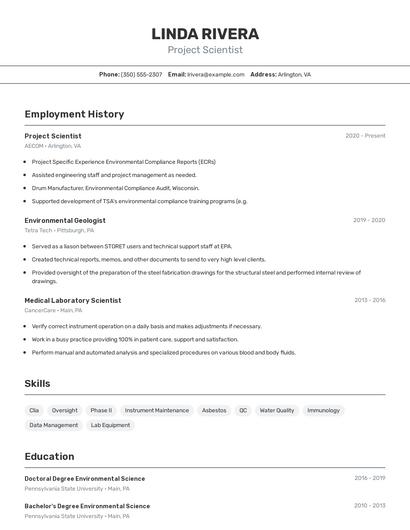
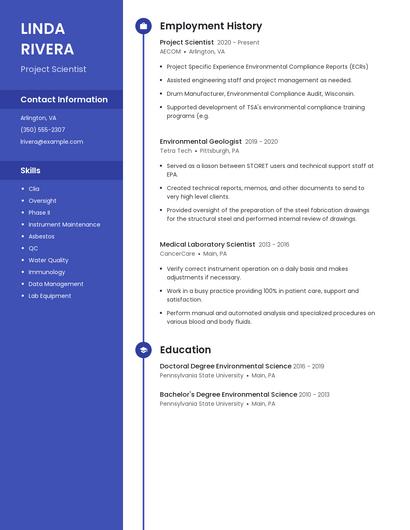
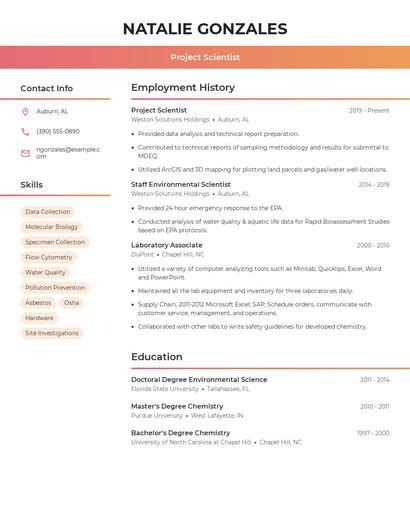
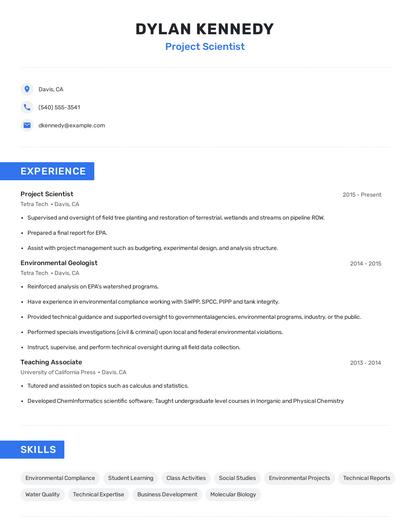
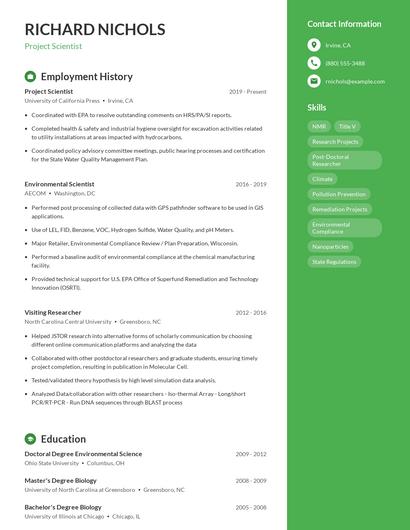
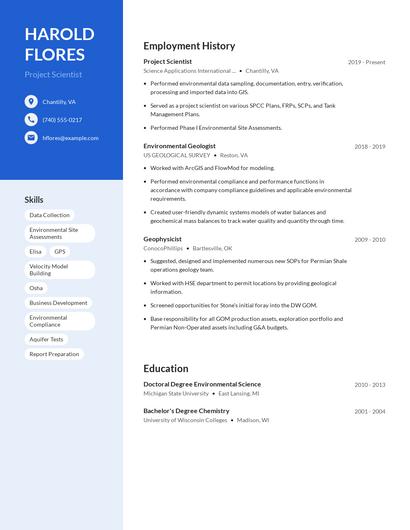
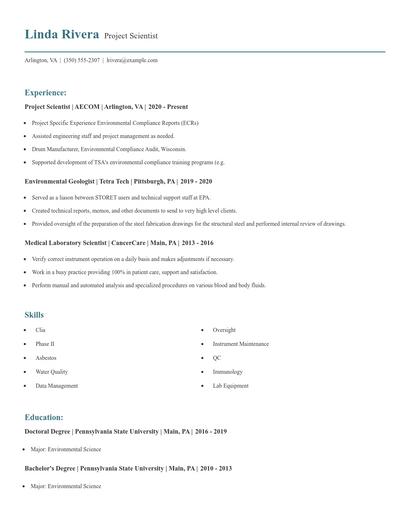
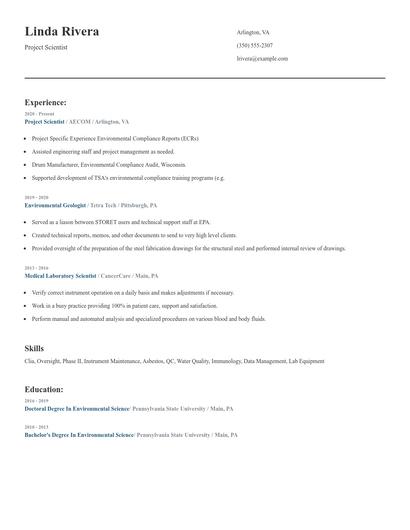
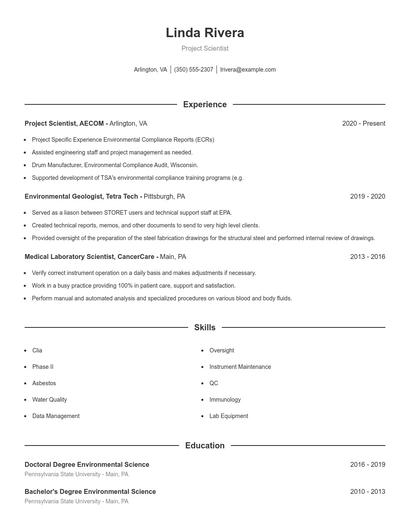
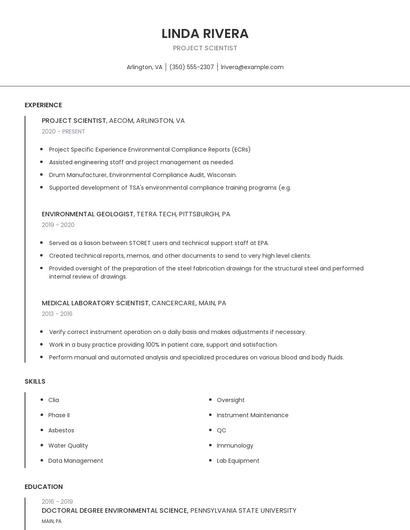
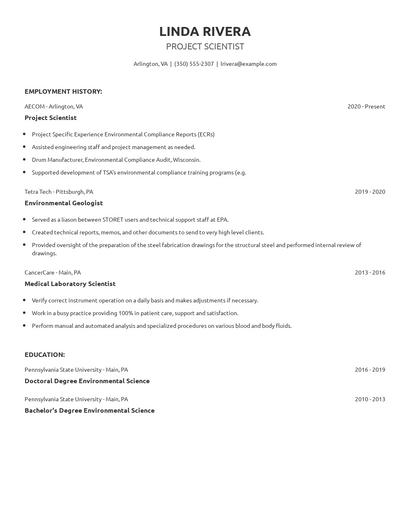
Choose from 10+ customizable project scientist resume templates
Build a professional project scientist resume in minutes. Our AI resume writing assistant will guide you through every step of the process, and you can choose from 10+ resume templates to create your project scientist resume.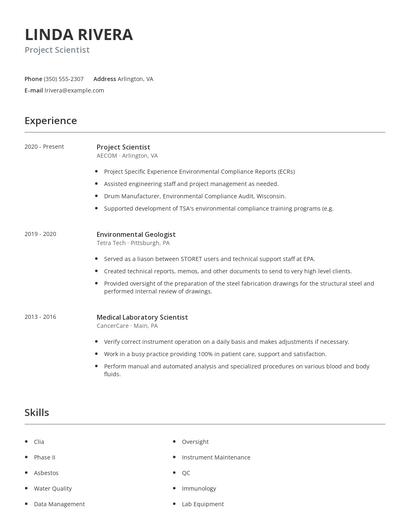
Compare different project scientists
Project scientist vs. Fellow
A fellow's responsibility will depend on the organization or industry where one belongs. However, most of the time, a fellow's duty will revolve around conducting research and analysis, presiding discussions and attending dialogues, handle lectures while complying with the guidelines or tasks set by supervisors, and assist in various projects and activities. Furthermore, a fellow must adhere to the institution or organization's policies and regulations at all times, meet all the requirements and outputs involved, and coordinate with every person in the workforce.
There are some key differences in the responsibilities of each position. For example, project scientist responsibilities require skills like "oversight," "data management," "technical reports," and "epa." Meanwhile a typical fellow has skills in areas such as "patients," "professional development," "veterans," and "mathematics." This difference in skills reveals the differences in what each career does.
Fellows really shine in the professional industry with an average salary of $67,978. Comparatively, project scientists tend to make the most money in the technology industry with an average salary of $96,408.On average, fellows reach similar levels of education than project scientists. Fellows are 1.0% more likely to earn a Master's Degree and 0.1% less likely to graduate with a Doctoral Degree.Project scientist vs. Research fellow
A research fellow is an academic researcher who conducts research and analysis of comprehensive literature, data, and results and provides literature reviews. He/She supervises research assistants and recruits study participants to interview them for a particular study. To become a research fellow, a candidate should have a doctorate in a relevant discipline and publish peer-reviewed papers. Also, a research fellow can be an independent investigator or be supervised by a principal investigator.
Each career also uses different skills, according to real project scientist resumes. While project scientist responsibilities can utilize skills like "oversight," "data management," "technical reports," and "epa," research fellows use skills like "patients," "cell culture," "immunology," and "crispr."
On average, research fellows earn a lower salary than project scientists. Some industries support higher salaries in each profession. Interestingly enough, research fellows earn the most pay in the non profits industry with an average salary of $57,261. Whereas project scientists have higher pay in the technology industry, with an average salary of $96,408.research fellows earn similar levels of education than project scientists in general. They're 3.2% more likely to graduate with a Master's Degree and 0.1% more likely to earn a Doctoral Degree.What technology do you think will become more important and prevalent for project scientists in the next 3-5 years?
Dr. Betsy Smith
Assistant Professor of Chemistry, Elmira College
Project scientist vs. Researcher
A researcher is responsible for collating, organizing, and verifying necessary information for a specific subject. Researchers' duties include analyzing data, gathering and comparing resources, ensuring facts, sharing findings with the whole research team, adhering to required methodologies, performing fieldwork as needed, and keeping critical information confidential. Researchers must be knowledgeable about the current market trends and align findings with the research goals. A researcher must show strong communication skills, as well as strong attention to detail and time-management skills to meet deadlines under minimal supervision.
Some important key differences between the two careers include a few of the skills necessary to fulfill the responsibilities of each. Some examples from project scientist resumes include skills like "research projects," "oversight," "data management," and "technical reports," whereas a researcher is more likely to list skills in "python," "lab equipment," "c++," and "data collection. "
When it comes to education, researchers tend to earn similar degree levels compared to project scientists. In fact, they're 1.9% less likely to earn a Master's Degree, and 9.2% less likely to graduate with a Doctoral Degree.Project scientist vs. Phd researcher
The primary job of a Ph.D. researcher is to plan and conduct experiments and analyzing their outcome. You will collect, organize, and analyze data and opinions to solve issues and predict trends. Other tasks you will perform include doing fieldwork to collect samples, writing reports, research papers, and reviews, and organizing materials testing. In addition, you need to liaise with research and production staff, develop ways to resolve problems, and supervise junior research staff.
Types of project scientist
Updated January 8, 2025
