What does a quality assistant do?
Quality Assistants will, in some cases, require only a high school diploma, while other positions may need degrees in chemistry, engineering, or computer science. There are even some related bachelor's, master's, and doctoral degrees in the field for those wishing to take their career to the next level. Skills in leadership, organization, planning, communication, statistical analysis, problem-solving, and industry-specific technical knowledge will be vital, and the payout for this career comes in at around $46K per year. Those who make this career choice will receive responsibilities such as ensuring safety and specification standards for product production so that any products can be brought to the final stage.
Quality assistant responsibilities
Here are examples of responsibilities from real quality assistant resumes:
- Manage and maintain tracking system for all company QC s and record when review.
- Manage the logistics requirements, handling, processing, and repairing of avionics equipment and avionics support equipment.
- Adhere to GCP, cGMP, and FDA standards and policies.
- Train and mentor production employees to AS9100 requirements.
- Schedule and conduct meetings, coordinate ISO document training, and assist with quality initiatives.
- Travel to other offices to provide training, receive program feedback and generally strengthen the QC process.
- Train as an ISO auditor, as well as facilitator of all ISO upgrades and distribution to the organization.
- Check calibration of calipers and comparator.
- Check calibration weekly on calipers and comparator.
- Support both internal and external CAPA relate audit activities
- Maintain corporate control folders on network and SharePoint.
- Release and maintain all program and engineering documentation in a document library on SharePoint.
- Define and implement intervals of reviewing the QMS for the continuous suitability, adequacy, effectiveness and efficiency.
- Work with collaborative and cross-functional team to prepare dimensional inspection reports of various CNC components after reading and understanding engineering drawings.
- Used UNIX command line and UNIX scripting to work with files.
Quality assistant skills and personality traits
We calculated that 13% of Quality Assistants are proficient in Internal Audit, Data Entry, and Quality Improvement. They’re also known for soft skills such as Interpersonal skills, Leadership skills, and Problem-solving skills.
We break down the percentage of Quality Assistants that have these skills listed on their resume here:
- Internal Audit, 13%
Conduct internal audits, including closing out audit finding, creating audits finding reports and determine proper corrective and preventive actions.
- Data Entry, 11%
Tracked participation, performed data collection, and completed data entry with accuracy.
- Quality Improvement, 8%
Represent Quality Improvement Director at internal and external meetings when the Quality Improvement Director is not available.
- Data Collection, 7%
Performed data collection and entry of confidential information into statistical analysis programs such as STATA, Excel, and government databases.
- Inspection Reports, 7%
Reviewed travelers, blueprints, and first article inspection reports.
- ISO, 6%
Led ISO implementation and Quality Systems development to meet key customer requirements and improve consistency.
Common skills that a quality assistant uses to do their job include "internal audit," "data entry," and "quality improvement." You can find details on the most important quality assistant responsibilities below.
Interpersonal skills. The most essential soft skill for a quality assistant to carry out their responsibilities is interpersonal skills. This skill is important for the role because "industrial production managers must have excellent communication skills to work well other managers and with staff." Additionally, a quality assistant resume shows how their duties depend on interpersonal skills: "used organization, communication, and interpersonal skills to facilitate a highly effective, customer service oriented environment. "
Leadership skills. Another soft skill that's essential for fulfilling quality assistant duties is leadership skills. The role rewards competence in this skill because "to keep the production process running smoothly, industrial production managers must motivate and direct employees." According to a quality assistant resume, here's how quality assistants can utilize leadership skills in their job responsibilities: "coordinated all quality assurance activities.provided leadership for quality training awareness with the quality management system. "
Problem-solving skills. quality assistants are also known for problem-solving skills, which are critical to their duties. You can see how this skill relates to quality assistant responsibilities, because "production managers must identify and address problems that arise." A quality assistant resume example shows how problem-solving skills is used in the workplace: "updated customer accounts and resolved customer issues. "
The three companies that hire the most quality assistants are:
- Grand View Health13 quality assistants jobs
- Queens Health Systems5 quality assistants jobs
- Northrop Grumman4 quality assistants jobs
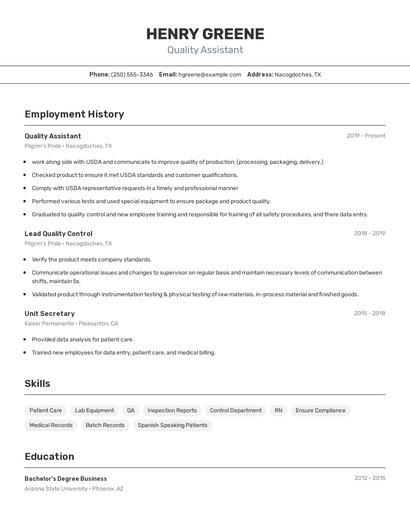
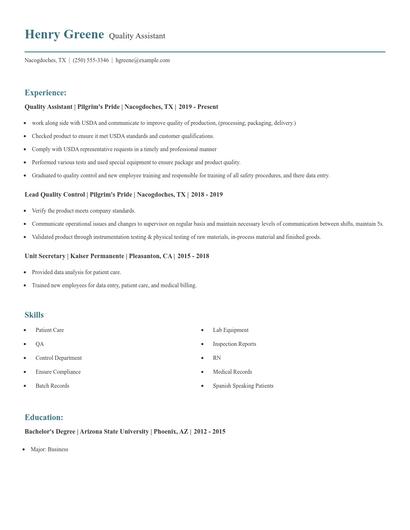
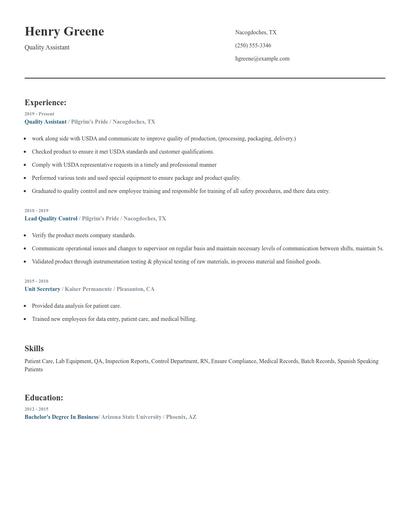
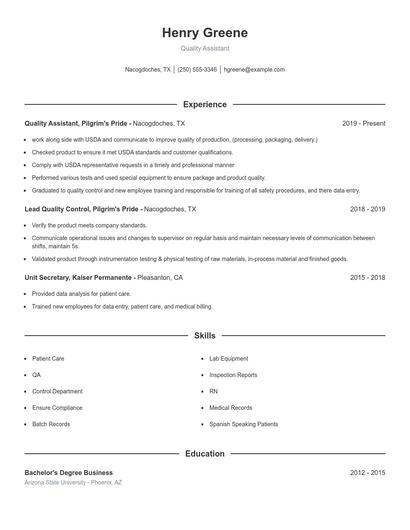
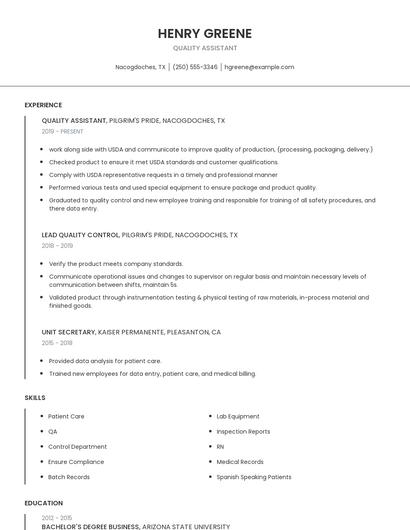
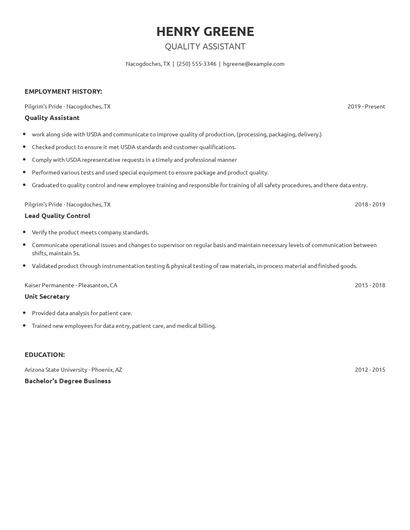
Choose from 10+ customizable quality assistant resume templates
Build a professional quality assistant resume in minutes. Our AI resume writing assistant will guide you through every step of the process, and you can choose from 10+ resume templates to create your quality assistant resume.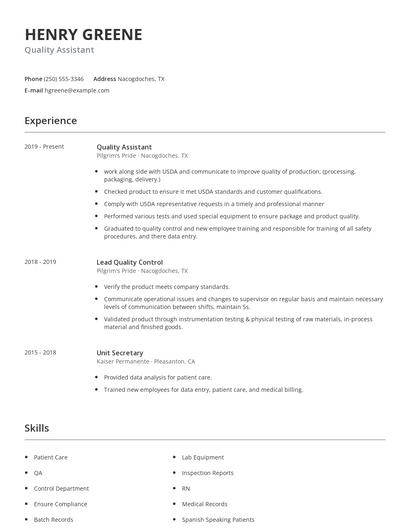


Compare different quality assistants
Quality assistant vs. Auditor/quality
A quality auditor is responsible for inspecting the company's services and products, ensuring its adherence to business requirements and internal regulations. Quality auditors analyze the efficiency of operational functions and production processes to maintain high-quality deliverables with the utmost consideration for the safety and security of the production staff. They run quality checks for the outputs, create findings reports, and strategize methodologies to enhance stability by utilizing standard testing parameters. A quality auditor must have excellent communication and organizational skills, as they may also recommend opportunities to generate more resources and increase revenues.
While similarities exist, there are also some differences between quality assistants and auditor/quality. For instance, quality assistant responsibilities require skills such as "data entry," "quality improvement," "data collection," and "inspection reports." Whereas a auditor/quality is skilled in "excellent interpersonal," "excellent organizational," "audit findings," and "customer service." This is part of what separates the two careers.
Auditors/quality earn the highest salaries when working in the retail industry, with an average yearly salary of $40,479. On the other hand, quality assistants are paid more in the automotive industry with an average salary of $44,057.On average, auditors/quality reach similar levels of education than quality assistants. Auditors/quality are 0.2% more likely to earn a Master's Degree and 0.2% less likely to graduate with a Doctoral Degree.Quality assistant vs. Quality control internship
A quality control internship is a trainee employee who gains experience by working in the quality control department of a company's production facility. Quality control interns must analyze production lines and devise test procedures to identify manufacturing deficiencies that cause quality control issues. To address manufacturing deficiencies, quality control interns should coordinate with the facility's supervisors and site contractors. Quality control interns must also create standard operating procedures (SOP) for tests so that they can increase product quality as well as customer satisfaction.
In addition to the difference in salary, there are some other key differences worth noting. For example, quality assistant responsibilities are more likely to require skills like "inspection reports," "quality management system," "customer specifications," and "assist quality." Meanwhile, a quality control internship has duties that require skills in areas such as "patients," "management system," "test procedures," and "lab equipment." These differences highlight just how different the day-to-day in each role looks.
On average, quality control interns earn a lower salary than quality assistants. Some industries support higher salaries in each profession. Interestingly enough, quality control interns earn the most pay in the technology industry with an average salary of $43,840. Whereas quality assistants have higher pay in the automotive industry, with an average salary of $44,057.In general, quality control interns achieve higher levels of education than quality assistants. They're 5.7% more likely to obtain a Master's Degree while being 0.2% more likely to earn a Doctoral Degree.Quality assistant vs. Quality control clerk
Quality control assistants analyze and audit the quality control manager's paperwork, as well as calibrate equipment to ensure its proper function and inspect products for flaws or defects. They will need to be able to analyze quality, be thorough and attentive, and have a keen attention to detail for this career. They will also work under a lead and with other team members to collaborate on workflows.
The required skills of the two careers differ considerably. For example, quality assistants are more likely to have skills like "internal audit," "quality improvement," "data collection," and "corrective action." But a quality control clerk is more likely to have skills like "quality control procedures," "inventory control," "cycle counts," and "usda."
Quality control clerks earn the best pay in the technology industry, where they command an average salary of $33,318. Quality assistants earn the highest pay from the automotive industry, with an average salary of $44,057.Most quality control clerks achieve a similar degree level compared to quality assistants. For example, they're 3.4% less likely to graduate with a Master's Degree, and 0.3% less likely to earn a Doctoral Degree.Quality assistant vs. Quality coordinator
A quality coordinator is responsible for monitoring quality control and testing procedures, ensuring that the processes and policies adhere to the company's standards and business requirements. Quality coordinators assist the project management team in developing strategic techniques according to clients' specifications from conceptualization to the final outputs. They recommend cost-reduction materials depending on the budget limitations, as well as conducting audits and creating reports. A quality coordinator must be highly organizational and communicative, especially on suggesting opportunities to increase revenues and drive more client partnerships.
Even though a few skill sets overlap between quality assistants and quality coordinators, there are some differences that are important to note. For one, a quality assistant might have more use for skills like "inspection reports," "qa," "assist quality," and "purchase orders." Meanwhile, some responsibilities of quality coordinators require skills like "patients," "performance improvement," "customer service," and "patient care. "
The automotive industry tends to pay the highest salaries for quality coordinators, with average annual pay of $69,646. Comparatively, the highest quality assistant annual salary comes from the automotive industry.In general, quality coordinators hold higher degree levels compared to quality assistants. Quality coordinators are 6.1% more likely to earn their Master's Degree and 0.3% more likely to graduate with a Doctoral Degree.Types of quality assistant
Updated January 8, 2025
