What does a sanitation supervisor do?
Sanitation supervisors are responsible for supervising the manufacturing process to regulate sanitation protocols. They design and execute sanitation policies and procedures. Their duties include coordinating and keeping track of cleaning routines as well as create and disseminating work schedules for the sanitation staff. Also, they do a daily checkup of the manufacturing facility, record any irregularities, and implement reformative actions to make certain compliance with monitoring authorities. Additionally, observe the preparation and utilization of cleaning chemicals as well as train sanitation staff and arrange refresher workshops for the workers.
Sanitation supervisor responsibilities
Here are examples of responsibilities from real sanitation supervisor resumes:
- Achieve an SQF rating of 97/100 and a 91/100 with surprise inspections at a facility.
- Implement and maintain SSOP for grocery warehouse and lead sanitation team members in doing so.
- Manage overall package and product quality to ensure all specifications are according to FDA, GMP, and ISO standards.
- Manage day-to-day production/sanitation operations in a USDA poultry processing facility.
- Eliminate down time while maintaining the highest level of regulatory standards of the USDA and FDA.
- Work with USDA to ensure the facility are following USDA guidelines and the facility master HACCP plan.
- Direct and perform cleaning and sanitizing of all production areas and equipment in accordance with USDA and FDA regulations.
- Champion audits of facilities sanitation program by USDA and various customers successfully.
- Maintain, organize and implement proper sanitation procedures to ensure cleanliness and efficiency of plant.
- Improve HACCP plan, control rework inventory, and coordinate sanitation programs.
- Perform testings on weekly basis for mold, allergens with ACCUPOINT ATP reader.
- Prepare for annual SQF (safe quality food) audit plus monthly sanitation audits.
- Assure compliance to sanitation standard operating procedure (SSOP) via training and accountability.
- Distribute personal protective equipment and ensure all staff members working wear PPE as per company policy.
- Perform ATP swab testing on all food contact surfaces and visually inspect all non-food contact surfaces.
Sanitation supervisor skills and personality traits
We calculated that 12% of Sanitation Supervisors are proficient in Food Safety, GMP, and Master Sanitation Schedule. They’re also known for soft skills such as Ability to use technology, Communication skills, and Detail oriented.
We break down the percentage of Sanitation Supervisors that have these skills listed on their resume here:
- Food Safety, 12%
Establish and maintain FDA and food safety regulatory requirements for a major food manufacturing facility.
- GMP, 6%
Maintained supportive documentation for the sanitation standard operating procedures, GMP's and master sanitation schedule.
- Master Sanitation Schedule, 6%
Maintained Master Sanitation Schedule compiling reports regarding regular inspection, sanitation violations, and taking steps to resolve deficiencies.
- HACCP, 5%
Trained in HACCP, and works as a member of the HACCP team to ensure our product meets the highest standards.
- FDA, 4%
Directed and performed cleaning and sanitizing of all production areas and equipment in accordance with USDA and FDA regulations.
- Cleanliness, 4%
Maintained, organized and implement proper sanitation procedures to ensure cleanliness and efficiency of plant.
Common skills that a sanitation supervisor uses to do their job include "food safety," "gmp," and "master sanitation schedule." You can find details on the most important sanitation supervisor responsibilities below.
Ability to use technology. The most essential soft skill for a sanitation supervisor to carry out their responsibilities is ability to use technology. This skill is important for the role because "occupational health and safety specialists and technicians must be able to use advanced technology." Additionally, a sanitation supervisor resume shows how their duties depend on ability to use technology: "provide support to manufacturing management during internal audits and during external regulatory inspections such as the fda and other regulatory agencies. "
Communication skills. Another essential skill to perform sanitation supervisor duties is communication skills. Sanitation supervisors responsibilities require that "occupational health and safety specialists and technicians must be able to communicate safety instructions and concerns to employees and managers." Sanitation supervisors also use communication skills in their role according to a real resume snippet: "established improved inventory control management via consistent inter-departmental communications. "
Detail oriented. This is an important skill for sanitation supervisors to perform their duties. For an example of how sanitation supervisor responsibilities depend on this skill, consider that "occupational health and safety specialists and technicians need to understand and follow safety standards and complex government regulations." This excerpt from a resume also shows how vital it is to everyday roles and responsibilities of a sanitation supervisor: "detailed cleaning in sanitation throughout facility, kept building in clean and orderly condition for usda. ".
Problem-solving skills. A big part of what sanitation supervisors do relies on "problem-solving skills." You can see how essential it is to sanitation supervisor responsibilities because "occupational health and safety specialists and technicians must be able to solve problems in order to design and implement workplace processes and procedures that help protect workers from hazardous conditions." Here's an example of how this skill is used from a resume that represents typical sanitation supervisor tasks: "resolved pre-op, atp and micro issues. "
The three companies that hire the most sanitation supervisors are:
- Conagra Brands23 sanitation supervisors jobs
- Compass Group USA14 sanitation supervisors jobs
- Kwik Trip7 sanitation supervisors jobs
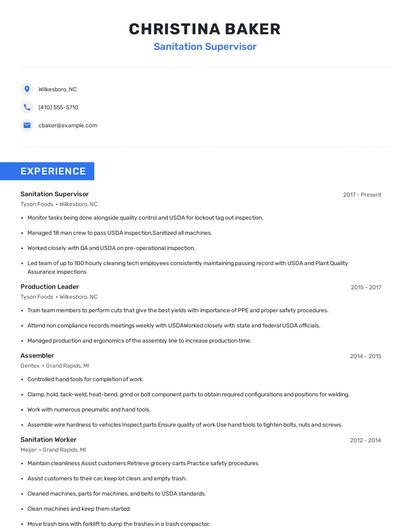
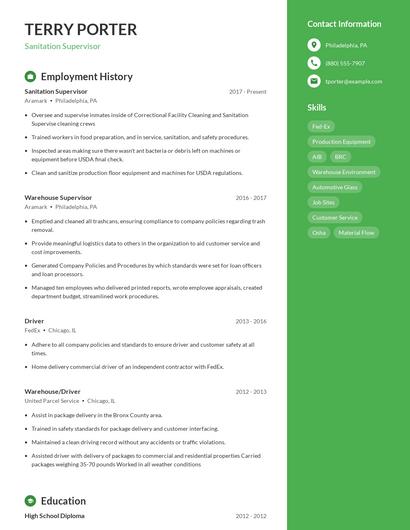
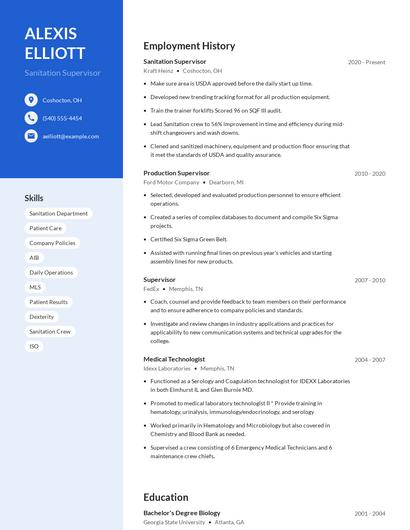
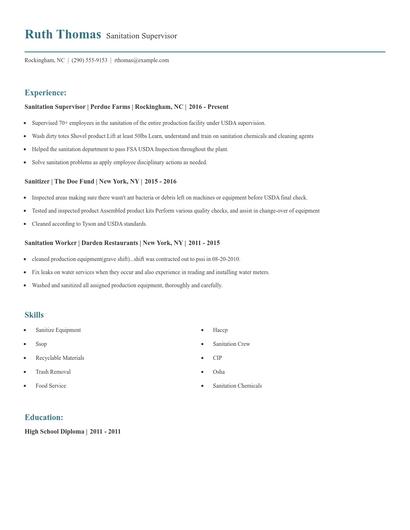
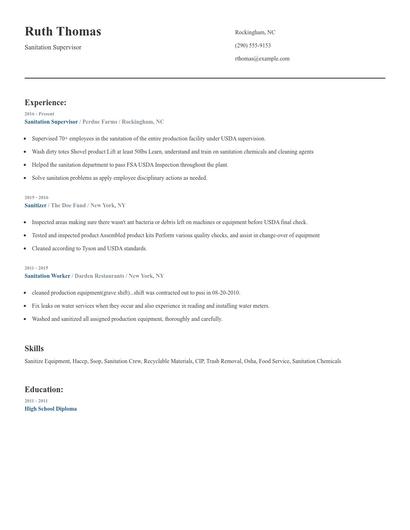
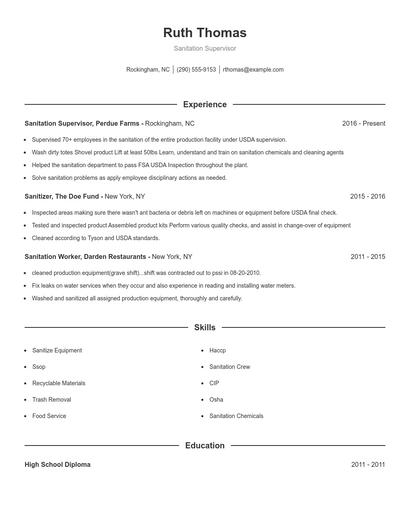
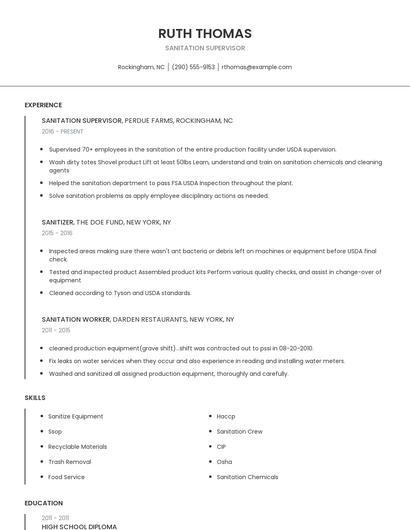
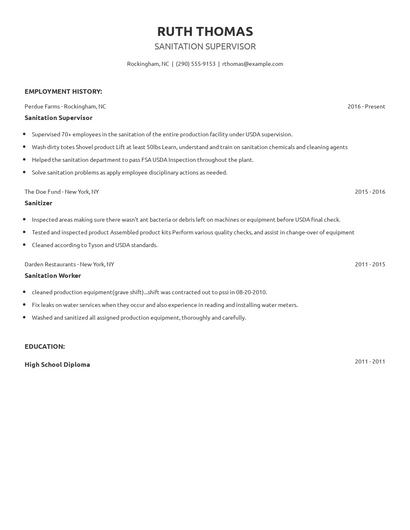
Choose from 10+ customizable sanitation supervisor resume templates
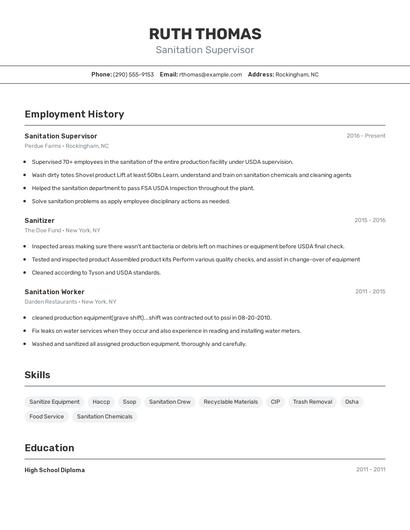
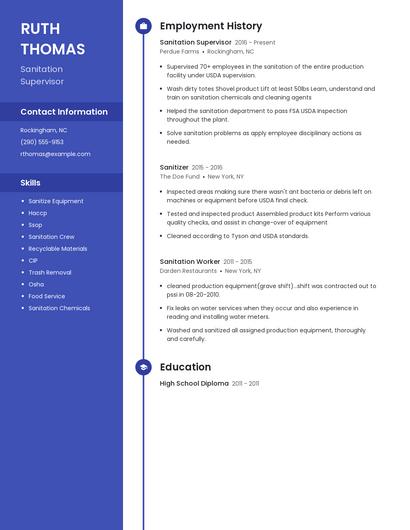
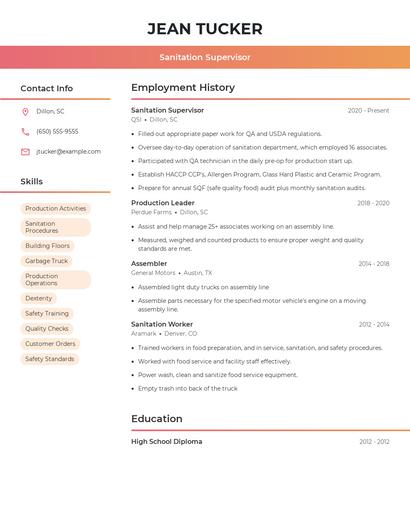
Build a professional sanitation supervisor resume in minutes. Our AI resume writing assistant will guide you through every step of the process, and you can choose from 10+ resume templates to create your sanitation supervisor resume.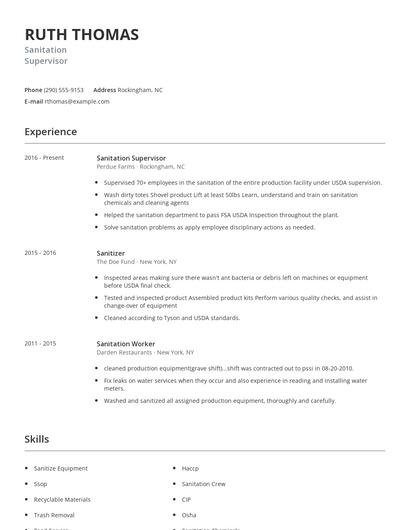
Compare different sanitation supervisors
Sanitation supervisor vs. Assembly supervisor
Assembly Supervisors oversee and coordinate employees' work on assembly-lines. The supervisors assign personnel to stations or tasks and prepare their work schedules. They monitor processes to make sure that the employees are carrying out their tasks correctly. It is their responsibility to monitor the whole assembly process for delay prevention. They also contribute to developing procedures and processes to boost the overall operation of the assembly lines.
There are some key differences in the responsibilities of each position. For example, sanitation supervisor responsibilities require skills like "food safety," "gmp," "master sanitation schedule," and "haccp." Meanwhile a typical assembly supervisor has skills in areas such as "assembly line," "assembly operations," "delivery dates," and "assembly procedures." This difference in skills reveals the differences in what each career does.
Assembly supervisors earn the highest salaries when working in the automotive industry, with an average yearly salary of $79,821. On the other hand, sanitation supervisors are paid more in the hospitality industry with an average salary of $53,282.assembly supervisors tend to reach similar levels of education than sanitation supervisors. In fact, assembly supervisors are 0.8% more likely to graduate with a Master's Degree and 0.2% less likely to have a Doctoral Degree.Sanitation supervisor vs. Production supervisor/manager
Production supervision managers display strong skills in supervision, decision-making, effective planning, and also have a keen eye for detail. This career will call on the maintenance of a production line's operations, as well as the ongoing production of the end product, in addition to maximizing production while maintaining quality products and staff safety.
Each career also uses different skills, according to real sanitation supervisor resumes. While sanitation supervisor responsibilities can utilize skills like "food safety," "master sanitation schedule," "cleanliness," and "osha," production supervisors/manager use skills like "spc," "production supervisors," "on-time delivery," and "production facility."
Production supervisors/manager earn similar levels of education than sanitation supervisors in general. They're 3.5% more likely to graduate with a Master's Degree and 0.2% more likely to earn a Doctoral Degree.Sanitation supervisor vs. Welding supervisor
A working supervisor is responsible for overseeing the daily performance of employees. Depending on the business, company, or organization, a working supervisor's primary job is to orchestrate coordinated teamwork. This job requires excellent communication and organizational skills. These skills ensure that working supervisors can transfer information or instructions from higher-level management to employees and provide reports to upper management.
There are many key differences between these two careers, including some of the skills required to perform responsibilities within each role. For example, a sanitation supervisor is likely to be skilled in "food safety," "gmp," "master sanitation schedule," and "haccp," while a typical welding supervisor is skilled in "gmaw," "blueprint specifications," "aluminum," and "aws."
Welding supervisors earn the highest salary when working in the professional industry, where they receive an average salary of $56,748. Comparatively, sanitation supervisors have the highest earning potential in the hospitality industry, with an average salary of $53,282.When it comes to education, welding supervisors tend to earn similar degree levels compared to sanitation supervisors. In fact, they're 0.1% more likely to earn a Master's Degree, and 0.1% more likely to graduate with a Doctoral Degree.Sanitation supervisor vs. Working supervisor
Even though a few skill sets overlap between sanitation supervisors and working supervisors, there are some differences that are important to note. For one, a sanitation supervisor might have more use for skills like "food safety," "gmp," "master sanitation schedule," and "haccp." Meanwhile, some responsibilities of working supervisors require skills like "direct supervision," "grass," "payroll," and "community resources. "
In general, working supervisors earn the most working in the government industry, with an average salary of $51,102. The highest-paying industry for a sanitation supervisor is the hospitality industry.working supervisors reach similar levels of education compared to sanitation supervisors, in general. The difference is that they're 3.1% more likely to earn a Master's Degree, and 0.2% more likely to graduate with a Doctoral Degree.Types of sanitation supervisor
Updated January 8, 2025
