What does a security monitor do?
A security monitor collects and analyzes information for detecting unauthorized systems or suspicious changes on the network. This job requires the person to define the behavior that triggers the alerts. The personnel makes sure that the property is safe, including that inside from fire, home intrusion, burglary, and any other environmental disasters. Among the necessary skills for this job include attention to detail, alertness, analytical thinking, and communication skills.
Security monitor responsibilities
Here are examples of responsibilities from real security monitor resumes:
- Check operating equipment to ensure proper use and cleanliness.
- Monitor and maintain 300 plus CCTV cameras for on and off campus locations.
- Provide technical support to lower level JPAS users with account lockouts, creations, modifications, and password resets.
- Monitor personnel security to ensure investigations are up to date, maintain visit request both paper and electronic using JPAS.
- Monitor, investigate, and report suspicious persons and situations, safety hazards, unusual or illegal activity in patrol area.
- Perform the collection and testing of urinalysis and breathalyzer samples as well as processed urine specimens for shipment to the laboratory.
- Certificate at standard first aid and CPR certify, also take mandatory classes on self-defense, handcuffing, and chemical agents.
- Provide assistance in administering urinalysis drug testing.
- Monitor campus-wide CCTV and alarm systems and dispatch officers to respond to suspicious activity.
- Support physical/personnel security staff of 15-20 leads/managers within EMCOR providing coverage to unclear contractors throughout DOD facilities.
- Maintain and control records and initiate necessary actions for registration, cancellation of registrations of DOD vehicle decals.
- Maintain a standard of punctuality and dependability of attendance and retain myself cleanliness, tidiness, neatness and appropriately attire.
- Perform personal escorts, VIP services, and experience in controlling and deescalating physical altercations and accidents among customers and personnel.
Security monitor skills and personality traits
We calculated that 20% of Security Monitors are proficient in Patrol, CPR, and Cleanliness. They’re also known for soft skills such as Communication skills, Good judgment, and Observation skills.
We break down the percentage of Security Monitors that have these skills listed on their resume here:
- Patrol, 20%
Monitored, investigated, and reported suspicious persons and situations, safety hazards, unusual or illegal activity in patrol area.
- CPR, 17%
Maintain Level 1 Department of Public SafetyFinger Print Card, CPR, 1st Aid and AED Certified.
- Cleanliness, 8%
Check operating equipment to ensure proper use and cleanliness.
- Data Entry, 7%
Maintained computer data entry logs of all employees, inmates, and all other activities that occurred on the property daily.
- Disciplinary Actions, 7%
Processed and filed documentation pertaining to student disciplinary actions.
- Substance Abuse, 6%
Monitor female residents undergoing court-ordered substance abuse treatment.
Common skills that a security monitor uses to do their job include "patrol," "cpr," and "cleanliness." You can find details on the most important security monitor responsibilities below.
Communication skills. The most essential soft skill for a security monitor to carry out their responsibilities is communication skills. This skill is important for the role because "security guards and surveillance officers must communicate effectively with others, even in stressful situations." Additionally, a security monitor resume shows how their duties depend on communication skills: "maintained security monitoring systems cctv, internal/perimeter electronic sensors, and communication links. "
Observation skills. security monitors are also known for observation skills, which are critical to their duties. You can see how this skill relates to security monitor responsibilities, because "security guards and surveillance officers must be alert and aware of their surroundings, and be able to quickly recognize anything out of the ordinary." A security monitor resume example shows how observation skills is used in the workplace: "completed incident reports by recording observations, information, occurrences, and surveillance activities; interviewing witnesses; obtaining signatures. "
The three companies that hire the most security monitors are:
- The GEO Group22 security monitors jobs
- Pacific Architects and Engineers
14 security monitors jobs
- Urban Resources9 security monitors jobs
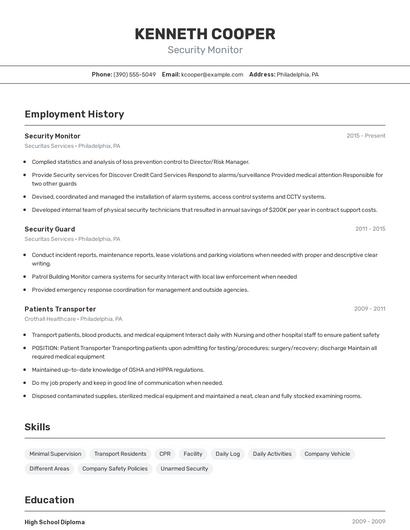
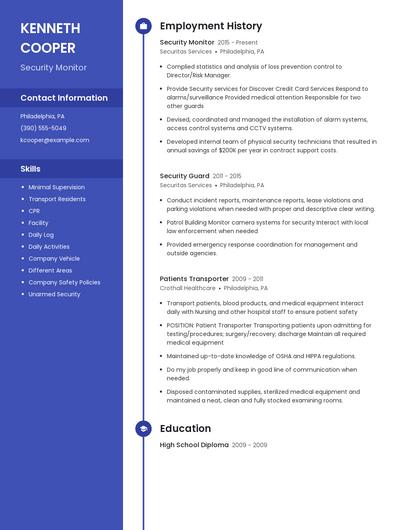
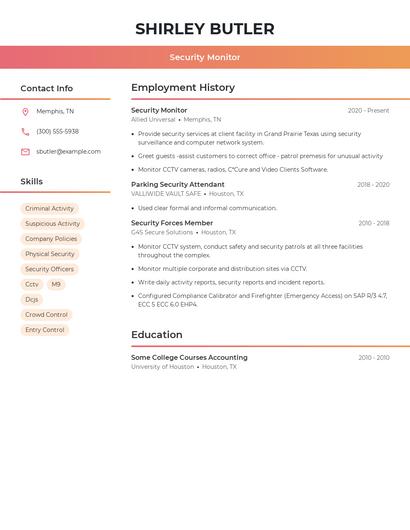
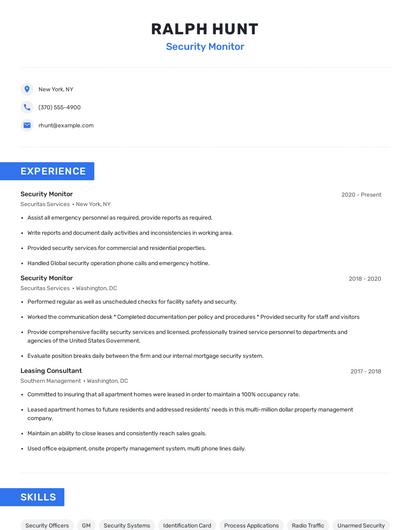
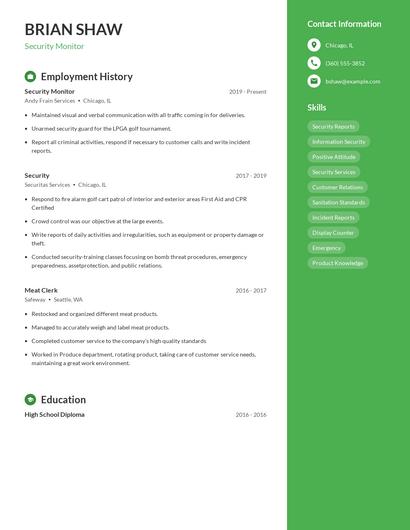
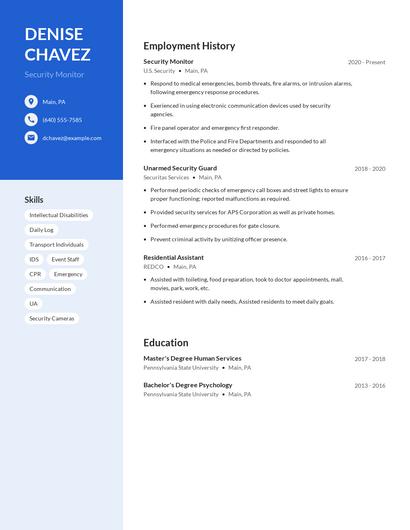
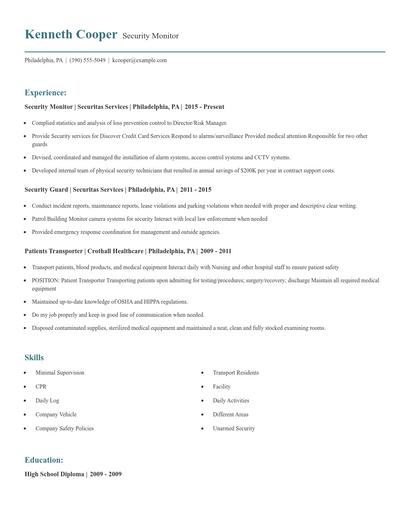
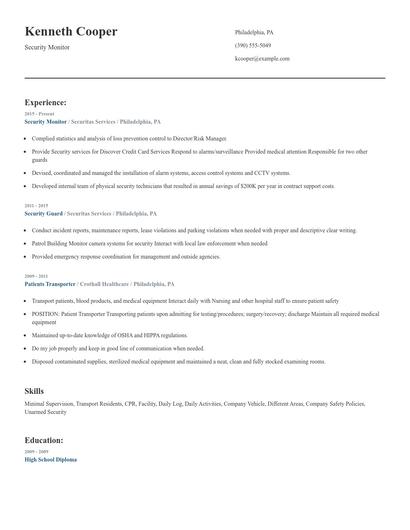
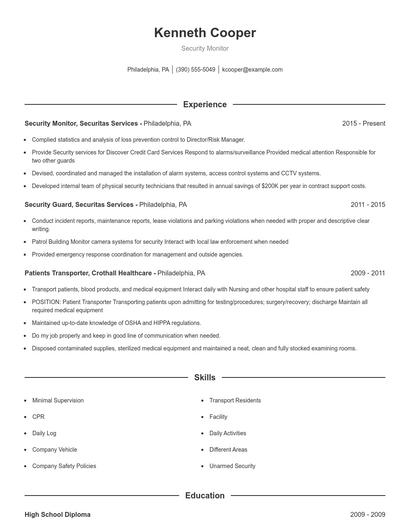
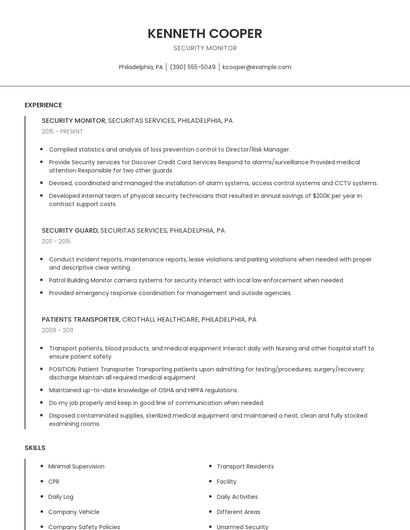
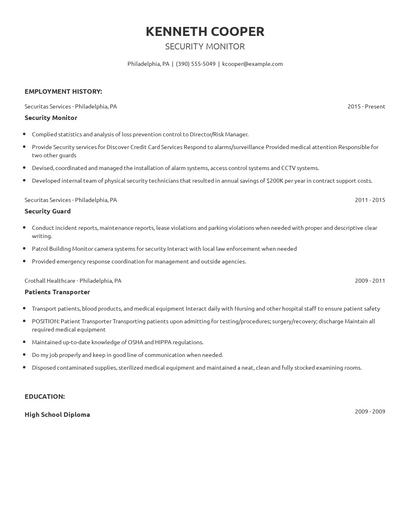
Choose from 10+ customizable security monitor resume templates
Build a professional security monitor resume in minutes. Our AI resume writing assistant will guide you through every step of the process, and you can choose from 10+ resume templates to create your security monitor resume.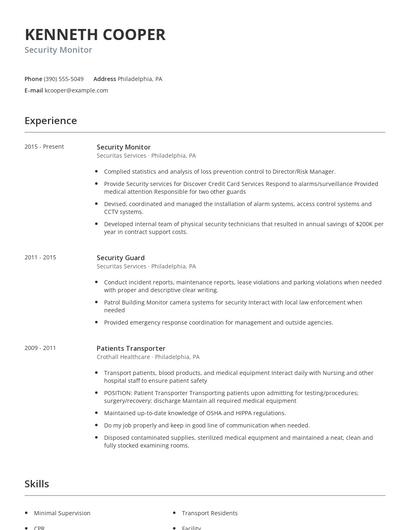
Compare different security monitors
Security monitor vs. Protective officer
A protective officer is in charge of preventing theft and damages in stores and other establishments. Among their responsibilities include monitoring alarm systems and surveillance cameras, patrolling areas, keeping an eye on suspicious activities and behavior, developing strategies to enforce security protocols, and responding to distress. There are also instances where they must conduct inspections and produce reports. Furthermore, as a protective officer, it is essential to coordinate with law enforcement should the situation require.
While similarities exist, there are also some differences between security monitors and protective officer. For instance, security monitor responsibilities require skills such as "cleanliness," "data entry," "disciplinary actions," and "substance abuse." Whereas a protective officer is skilled in "customer service," "patients," "loss prevention," and "vehicle inspections." This is part of what separates the two careers.
Protective officers really shine in the professional industry with an average salary of $38,169. Comparatively, security monitors tend to make the most money in the health care industry with an average salary of $32,794.protective officers tend to reach similar levels of education than security monitors. In fact, protective officers are 2.4% more likely to graduate with a Master's Degree and 0.2% more likely to have a Doctoral Degree.Security monitor vs. Community services officer
Community service offers or CSO support in crime response, investigation, and prevention where police powers are not necessary. The community service officers assist the police officers in terms of upholding order and law in the community. They provide citizens with customer service, community outreach, and patrol. It is their job to implement city codes and other non-criminal police associated duties. They provide non-EMS in-home and on-site assistance to the citizens. Also, they respond to non-criminal complaints, building checks, and more.
Each career also uses different skills, according to real security monitor resumes. While security monitor responsibilities can utilize skills like "cleanliness," "data entry," "disciplinary actions," and "substance abuse," community services officers use skills like "public safety," "traffic control," "parking enforcement," and "rehabilitation."
Community services officers may earn a higher salary than security monitors, but community services officers earn the most pay in the education industry with an average salary of $42,187. On the other hand, security monitors receive higher pay in the health care industry, where they earn an average salary of $32,794.community services officers earn similar levels of education than security monitors in general. They're 1.6% more likely to graduate with a Master's Degree and 0.2% more likely to earn a Doctoral Degree.Security monitor vs. Public safety officer
Public relations assistants are professionals who are responsible for creating and distributing promotional materials to help clients increase their public image and awareness of their products and services. These assistants are required to help develop and distribute public relations materials such as brochures, pamphlets, newsletters, and sell sheets. They must handle all the communications of their clients to the public by supervising social media content, press releases, and emails. Public relations assistants must also gather materials to be used in trade shows or client presentations.
The required skills of the two careers differ considerably. For example, security monitors are more likely to have skills like "cleanliness," "data entry," "disciplinary actions," and "substance abuse." But a public safety officer is more likely to have skills like "patients," "public safety," "customer service," and "motor vehicle."
Public safety officers make a very good living in the health care industry with an average annual salary of $38,645. On the other hand, security monitors are paid the highest salary in the health care industry, with average annual pay of $32,794.When it comes to education, public safety officers tend to earn similar degree levels compared to security monitors. In fact, they're 0.9% more likely to earn a Master's Degree, and 0.0% more likely to graduate with a Doctoral Degree.Security monitor vs. Commissioned security officer
Types of security monitor
Updated January 8, 2025
