What does a systems operator do?

Systems operators often act as the front liners whose primary job is to ensure the reliable delivery of electricity service to consumers and businesses. They are responsible for overseeing and managing the power grid and controlling electricity flow through transmission lines. Other duties and responsibilities of systems operators include monitoring and operating current converters, observing circuit breakers and voltage transformers, and anticipating the changing needs for power due to weather. They are also responsible for communicating with key stakeholders such as power plant operators to route energy to consumers.
Systems operator responsibilities
Here are examples of responsibilities from real systems operator resumes:
- Manage SMS and TCP/IP protocol.
- Perform and manage routine building maintenance tasks, including carpentry, plumbing, and HVAC repair and maintenance.
- Manage tactical high-speed data network (THSDN), internet subscriber IP addresses, and switch caller profiles.
- Manage print production, registration and logistics for several high-profile events, annual fund solicitations and annual telephone campaign.
- Create and modify new user accounts in accordance with local and DOD policies and procedures.
- Provide technical support for full setup, debug the problems of OSPF, switching and HSRP.
- Experience in handling network resources and protocols such as TCP/IP, Ethernet, DNS, and DHCP.
- Maintain secure email circuits for DoD mobile platforms and safeguard combat operations message delivery system.
- Configure VPN connections for SonicWall.
- Deploy software and OS kernel updates.
- Experience in Cisco router protocols OSPF and DHCP.
- Ghost hard drive images and conduct OS system diagnostics.
- Perform IOS upgrades and router hardware upgrades as necessary.
- Involve in network configuration for plan installation of Ethernet LAN.
- Use of internal gateway routing protocols including OSP and EIGRP.
Systems operator skills and personality traits
We calculated that 13% of Systems Operators are proficient in Computer System, Management System, and Combat. They’re also known for soft skills such as Communication skills, Analytical skills, and Problem-solving skills.
We break down the percentage of Systems Operators that have these skills listed on their resume here:
- Computer System, 13%
Performed surveillance, combat identification, weapons control, tactical data link management, communications and computer system management.
- Management System, 11%
Performed weekly supply and equipment inventories, preventative maintenance, and logistics of equipment using COLTS inventory management system.
- Combat, 11%
Performed maintenance on electronic switches, control centers, combat radios and communication security devices used on US Army telecommunications networks.
- Switches, 10%
Well versed in associated transit cased subscriber interface equipment including network routers, switches, security devices and supporting operating systems/firmware.
- Situational Awareness, 9%
Japan Operated passive satellite surveillance system gathered and reported satellite positional data in support of DoD space situational awareness mission.
- Lan, 7%
Installed, configured and upgraded workstations, servers and related hardware and software in a LAN, WAN and stand-alone environment.
"computer system," "management system," and "combat" are among the most common skills that systems operators use at work. You can find even more systems operator responsibilities below, including:
Communication skills. To carry out their duties, the most important skill for a systems operator to have is communication skills. Their role and responsibilities require that "administrators must describe problems and their solutions to non-it workers." Systems operators often use communication skills in their day-to-day job, as shown by this real resume: "deployed, operated, and maintained communications equipment units in garrison and during deployments while holding a secret security clearance. "
Analytical skills. Another soft skill that's essential for fulfilling systems operator duties is analytical skills. The role rewards competence in this skill because "administrators need to evaluate networks and systems to make sure that they perform reliably and to anticipate new requirements as customers’ needs change." According to a systems operator resume, here's how systems operators can utilize analytical skills in their job responsibilities: "set up and deployed satellite communications to pull data and voice services. "
Problem-solving skills. Another skill that relates to the job responsibilities of systems operators is problem-solving skills. This skill is critical to many everyday systems operator duties, as "administrators must quickly resolve problems that arise with computer networks." This example from a resume shows how this skill is used: "investigated, reported and resolved issues regarding computer systems and networks. "
The three companies that hire the most systems operators are:
- Army National Guard134 systems operators jobs
- National Guard73 systems operators jobs
- Toshiba America Business Solutions38 systems operators jobs
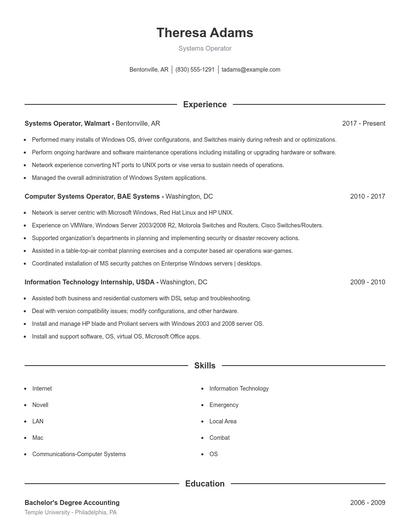
Choose from 10+ customizable systems operator resume templates
Build a professional systems operator resume in minutes. Our AI resume writing assistant will guide you through every step of the process, and you can choose from 10+ resume templates to create your systems operator resume.




Compare different systems operators
Systems operator vs. Information systems internship
An information systems internship involves a trainee who gains working experience by maintaining hardware and software systems that support data-intensive applications of a company. Information systems interns are required to troubleshoot and analyze system problems as well as replace problematic computer hardware and install updated software. They must answer any inquiries regarding computer hardware and software operations and should refer to vendors or manufacturers of any defective products for service. Information systems interns are required to train users about computer software, hardware, and other electronic office equipment.
These skill sets are where the common ground ends though. The responsibilities of a systems operator are more likely to require skills like "lan wan," "combat," "switches," and "situational awareness." On the other hand, a job as an information systems internship requires skills like "python," "c++," "c #," and "patients." As you can see, what employees do in each career varies considerably.
Information systems interns really shine in the manufacturing industry with an average salary of $35,087. Comparatively, systems operators tend to make the most money in the finance industry with an average salary of $38,937.The education levels that information systems interns earn slightly differ from systems operators. In particular, information systems interns are 6.4% more likely to graduate with a Master's Degree than a systems operator. Additionally, they're 0.2% more likely to earn a Doctoral Degree.Systems operator vs. Information systems technician
An information systems technician is responsible for maintaining the efficiency of various network systems' performance. Information systems technicians provide network troubleshooting, upgrading systems for optimization, maintaining the security of databases, managing the interaction of networks, and inspecting and troubleshooting system inconsistencies. Additional duties include creating network designs based on clients' specifications, configuring software and hardware applications, and creating reports on system issues and resolutions. An information systems technician must have excellent knowledge of information systems procedures, programming languages, detecting malfunctions, and making resolutions promptly.
While some skills are similar in these professions, other skills aren't so similar. For example, resumes show us that systems operator responsibilities requires skills like "lan wan," "management system," "combat," and "switches." But an information systems technician might use other skills in their typical duties, such as, "technical support," "phone calls," "desk support," and "user support."
On average, information systems technicians earn a higher salary than systems operators. Some industries support higher salaries in each profession. Interestingly enough, information systems technicians earn the most pay in the government industry with an average salary of $63,116. Whereas systems operators have higher pay in the finance industry, with an average salary of $38,937.Average education levels between the two professions vary. Information systems technicians tend to reach similar levels of education than systems operators. In fact, they're 1.0% more likely to graduate with a Master's Degree and 0.2% less likely to earn a Doctoral Degree.Systems operator vs. Technical systems engineer
Technical Systems Engineers are responsible for maintaining the integrity of the infrastructure or systems network. They build, maintain, and repair all the systems and network infrastructure of the organization. They troubleshoot problems and find the best possible solution to address such problems. They also ensure that those problems will be resolved and would never be encountered again. Technical Systems Engineers also help out in information technology or network infrastructure projects of other departments. They provide expertise on the systems-related aspects of the project. They help guide project teams on the feasibility and the success factors of the project.
The required skills of the two careers differ considerably. For example, systems operators are more likely to have skills like "combat," "situational awareness," "communication systems," and "radar." But a technical systems engineer is more likely to have skills like "cloud," "windows server," "technical support," and "powershell."
Technical systems engineers make a very good living in the finance industry with an average annual salary of $116,420. On the other hand, systems operators are paid the highest salary in the finance industry, with average annual pay of $38,937.Most technical systems engineers achieve a higher degree level compared to systems operators. For example, they're 6.9% more likely to graduate with a Master's Degree, and 0.1% more likely to earn a Doctoral Degree.Systems operator vs. Principal systems engineer
A Principal Systems Engineer supervises a group of other engineers in technical projects. They develop and lead systems engineering projects and efforts.
Types of systems operator
Updated January 8, 2025
