What does a systems supervisor do?
A System Supervisor is often referred to as the IT supervisor. They work in corporate IT departments. They manage staff that promotes and even maintains a company's computer systems such as database, mainframe system, data communication, and vivid software programs.
Systems supervisor responsibilities
Here are examples of responsibilities from real systems supervisor resumes:
- Manage PBX and voice mail systems.
- Manage asset tracking and depreciation of UNIX hardware and supporting software.
- Manage, install, and repair IP communication systems in fix and deploy locations.
- Achieve and maintain certifications in health and safety, according to company and OSHA regulations.
- Manage the development, deployment, and availability of multiple VMware desktop pools and servers.
- Lead and successfully complete the vendor sign off for agree SLA's with each vendor.
- Create test benches, networks, and TPS to test Linux base network hardware and configure Cisco routers switches.
- Used state-of-the-art test equipment to troubleshoot, locate and repair telephone/fiber circuit troubles/outages.
- Provide project management oversight over all infrastructure projects relating to property management systems.
- Utilize schematics, technical manuals, diagnostic test equipment and bit error rate quality reports to troubleshoot and repair telecommunications equipment.
- Configure and deploy VPN routers.
- Develop, implement, and perform procedures to QA shipment release.
- Document GIS data creation in the form of BNGIS approve metadata files.
- Create filters using SQL language to pull records from the daily call list.
- Act as liaison between field operations, switch operations and RF engineering teams.
Systems supervisor skills and personality traits
We calculated that 6% of Systems Supervisors are proficient in Project Management, Management System, and Windows. They’re also known for soft skills such as Business skills, Leadership skills, and Organizational skills.
We break down the percentage of Systems Supervisors that have these skills listed on their resume here:
- Project Management, 6%
Project Management Coordinator including initiating, planning, controlling, meeting milestones and deadlines.
- Management System, 5%
Selected to manage Digital Training Management System, accurately tracking required professional development and compliance training for hundreds of team members.
- Windows, 5%
Provided daily administration of Microsoft Windows 2000 LAN, which included both Server administration and security configuration.
- Control Systems, 5%
Prepared annual proposals justifying and defining major additions/upgrades for new and existing Control Systems in the refinery.
- Logistics, 5%
Implemented new security policy and guidelines in support of Calvary Squadron resulting in a commendable rating during Communications Security Logistics inspection.
- Continuous Improvement, 5%
Work directly with Boiler Inspector and Chemical representatives to maintain and participate in Inspections and continuous improvement projects.
Common skills that a systems supervisor uses to do their job include "project management," "management system," and "windows." You can find details on the most important systems supervisor responsibilities below.
Business skills. To carry out their duties, the most important skill for a systems supervisor to have is business skills. Their role and responsibilities require that "it managers must develop and implement strategic plans to reach the goals of their organizations." Systems supervisors often use business skills in their day-to-day job, as shown by this real resume: "sit on numerous management groups including process management, sap users, new business sourcing, and quality systems. "
Leadership skills. Another soft skill that's essential for fulfilling systems supervisor duties is leadership skills. The role rewards competence in this skill because "it managers must lead and motivate it teams or departments so that workers are efficient and effective." According to a systems supervisor resume, here's how systems supervisors can utilize leadership skills in their job responsibilities: "provide clinical leadership to the mst team-ensuring that the needs of the family are paramount. "
Organizational skills. systems supervisors are also known for organizational skills, which are critical to their duties. You can see how this skill relates to systems supervisor responsibilities, because "some it managers must coordinate the work of several different it departments to make the organization run efficiently." A systems supervisor resume example shows how organizational skills is used in the workplace: "installed and managed organizational level local area networks (lan), routers, operating systems and application software. "
Analytical skills. For certain systems supervisor responsibilities to be completed, the job requires competence in "analytical skills." The day-to-day duties of a systems supervisor rely on this skill, as "it managers must analyze problems and consider and select the best ways to solve them." For example, this snippet was taken directly from a resume about how this skill applies to what systems supervisors do: "test and analyze boiler water to insure proper chemical balance that meets usda and fda polices and regulations. "
Communication skills. A commonly-found skill in systems supervisor job descriptions, "communication skills" is essential to what systems supervisors do. Systems supervisor responsibilities rely on this skill because "it managers must explain their work to top executives and give clear instructions to their subordinates." You can also see how systems supervisor duties rely on communication skills in this resume example: "installed links through satellite communications, fiber optic cabling and line of site (los) wireless radio systems. "
The three companies that hire the most systems supervisors are:
- FIS15 systems supervisors jobs
- Cirrus Aircraft6 systems supervisors jobs
- RGNext5 systems supervisors jobs
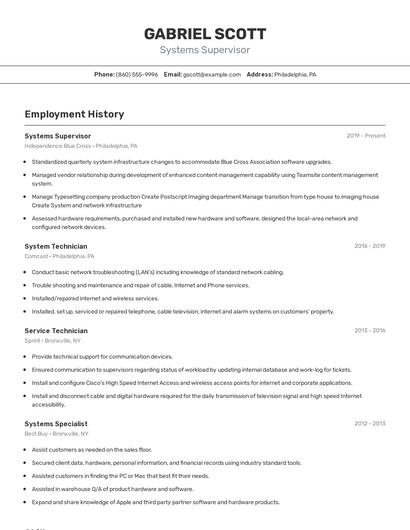
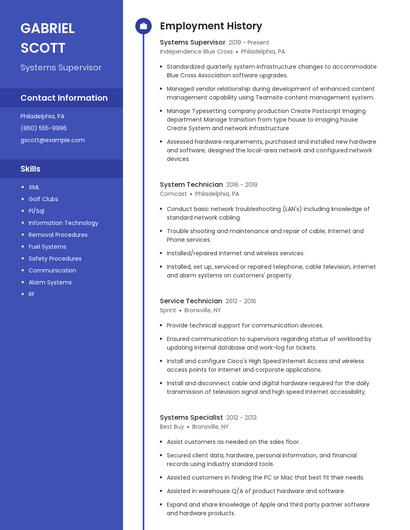
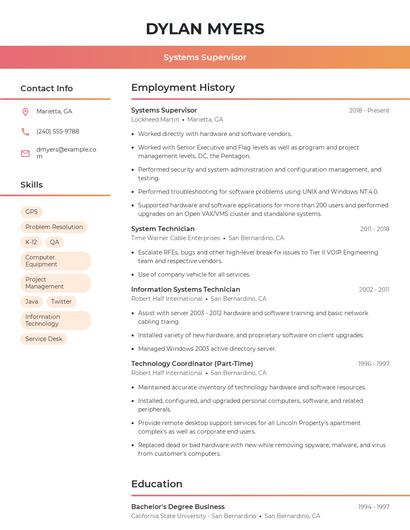
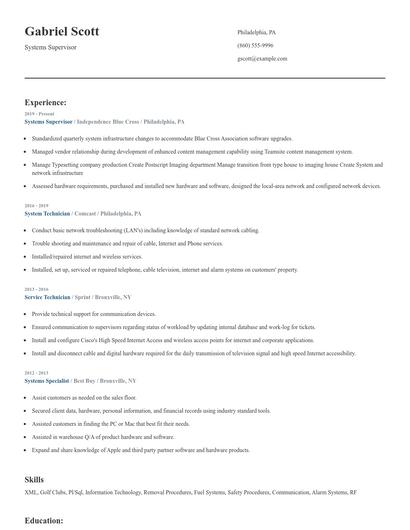
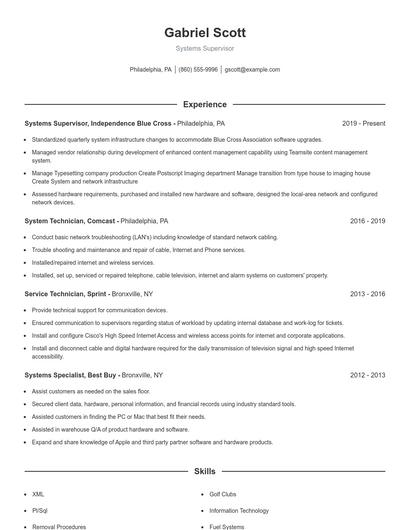
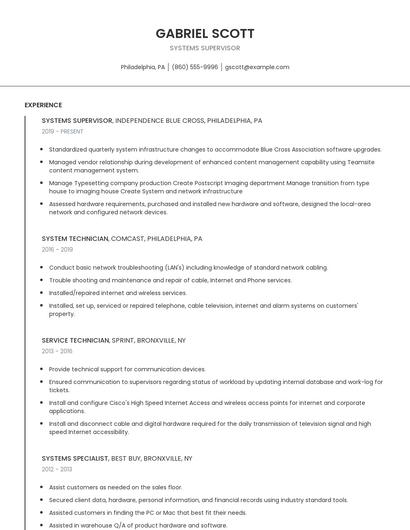
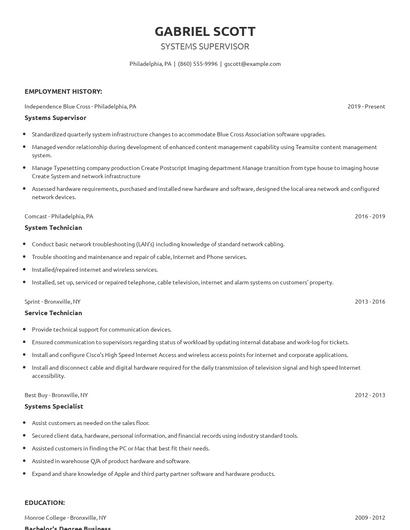
Choose from 10+ customizable systems supervisor resume templates
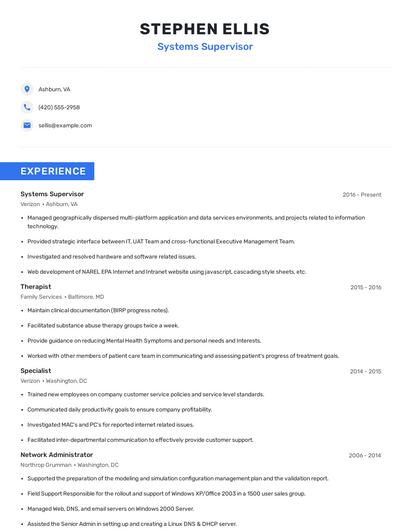
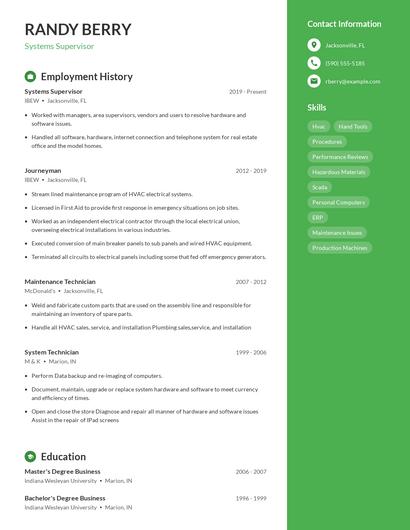
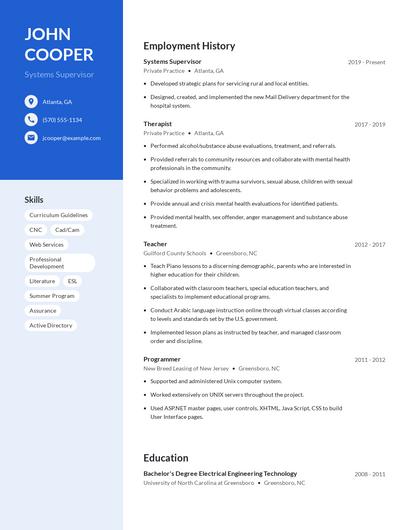
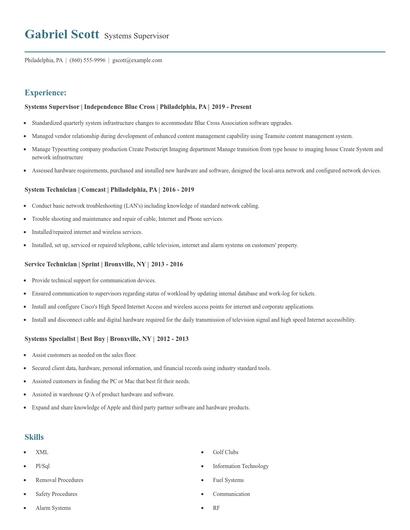
Build a professional systems supervisor resume in minutes. Our AI resume writing assistant will guide you through every step of the process, and you can choose from 10+ resume templates to create your systems supervisor resume.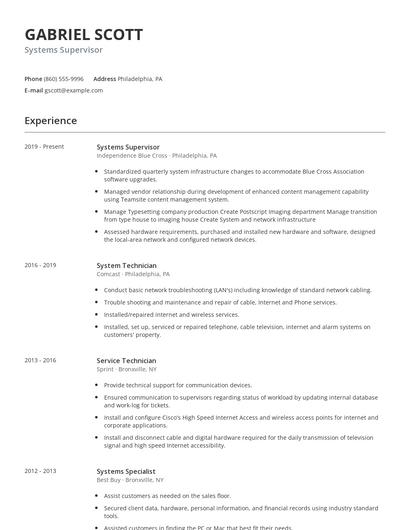
Compare different systems supervisors
Systems supervisor vs. Vice president, technology
A vice president of technology is in charge of overseeing all technological operations in a company while managing the workforce involved, ensuring efficiency and smooth workflow. Typically, it is their responsibility to establish goals and objectives, devising strategies to enforce them. They also spearhead the development of new systems and tools that boost workforce productivity, coordinate with analysts and specialists, and resolve any issues and concerns. Furthermore, as a vice president, it is essential to implement the company's policies and regulations, creating new ones as needed.
These skill sets are where the common ground ends though. The responsibilities of a systems supervisor are more likely to require skills like "control systems," "logistics," "continuous improvement," and "osha." On the other hand, a job as a vice president, technology requires skills like "analytics," "architecture," "java," and "portfolio." As you can see, what employees do in each career varies considerably.
Vice presidents, technology really shine in the technology industry with an average salary of $156,843. Comparatively, systems supervisors tend to make the most money in the automotive industry with an average salary of $89,229.vice presidents, technology tend to reach higher levels of education than systems supervisors. In fact, vice presidents, technology are 8.9% more likely to graduate with a Master's Degree and 2.0% more likely to have a Doctoral Degree.Systems supervisor vs. Information technology director
An information technology (IT) Director is an individual responsible for the management, strategy, and execution of an organization's IT infrastructure. He/She supervises a team of workers while working with the organization's management and external vendors and advisors. Aside from managing workers, an IT director should possess problem-solving skills and an aptitude for organizational thinking. An IT director must also identify new market opportunities and should lead an effort to improve the organization's IT process.
In addition to the difference in salary, there are some other key differences worth noting. For example, systems supervisor responsibilities are more likely to require skills like "windows," "control systems," "logistics," and "continuous improvement." Meanwhile, an information technology director has duties that require skills in areas such as "customer service," "cloud," "network infrastructure," and "disaster recovery." These differences highlight just how different the day-to-day in each role looks.
Information technology directors earn a higher average salary than systems supervisors. But information technology directors earn the highest pay in the technology industry, with an average salary of $145,076. Additionally, systems supervisors earn the highest salaries in the automotive with average pay of $89,229 annually.information technology directors earn higher levels of education than systems supervisors in general. They're 6.0% more likely to graduate with a Master's Degree and 2.0% more likely to earn a Doctoral Degree.Systems supervisor vs. Information technology manager
An information technology manager is responsible for supervising tasks for the company's network and information systems operations. Information technology managers require excellent knowledge of the information systems industry, a strong command of programming languages, and software and hardware application processes. An information technology manager reviews the performance of the IT department staff, ensuring that networks and systems maintain the highest quality and efficiency, and adjusting the specific system updates as needed. Information technology managers monitor the security of the system's database and identify business opportunities to utilize all business systems to improve the company's services.
There are many key differences between these two careers, including some of the skills required to perform responsibilities within each role. For example, a systems supervisor is likely to be skilled in "windows," "control systems," "logistics," and "continuous improvement," while a typical information technology manager is skilled in "customer service," "database," "network infrastructure," and "san."
Most information technology managers achieve a similar degree level compared to systems supervisors. For example, they're 3.4% more likely to graduate with a Master's Degree, and 0.1% more likely to earn a Doctoral Degree.Systems supervisor vs. Vice president of information technology
A Vice President Of Information Technology supervises an organization's technology initiatives, IT changes, and updates to all projects. They also identify and propose new information technologies and systems to improve business processes and decision-making.
Even though a few skill sets overlap between systems supervisors and vice president of information technologies, there are some differences that are important to note. For one, a systems supervisor might have more use for skills like "control systems," "logistics," "continuous improvement," and "osha." Meanwhile, some responsibilities of vice president of information technologies require skills like "architecture," "cloud," "customer service," and "network infrastructure. "
Vice president of information technologies enjoy the best pay in the automotive industry, with an average salary of $162,421. For comparison, systems supervisors earn the highest salary in the automotive industry.In general, vice president of information technologies hold higher degree levels compared to systems supervisors. Vice president of information technologies are 8.9% more likely to earn their Master's Degree and 0.2% more likely to graduate with a Doctoral Degree.Types of systems supervisor
Updated January 8, 2025
