What does a technical operations manager do?

A technical operations manager is an upper management position in the technical department of an organization; they are considered leaders. They are responsible primarily for planning, coordinating, and executing company technical processes from the beginning to the end. It is part of their responsibility to sustain the technical goals of the company and handle any future potential needs. Typically, they create and sustain the best practice standards for technical operations and set the direction to technical staff in times of uncertainty.
Technical operations manager responsibilities
Here are examples of responsibilities from real technical operations manager resumes:
- Manage the administration of both the UNIX and NT domains.
- Reduce deployment times to ensure that production maintenance windows are achieved.
- Perform installation and administration of VMware ESXi and manage virtual machines with VCenter.
- Delegate assignments and tasks; manage plant reliability, outage repair, and CLI compliance.
- Assemble, network, maintain, manage, and implement security on POS and all company PCs.
- Manage EDI processing which include the setting up of new customers and all the communications facilitating procedures.
- Perform all tasks in administration of UNIX AIX, Linux RHAS & SLES performance improvement.
- Play key role in validating QC plan.
- Ensure all support requests are completed within state SLA requirements.
- Perform direct hands on Linux troubleshooting at the OS and hardware level.
- Strengthen support processes and performance, helping to fuel external client SaaS sales initiatives.
- Collaborate with multiple teams to migrate the VTC platform from ISDN connectivity to IP connectivity.
- Experience with RF, optical, data, electrical, mechanical, and architectural schematics.
- Provide hardware, software, and network support to the NOC infrastructure and end users.
- Review service level agreements (SLA) and ensure full compliance to all contractual obligations.
Technical operations manager skills and personality traits
We calculated that 10% of Technical Operations Managers are proficient in Technical Operations, Customer Service, and Project Management. They’re also known for soft skills such as Management skills, Problem-solving skills, and Time-management skills.
We break down the percentage of Technical Operations Managers that have these skills listed on their resume here:
- Technical Operations, 10%
Managed initiation, development, implementation and monitoring of technical activities for Operations, Manufacturing Engineering and Technical Operations.
- Customer Service, 9%
Managed day-to-day operations of business to ensure maximum profitability was maintained while achieving the highest level of customer service.
- Project Management, 8%
Key Responsibilities: The Operations Support Manager provides Senior Project Management technical expertise for technical and infrastructure related projects.
- Oversight, 6%
Created and reviewed/revised, as necessary, operating budgets to meet financial objectives/targets with oversight from corporate officers.
- Process Improvement, 4%
Provide feedback on trend analysis for continual improvement and recommend changes for continual process improvement with emphasis on automation and efficiency.
- Continuous Improvement, 4%
Translate business needs and priorities into Continuous Improvement Strategies and Initiatives that contributed to improve manufacturing process.
"technical operations," "customer service," and "project management" are among the most common skills that technical operations managers use at work. You can find even more technical operations manager responsibilities below, including:
Problem-solving skills. Another soft skill that's essential for fulfilling technical operations manager duties is problem-solving skills. The role rewards competence in this skill because "top executives need to identify and resolve issues within an organization." According to a technical operations manager resume, here's how technical operations managers can utilize problem-solving skills in their job responsibilities: "implement technology solutions and services for technical operations, badge identification, and access cards. "
Time-management skills. This is an important skill for technical operations managers to perform their duties. For an example of how technical operations manager responsibilities depend on this skill, consider that "top executives do many tasks concurrently to ensure that their work gets done and that the organization meets its goals." This excerpt from a resume also shows how vital it is to everyday roles and responsibilities of a technical operations manager: "plan for technology infrastructure based on projected organic grown to ensure quality software delivered on time and within budget. ".
Communication skills. A big part of what technical operations managers do relies on "communication skills." You can see how essential it is to technical operations manager responsibilities because "top executives must be able to convey information clearly and persuasively." Here's an example of how this skill is used from a resume that represents typical technical operations manager tasks: "managed it customer support, corporate email, applications, servers and telecommunications needs for 3 offices. "
Leadership skills. Another common skill required for technical operations manager responsibilities is "leadership skills." This skill comes up in the duties of technical operations managers all the time, as "top executives must be able to shape and direct an organization by coordinating policies, people, and resources." An excerpt from a real technical operations manager resume shows how this skill is central to what a technical operations manager does: "managed the daily activities of up to 100 technical operations union and non union personnel through the leadership of supervisors. "
The three companies that hire the most technical operations managers are:
- Deloitte77 technical operations managers jobs
- Ernst & Young60 technical operations managers jobs
- Black & Veatch48 technical operations managers jobs
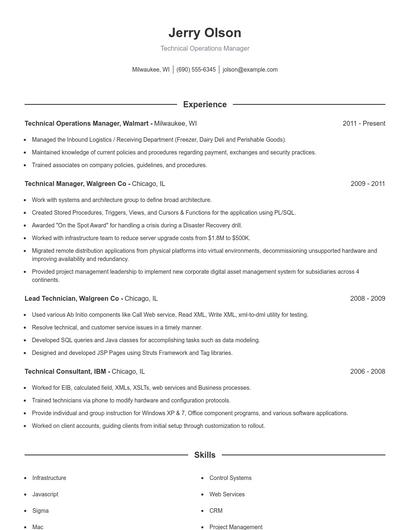
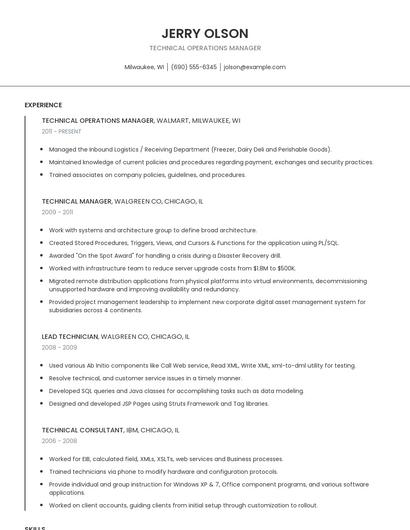
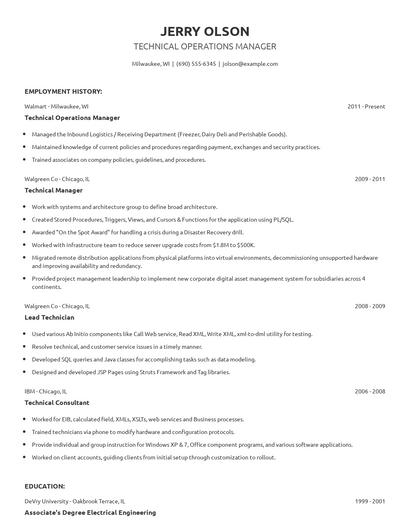
Choose from 10+ customizable technical operations manager resume templates
Build a professional technical operations manager resume in minutes. Our AI resume writing assistant will guide you through every step of the process, and you can choose from 10+ resume templates to create your technical operations manager resume.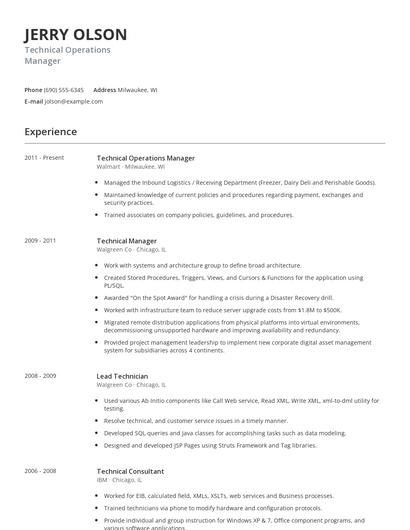
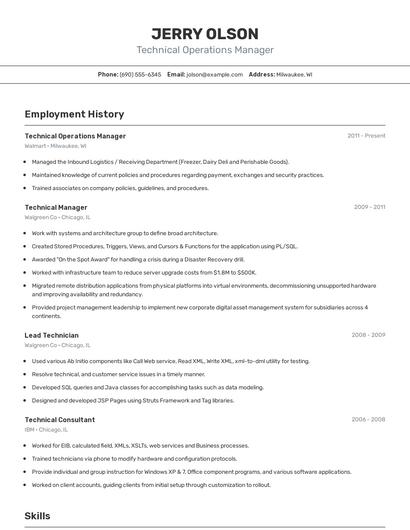


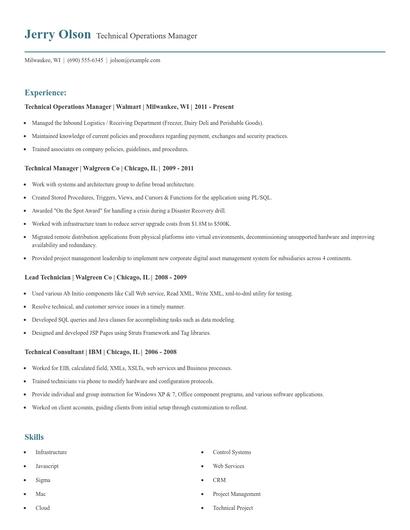
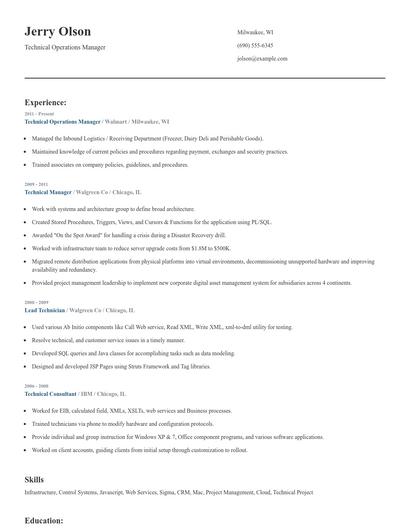
Compare different technical operations managers
Technical operations manager vs. Manager, center operations
The duties of a manager of center operations depend on one's industry of employment. Typically, their responsibilities revolve around overseeing business operations, setting targets, assessing the workforce's performance, and performing corrective measures on any issues or concerns. Moreover, there are also instances where they have to produce progress reports, devise strategies for optimal business performance, delegate tasks, and even manage the budget. As a manager, it is crucial to lead and encourage the team to reach goals and sales targets while implementing the company's policies and regulations.
There are some key differences in the responsibilities of each position. For example, technical operations manager responsibilities require skills like "technical operations," "customer service," "oversight," and "service delivery." Meanwhile a typical manager, center operations has skills in areas such as "infrastructure," "standard operating procedure," "quality standards," and "patients." This difference in skills reveals the differences in what each career does.
Managers, center operations tend to make the most money working in the manufacturing industry, where they earn an average salary of $68,400. In contrast, technical operations managers make the biggest average salary, $117,610, in the retail industry.managers, center operations tend to reach similar levels of education than technical operations managers. In fact, managers, center operations are 0.8% more likely to graduate with a Master's Degree and 0.1% less likely to have a Doctoral Degree.Technical operations manager vs. General manager of operations
General managers of operations are employed to oversee the overall operations of businesses. Their responsibilities include the improvement of the efficiency of the operations and overall management. They coordinate the primary performance goals for direct reporting functions and set the strategies for the organization. It is their responsibility to communicate strategy as well as results to employees. They also engage with the corporate officers in the strategic planning and development of the organization or enterprise.
In addition to the difference in salary, there are some other key differences worth noting. For example, technical operations manager responsibilities are more likely to require skills like "technical operations," "project management," "service delivery," and "emerging technologies." Meanwhile, a general manager of operations has duties that require skills in areas such as "develop team," "financial statements," "human resources," and "personnel processes." These differences highlight just how different the day-to-day in each role looks.
General managers of operations earn similar levels of education than technical operations managers in general. They're 0.1% more likely to graduate with a Master's Degree and 0.1% less likely to earn a Doctoral Degree.What technology do you think will become more important and prevalent for technical operations managers in the next 3-5 years?
Eric Olsen
Professor, Industrial Technology and Packaging, Orfalea College of Business
Technical operations manager vs. Information technology technical services manager
An information technology/technical services manager is responsible for supervising the operations of the information technology team, assisting the technical staff in providing efficient performance by improving technology systems and network infrastructure to support business functions. This job requires extensive knowledge of the technology industry, as well as an excellent command of programming and system processes to ensure smooth navigation and consistent transitions. An information technology/technical services manager also handles the development of new network systems according to business requirements and client specifications.
The required skills of the two careers differ considerably. For example, technical operations managers are more likely to have skills like "technical operations," "oversight," "continuous improvement," and "windows." But a information technology technical services manager is more likely to have skills like "service management," "itsm," "level agreements," and "problem management."
Information technology technical services managers make a very good living in the finance industry with an average annual salary of $124,604. On the other hand, technical operations managers are paid the highest salary in the retail industry, with average annual pay of $117,610.Most information technology technical services managers achieve a higher degree level compared to technical operations managers. For example, they're 5.5% more likely to graduate with a Master's Degree, and 0.2% more likely to earn a Doctoral Degree.Technical operations manager vs. Operations support manager
Operations Support Managers are employees who handle different support initiatives for the employees or operations-related departments. These support initiatives may come in people management and upskilling, IT infrastructure assistance, or process improvement, among others. Operations Support Managers must have a deep understanding of company operations and the employees' needs. They manage processes and standards to ensure that company operations are fully supported and will not be disrupted. They resolve concerns and anticipate problems that may come. They can plan and create safeguards to ensure that such problems will not arise in the future.
Types of technical operations manager
Updated January 8, 2025
