What does a technical support professional do?
A Technical Support Professional is someone in an organization or company who gives assistance and technical support to customers and businesses. As a Technical Support Professional, your job will be to maintain all computer systems and troubleshoot technical, software, and hardware problems. You will also be expected to walk customers through the process of installing software on their computers and launching programs. And, of course, you will also send technical documentation to customers and end-users.
Technical support professional responsibilities
Here are examples of responsibilities from real technical support professional resumes:
- Manage all operating end-user software including JavaScript - updating/installing Java.
- Addressed customer concerns with speed, accuracy and professionalism with a proven capacity to troubleshoot issues and ensure customer satisfaction.
- Analyze, troubleshoot and determine resolution for technical issues relate to standard and non-standard work environment, including end-users working remotely.
- Obtain a thorough, working knowledge of TCP/IP
- Log sales orders and process billing using CRM software.
- Single point of contact for fully provision Verizon DSL subscribers.
- Provide customer's support with DSL hardware and software setup.
- Configure network protocols including NetBEUI, TCP/IP, Microsoft file and print sharing.
- Develop a CRM system to run automate marketing campaigns and meet customer service compliance requirements.
- Trouble shooting using various command tools on CISCO routers and network segments at various OSI layers.
- Recognize for delivering high-level technical support requiring diverse knowledge in specialize subject areas including numerous types PC hardware, application software.
- Train and proficient in operating system configuration and patching HP-UX, HP-MPE, NT.
- Provide QA acceptance testing on software & hardware products.
- Support corporate ISO quality standards by communicating any complaints relating to fit, form, and functionality to QA department.
- Provide server, network and SAN hardware and cabling installations, troubleshooting and de-installations.
Technical support professional skills and personality traits
We calculated that 14% of Technical Support Professionals are proficient in Java, Client Facing, and Troubleshoot. They’re also known for soft skills such as Customer-service skills, Listening skills, and Problem-solving skills.
We break down the percentage of Technical Support Professionals that have these skills listed on their resume here:
- Java, 14%
Created and documented process to complete quarterly health checks for 20 Apache web servers and a Tomcat Java Application Server.
- Client Facing, 8%
Point of contact for escalation agents and client facing outside of department escalations.
- Troubleshoot, 7%
Analyze, troubleshoot and determine resolution for technical issues related to standard and non-standard work environment, including end-users working remotely.
- Customer Satisfaction, 4%
Achieved strong customer satisfaction through staff training including negotiation resulting in successful outcome/solution to multiple customer business/technical issues.
- Technical Problems, 4%
Diagnosed and resolved various technical problems while increasing overall client satisfaction.
- Problem Resolution, 3%
Collaborated with other support centers and business units to provide seamless problem resolution.
Common skills that a technical support professional uses to do their job include "java," "client facing," and "troubleshoot." You can find details on the most important technical support professional responsibilities below.
Customer-service skills. To carry out their duties, the most important skill for a technical support professional to have is customer-service skills. Their role and responsibilities require that "computer support specialists must be patient and sympathetic." Technical support professionals often use customer-service skills in their day-to-day job, as shown by this real resume: "participated in improving customer support and product related features unique to hp computers. "
Listening skills. Another essential skill to perform technical support professional duties is listening skills. Technical support professionals responsibilities require that "support workers must be able to understand the problems that their customers are describing and know when to ask questions to clarify the situation." Technical support professionals also use listening skills in their role according to a real resume snippet: "communicated customer issues and feedback. "
Problem-solving skills. Another skill that relates to the job responsibilities of technical support professionals is problem-solving skills. This skill is critical to many everyday technical support professional duties, as "support workers must identify both simple and complex computer problems, analyze them, and solve them." This example from a resume shows how this skill is used: "lead help desk team in first call resolutions, call statisticsand customer support awards reducing trouble calls by 75%. "
Speaking skills. A big part of what technical support professionals do relies on "speaking skills." You can see how essential it is to technical support professional responsibilities because "support workers must describe the solutions to computer problems in a way that a nontechnical person can understand." Here's an example of how this skill is used from a resume that represents typical technical support professional tasks: "plan and presented a forum to raise awareness for developmental disabilities. "
Writing skills. Another crucial skill for a technical support professional to carry out their responsibilities is "writing skills." A big part of what technical support professionals relies on this skill, since "strong writing skills are useful for preparing instructions and email responses for employees and customers, as well as for real-time web chat interactions." How this skill relates to technical support professional duties can be seen in an example from a technical support professional resume snippet: "guided customers to freddie mac's all regulations underwriting guideline system. "
The three companies that hire the most technical support professionals are:
- Cintas7 technical support professionals jobs
- district6 technical support professionals jobs
- Lutheran Social Services Of Wi & Upper Mi6 technical support professionals jobs
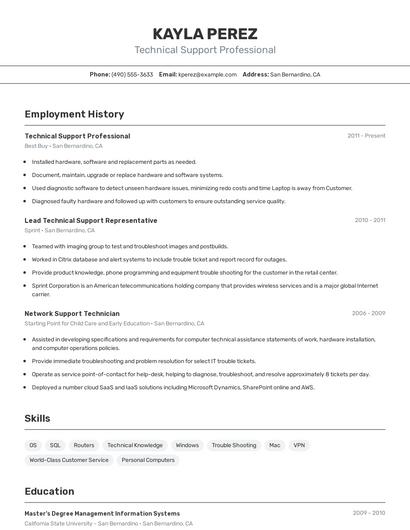
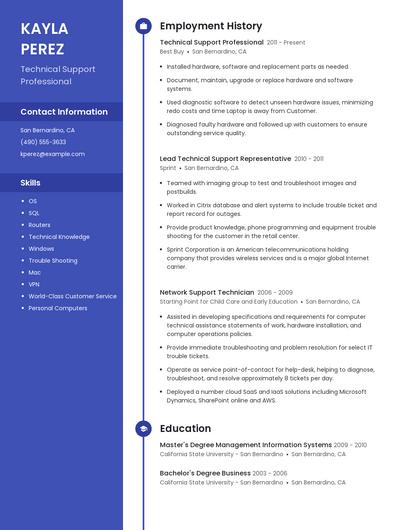
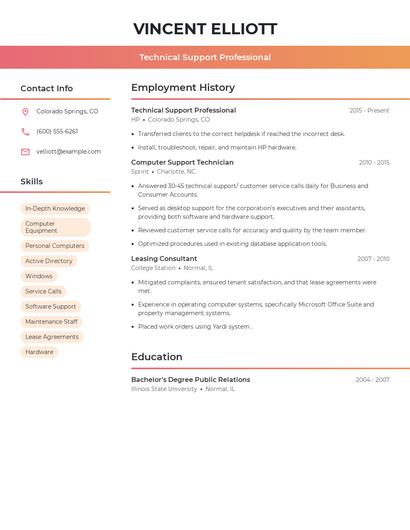
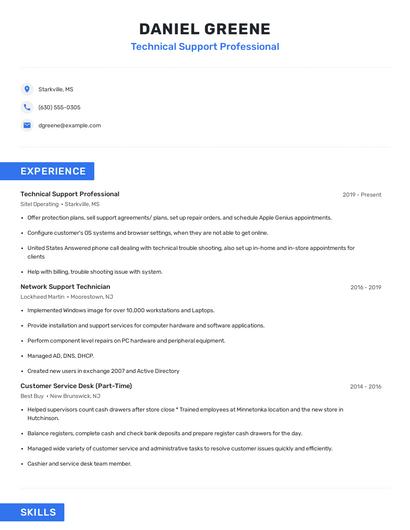
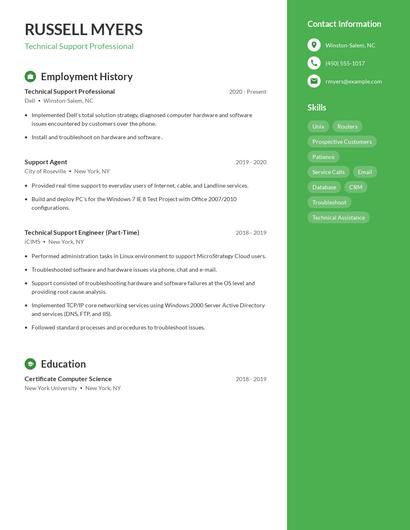
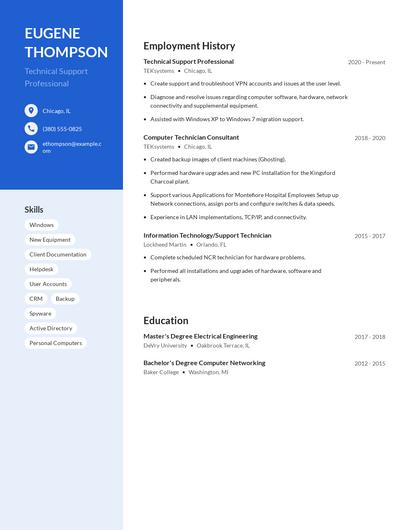
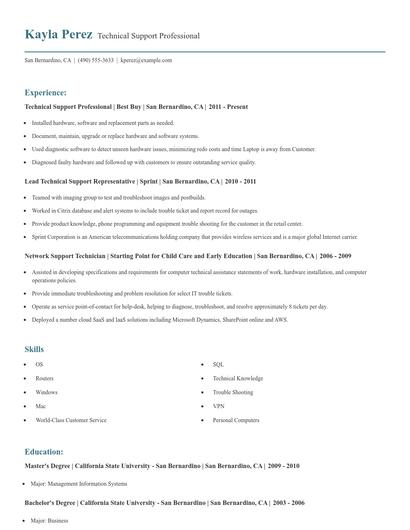
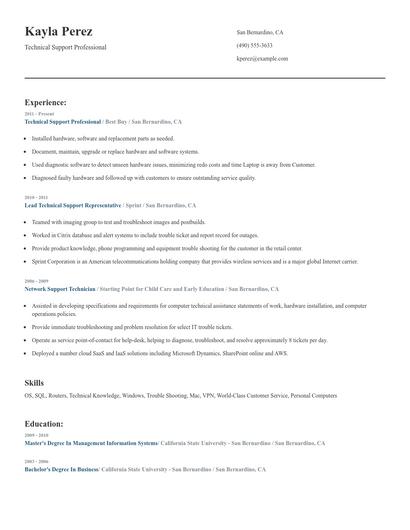
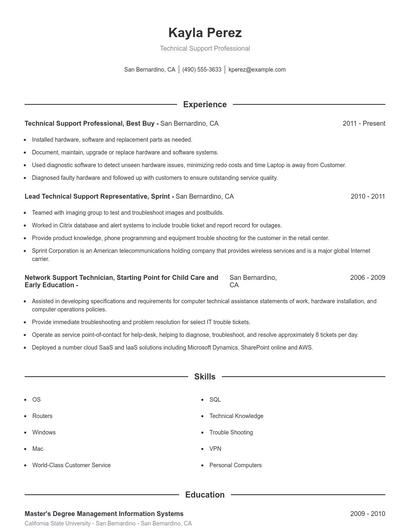
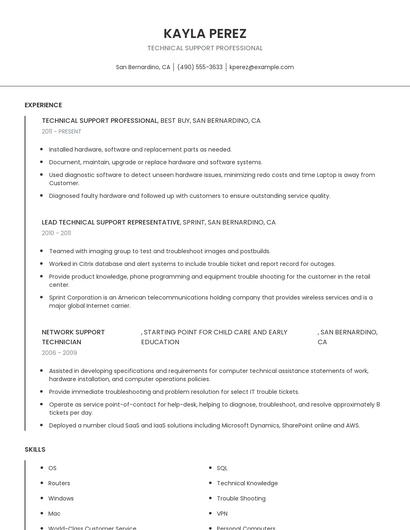
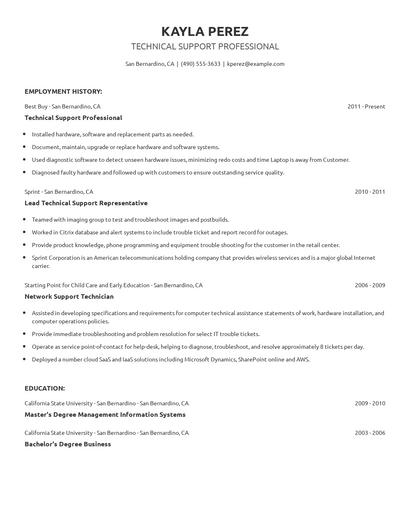
Choose from 10+ customizable technical support professional resume templates
Build a professional technical support professional resume in minutes. Our AI resume writing assistant will guide you through every step of the process, and you can choose from 10+ resume templates to create your technical support professional resume.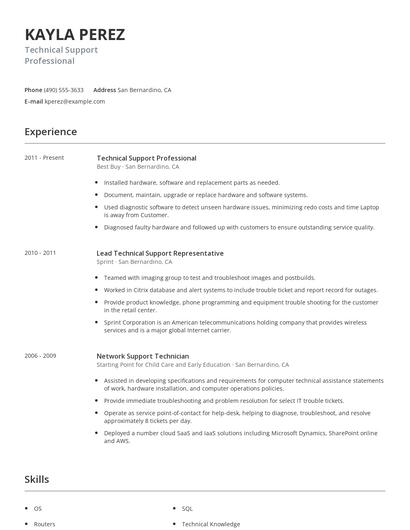
Compare different technical support professionals
Technical support professional vs. Systems support
A systems support agent is responsible for resolving system applications and network issues, performing technical configuration, and upgrading systems infrastructure. A systems support representative conducts regular maintenance and diagnostic tests on the computer applications to ensure its optimal performance and efficiency to support business operations and avoid delays in deliverables. They also assist the technology team in designing backup systems and improve existing networks according to business requirements and specifications. They write resolution reports for reference to prevent the reoccurrence of system malfunction and inconsistencies.
There are some key differences in the responsibilities of each position. For example, technical support professional responsibilities require skills like "client facing," "compassion," "technical knowledge," and "crm." Meanwhile a typical systems support has skills in areas such as "customer service," "technical support," "provides technical support," and "desktop support." This difference in skills reveals the differences in what each career does.
On average, systems supports reach similar levels of education than technical support professionals. Systems supports are 0.2% more likely to earn a Master's Degree and 0.2% less likely to graduate with a Doctoral Degree.Technical support professional vs. Software support technician
A software support technician is responsible for resolving software application issues, diagnosing related system failures, and writing resolution reports for reference. Software support technicians must be highly-familiarized with the system's infrastructure and interface to immediately diagnose malfunctions and identify maintenance techniques to prevent the reoccurrence of downtimes and delays. They also assist the system engineers in the configuration and optimization of networks, including the installment of upgrades and patch updates. A software support technician must have excellent organizational and communication skills, especially in navigating computer tools and applications to create support tickets and fix the customers' issues efficiently.
In addition to the difference in salary, there are some other key differences worth noting. For example, technical support professional responsibilities are more likely to require skills like "client facing," "compassion," "customer satisfaction," and "pc." Meanwhile, a software support technician has duties that require skills in areas such as "customer service," "database," "phone calls," and "sql server." These differences highlight just how different the day-to-day in each role looks.
Software support technicians earn similar levels of education than technical support professionals in general. They're 0.8% more likely to graduate with a Master's Degree and 0.2% more likely to earn a Doctoral Degree.What technology do you think will become more important and prevalent for technical support professionals in the next 3-5 years?
Babak Beheshti Ph.D.
Dean, Professor, New York Institute of Technology
-We will be witnessing a more widespread commercial deployment of 5G in 2020. With the implementation of the Standalone 5G devices based on the 3gpp release 16, we should be seeing the more robust mobile broadband deployment of 5G, wider availability of 5G smartphones, and a push towards an all 5G Network in select urban areas around the world.
-Significant growth in AI-based technologies, from face recognition and voice recognition to business intelligence and market predictions. As machines and deep learning algorithms get integrated into many applications, many industries will undergo substantial changes. AI systems will continue to interact with our phones; cars will interpret and analyze their surroundings and intelligently drive themselves. Online vendors will monitor our browsing habits, and Google decides what kind of search results to give us, based on who it thinks we are.
Technical support professional vs. Customer support technician
A customer support technician is responsible for resolving customer complaints with their network issues through remote communication, providing the customers with a step-by-step procedure to fix their systems. Customer support technicians assist the customers in setting up their programs and applications, guiding them with the instructional manuals, and responding to the inquiries and concerns they have. They also escalate high-level complaints to the immediate supervisor as needed while monitoring system solutions and creating technical tickets.
The required skills of the two careers differ considerably. For example, technical support professionals are more likely to have skills like "client facing," "troubleshoot," "compassion," and "pc." But a customer support technician is more likely to have skills like "customer service," "sql," "technical support," and "debugging."
When it comes to education, customer support technicians tend to earn similar degree levels compared to technical support professionals. In fact, they're 2.6% less likely to earn a Master's Degree, and 0.4% less likely to graduate with a Doctoral Degree.Technical support professional vs. Computer support technician
A computer support technician is responsible for diagnosing and resolving computer and network issues, identifying the source of malfunctions, and improving infrastructure to avoid downtimes and operational delays. Computer support technicians manage the efficiency of all equipment and peripherals for the computers, assist in installing components, and keeping adequate resources or alternatives for defective items. They also recommend minimal costs technology materials and create troubleshooting manuals for reference, ensuring that the network processes adhere to internal guidelines and regulations.
Types of technical support professional
Updated January 8, 2025
