What does a time clerk do?
Time clerk responsibilities
Here are examples of responsibilities from real time clerk resumes:
- Manage orthopedic accounts regarding payment posting through IDX medical systems.
- Perform payroll functions, such as maintaining timekeeping information, corrects errors to ensure accuracy.
- Maintain files of timekeeping records via regular paper files and electronically.
- Collect, verify, update and register patients demographics and insurance/ medical coverage information in accordance with the guidelines.
- Verify eligibility for FMLA and other benefits.
Time clerk skills and personality traits
We calculated that 21% of Time Clerks are proficient in Timekeeping, Pay Period, and Attendance Reports. They’re also known for soft skills such as Communication skills, Math skills, and Organizational skills.
We break down the percentage of Time Clerks that have these skills listed on their resume here:
- Timekeeping, 21%
Maintain files of timekeeping records via regular paper files and electronically.
- Pay Period, 17%
Collected and audited the hours worked by employees and any deductions for a pay period Maintained and posted the time sheets
- Attendance Reports, 17%
Controlled the accuracy of information on computer attendance reports by daily reviewing the maintenance time cards and utility labor distribution sheets.
- Payroll System, 15%
Trained all new employees in location on the payroll system.
- Payroll Issues, 14%
Recognized as the point person with all payroll issues for all 800+ employees.
- FMLA, 6%
Verified eligibility for FMLA and other benefits.
Common skills that a time clerk uses to do their job include "timekeeping," "pay period," and "attendance reports." You can find details on the most important time clerk responsibilities below.
Communication skills. To carry out their duties, the most important skill for a time clerk to have is communication skills. Their role and responsibilities require that "financial clerks should be able to explain policies and procedures to colleagues and customers." Time clerks often use communication skills in their day-to-day job, as shown by this real resume: "trained staff to deliver outstanding customer service, addressing and correcting sales staff communication issues quickly and effectively. "
Math skills. Another essential skill to perform time clerk duties is math skills. Time clerks responsibilities require that "the job duties of financial clerks includes calculating charges and updating financial records." Time clerks also use math skills in their role according to a real resume snippet: "check figures, postings, and documents for correct entry, mathematical accuracy, and propercodes. "
Organizational skills. This is an important skill for time clerks to perform their duties. For an example of how time clerk responsibilities depend on this skill, consider that "financial clerks must be able to arrange files so they can find them quickly and efficiently." This excerpt from a resume also shows how vital it is to everyday roles and responsibilities of a time clerk: "prepare confidential reports, powerpoint presentations, correspondence, organizational charts and other documents as required. ".
Choose from 10+ customizable time clerk resume templates
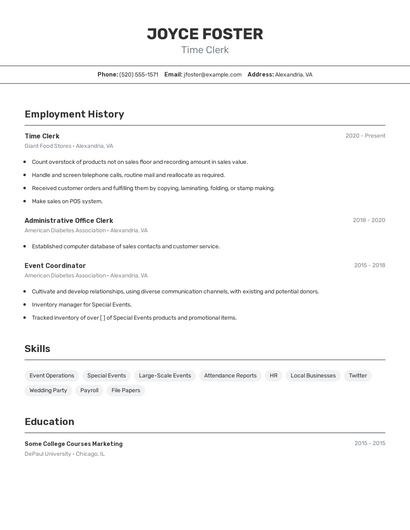
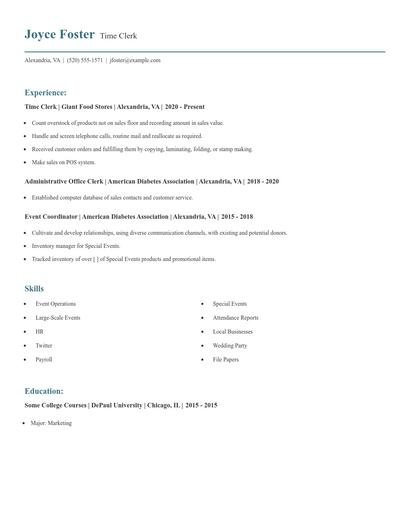
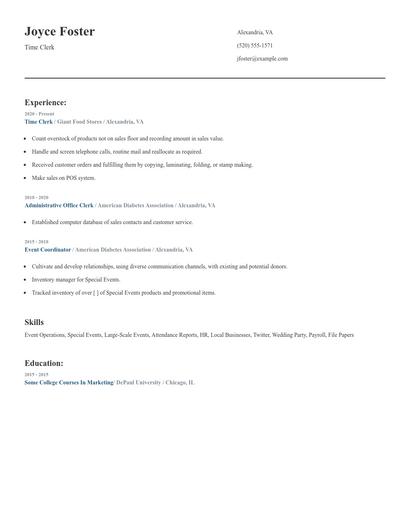
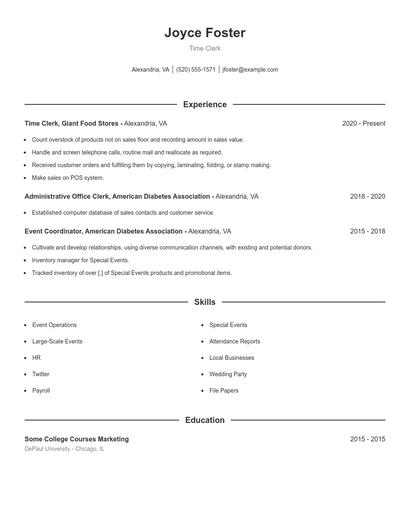
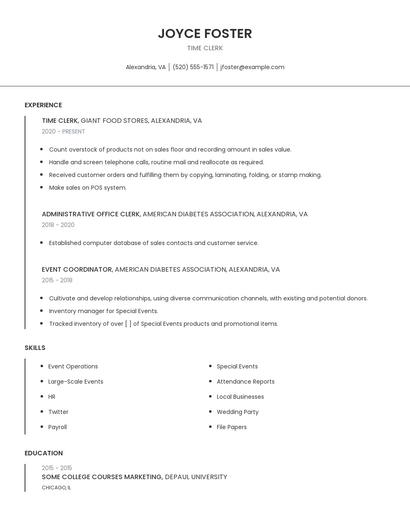
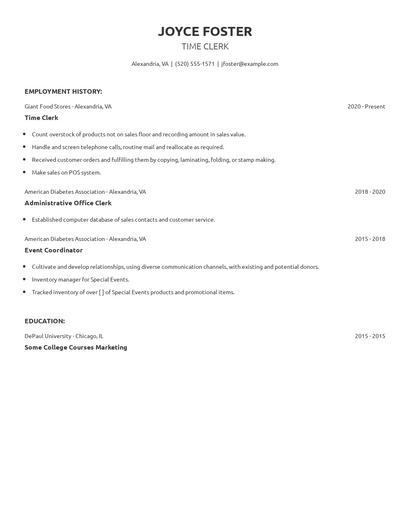
Build a professional time clerk resume in minutes. Our AI resume writing assistant will guide you through every step of the process, and you can choose from 10+ resume templates to create your time clerk resume.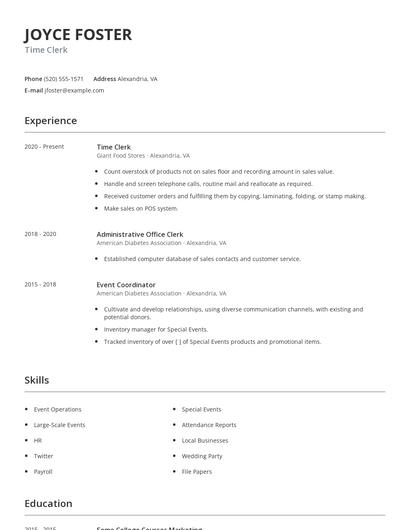


Compare different time clerks
Time clerk vs. Clerk typist
A clerk typist is responsible for data entry procedures and document transcriptions, alongside other clerical and administrative duties as required by the employer. Clerk typists create reports and presentation materials, transcribe audio meetings, write business drafts, and send documents to appropriate office personnel or clients. A clerk-typist must show excellent organizational and time-management skills, especially with handling various typing tasks under strict deadlines and minimal supervision. They also respond and take calls from clients and customers, assisting with their inquiries and concerns.
There are some key differences in the responsibilities of each position. For example, time clerk responsibilities require skills like "timekeeping," "pay period," "attendance reports," and "payroll system." Meanwhile a typical clerk typist has skills in areas such as "data entry," "customer service," "telephone calls," and "payroll." This difference in skills reveals the differences in what each career does.
Clerks typist tend to make the most money working in the education industry, where they earn an average salary of $32,312. In contrast, time clerks make the biggest average salary, $45,227, in the energy industry.The education levels that clerks typist earn slightly differ from time clerks. In particular, clerks typist are 4.0% less likely to graduate with a Master's Degree than a time clerk. Additionally, they're 0.1% more likely to earn a Doctoral Degree.Time clerk vs. Office services clerk
An office services clerk is an individual employee who performs a multitude of administrative tasks as well as office maintenance duties of an organization. Office services clerks are required to maintain an inventory of office supplies as well as purchase and distribute office supplies to all employees when needed. They must manage office services staff to ensure that their duties are met efficiently and effectively. Office services clerks must also provide customer service to a wide range of customers by answering phones and responding to emails.
While some skills are similar in these professions, other skills aren't so similar. For example, resumes show us that time clerk responsibilities requires skills like "timekeeping," "pay period," "attendance reports," and "payroll system." But an office services clerk might use other skills in their typical duties, such as, "customer service," "office services," "data entry," and "word processing."
On average, office services clerks earn a lower salary than time clerks. Some industries support higher salaries in each profession. Interestingly enough, office services clerks earn the most pay in the utilities industry with an average salary of $37,812. Whereas time clerks have higher pay in the energy industry, with an average salary of $45,227.Average education levels between the two professions vary. Office services clerks tend to reach similar levels of education than time clerks. In fact, they're 4.1% less likely to graduate with a Master's Degree and 0.1% more likely to earn a Doctoral Degree.Time clerk vs. Support clerk
A support clerk is primarily in charge of performing administrative support tasks in an office, making the daily workflow easier. Their responsibilities typically include preparing and processing documentation, answering and forwarding calls, handling correspondence, disseminating and organizing files, and running errands as needed. They may also update databases, maintaining records of all transactions. Furthermore, as a support clerk, it is essential to maintain an active communication line with staff, coordinating to ensure efficient and smooth workplace operations.
There are many key differences between these two careers, including some of the skills required to perform responsibilities within each role. For example, a time clerk is likely to be skilled in "timekeeping," "pay period," "attendance reports," and "payroll system," while a typical support clerk is skilled in "customer service," "data entry," "patients," and "clerical support."
Support clerks earn the highest salary when working in the government industry, where they receive an average salary of $35,567. Comparatively, time clerks have the highest earning potential in the energy industry, with an average salary of $45,227.When it comes to education, support clerks tend to earn similar degree levels compared to time clerks. In fact, they're 3.9% less likely to earn a Master's Degree, and 0.5% less likely to graduate with a Doctoral Degree.Time clerk vs. Control clerk
Being a control clerk involves a variety of administrative and clerical tasks, including the maintenance of business files, answering phone calls, and running errands. A control clerk's responsibility includes coordination and assistance of project team members to resolve data issues and protocols. Since the job is to keep business efficiency by overseeing the safety and quality of work, a control clerk should have attention to detail, good verbal and written communication skills, and the ability to work individually and to concentrate for long periods.
Types of time clerk
Updated January 8, 2025
