What does a training development director do?
A training development director spearheads and oversees programs designed to provide training and development services to employees, typically in a corporate setting. Among their responsibilities include developing career and training plans, performing research and analysis to identify the needs of employees, conducting skills assessments, gathering and analyzing data, setting goals, establishing guidelines and timelines, and liaising with external parties such as suppliers and vendors. Moreover, a training development director leads and encourages teams to reach goals, all while implementing the company's policies and regulations.
Training development director responsibilities
Here are examples of responsibilities from real training development director resumes:
- Manage instructional design and facilitation teams to create exceptional instructor-le and eLearning interventions.
- Extend product revenue by delivering new products for managing configuration of Linux platforms.
- Provide a comprehensive training approach including eLearning and classroom-base training.
- Develop and market management training programs and leadership initiatives base on ongoing assessments of enterprise-wide needs and client consultations.
- Formalize processes; create and maintain training records and prepare statistical reports to evaluate performance and ROI.
- Determine learning and performance requirements for clients through needs analyses, along with customization requirements and follow-up ROI analyses.
- Prepare and deliver training presentations covering company hardware and software products and ISO audit preparation.
Training development director skills and personality traits
We calculated that 6% of Training Development Directors are proficient in Project Management, Human Resources, and Professional Development. They’re also known for soft skills such as Business skills, Communication skills, and Collaboration skills.
We break down the percentage of Training Development Directors that have these skills listed on their resume here:
- Project Management, 6%
Implemented a comprehensive project management system.
- Human Resources, 5%
Partnered with executive management, business leaders and human resources.
- Professional Development, 5%
Participated in professional developmental activities.
- Training Development, 5%
Planned training development programs using effective methods such as classroom training, demonstrations and other learning methods.
- Training Curriculum, 5%
Created, implemented, and managed an operations-focused training curriculum for a 12-division manufacturing and distribution company.
- Learning Management System, 4%
Selected, structured, implemented and managed Learning Management System and all learning activity reporting.
"project management," "human resources," and "professional development" are among the most common skills that training development directors use at work. You can find even more training development director responsibilities below, including:
Business skills. One of the key soft skills for a training development director to have is business skills. You can see how this relates to what training development directors do because "training and development managers must understand business operations in order to match training with business goals." Additionally, a training development director resume shows how training development directors use business skills: "directed the corporate training and development function * collaborated with business leaders to align training solutions/initiatives with business strategy and goals. "
Communication skills. Many training development director duties rely on communication skills. "training and development managers must clearly convey information to diverse audiences," so a training development director will need this skill often in their role. This resume example is just one of many ways training development director responsibilities rely on communication skills: "create best-in-class training, communication and performance management tools to enhance retention and professional development of program associates. "
Collaboration skills. training development directors are also known for collaboration skills, which are critical to their duties. You can see how this skill relates to training development director responsibilities, because "training and development managers need strong interpersonal skills because delivering training programs requires working in concert with staff, trainees, subject matter experts, and the organization’s leaders." A training development director resume example shows how collaboration skills is used in the workplace: "created and expanded a world-class sales program through successful leadership collaboration. "
Instructional skills. A big part of what training development directors do relies on "instructional skills." You can see how essential it is to training development director responsibilities because "training and development managers need to understand the fundamentals of teaching and lesson planning." Here's an example of how this skill is used from a resume that represents typical training development director tasks: "managed a staff of subject matter experts, instructional designers and graphic artists. "
Leadership skills. Another crucial skill for a training development director to carry out their responsibilities is "leadership skills." A big part of what training development directors relies on this skill, since "managers are often in charge of a staff and programs." How this skill relates to training development director duties can be seen in an example from a training development director resume snippet: "created arby's university, a corporate professional development curriculum addressing all aspects of management through executive leadership. "
The three companies that hire the most training development directors are:
- Aya Healthcare19 training development directors jobs
- First Republic Bank
2 training development directors jobs
- Nexstar Media Group2 training development directors jobs
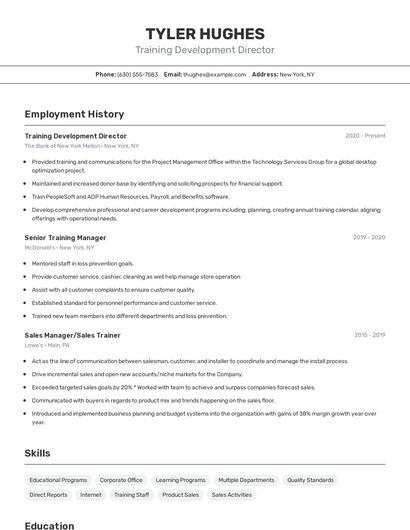
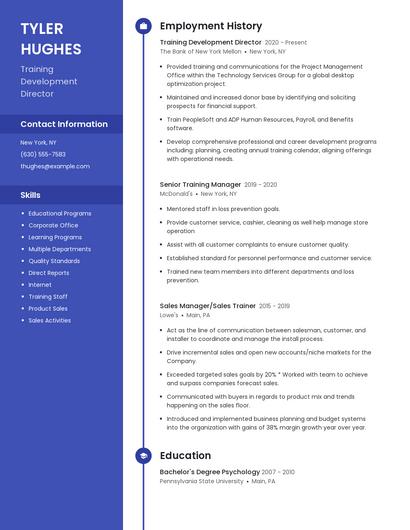
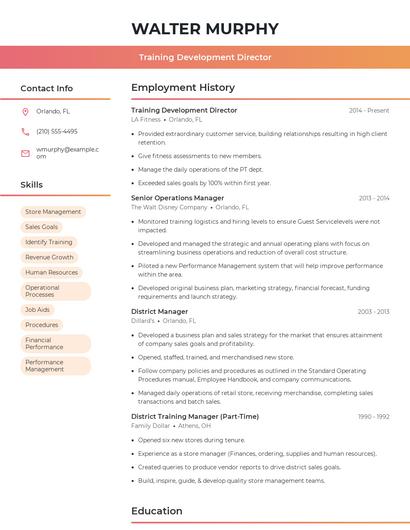
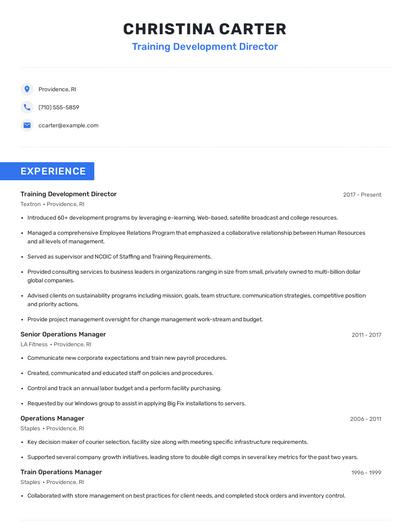
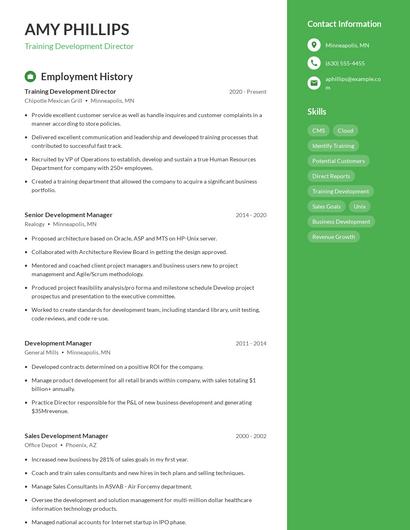
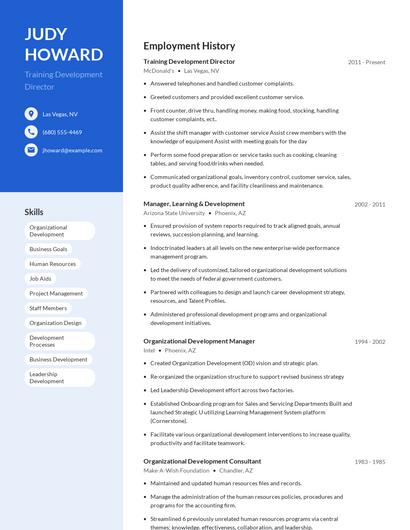
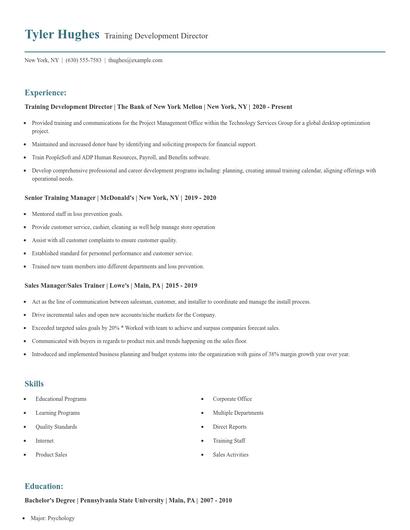
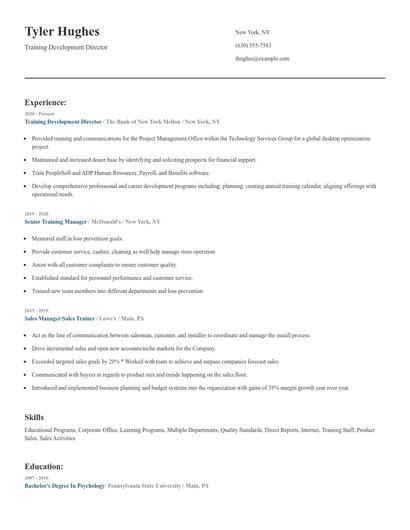
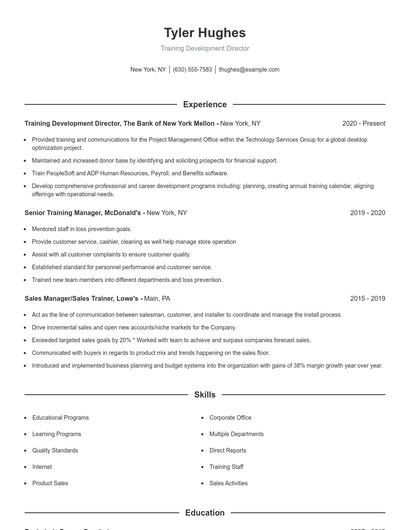
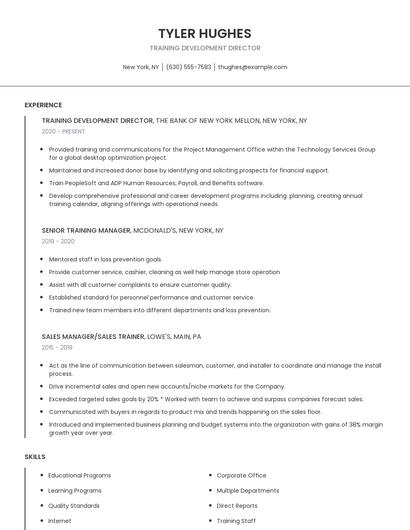
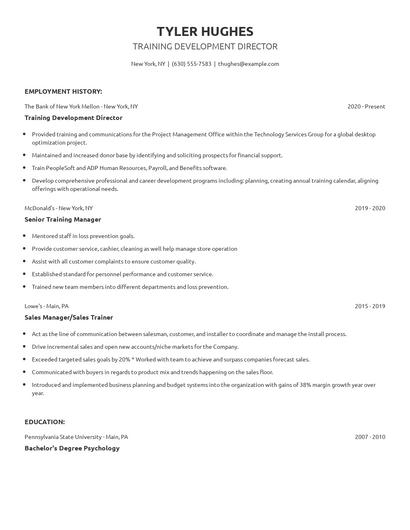
Choose from 10+ customizable training development director resume templates
Build a professional training development director resume in minutes. Our AI resume writing assistant will guide you through every step of the process, and you can choose from 10+ resume templates to create your training development director resume.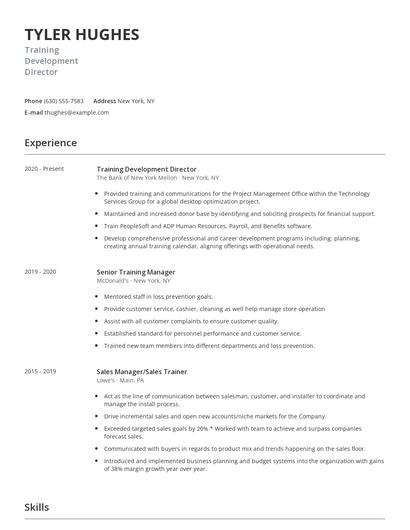
Compare different training development directors
Training development director vs. Educational manager
An educational manager is responsible for organizing educational strategies and managing learning resources, following the standard curriculum and guidelines. They coordinate with instructors and other educational institutions to develop teaching practices and adjust curriculum objectives as needed. Educational managers also handle department budgets, allocating adequate resources and materials to support students' learning and activities. An educational manager must have excellent knowledge of the teaching strategies, as well as educational disciplines, to handle concerns related to educational objectives.
While similarities exist, there are also some differences between training development directors and educational manager. For instance, training development director responsibilities require skills such as "human resources," "training development," "leadership development," and "organizational development." Whereas a educational manager is skilled in "patients," "education programs," "patient care," and "powerpoint." This is part of what separates the two careers.
Educational managers really shine in the manufacturing industry with an average salary of $105,157. Comparatively, training development directors tend to make the most money in the technology industry with an average salary of $118,907.On average, educational managers reach similar levels of education than training development directors. Educational managers are 0.6% more likely to earn a Master's Degree and 0.9% less likely to graduate with a Doctoral Degree.Training development director vs. Hse manager
A health, safety, and environmental (HSE) manager is primarily in charge of spearheading and overseeing a company's health and safety programs. Their responsibilities typically revolve around coordinating with different departments to gather data, assessing existing programs and policies to identify areas needing improvement, implementing solutions on issues and concerns, developing strategies to execute programs, and creating new safety policies as necessary. Furthermore, as an HSE manager, it is essential to lead and encourage team members to reach goals, all while enforcing the company's policies and regulations.
In addition to the difference in salary, there are some other key differences worth noting. For example, training development director responsibilities are more likely to require skills like "human resources," "professional development," "training development," and "training curriculum." Meanwhile, an hse manager has duties that require skills in areas such as "regulatory agencies," "osha," "environmental regulations," and "safety program." These differences highlight just how different the day-to-day in each role looks.
Hse managers may earn a higher salary than training development directors, but hse managers earn the most pay in the construction industry with an average salary of $105,683. On the other hand, training development directors receive higher pay in the technology industry, where they earn an average salary of $118,907.In general, hse managers achieve lower levels of education than training development directors. They're 7.4% less likely to obtain a Master's Degree while being 0.9% less likely to earn a Doctoral Degree.What technology do you think will become more important and prevalent for training development directors in the next 3-5 years?
Gregory Zobel Ph.D.
Associate Professor of Educational Technology, Education & Leadership, Western Oregon University
Training development director vs. Director of training
Training directors are responsible for directing the planning, design, and implementation of training programs. They are responsible for assessing and identifying the company's training needs, maintaining a consistent culture regarding training, and managing and directing employee training. Training directors are expected to provide engaging communication about the program to encourage employee participation and emphasize the benefits and value of exercise. They are also expected to establish and maintain good relationships with vendors to provide more training programs.
There are many key differences between these two careers, including some of the skills required to perform responsibilities within each role. For example, a training development director is likely to be skilled in "organizational development," "employee development," "needs assessment," and "identify training," while a typical director of training is skilled in "customer service," "powerpoint," "cpr," and "management training."
Most directors of training achieve a similar degree level compared to training development directors. For example, they're 1.8% less likely to graduate with a Master's Degree, and 0.8% less likely to earn a Doctoral Degree.Training development director vs. Manager & instructor
Types of training development director
Updated January 8, 2025
