Find a Job You Really Want In
Crafting a resume can be a daunting task, especially when it comes to the nuances of grammar. However, these details can significantly impact the professionalism of your resume. A common question that arises is: which verb tense should you use?
In this article, we will explore the distinctions between past and present tense and guide you on when to utilize each in your resume. We’ll also provide insights on employing future tense, as well as the appropriate tense for your cover letter.
Key Takeaways
-
Past tense refers to events that have occurred, while present tense pertains to ongoing activities.
-
Both past and present tense can be effectively used in your resume.
-
Typically, most of your resume should be written in past tense.
- The Difference Between Past Tense and Present Tense
- Using Past Tense in Your Resume
- Using Present Tense in Your Resume
- Using Both Tenses in One Section of Your Resume
- Tips to Remember When Choosing a Tense
- When to Use Future Tense
- Should You Use Past or Present Tense in Your Cover Letter?
- Ask the Experts
- Sign Up For More Advice and Jobs
The Difference Between Past Tense and Present Tense
Here’s a brief overview of the differences between past and present tense verbs:
-
Past tense verbs indicate actions that have already taken place. These verbs generally end in -ed, although some, like “sang” or “went,” have unique forms.
For your resume, use the verb alone without “have.” For example, you would write “Coordinated” rather than “Have coordinated.”
-
Present tense verbs describe actions that are currently ongoing. They can also refer to habitual actions. Typically, these verbs do not have endings, although some may end with -s.
For instance, you would write “Make” instead of “I make” for a resume.
Using Past Tense in Your Resume
The guideline for using past tense is straightforward: employ it when discussing past experiences.
This includes any achievements, degrees or certifications earned, training completed, previous responsibilities, and volunteer work undertaken.
Consequently, the majority of your resume should be composed in past tense.
Here are some illustrative examples:
Earned administrative assistant certification.
Exceeded sales goals by 25% in 2020.
Wrote and edited 25 memos each week for corporate offices.
Handled over 30 customer service inquiries and complaints daily.
Received recognition for excellence in innovation from CEO.
Since most of the actions on your resume occurred in the past, it is advisable to maintain past tense throughout the majority of your resume.
Using Present Tense in Your Resume
Just as past tense is used for completed actions, present tense is reserved for describing ongoing responsibilities.
This applies to your current job tasks as well as any volunteer work or activities you are presently engaged in.
Consider these examples:
Oversee projects for eight teams within the department.
Edit an average of 15 novella drafts each week.
Create and manage social media advertising campaigns on four platforms for three different products.
Volunteer with Thursday Night Lights once a week to feed the homeless.
Teach at a local tutoring center twice a month.
While it is acceptable to use present tense, it should primarily be reserved for your current role and any ongoing activities.
Using Both Tenses in One Section of Your Resume
It is possible and occasionally necessary to incorporate both past and present tense within the same resume section.
This scenario arises when you discuss your ongoing tasks in your current job alongside any achievements attained in that role.
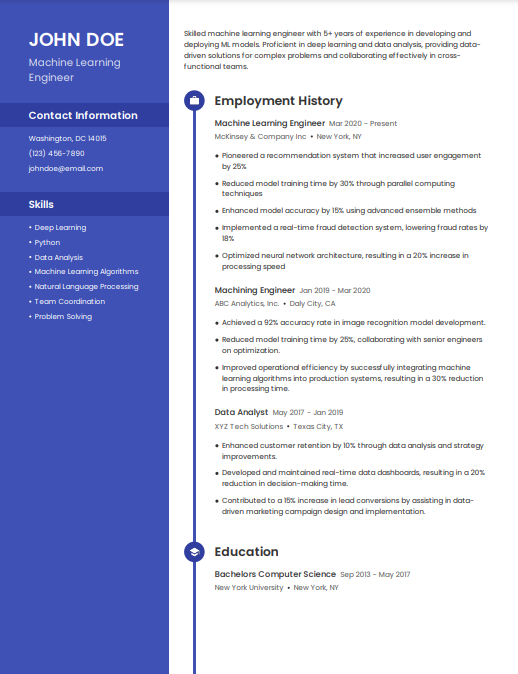
For example, if you were crafting a resume for an elementary school teacher, your current work history section might appear as follows:
Third Grade Teacher
Ralston Creek Elementary School
August 2018 – Present
Teach a class of 25 third-grade students.
Meet with students’ parents and guardians every two months, both in group settings and individual meetings.
Implemented a new writing curriculum, resulting in a 5% increase in standardized test scores.
Received teacher of the year award in 2019.
Provide feedback on lesson plans for other third-grade teachers.
Initiated weekly meetings with fellow third-grade instructors to identify and implement best practices, leading to a 4% increase in student retention rates from third to fourth grade.
A previous position might be documented as follows:
Fourth Grade Teacher
Myers Elementary School
August 2015 – May 2018
Taught three classes of 30 students each.
Developed a new parent communication system, improving satisfaction rates by 8%, as per the end-of-year survey.
Participated in the school event planning committee, assisting with the planning and supervision of four events annually.
Selected and implemented a new math curriculum.
Tips to Remember When Choosing a Tense
-
Maintain consistency. The only instance where you can mix tenses is when discussing your ongoing responsibilities in your current job or active volunteer work.
For all other sections, avoid mixing tenses, especially under the same heading. If you find this challenging, make a note to verify that your verbs align correctly, as most will appear at the beginning of each bullet point.
-
When in doubt, default to past tense. This is generally the safest route if you’re uncertain about which tense to use. Excessive present tense can create confusion for hiring managers, as they may wonder why you describe multiple roles in the present tense. Using past tense consistently indicates your focus on future opportunities.
-
Avoid weakening your resume with present participles. Present participles end in -ing and are typically preceded by a form of “to be.” For instance, instead of writing, “Am volunteering as a tutor four times a week,” say, “Volunteer as a tutor four times a week.” This approach projects a stronger and clearer message.
-
Match keywords as necessary. Many organizations utilize automated applicant tracking systems to ensure resumes include essential keywords. Review the job description and incorporate keywords from the requirements section, particularly when applying to larger companies.
For example, if the job description emphasizes “data entry” and “database management,” state, “Handled department data entry and database management,” instead of “Organized department databases and entered data.” While both phrases convey the same meaning, ATS may not recognize the latter due to the lack of keyword alignment.
However, if you are emailing your resume to a small company, prioritizing tense consistency is usually more impactful than strict keyword matching, as a human reader will appreciate clarity over keyword stuffing.
When to Use Future Tense
The future tense is another important aspect to consider. You can identify future tense verbs by the word “will” that precedes them in phrases like “will receive” or “will implement.”
Future tense should only be used in specific scenarios, such as when outlining goals in your objective section or if you are a student applying for a job or internship and wish to indicate an upcoming class, activity, or position.
For example, if it’s January and you’re applying for a summer internship, you might mention that you will complete a relevant class in the spring semester that enhances your qualifications for the role.
In other contexts, avoid future tense. Here are some examples:
-
Discussing a future degree. If you have not yet earned your degree but plan to, say, “Expected May 2026.”
-
Mentioning a future position. If you have been elected to a position, such as student body president, but will not assume the role until the next academic year, you could state, “Elected to serve as student body president beginning in August 2026.”
Should You Use Past or Present Tense in Your Cover Letter?
Similar to your resume, use past tense for former responsibilities and accomplishments, and present tense for your current duties in your cover letter. The same tense guidelines apply, so aim to keep your message clear by aligning present tense with present actions and past tense with past actions whenever possible.
Ask the Experts
What are some tips for listing experience on a resume?
Lexi N. Albrecht
JohnLeonard Employment Services
Three quick tips:
- Your resume should be written in the first person, but without pronouns such as “I,” “me,” or “my.”
- Present your responsibilities in a bulleted format.
- Utilize present tense action verbs for current positions and past tense verbs for completed roles.

Author

Chris Kolmar is a co-founder of Zippia and the editor-in-chief of the Zippia career advice blog. He has hired over 50 people in his career, been hired five times, and wants to help you land your next job. His research has been featured on the New York Times, Thrillist, VOX, The Atlantic, and a host of local news. More recently, he's been quoted on USA Today, BusinessInsider, and CNBC.