What does an allocation analyst do?
In the retail industry, an allocation analyst is in charge of providing analytical services to optimize a company's supply chain operations. Among their responsibilities include performing market research and analysis, determining the customers' purchase needs, managing product inventory, coordinating with store managers, gathering and analyzing data from internal and external parties, keeping abreast with the latest trends, and developing strategies to reach sales and inventory targets. Moreover, an allocation analyst must maintain an active communication line with staff while enforcing and promoting the company's policies and regulations.
Allocation analyst responsibilities
Here are examples of responsibilities from real allocation analyst resumes:
- Manage sales forecast and inventory at store level using E3.
- Analyze and forecast sales, manage inventory levels and determine distribution strategy to all Marshalls stores.
- Establish and maintain significant cross-functional relationships with buying team, distribution centers, logistics, store operations and other departments.
- Utilize E3 slim to project forecast, sales, and promotional events.
- Partner with the JDA systems administrator on the appropriate set up and maintenance of department SKUs.
- Analyze POS, inventory and shipment data to make inform decisions regarding replenishment of items at the store level.
- Compile data from factories, logistics, sales, and purchasing to determine inventory needs and allocate goods to customers.
- Convey any system shortcomings to the business analysis team for correction as well as testing of the new JDA system.
- Transform data into stories through effective use of data visualization, simplification and understanding of intend audiences.
- Process and analyze all EDI transactions.
- Communicate with customer service, purchasing, EDI, shipping, receiving, sales staff, regarding gaps in processes.
- Advise buyers and make product distribution decisions to maximize product ROI
- Transform data into stories through effective use of data visualization, simplification and understanding of intend audiences.
Allocation analyst skills and personality traits
We calculated that 11% of Allocation Analysts are proficient in Allocation Strategies, Purchase Orders, and Logistics. They’re also known for soft skills such as Analytical skills, Communication skills, and Detail oriented.
We break down the percentage of Allocation Analysts that have these skills listed on their resume here:
- Allocation Strategies, 11%
Developed and executed initial SKU allocation strategies by analyzing historical and current selling trends to maximize key planning metrics.
- Purchase Orders, 8%
Developed and ran weekly allocation simulation report to identify customer and factory purchase orders in jeopardy of shipping late.
- Logistics, 7%
Established and maintained significant cross-functional relationships with buying team, distribution centers, logistics, store operations and other departments.
- Distribution Centers, 4%
Maintained open-to-ship and order management systems between distribution centers and home office.
- Apparel, 4%
Lead a team of 4 analysts, together allocating Men's and Youth Apparel for Retail Outlet, North America.
- Store Sales, 4%
Suggested sales plan changes/opportunities by consistently monitoring the ladder plan and creating more accurate store plans which consequently drove store sales.
Most allocation analysts use their skills in "allocation strategies," "purchase orders," and "logistics" to do their jobs. You can find more detail on essential allocation analyst responsibilities here:
Analytical skills. To carry out their duties, the most important skill for an allocation analyst to have is analytical skills. Their role and responsibilities require that "market research analysts must evaluate large amounts of data and information related to market conditions." Allocation analysts often use analytical skills in their day-to-day job, as shown by this real resume: "analyzed sales trends, anticipated consumer buying patterns and trends and evaluated in-store and competitors' merchandise selections. "
Communication skills. Another soft skill that's essential for fulfilling allocation analyst duties is communication skills. The role rewards competence in this skill because "market research analysts must be able to clearly convey information when gathering material, interpreting data, and presenting results to clients." According to an allocation analyst resume, here's how allocation analysts can utilize communication skills in their job responsibilities: "maintained open lines of communication with vendors regarding purchase order shipment and tracking as well as availability issues. "
Detail oriented. This is an important skill for allocation analysts to perform their duties. For an example of how allocation analyst responsibilities depend on this skill, consider that "market research analysts must pay attention to minutiae to evaluate data." This excerpt from a resume also shows how vital it is to everyday roles and responsibilities of an allocation analyst: "receive inventory reports from the accountant department and verify the details against the actual balance. ".
The three companies that hire the most allocation analysts are:
- BJ's Wholesale Club44 allocation analysts jobs
- Columbia Sportswear4 allocation analysts jobs
- Ross Stores4 allocation analysts jobs
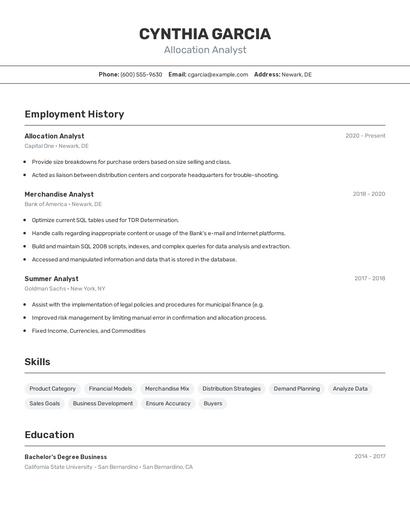
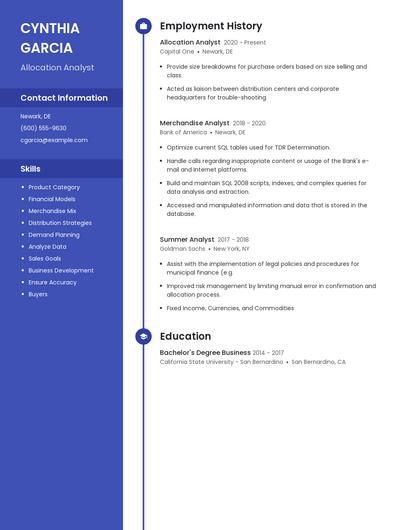
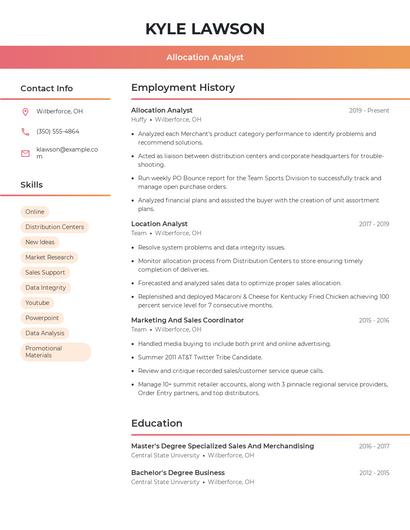
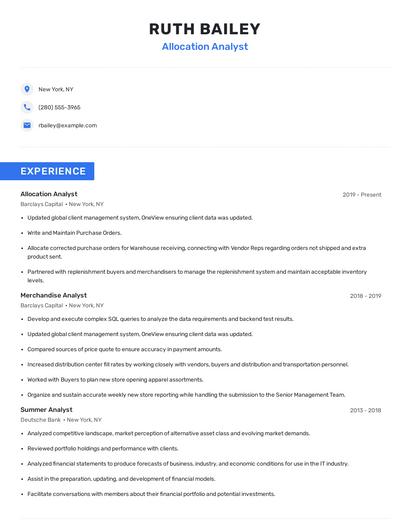
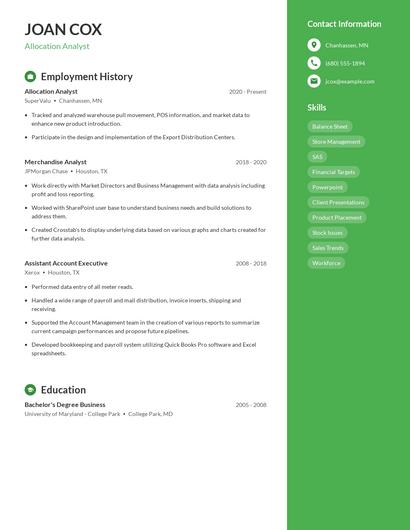
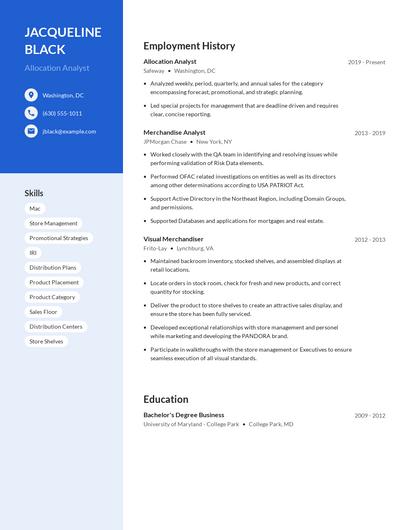
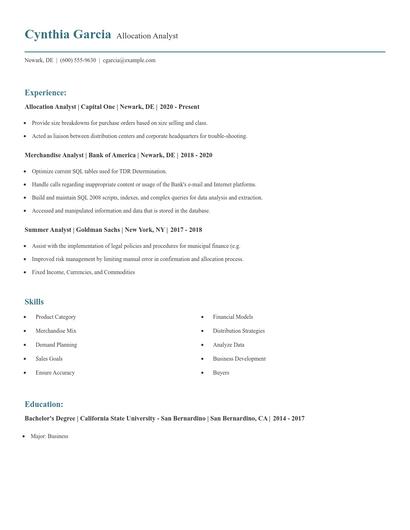
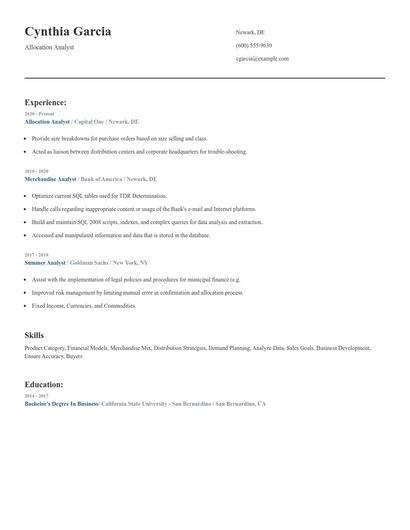
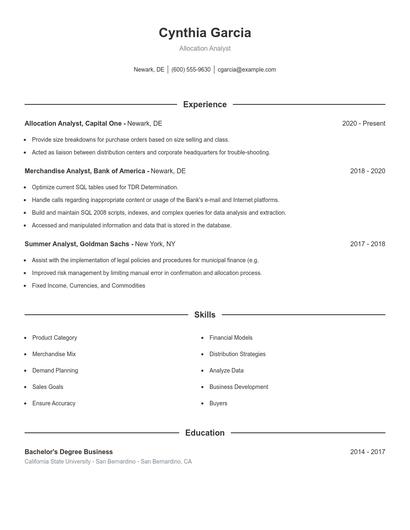
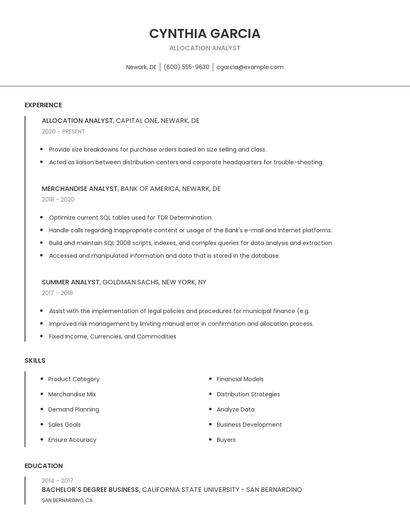
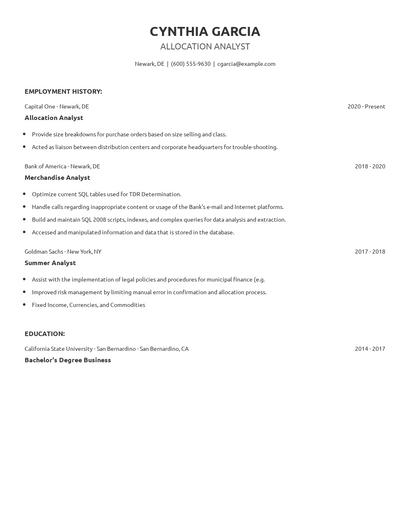
Choose from 10+ customizable allocation analyst resume templates
Build a professional allocation analyst resume in minutes. Our AI resume writing assistant will guide you through every step of the process, and you can choose from 10+ resume templates to create your allocation analyst resume.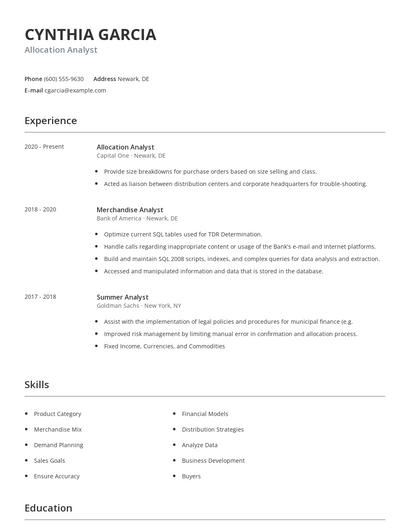
Compare different allocation analysts
Allocation analyst vs. Marketing representative
A marketing representative's responsibilities will vary on the line of work or industry. However, it is the role of a marketing representative to engage with clients and secure sales by promoting, demonstrating, and even advertising products or services. Furthermore, they must devise marketing strategies, conduct research and analysis through surveys and polls, lookout for new opportunities and trends, and coordinate with advertisers. One must have extensive knowledge about the product as well as communication skills, being that building rapport will be very useful in accomplishing every task.
These skill sets are where the common ground ends though. The responsibilities of an allocation analyst are more likely to require skills like "allocation strategies," "purchase orders," "logistics," and "distribution centers." On the other hand, a job as a marketing representative requires skills like "product knowledge," "customer service," "sales presentations," and "life insurance." As you can see, what employees do in each career varies considerably.
Marketing representatives tend to make the most money working in the finance industry, where they earn an average salary of $60,984. In contrast, allocation analysts make the biggest average salary, $70,970, in the retail industry.The education levels that marketing representatives earn slightly differ from allocation analysts. In particular, marketing representatives are 1.2% more likely to graduate with a Master's Degree than an allocation analyst. Additionally, they're 0.2% less likely to earn a Doctoral Degree.Allocation analyst vs. Research internship
A research intern is responsible for assisting the research team with conducting an investigation, compiling information, and analyzing results for an organized research study. Research interns' duties also include understanding the work processes and operation procedures, sharing strategies and recommendations on research methods, reaching out to appropriate research correspondents, managing clients' inquiries and concerns, keeping important client records for reference, studying current market trends, and maintaining the eagerness to learn. A research intern must have strong attention to detail and excellent communication skills to perform on daily research tasks.
While some skills are similar in these professions, other skills aren't so similar. For example, resumes show us that allocation analyst responsibilities requires skills like "allocation strategies," "purchase orders," "logistics," and "distribution centers." But a research internship might use other skills in their typical duties, such as, "python," "c++," "research intern," and "java."
Research interns may earn a lower salary than allocation analysts, but research interns earn the most pay in the technology industry with an average salary of $52,879. On the other hand, allocation analysts receive higher pay in the retail industry, where they earn an average salary of $70,970.In general, research interns achieve higher levels of education than allocation analysts. They're 9.9% more likely to obtain a Master's Degree while being 0.2% more likely to earn a Doctoral Degree.Allocation analyst vs. Marketing coordinator
A marketing coordinator supports the marketing department on deciding strategies and business efforts to develop the brand image and boost customer satisfaction. Marketing coordinators' duties include assisting in advertising campaigns, scheduling promotional events, monitoring sales status, researching current market trends, maintaining a record of existing and potential clients, and contributing ideas to improve the brand's profitability. A marketing coordinator must have excellent critical thinking and writing skills to help with the creation of social media advertisements and marketing content. It also requires impressive time-management and multi-tasking skills, especially on meeting deadlines and making adjustments on the initial plans as needed.
Some important key differences between the two careers include a few of the skills necessary to fulfill the responsibilities of each. Some examples from allocation analyst resumes include skills like "allocation strategies," "purchase orders," "logistics," and "distribution centers," whereas a marketing coordinator is more likely to list skills in "digital marketing," "customer service," "marketing campaigns," and "powerpoint. "
Marketing coordinators earn the highest salary when working in the technology industry, where they receive an average salary of $53,831. Comparatively, allocation analysts have the highest earning potential in the retail industry, with an average salary of $70,970.When it comes to education, marketing coordinators tend to earn similar degree levels compared to allocation analysts. In fact, they're 2.1% more likely to earn a Master's Degree, and 0.3% more likely to graduate with a Doctoral Degree.Allocation analyst vs. Merchandise planner
A merchandise planner is responsible for monitoring the adequacy of stock inventories and requesting purchase orders by researching current market trends to meet customer demands. Merchandise planners assist with marketing campaigns and promotional offers of the business, selling goods and services to the customers based on their needs and budget requirements. They also write sales reports, inspect the validity of merchandise, and maintain an attractive visual display of items. A merchandise planner resolves and escalates customer complaints timely, processes replacements, and issues refunds as needed.
Even though a few skill sets overlap between allocation analysts and merchandise planners, there are some differences that are important to note. For one, an allocation analyst might have more use for skills like "purchase orders," "logistics," "distribution centers," and "store performance." Meanwhile, some responsibilities of merchandise planners require skills like "strong analytical," "math," "open-to-buy," and "recap. "
In general, merchandise planners earn the most working in the retail industry, with an average salary of $66,788. The highest-paying industry for an allocation analyst is the retail industry.In general, merchandise planners hold similar degree levels compared to allocation analysts. Merchandise planners are 2.8% more likely to earn their Master's Degree and 0.5% less likely to graduate with a Doctoral Degree.Types of allocation analyst
Updated January 8, 2025
