What does an assessment coordinator do?
An assessment coordinator is primarily in charge of evaluating programs and projects. Their responsibilities include identifying the purpose of programs and projects, understanding the company's vision and mission, developing criteria and test structures, conducting inspections and investigations, and coordinating with staff to gather and analyze data. They may conduct research and analysis, studying the client's feedback to gain insights. Furthermore, as an assessment coordinator, it is essential to maintain an active communication line with staff while implementing the company's policies and regulations.
Assessment coordinator responsibilities
Here are examples of responsibilities from real assessment coordinator resumes:
- Initial triage of members, administrative intake of members and managing the admission/discharge information post-notification.
- Assess and coordinate admissions for rehabilitation hospital/skil nursing facility and ongoing marketing/public relations
- Assess and coordinate admissions for rehabilitation hospital/skil nursing facility and ongoing marketing/public relations
Assessment coordinator skills and personality traits
We calculated that 24% of Assessment Coordinators are proficient in Patients, Rehabilitation, and Patient Care. They’re also known for soft skills such as Listening skills, Speaking skills, and Analytical skills.
We break down the percentage of Assessment Coordinators that have these skills listed on their resume here:
- Patients, 24%
Staff referred incoming patients with appropriate doctor which requires constant communication with multiple physicians.
- Rehabilitation, 8%
Educated and marketed physicians and discharge planners internally and externally regarding services available through inpatient rehabilitation.
- Patient Care, 7%
Delivered health care knowledge/patient care skills to students seeking certification as a nursing assistant.
- Data Collection, 7%
Managed assessment of General Education curriculum and semester initiatives involving data collection and analysis for major and minor programs.
- Patient Assessment, 5%
Conducted patient assessments and interviews, analyzed interdisciplinary care plans, and performed chart audits.
- Crisis Intervention, 5%
Conducted clinical evaluations, crisis interventions, and referrals.
Common skills that an assessment coordinator uses to do their job include "patients," "rehabilitation," and "patient care." You can find details on the most important assessment coordinator responsibilities below.
Listening skills. One of the key soft skills for an assessment coordinator to have is listening skills. You can see how this relates to what assessment coordinators do because "school and career counselors and advisors need to give full attention to students and clients in order to understand their problems." Additionally, an assessment coordinator resume shows how assessment coordinators use listening skills: "communicated and worked with psychiatrist and physicians to place patients appropriately. "
Speaking skills. Another soft skill that's essential for fulfilling assessment coordinator duties is speaking skills. The role rewards competence in this skill because "school and career counselors and advisors must communicate effectively with clients and students." According to an assessment coordinator resume, here's how assessment coordinators can utilize speaking skills in their job responsibilities: "attended and presented nursing criteria for each pt at idt review conference with geripsychiatrist and idt. "
Analytical skills. assessment coordinators are also known for analytical skills, which are critical to their duties. You can see how this skill relates to assessment coordinator responsibilities, because "school and career counselors and advisors interpret student records, schoolwide data, and assessments to match interests and abilities with potential careers. ." An assessment coordinator resume example shows how analytical skills is used in the workplace: "test administration record keeping and data management"
Compassion. assessment coordinator responsibilities often require "compassion." The duties that rely on this skill are shown by the fact that "school and career counselors and advisors often work with people who are dealing with stressful and difficult situations, so they must be able to empathize with their clients and students." This resume example shows what assessment coordinators do with compassion on a typical day: "interact effectively and compassionately with patients, families, visitors and staff. "
Interpersonal skills. A commonly-found skill in assessment coordinator job descriptions, "interpersonal skills" is essential to what assessment coordinators do. Assessment coordinator responsibilities rely on this skill because "school and career counselors and advisors must be able to work with people of all backgrounds and personalities." You can also see how assessment coordinator duties rely on interpersonal skills in this resume example: "demonstrated excellent organizational, interpersonal, written and verbal communication skills with clients, supervisor, and command leadership. "
The three companies that hire the most assessment coordinators are:
- Encompass Health13 assessment coordinators jobs
- Universal Health Services10 assessment coordinators jobs
- Kindred Healthcare3 assessment coordinators jobs
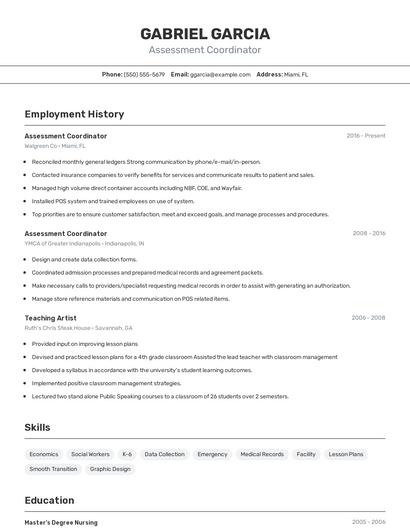
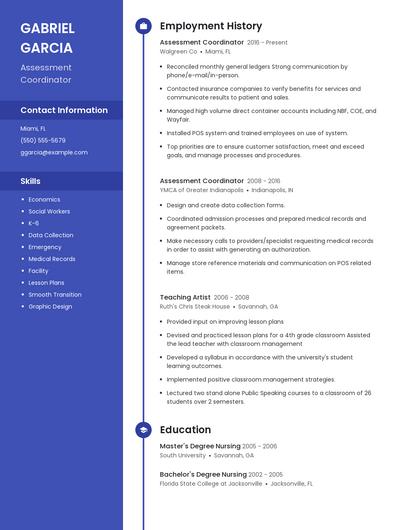
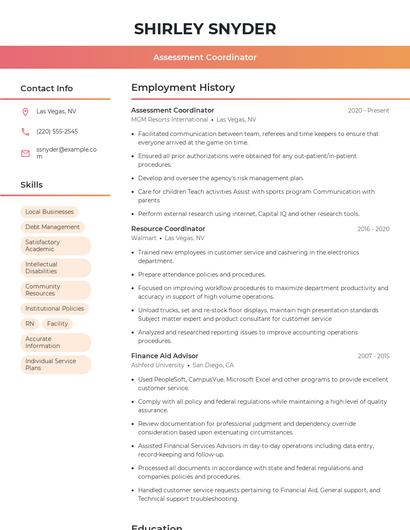
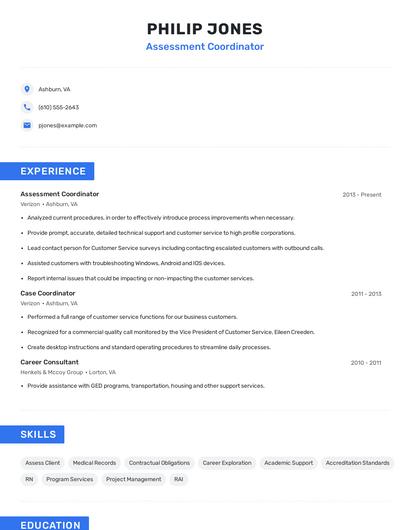
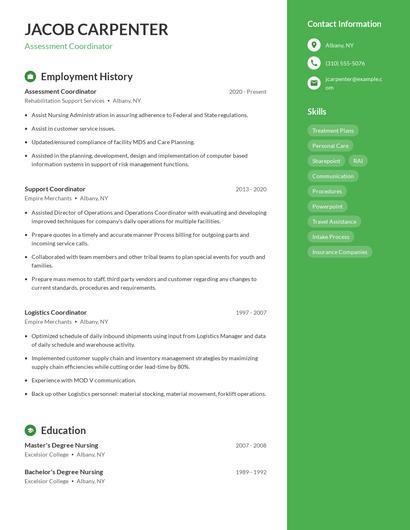
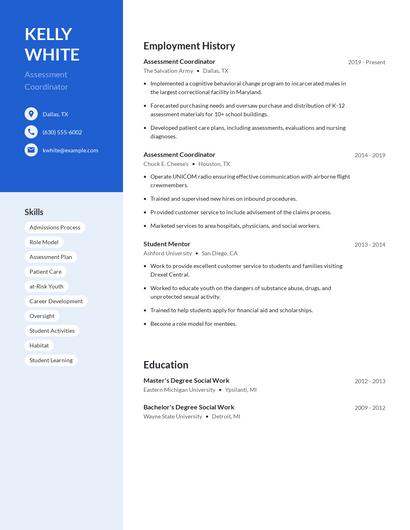
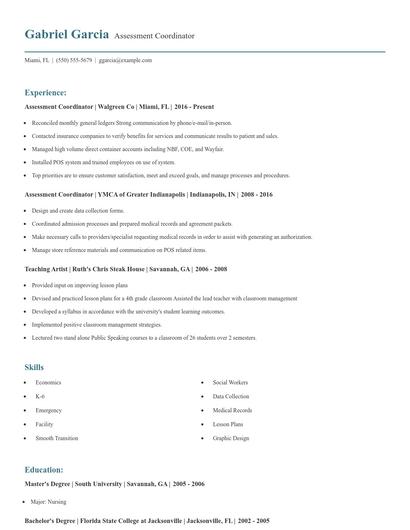
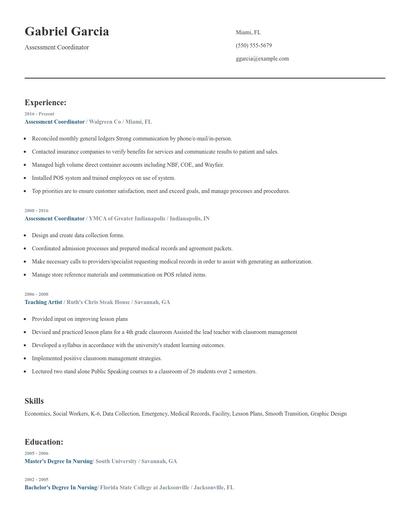
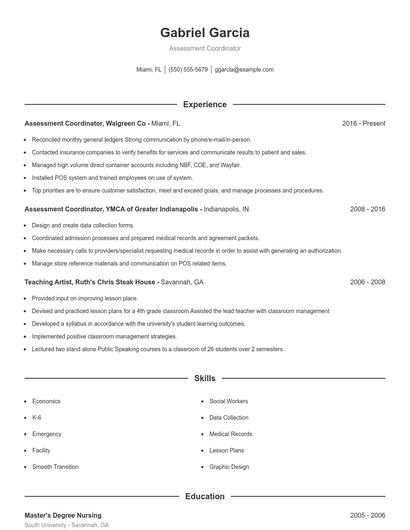
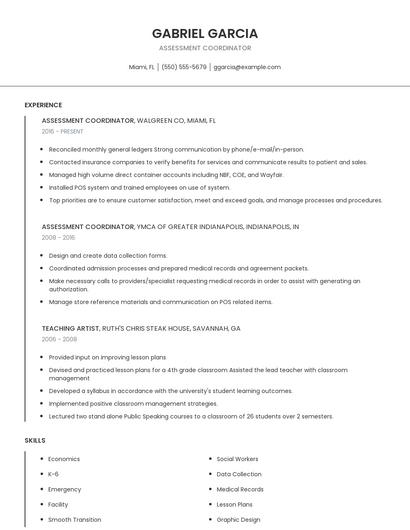
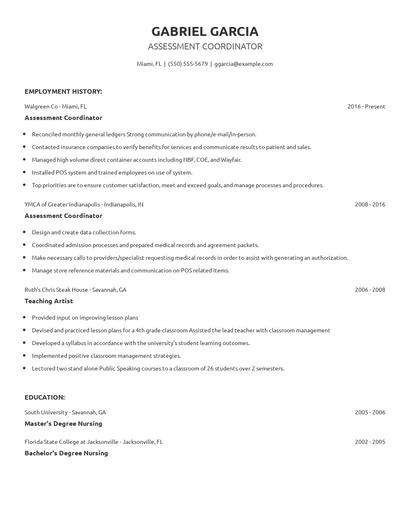
Choose from 10+ customizable assessment coordinator resume templates
Build a professional assessment coordinator resume in minutes. Our AI resume writing assistant will guide you through every step of the process, and you can choose from 10+ resume templates to create your assessment coordinator resume.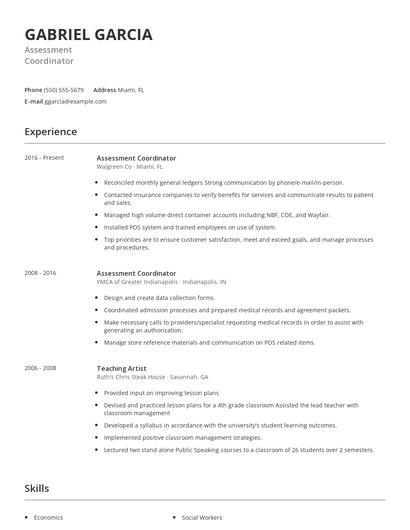
Compare different assessment coordinators
Assessment coordinator vs. Education internship
An education intern is responsible for assisting class activities, teaching students with various learning methodologies under a head instructor's supervision. Education interns create comprehensive lesson plans subject for the teacher's review and develop engaging activities and learning materials to create an active learning environment to monitor the students' personal and social development. They assist the students with their needs, such as identifying their areas of improvement, planning strategies to address those difficulties, and strictly adhering to the school policies.
There are some key differences in the responsibilities of each position. For example, assessment coordinator responsibilities require skills like "patients," "rehabilitation," "patient care," and "patient assessment." Meanwhile a typical education internship has skills in areas such as "education programs," "classroom management," "curriculum development," and "community outreach." This difference in skills reveals the differences in what each career does.
Education interns really shine in the government industry with an average salary of $43,410. Comparatively, assessment coordinators tend to make the most money in the energy industry with an average salary of $47,709.education interns tend to reach lower levels of education than assessment coordinators. In fact, education interns are 12.6% less likely to graduate with a Master's Degree and 2.6% less likely to have a Doctoral Degree.Assessment coordinator vs. Academic adviser
An academic adviser is responsible for managing the students' educational goals and future career aspirations by encouraging them to join scholastic activities, conducting one-on-one discussions to identify their challenges and areas of improvement, and developing educational plans to address possible difficulties. Academic advisers also monitor the students' interests and abilities for a career setting, track the students' progress, and create engaging activities to observe the students' personal and social behavior. An academic adviser must have excellent communication skills and extensive knowledge of teaching principles and disciplines to handle different personalities.
In addition to the difference in salary, there are some other key differences worth noting. For example, assessment coordinator responsibilities are more likely to require skills like "patients," "rehabilitation," "patient care," and "data collection." Meanwhile, an academic adviser has duties that require skills in areas such as "customer service," "student services," "financial aid," and "support services." These differences highlight just how different the day-to-day in each role looks.
Academic advisers earn a higher average salary than assessment coordinators. But academic advisers earn the highest pay in the government industry, with an average salary of $52,873. Additionally, assessment coordinators earn the highest salaries in the energy with average pay of $47,709 annually.Average education levels between the two professions vary. Academic advisers tend to reach similar levels of education than assessment coordinators. In fact, they're 1.5% more likely to graduate with a Master's Degree and 2.6% less likely to earn a Doctoral Degree.Assessment coordinator vs. Job coach
A job coach is responsible for evaluating people's skills and qualifications, advising them with career paths, helping with their aspirations, and promote employment opportunities. Job coaches help the clients build self-confidence and explore their maximum potentials to develop their professional growth. They provide counseling, understanding the clients' strengths and weaknesses, analyzing clients' personal goals, and guiding clients through job interviews and assessments. A job coach must have excellent communication, listening, and analytical skills to handle their clients' challenges and match their interests for the best career suited for them.
Some important key differences between the two careers include a few of the skills necessary to fulfill the responsibilities of each. Some examples from assessment coordinator resumes include skills like "patients," "patient care," "patient assessment," and "social work," whereas a job coach is more likely to list skills in "developmental disabilities," "cpr," "customer service," and "mental health. "
Job coaches earn the highest salary when working in the education industry, where they receive an average salary of $38,362. Comparatively, assessment coordinators have the highest earning potential in the energy industry, with an average salary of $47,709.job coaches typically earn lower educational levels compared to assessment coordinators. Specifically, they're 16.2% less likely to graduate with a Master's Degree, and 3.1% less likely to earn a Doctoral Degree.Assessment coordinator vs. School counselor
A school counselor is responsible for monitoring the students' social and personal development, advising them of their career aspirations, and assisting them with their academic achievements and goals. School counselors also ensure that the students receive the highest learning standards to pave their way towards society's advancement and global competitiveness. They evaluate students' behavior through personal counseling, understanding their challenges, and develop strategies to overcome their needs. A school counselor must have excellent communication and decision-making skills, supporting students with their goals, and honing their skills efficiently.
Types of assessment coordinator
Updated January 8, 2025
