What does a collection supervisor do?

Collection Supervisors are responsible for managing the operations of credit card debt collection. Their duties include overseeing credit applications, supervising the debt collection team, setting team goals, making sure collectors adhere to regulations, laws, and protocols, creating progress spreadsheets, coordinating activities for debt collectors, and assess delinquent accounts. They also organize team workload, write official debt collection letters, authorize repossessions, and supervise difficult collection cases. A Collection Supervisor participates in implementing credit procedures and policies that contribute to smooth operations.
Collection supervisor responsibilities
Here are examples of responsibilities from real collection supervisor resumes:
- Manage receivables, calculate DSO, cash projections, and presentations to upper level management.
- Manage re-billings for third party accounts including: commercial carriers, manage care, PPO, POS and HMO organizations.
- Verify insurance coverage including Medicaid, Medicare, HMO and indemnity insurance.
- Demonstrate effective negotiation urgency and problem resolution skills to resolve delinquent accounts by following state and federal guidelines.
- Call monitoring template/system utilize daily to ensure agents are using proper collection techniques, maintaining professionalism and following FDCPA guidelines.
- Complete weekly QA's and coaching's for a team of 12+.
- Prepare QA reports for each team member.
- Ensure compliance to HIPPA laws and federal regulations.
- Skip tracing non-contact accounts using skip tracing tools such as accurint.
- Design SOX matrix and testing procedures to comply with industry standards.
- Skip trace with Accurint as well as other non-pay web search sites.
- Document and maintain audit procedures and internal controls to ensure department is SOX compliant.
- Correspond with clients on changes in Medicaid programs and accounts receivable (AR) issues.
- Supervise collections functions on Delaware Medicaid accounts.
- Supervise 30 A/R collection representatives and administer daily assignment of accounts.
Collection supervisor skills and personality traits
We calculated that 22% of Collection Supervisors are proficient in Customer Service, FDCPA, and Delinquent Accounts. They’re also known for soft skills such as Listening skills, Negotiating skills, and Speaking skills.
We break down the percentage of Collection Supervisors that have these skills listed on their resume here:
- Customer Service, 22%
Processed Performance Development Reviews for agents and ensured company policies and legal compliance regulations were being followed by Customer Service Professionals.
- FDCPA, 5%
Call monitoring template/system utilized daily to ensure agents were using proper collection techniques, maintaining professionalism and following FDCPA guidelines.
- Delinquent Accounts, 4%
Researched delinquent accounts initiated collection calls, maintained successful documentation and created financial budget for consumer payment plans and settlements
- Credit Card, 4%
Performed various project, supervisory and managerial functions within various departments of Credit Card Services.
- Direct Reports, 3%
Provide leadership direction to direct reports by offering constructive feedback and accurate performance evaluations.
- Medicare, 3%
Administered Medicare accounts requiring proficiency in correcting billing errors, requesting retro authorizations, and submitting appeals.
"customer service," "fdcpa," and "delinquent accounts" are among the most common skills that collection supervisors use at work. You can find even more collection supervisor responsibilities below, including:
Listening skills. To carry out their duties, the most important skill for a collection supervisor to have is listening skills. Their role and responsibilities require that "collectors must pay attention to what debtors say when trying to negotiate a repayment plan." Collection supervisors often use listening skills in their day-to-day job, as shown by this real resume: "listened to collection calls and giving feedback to the collectors. "
Negotiating skills. Many collection supervisor duties rely on negotiating skills. "the main aspects of a collector’s job are reconciling the differences between two parties (the debtor and the creditor) and offering a solution that is acceptable to both parties.," so a collection supervisor will need this skill often in their role. This resume example is just one of many ways collection supervisor responsibilities rely on negotiating skills: "assisted with management level collection calls from customers negotiating payment plans and settlements. "
Speaking skills. This is an important skill for collection supervisors to perform their duties. For an example of how collection supervisor responsibilities depend on this skill, consider that "collectors must be able to speak to debtors to explain their options and ensure that they fully understand what is being said." This excerpt from a resume also shows how vital it is to everyday roles and responsibilities of a collection supervisor: "addressed employee performance & hr issues. ".
The three companies that hire the most collection supervisors are:
- Bath & Body Works6 collection supervisors jobs
- J.P. Morgan4 collection supervisors jobs
- Selene Finance
4 collection supervisors jobs
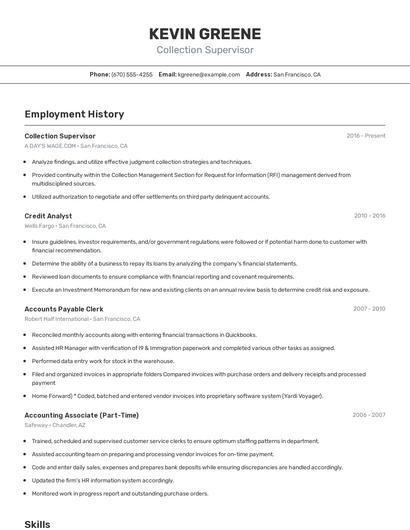
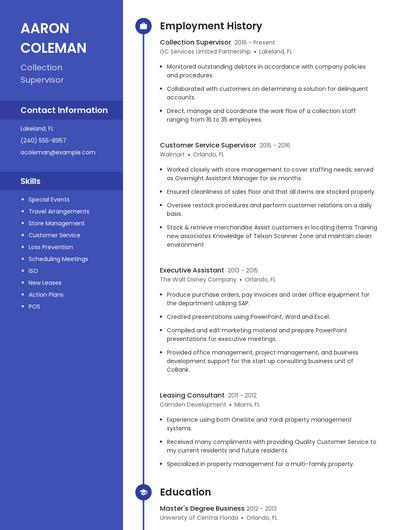
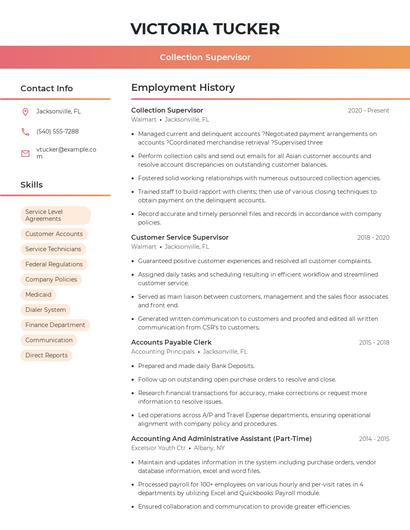
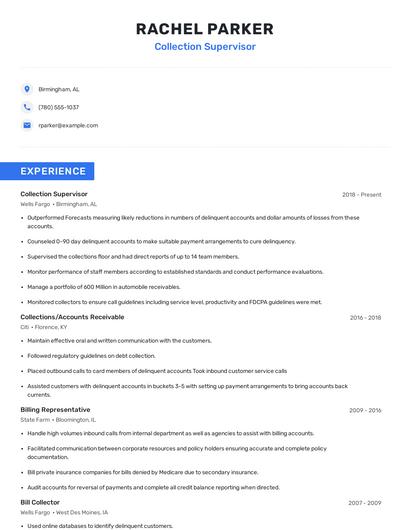
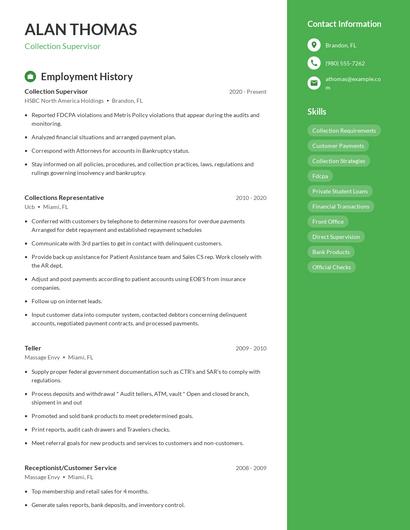
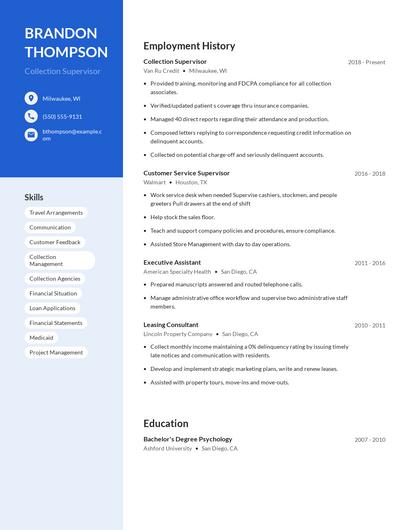
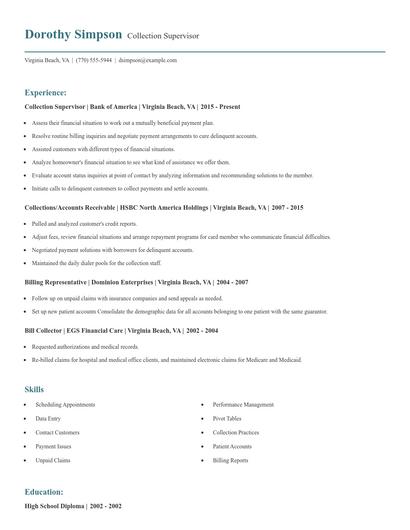
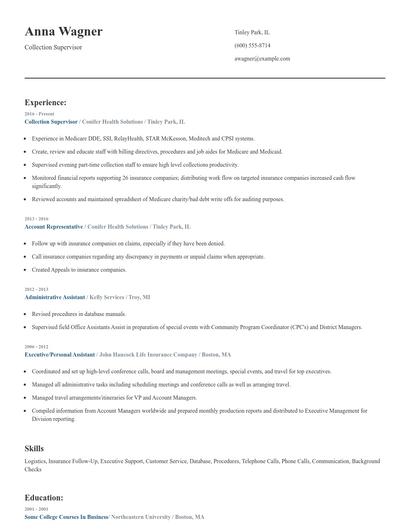
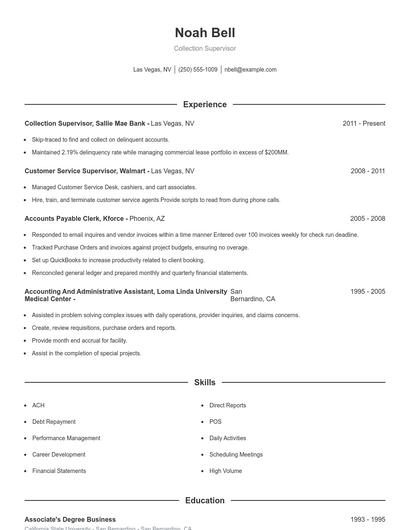
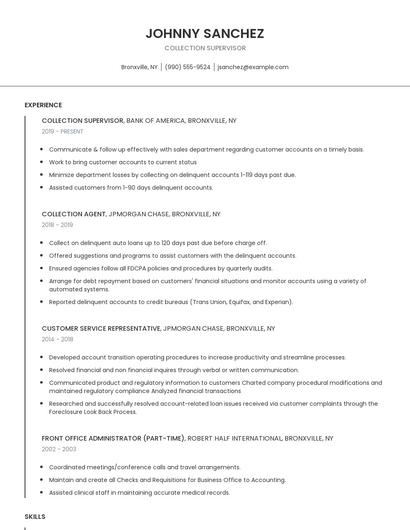
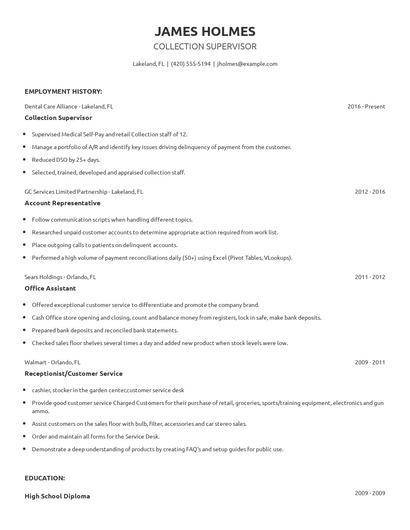
Choose from 10+ customizable collection supervisor resume templates
Build a professional collection supervisor resume in minutes. Our AI resume writing assistant will guide you through every step of the process, and you can choose from 10+ resume templates to create your collection supervisor resume.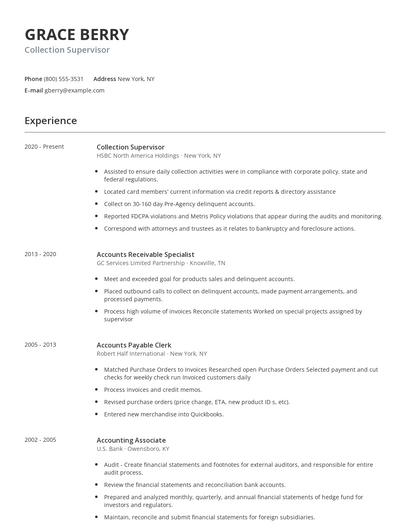
Compare different collection supervisors
Collection supervisor vs. Senior collector
A credit and collection manager is responsible for evaluating credit services and supervising the credit and collection team in reaching out to clients with outstanding debts and credit applications. Credit and collection managers oversee the cash flow systems and identify opportunities to minimize excessive loss and resolve credit disputes. They also determine a customer's eligibility for credit options by analyzing documents and financial status. A credit collection manager must have excellent communication and analytical skills to process receivables and perform credit reconciliations accurately and efficiently.
These skill sets are where the common ground ends though. The responsibilities of a collection supervisor are more likely to require skills like "delinquent accounts," "credit card," "direct reports," and "collection procedures." On the other hand, a job as a senior collector requires skills like "loss mitigation," "credit card accounts," "foreclosure," and "outbound collection calls." As you can see, what employees do in each career varies considerably.
Senior collectors tend to reach similar levels of education than collection supervisors. In fact, senior collectors are 2.5% less likely to graduate with a Master's Degree and 0.2% less likely to have a Doctoral Degree.Collection supervisor vs. Credit and collection manager
While some skills are similar in these professions, other skills aren't so similar. For example, resumes show us that collection supervisor responsibilities requires skills like "fdcpa," "credit card," "medicare," and "federal laws." But a credit and collection manager might use other skills in their typical duties, such as, "credit limits," "credit risk," "credit policies," and "credit card payments."
Credit and collection managers may earn a higher salary than collection supervisors, but credit and collection managers earn the most pay in the technology industry with an average salary of $77,448. On the other hand, collection supervisors receive higher pay in the finance industry, where they earn an average salary of $66,508.credit and collection managers earn similar levels of education than collection supervisors in general. They're 2.3% more likely to graduate with a Master's Degree and 0.2% more likely to earn a Doctoral Degree.Collection supervisor vs. Collection team lead
The required skills of the two careers differ considerably. For example, collection supervisors are more likely to have skills like "medicare," "collection procedures," "federal laws," and "performance management." But a collection team lead is more likely to have skills like "patient accounts," "a/r," "customer calls," and "medical claims."
Most collection team leads achieve a similar degree level compared to collection supervisors. For example, they're 1.5% less likely to graduate with a Master's Degree, and 0.2% less likely to earn a Doctoral Degree.Collection supervisor vs. Front line supervisor
Types of collection supervisor
Updated January 8, 2025
