What does a data and reporting analyst do?
A data and reporting analyst is an individual who is responsible for gathering information from various sources to help an organization make informed decisions. Data and reporting analysts must develop and maintain computer databases, spreadsheets, and other tools used for data analysis to get accurate data information. They collaborate with other professionals to identify and contact prospective customers using the internet. Data and reporting analysts can also work in a wide variety of industry ranging from information technology (IT), finance, and the government.
Data and reporting analyst responsibilities
Here are examples of responsibilities from real data and reporting analyst resumes:
- Gather business requirements and deliver business analytics base solutions using structured/unstructure business data to help achieve measurable business outcomes for clients.
- Prepare files and reports by performing ETL, data extraction, and data validation.
- Report creation using PL/SQL, PROC/SQL, and T/SQL, and SAS programming language.
- Extract customer information from databases and employ SAS to generate reports that meet business requirements.
- Deliver performance KPIs and metrics in an accurate and timely manner via the executive dashboard and customer portal.
- Create VBA programs to automatically create report from HPALM tool, update excel workbooks and execute external data queries.
- Insure the integrity of data, which includes data extraction, processing, storage, and manipulation and analysis.
- Monitor all business requirements and validate all designs and schedule all ETL processes and prepare documents for all data flow diagrams.
- Review Salesforce training videos and provide critiques.
- Create and maintain SharePoint website for centralize team information sharing.
- Provide data extraction, transformation, and presentation for all data relate activities
- Produced/Edite multiple SIGINT product reports utilizing CPE, satisfying national and tactical customer requirements
- Develop PL/SQL store procedures to provide interfaces for Java applications and other accounting processes.
- Translate specialized Russian-language material into English and issue SIGINT technical reports to high-level consumers.
- Distribute generated reports according to distribution lists as well as upload reports to departmental SharePoint site.
Data and reporting analyst skills and personality traits
We calculated that 13% of Data And Reporting Analysts are proficient in Power Bi, Data Analysis, and Dashboards. They’re also known for soft skills such as Interpersonal skills, Problem-solving skills, and Time-management skills.
We break down the percentage of Data And Reporting Analysts that have these skills listed on their resume here:
- Power Bi, 13%
Created multiple data visualization solution for initial Power BI business preview.
- Data Analysis, 11%
Write business requirements for marketing group; perform statistical data analysis and reporting on consumer internet usage.
- Dashboards, 8%
Developed interactive dashboards from static templates and proved the Tableau visualization abilities.
- Visualization, 6%
Convey information through interactive dashboards and visualization by effectively utilizing agile methodology to collect, analyze, and synthesize data.
- BI, 5%
Collaborate with business analysts, database and BI developers in performing various data focused activities.
- Data Collection, 3%
Research and determine the appropriate data-sources and methodology for data collection and interpretation.
"power bi," "data analysis," and "dashboards" are among the most common skills that data and reporting analysts use at work. You can find even more data and reporting analyst responsibilities below, including:
Interpersonal skills. To carry out their duties, the most important skill for a data and reporting analyst to have is interpersonal skills. Their role and responsibilities require that "management analysts work with managers and other employees of the organizations for which they provide consulting services." Data and reporting analysts often use interpersonal skills in their day-to-day job, as shown by this real resume: "provided superior customer service, pleasant interpersonal skills, analytical, and comprehensive problem solving skills. "
Problem-solving skills. Many data and reporting analyst duties rely on problem-solving skills. "management analysts must be able to think creatively to solve clients’ problems," so a data and reporting analyst will need this skill often in their role. This resume example is just one of many ways data and reporting analyst responsibilities rely on problem-solving skills: "innovated new techniques for campaign analysis and developed automated reporting solutions using vba macros to speed report generation and delivery. "
Time-management skills. Another skill that relates to the job responsibilities of data and reporting analysts is time-management skills. This skill is critical to many everyday data and reporting analyst duties, as "management analysts often work under tight deadlines and must use their time efficiently to complete projects on schedule." This example from a resume shows how this skill is used: "performed data mining, data analysis, report automation, which reduced production time by 60%. "
Analytical skills. A big part of what data and reporting analysts do relies on "analytical skills." You can see how essential it is to data and reporting analyst responsibilities because "management analysts must be able to interpret information and use their findings to make proposals." Here's an example of how this skill is used from a resume that represents typical data and reporting analyst tasks: "used qlikview to conduct financial analysis and build up visualization reports based on the analysis. "
Communication skills. A commonly-found skill in data and reporting analyst job descriptions, "communication skills" is essential to what data and reporting analysts do. Data and reporting analyst responsibilities rely on this skill because "management analysts must be able to convey information clearly in both writing and speaking." You can also see how data and reporting analyst duties rely on communication skills in this resume example: "served as primary contact for departmental and external vendor communications for monthly data changes, data loads and data validation. "
The three companies that hire the most data and reporting analysts are:
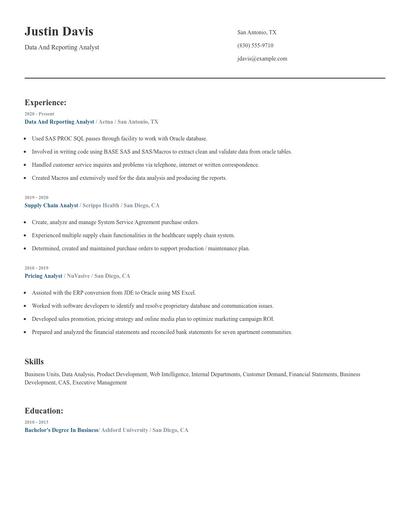
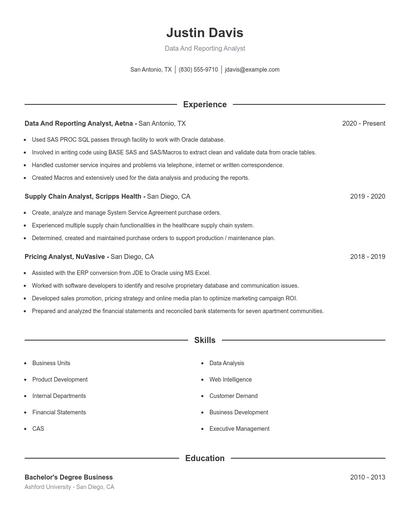
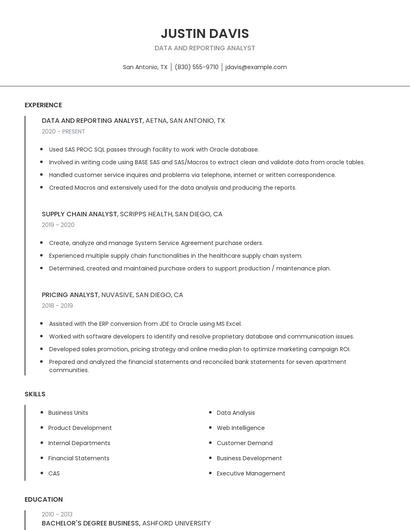
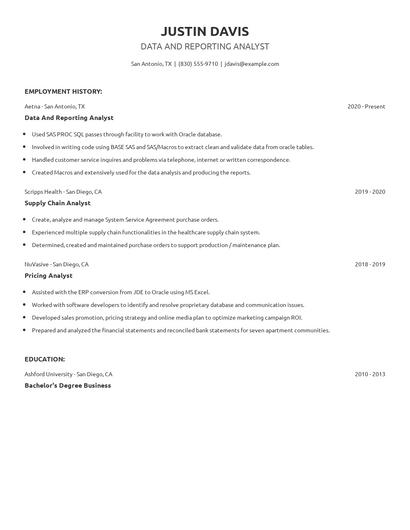
Choose from 10+ customizable data and reporting analyst resume templates
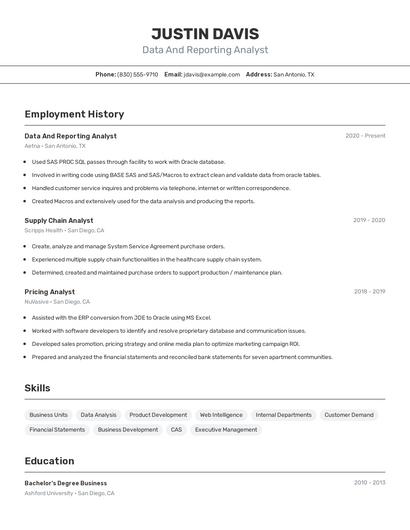
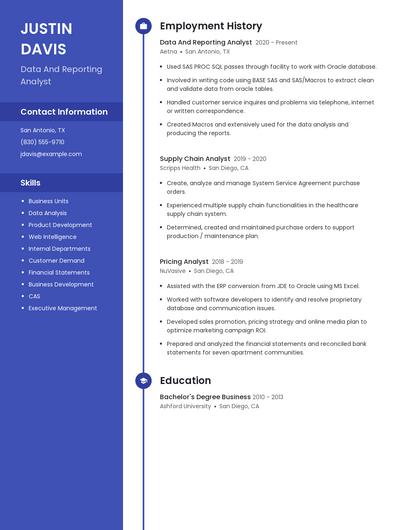
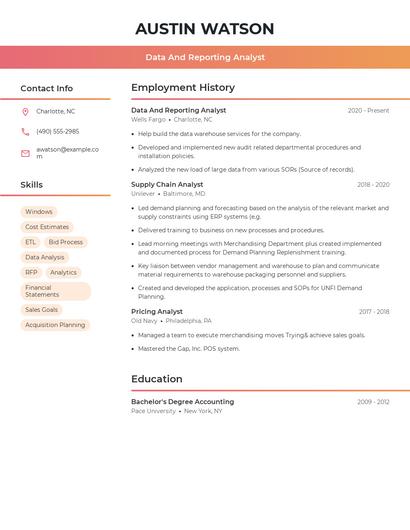
Build a professional data and reporting analyst resume in minutes. Our AI resume writing assistant will guide you through every step of the process, and you can choose from 10+ resume templates to create your data and reporting analyst resume.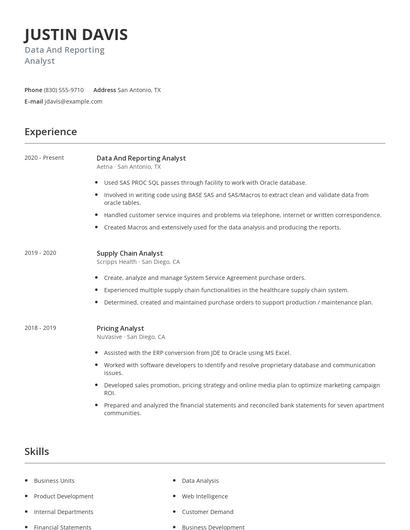
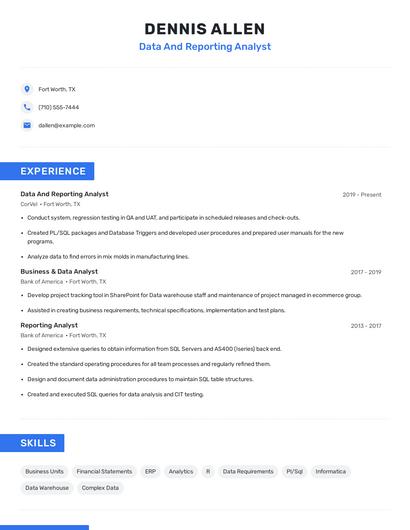
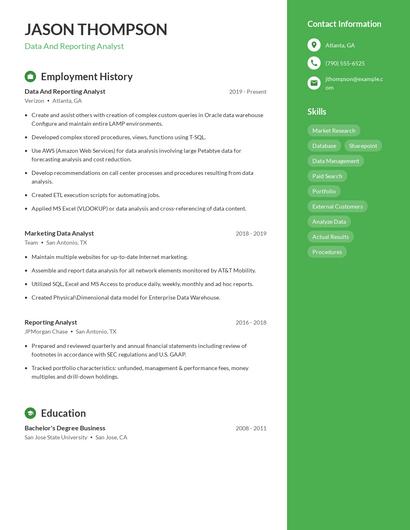
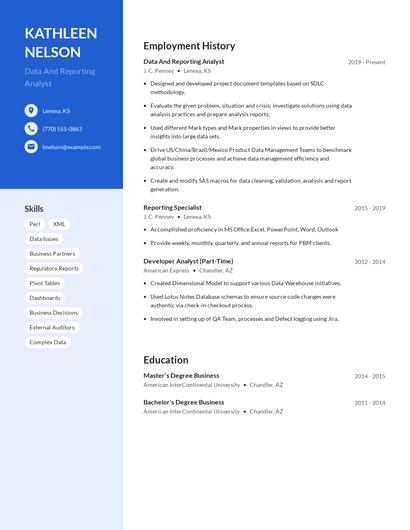
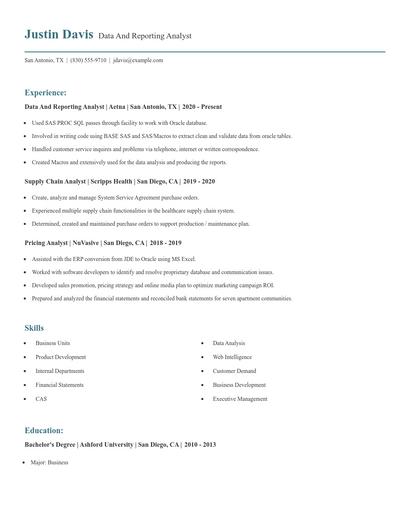
Compare different data and reporting analysts
Data and reporting analyst vs. Program management analyst
The job of a program management analyst involves optimizing business operations and analyzing organizational processes to increase productivity and maximize efficiency and profits. Program management analysts help track every company's schedule, budget, and delivery of goods and/or services. They prepare reports of the status of management projects. It is part of their job to determine business operations and opportunities. The analysts must develop skills in understanding long-term employer goals, management skills, and analytical skills.
There are some key differences in the responsibilities of each position. For example, data and reporting analyst responsibilities require skills like "power bi," "dashboards," "visualization," and "bi." Meanwhile a typical program management analyst has skills in areas such as "program management," "project management," "program operations," and "management practices." This difference in skills reveals the differences in what each career does.
Program management analysts tend to make the most money working in the technology industry, where they earn an average salary of $87,864. In contrast, data and reporting analysts make the biggest average salary, $80,527, in the technology industry.On average, program management analysts reach similar levels of education than data and reporting analysts. Program management analysts are 0.4% more likely to earn a Master's Degree and 1.0% more likely to graduate with a Doctoral Degree.Data and reporting analyst vs. Business operations analyst
A business operations analyst is an individual who identifies and solves issues related to the performance of the business operations. Together with the management and engineering departments, business operations analysts must analyze and review a vast amount of data to identify business opportunities. They must provide recommendations and updated policies so that they can improve the company's business performance. Business operations analysts are also required to create monthly reports and present them to upper management on their key findings and assessments.
While some skills are similar in these professions, other skills aren't so similar. For example, resumes show us that data and reporting analyst responsibilities requires skills like "dashboards," "bi," "data collection," and "sas." But a business operations analyst might use other skills in their typical duties, such as, "provide management," "business operations," "operational efficiency," and "project management."
Business operations analysts may earn a lower salary than data and reporting analysts, but business operations analysts earn the most pay in the technology industry with an average salary of $69,138. On the other hand, data and reporting analysts receive higher pay in the technology industry, where they earn an average salary of $80,527.business operations analysts earn similar levels of education than data and reporting analysts in general. They're 3.6% less likely to graduate with a Master's Degree and 1.0% less likely to earn a Doctoral Degree.What technology do you think will become more important and prevalent for data and reporting analysts in the next 3-5 years?
Erik Johnson Ph.D.
Assistant Professor of Economics, Carthage College
Data and reporting analyst vs. Analyst
Analysts are employees or individual contributors with a vast experience in a particular field that help the organization address challenges. They help the organization improve processes, policies, and other operations protocol by studying the current processes in place and determining the effectiveness of those processes. They also research industry trends and data to make sound inferences and recommendations on what the company should do to improve their numbers. Analysts recommend business solutions and often help the organization roll out these solutions. They ensure that the proposed action plans are effective and produce the desired results.
Some important key differences between the two careers include a few of the skills necessary to fulfill the responsibilities of each. Some examples from data and reporting analyst resumes include skills like "power bi," "dashboards," "visualization," and "bi," whereas an analyst is more likely to list skills in "customer service," "troubleshoot," "project management," and "digital transformation. "
Analysts make a very good living in the technology industry with an average annual salary of $79,330. On the other hand, data and reporting analysts are paid the highest salary in the technology industry, with average annual pay of $80,527.analysts typically earn lower educational levels compared to data and reporting analysts. Specifically, they're 5.8% less likely to graduate with a Master's Degree, and 0.2% less likely to earn a Doctoral Degree.Data and reporting analyst vs. Program analyst
The job of program analysts is to plan, manage, and evaluate a company's computer programs. They usually perform different tasks, including researching and analyzing complex data to identify trends and offer the best recommendations for improvements. Other duties for this position may include creating policies and procedures, monitoring and evaluating program performance, and resolving any issues. This role's skills and requirements include a bachelor's degree in computer science, business, or related field. Previous work experience as a program analyst and critical thinking skills are also valued.
Even though a few skill sets overlap between data and reporting analysts and program analysts, there are some differences that are important to note. For one, a data and reporting analyst might have more use for skills like "power bi," "dashboards," "visualization," and "bi." Meanwhile, some responsibilities of program analysts require skills like "veterans," "program management," "project management," and "logistics. "
Program analysts enjoy the best pay in the professional industry, with an average salary of $79,942. For comparison, data and reporting analysts earn the highest salary in the technology industry.In general, program analysts hold similar degree levels compared to data and reporting analysts. Program analysts are 0.1% less likely to earn their Master's Degree and 0.3% more likely to graduate with a Doctoral Degree.Types of data and reporting analyst
Updated January 8, 2025
