What does a program secretary do?
Program secretary responsibilities
Here are examples of responsibilities from real program secretary resumes:
- Lead DoD team that assist Pakistan in gaining military capabilities to conduct counter-terrorism operations against the Taliban.
- Maintain schedules, business travel, expense reports, overtime reports, payroll and labor time-card.
- Prepare and submit payroll, travel expenses, and other reimbursement relate material for staff.
- Create PowerPoint presentations for yearly events.
- Register patients/checked Medicaid for approval and schedule patient psychiatric appointments.
- Distribute Medicaid waivers and documentation reports to services and support managers on monthly basis.
- Prepare discharges, enter all updates into OASAS system and review patient information to verify patients eligibility to receive transportation reimbursement.
- Schedule appointments to perform HUD require interviews making sure contractors/sub-contractors follow lead-safe rules and regulations.
Program secretary skills and personality traits
We calculated that 14% of Program Secretaries are proficient in Data Entry, Scheduling Appointments, and Phone Calls. They’re also known for soft skills such as Interpersonal skills, Organizational skills, and Writing skills.
We break down the percentage of Program Secretaries that have these skills listed on their resume here:
- Data Entry, 14%
Created Excel database files, provided data entry, tracked various registrants for our various events, responded to e-mail/phone inquiries/etc.
- Scheduling Appointments, 9%
Managed busy office including copying, filing and preparing mailings and scheduling appointments.
- Phone Calls, 8%
Work with individual programs to provide mailings and phone calls to the parent's and Company's associated with each child.
- Office Equipment, 8%
Analyzed and scheduled central office equipment installation.
- Purchase Orders, 7%
Represented the program in absence of assigned administrator Monitored office expenditures and processed purchase orders.
- Clerical Support, 7%
Assist department and agency personnel with daily operations and clerical support training.
Common skills that a program secretary uses to do their job include "data entry," "scheduling appointments," and "phone calls." You can find details on the most important program secretary responsibilities below.
Interpersonal skills. One of the key soft skills for a program secretary to have is interpersonal skills. You can see how this relates to what program secretaries do because "secretaries and administrative assistants interact with clients, customers, or staff." Additionally, a program secretary resume shows how program secretaries use interpersonal skills: "demonstrated exceptional interpersonal skills serving as liaison between customers and office management. "
Organizational skills. Many program secretary duties rely on organizational skills. "secretaries and administrative assistants keep files, folders, and schedules in order so that an office runs efficiently.," so a program secretary will need this skill often in their role. This resume example is just one of many ways program secretary responsibilities rely on organizational skills: "experience with word processing, excel and organizational skills and public relations. "
Writing skills. Another skill that relates to the job responsibilities of program secretaries is writing skills. This skill is critical to many everyday program secretary duties, as "secretaries and administrative assistants write memos and emails when communicating with managers, employees, and customers." This example from a resume shows how this skill is used: "supervised front desk, answered phones, translate verbally or in writing, informed and directed people. "
The three companies that hire the most program secretarys are:
- Kindred Healthcare6 program secretaries jobs
- INSTITUTE OF COMMUNITY SERVICES2 program secretaries jobs
- Oaks Integrated Care2 program secretaries jobs
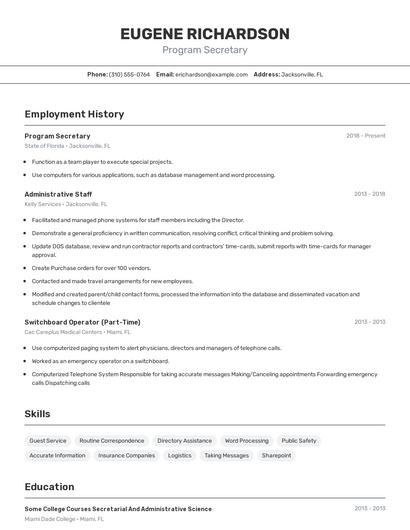
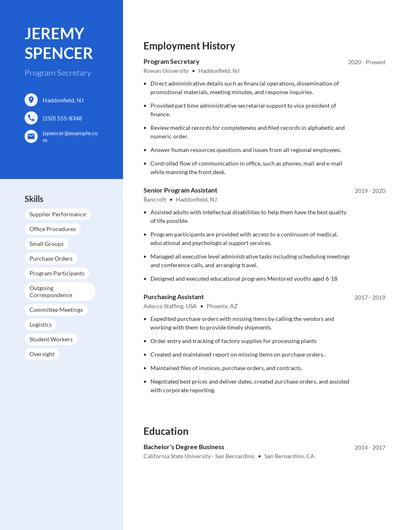
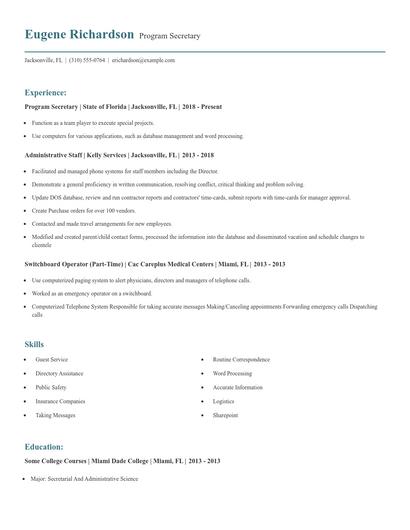
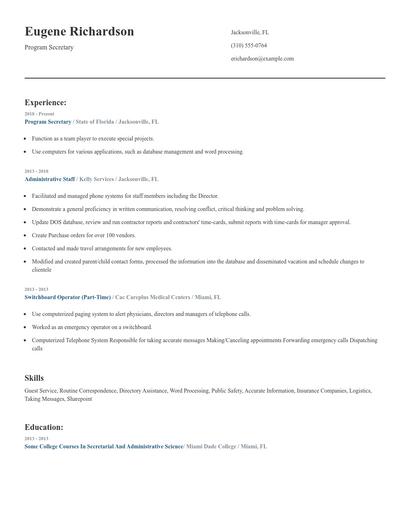
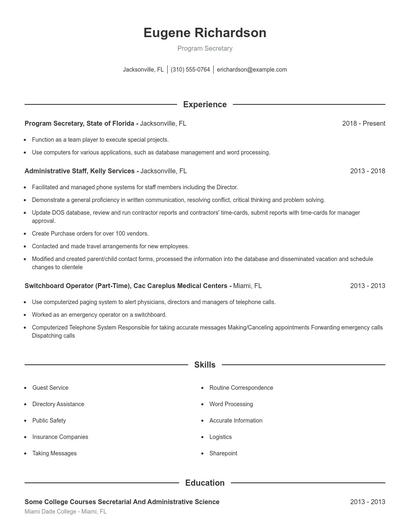
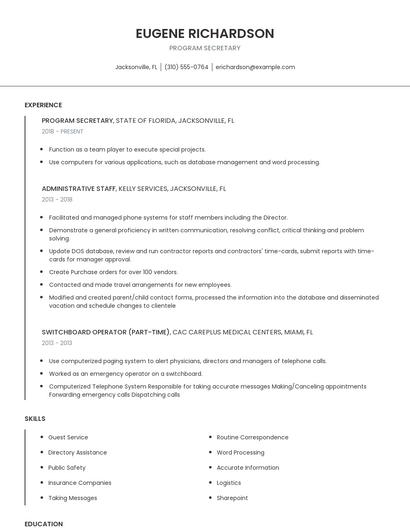
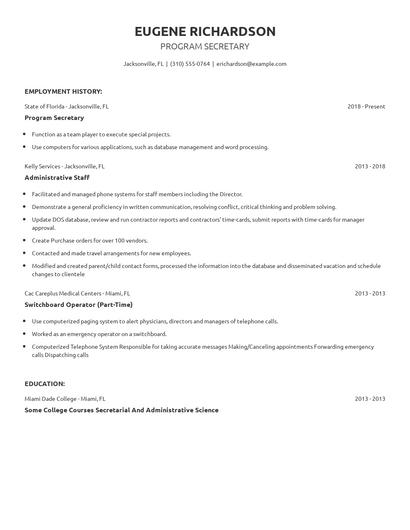
Choose from 10+ customizable program secretary resume templates
Build a professional program secretary resume in minutes. Our AI resume writing assistant will guide you through every step of the process, and you can choose from 10+ resume templates to create your program secretary resume.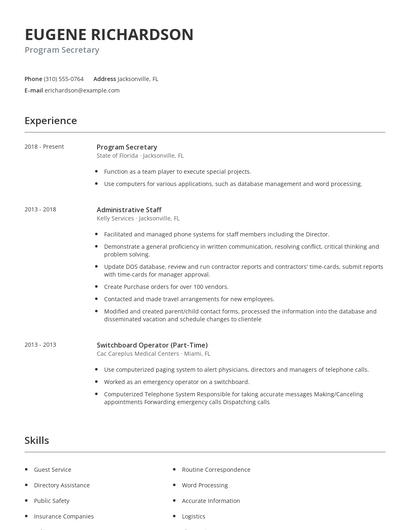


Compare different program secretaries
Program secretary vs. Office administrator
Office administrators are employees who ensure that the office is running in tip-top shape. They manage the administrative needs of the office. They answer calls directed to the official company phone, manage the inventory of supplies, take charge or purchase requisitions for needed supplies, and ensure the office equipment and fixtures are taken care of. Office administrators also manage correspondences, official memoranda, and other official company documents. They also keep track of files and records to ensure that these are properly organized. At times, office administrators also take charge of welcoming guests and accompanying them to their respective meetings.
There are some key differences in the responsibilities of each position. For example, program secretary responsibilities require skills like "phone calls," "meeting minutes," "payroll," and "provide clerical support." Meanwhile a typical office administrator has skills in areas such as "customer service," "patients," "financial reports," and "human resources." This difference in skills reveals the differences in what each career does.
Office administrators tend to make the most money working in the government industry, where they earn an average salary of $39,681. In contrast, program secretaries make the biggest average salary, $33,498, in the telecommunication industry.On average, office administrators reach similar levels of education than program secretaries. Office administrators are 0.3% more likely to earn a Master's Degree and 0.2% less likely to graduate with a Doctoral Degree.Program secretary vs. Administrative professional
An administrative professional specializes in performing administrative support and clerical tasks in a company or office, ensuring accuracy and smooth workflow. Their responsibilities typically revolve around managing schedules, arranging appointments and meetings, producing progress reports and presentations, delegating tasks, and attending meetings on behalf of executives or staff. There are also instances when an administrative assistant must answer calls and correspondence, respond to inquiries and concerns, welcome guests, relay messages, and provide staff with any support tasks or documents.
In addition to the difference in salary, there are some other key differences worth noting. For example, program secretary responsibilities are more likely to require skills like "purchase orders," "provide clerical support," "secretarial support," and "office machines." Meanwhile, an administrative professional has duties that require skills in areas such as "customer service," "sharepoint," "reservations," and "project management." These differences highlight just how different the day-to-day in each role looks.
Administrative professionals earn similar levels of education than program secretaries in general. They're 4.5% more likely to graduate with a Master's Degree and 0.2% more likely to earn a Doctoral Degree.Program secretary vs. Administrative associate
An administrative associate is responsible for performing various tasks such as handling and processing paperwork, attending meetings and preparing minutes, responding to inquiries and other forms of correspondence, keeping accurate records, updating databases, and monitoring the company's financial activities. They also communicate with various department personnel, ensuring coordination should any important matter would arise. Furthermore, as an administrative associate, they are in charge of procuring supplies, implementing company policies, and supporting any staff members if needed.
There are many key differences between these two careers, including some of the skills required to perform responsibilities within each role. For example, a program secretary is likely to be skilled in "office procedures," "secretarial support," "office machines," and "mail merge," while a typical administrative associate is skilled in "customer service," "patients," "medical terminology," and "patient care."
Administrative associates make a very good living in the finance industry with an average annual salary of $41,923. On the other hand, program secretaries are paid the highest salary in the telecommunication industry, with average annual pay of $33,498.administrative associates typically earn similar educational levels compared to program secretaries. Specifically, they're 4.1% more likely to graduate with a Master's Degree, and 0.3% more likely to earn a Doctoral Degree.Program secretary vs. Administrative coordinator
An Administrative Coordinator oversees the line of communication and schedules within a company, ensuring that every necessary information is delivered and conveyed. An administrative coordinator's responsibilities include responding to inquiries and requests from workforce personnel or client, managing calls and correspondence, maintaining and rotating various forms of documentation, and designing or improving systems that would help the company's operating procedures. Furthermore, it is also essential for an Administrative Coordinator to evaluate the methods and progress, continuity of workflow, and resolve issues as needed within the company.
Types of program secretary
Updated January 8, 2025
