What does a senior research assistant do?

A senior research assistant is responsible for monitoring the research methods and supporting the junior staff in gathering data to support research claims and studies. Senior research assistants implement research protocols according to business requirements and specifications. They conduct data and statistical analysis to generate accurate and comprehensive reports for discussion with the research supervisors. A senior research assistant must have excellent communication and organizational skills, especially in verifying the accuracy and authenticity of information before public release.
Senior research assistant responsibilities
Here are examples of responsibilities from real senior research assistant resumes:
- Manage all aspects of HPLC method development and analysis through interpretation of data ensuring accuracy of results.
- Facilitate the preparation of IACUC and IBC protocols, amendments and renewals.
- Train all undergraduates and graduates in proper lab technique, including DNA extraction and PCR.
- Maintain high quality research environment, ensuring compliance of all AALAC, IACUC and USDA standards.
- Blood processing to include CBC, blood glucose and DNA extraction in both human and animal specimens.
- Maintain multiple databases of confidential participant data according to IRB regulations.
- Prepare newsletters, display advertisements, PowerPoint presentations and email campaigns.
- Develop a code of mesh generation for visualization of results of geophysical surveys.
- Generate data from experiments in PowerPoint documents, experimental design for upcoming experiments for review.
- Envision and enable collaborative process to integrate crystallographic workflow with computational analysis and stakeholder visualization.
- Establish mammalian cell base target validation by optimizing an endogenous expression cassette system for short hairpin RNA.
- Work with patients one-on-one; gather medical histories, establish tentative diagnosis and measure visual acuity and contrast sensitivity.
- Draft recruitment materials undergoing IRB approval requiring clear communication of research protocols in language gear to a patient population.
- Implement a working protocol for isolating RNA from metastatic cell lines for investigating gene expression using differential display analysis.
- Develop advanced molecular and microbiological skills including DNA sequencing and analysis with additional experience in strain engineering and characterization.
Senior research assistant skills and personality traits
We calculated that 8% of Senior Research Assistants are proficient in Patients, Research Projects, and Data Collection. They’re also known for soft skills such as Analytical skills, Detail oriented, and Interpersonal skills.
We break down the percentage of Senior Research Assistants that have these skills listed on their resume here:
- Patients, 8%
Evaluated content validity and refined measure through conducting cognitive interviews with sarcoma patients that have experienced injury prior to diagnosis.
- Research Projects, 6%
Coordinated various research projects including literature searches, statistical analysis, preparation and submission of abstracts/papers.
- Data Collection, 5%
Participated in survey design, recruitment and data collection management, and reporting for projects
- Cell Culture, 4%
Skilled in general laboratory techniques in biochemistry, cell biology and cell culture, as required for experiments.
- Laboratory Equipment, 4%
Managed and maintained laboratory equipment and adjusted machines to ensure optimal performance.
- Data Analysis, 4%
Pioneered research and data analysis to support the development of policy recommendations and research publications.
"patients," "research projects," and "data collection" are among the most common skills that senior research assistants use at work. You can find even more senior research assistant responsibilities below, including:
Analytical skills. The most essential soft skill for a senior research assistant to carry out their responsibilities is analytical skills. This skill is important for the role because "market research analysts must evaluate large amounts of data and information related to market conditions." Additionally, a senior research assistant resume shows how their duties depend on analytical skills: "tracked data in drug log ci-cv per requirements of fda and university of cincinnati. "
Detail oriented. Many senior research assistant duties rely on detail oriented. "market research analysts must pay attention to minutiae to evaluate data.," so a senior research assistant will need this skill often in their role. This resume example is just one of many ways senior research assistant responsibilities rely on detail oriented: "gathered data collection through conducting interviews, provided detailed transcriptions, and accurate coding. "
The three companies that hire the most senior research assistants are:
- Univ. Of Texas Cancer Ctr.36 senior research assistants jobs
- Brigham and Women's Hospital29 senior research assistants jobs
- Oregon Health & Science University29 senior research assistants jobs
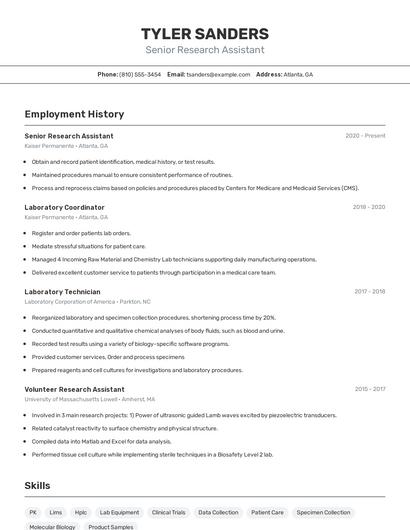
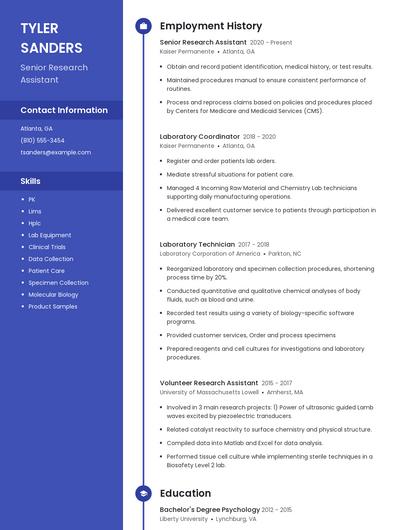
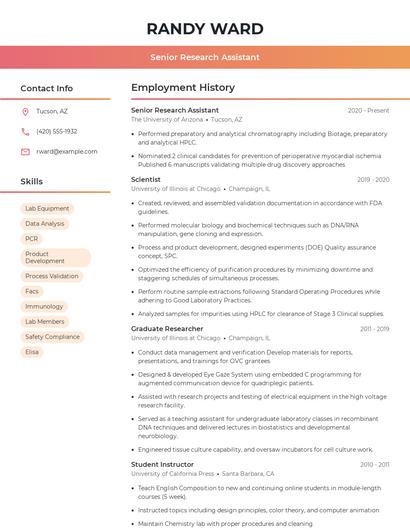
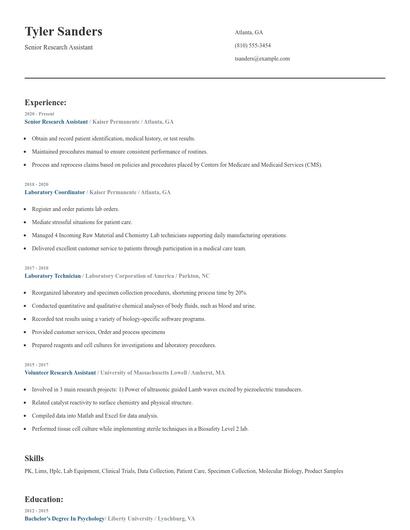
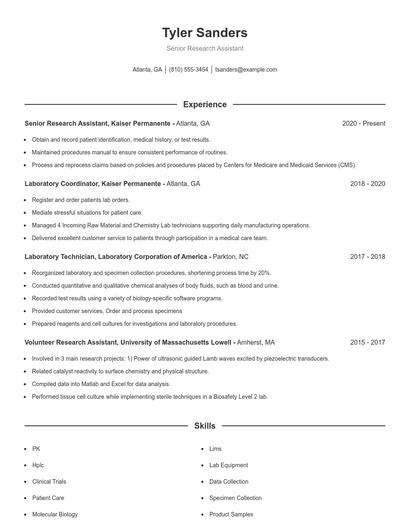
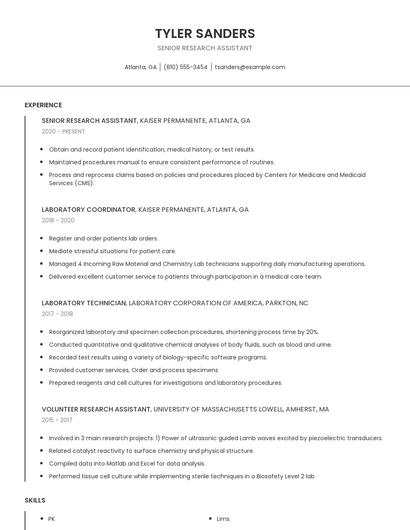
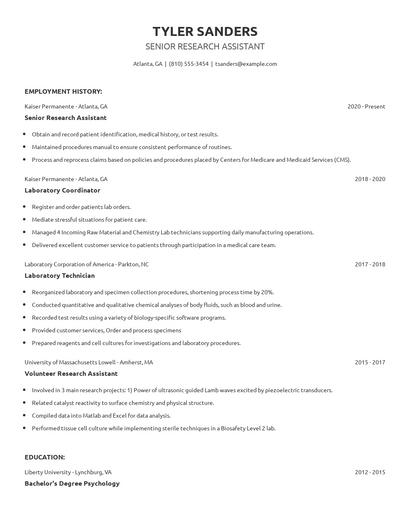
Choose from 10+ customizable senior research assistant resume templates
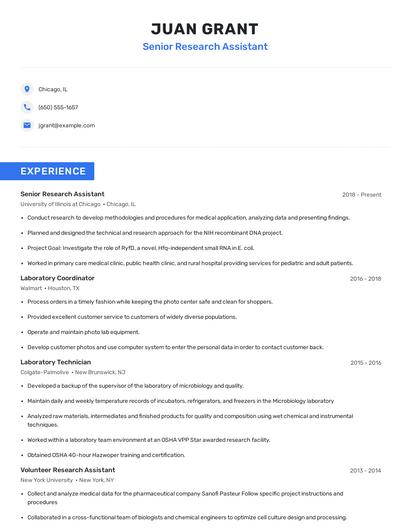
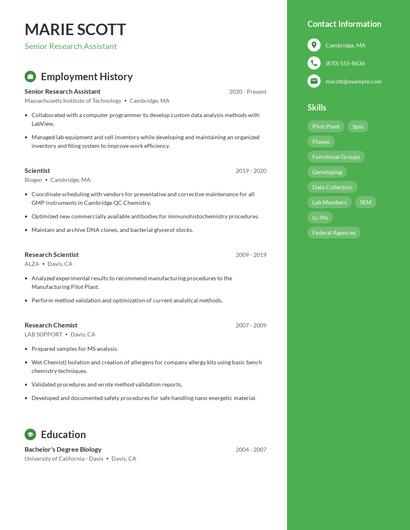
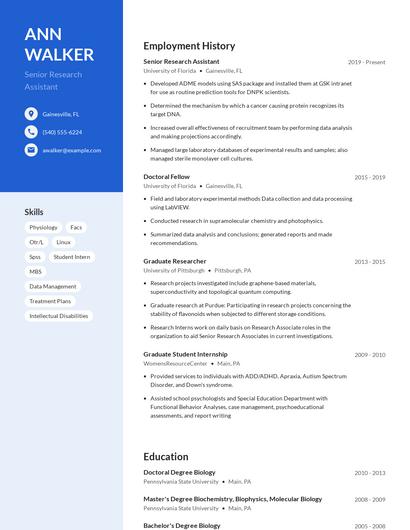
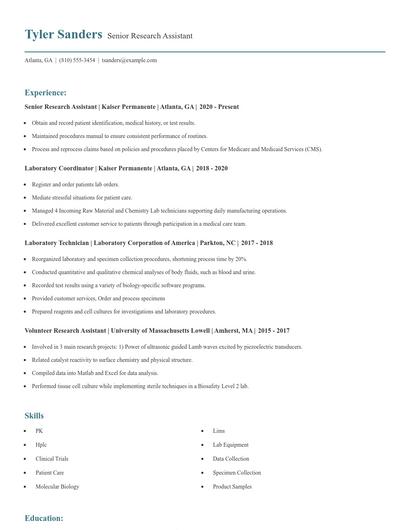
Build a professional senior research assistant resume in minutes. Our AI resume writing assistant will guide you through every step of the process, and you can choose from 10+ resume templates to create your senior research assistant resume.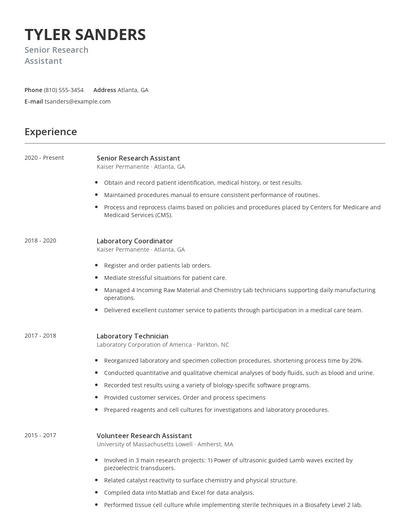
Compare different senior research assistants
Senior research assistant vs. Research fellow
A research fellow is an academic researcher who conducts research and analysis of comprehensive literature, data, and results and provides literature reviews. He/She supervises research assistants and recruits study participants to interview them for a particular study. To become a research fellow, a candidate should have a doctorate in a relevant discipline and publish peer-reviewed papers. Also, a research fellow can be an independent investigator or be supervised by a principal investigator.
While similarities exist, there are also some differences between senior research assistants and research fellow. For instance, senior research assistant responsibilities require skills such as "laboratory equipment," "molecular biology," "research data," and "data entry." Whereas a research fellow is skilled in "cell biology," "python," "rna," and "chemistry." This is part of what separates the two careers.
Research fellows really shine in the non profits industry with an average salary of $57,261. Comparatively, senior research assistants tend to make the most money in the health care industry with an average salary of $58,031.On average, research fellows reach similar levels of education than senior research assistants. Research fellows are 0.8% less likely to earn a Master's Degree and 26.9% more likely to graduate with a Doctoral Degree.Senior research assistant vs. Research leader
Research Leaders are academicians who oversee a group of researchers conducting a study. They are usually well-known researchers in their field of study or area of interest. They manage the group throughout the whole research process. They may orient them at the start of the engagement to ensure that everyone is on the same page. Research Leaders direct the group in identifying the resources needed, finding these resources, and eventually managing them. They also guide the team in conducting the research properly by providing strategic direction, sharing techniques, and helping them analyze the gathered data. With their experience in the field, Research Leaders usually provide frameworks that the team may work within.
While some skills are similar in these professions, other skills aren't so similar. For example, resumes show us that senior research assistant responsibilities requires skills like "patients," "cell culture," "laboratory equipment," and "molecular biology." But a research leader might use other skills in their typical duties, such as, "market research," "python," "human centered design," and "research methods."
On average, research leaders earn a higher salary than senior research assistants. Some industries support higher salaries in each profession. Interestingly enough, research leaders earn the most pay in the pharmaceutical industry with an average salary of $131,194. Whereas senior research assistants have higher pay in the health care industry, with an average salary of $58,031.research leaders earn similar levels of education than senior research assistants in general. They're 1.2% less likely to graduate with a Master's Degree and 26.9% more likely to earn a Doctoral Degree.What technology do you think will become more important and prevalent for senior research assistants in the next 3-5 years?
Friedbert Ninow Ph.D.
Dean, La Sierra University
- All kinds of digital stuff
- Technology that allows us to have alternatives to the screen; screen technology lets us shrink to two-dimensional beings.
Senior research assistant vs. Research internship
A research intern is responsible for assisting the research team with conducting an investigation, compiling information, and analyzing results for an organized research study. Research interns' duties also include understanding the work processes and operation procedures, sharing strategies and recommendations on research methods, reaching out to appropriate research correspondents, managing clients' inquiries and concerns, keeping important client records for reference, studying current market trends, and maintaining the eagerness to learn. A research intern must have strong attention to detail and excellent communication skills to perform on daily research tasks.
The required skills of the two careers differ considerably. For example, senior research assistants are more likely to have skills like "patients," "research projects," "laboratory equipment," and "molecular biology." But a research internship is more likely to have skills like "python," "c++," "research intern," and "java."
Research interns earn the highest salary when working in the technology industry, where they receive an average salary of $52,879. Comparatively, senior research assistants have the highest earning potential in the health care industry, with an average salary of $58,031.research interns typically earn similar educational levels compared to senior research assistants. Specifically, they're 4.5% less likely to graduate with a Master's Degree, and 2.4% less likely to earn a Doctoral Degree.Senior research assistant vs. Assistant research scientist
An Assistant Research Scientist assists in planning, conducting, and analyzing various research projects. They also order and manage lab inventory, materials, and equipment.
Even though a few skill sets overlap between senior research assistants and assistant research scientists, there are some differences that are important to note. For one, a senior research assistant might have more use for skills like "patients," "molecular biology," "research data," and "data entry." Meanwhile, some responsibilities of assistant research scientists require skills like "chemistry," "experimental design," "python," and "sample preparation. "
Assistant research scientists enjoy the best pay in the education industry, with an average salary of $71,080. For comparison, senior research assistants earn the highest salary in the health care industry.In general, assistant research scientists hold similar degree levels compared to senior research assistants. Assistant research scientists are 3.4% less likely to earn their Master's Degree and 10.3% more likely to graduate with a Doctoral Degree.Types of senior research assistant
Updated January 8, 2025
