What does a technical analyst do?

A technical analyst is responsible for analyzing technical information and aligning it to the business strategies and procedures in meeting project goals. Technical analysts monitor technical system errors and provide immediate resolutions to ensure an efficient and smooth flow of operations. They comply with the business requirements and clients' specifications to facilitate the technical team with the best techniques to get the job done. A technical analyst should have excellent critical-thinking and communication skills, as well as having a broad knowledge of the technology industry and disciplines.
Technical analyst responsibilities
Here are examples of responsibilities from real technical analyst resumes:
- Enable the automation team to automate the existing application flow by acting as an SME for the application.
- Manage lab operations including ISO standardization and audit preparation.
- Manage CRM database ensuring issues and client contacts are accurately document.
- Deploy and manage EMR implementation project plans for several large specialties simultaneously.
- Develop java processes for data transformation leveraging XML configuration for flexible table mapping from operational data store to the data warehouse.
- Web pages are coded using HTML, JavaScript, SQL, and some DHTML.
- Develop application to monitor cloud infrastructure and set alerts.
- Deliver business and technical support, including problem diagnosis, troubleshooting and resolution for application-relate issues and customer infrastructure challenges.
- Work with IP division and outside counsel.
- Power scripting with Perl, CGI, and JavaScript.
- Provide troubleshooting of EMR applications by appropriate documentation and research of the issue.
- Work as a member of scrum team working on AcuDose-Rx medication dispensing cabinet.
- Perform technical architecture planning, assist in business analysis, respond to RFP's.
- Apply IAVA updates to servers and conduct scans via Retina/ACAS to maintain DoD accreditation.
- Carry out competitive intelligence analysis of potential commercial partners, and market and value IP.
Technical analyst skills and personality traits
We calculated that 10% of Technical Analysts are proficient in Java, Customer Service, and Strong Analytical. They’re also known for soft skills such as Analytical skills, Communication skills, and Creativity.
We break down the percentage of Technical Analysts that have these skills listed on their resume here:
- Java, 10%
Developed a Java utility in a credit application which did authentication of the users by validating the security questions.
- Customer Service, 7%
Performed data analysis and created three-dimensional data drill-down cubes to assist management in making key decisions in various customer service areas.
- Strong Analytical, 5%
Worked on assignments that were unique in nature where strong analytical ability was required in order to resolve complex technical issues.
- C #, 4%
Developed Online CSV Protocol system using ASP.NET, C #, SQL and Web Services.
- Troubleshoot, 4%
Diagnose and troubleshoot various technical issues involving applications being used including Desktop applications as well as ASP.net applications.
- Technical Support, 3%
Provided technical support to sales teams for proposed customer frame relay network customer premises equipment and managed network services requirements.
Common skills that a technical analyst uses to do their job include "java," "customer service," and "strong analytical." You can find details on the most important technical analyst responsibilities below.
Analytical skills. One of the key soft skills for a technical analyst to have is analytical skills. You can see how this relates to what technical analysts do because "analysts must interpret complex information from various sources and decide the best way to move forward on a project." Additionally, a technical analyst resume shows how technical analysts use analytical skills: "migrated various map translations involving sap idocs, xml, x12 and edifact formats using wdi (websphere data interchange). "
Communication skills. Another soft skill that's essential for fulfilling technical analyst duties is communication skills. The role rewards competence in this skill because "analysts work as a go-between with management and the it department and must explain complex issues in a way that both will understand." According to a technical analyst resume, here's how technical analysts can utilize communication skills in their job responsibilities: "used xml webservices using soap and apache axis for data communication with external systems using services oriented architectures (soa). "
Creativity. technical analysts are also known for creativity, which are critical to their duties. You can see how this skill relates to technical analyst responsibilities, because "because analysts are tasked with finding innovative solutions to computer problems, an ability to “think outside the box” is important." A technical analyst resume example shows how creativity is used in the workplace: "point contact (sme) of inventory application consisting on 45 sub application on mainframe. "
The three companies that hire the most technical analysts are:
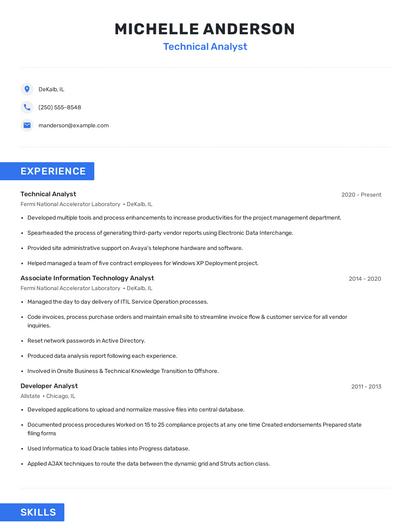
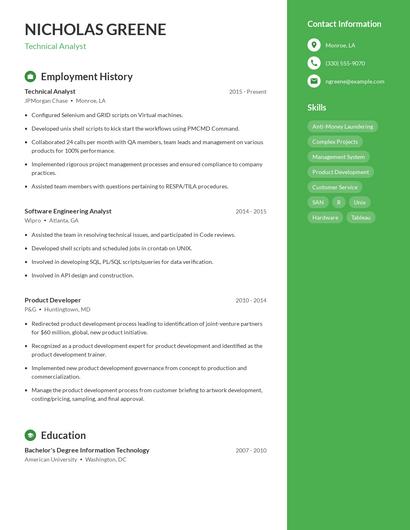
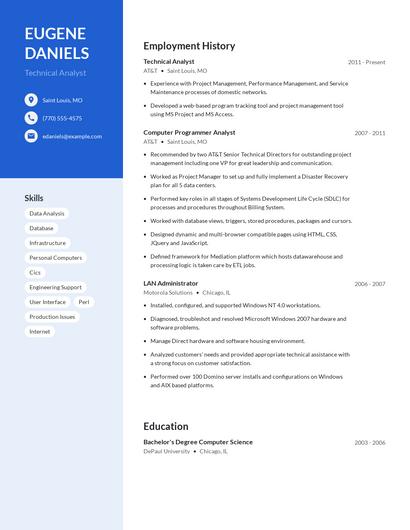
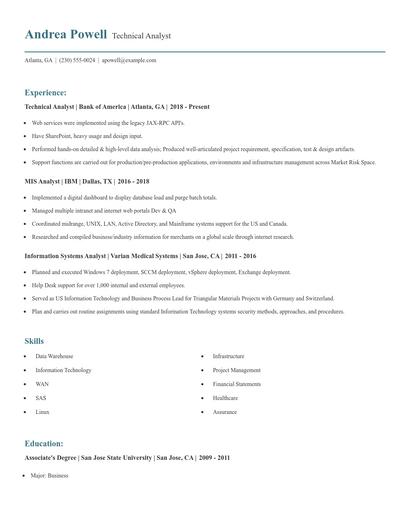
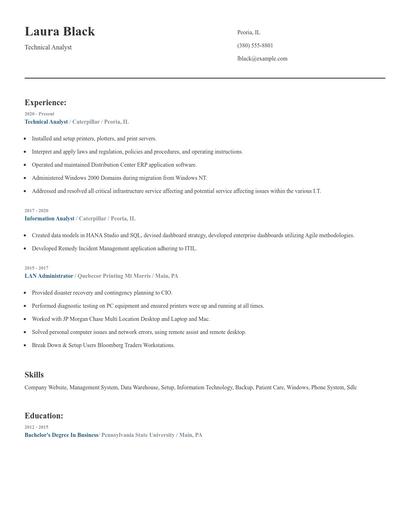
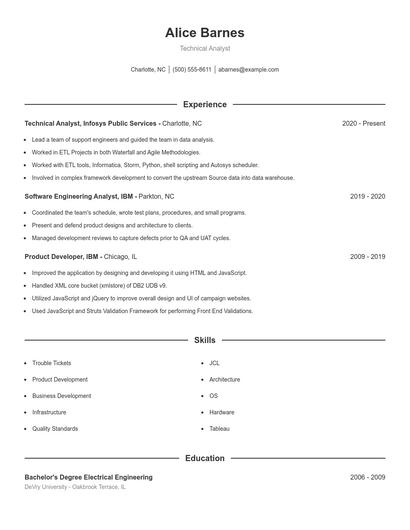
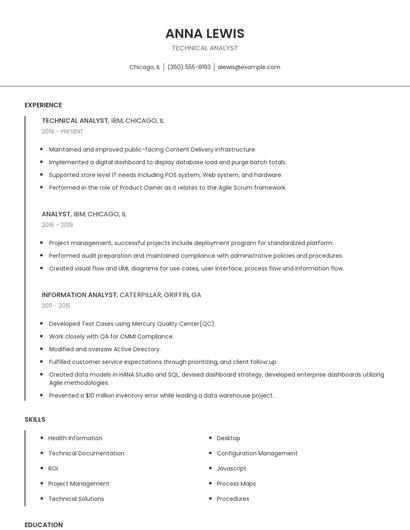
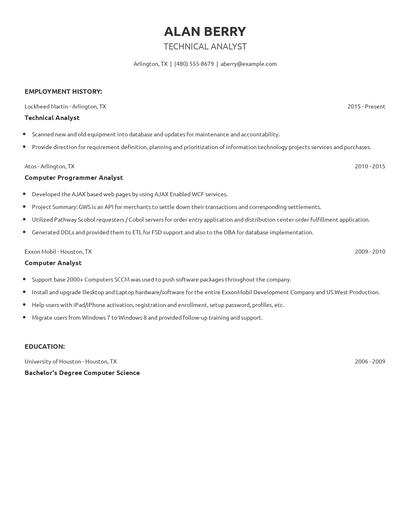
Choose from 10+ customizable technical analyst resume templates
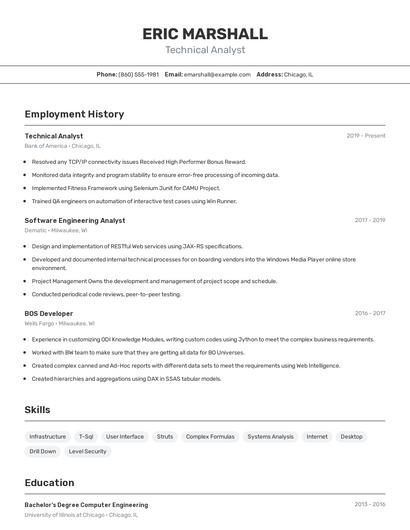
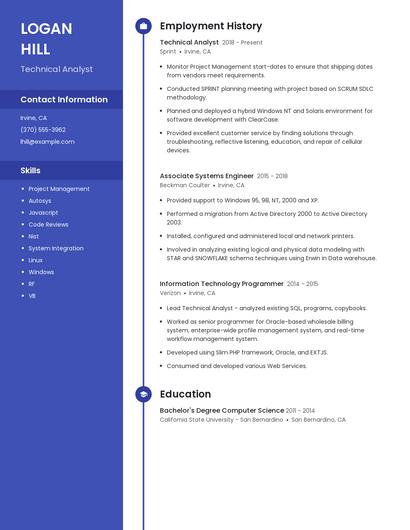
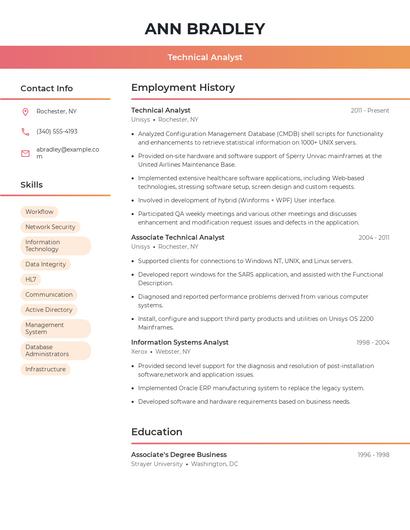
Build a professional technical analyst resume in minutes. Our AI resume writing assistant will guide you through every step of the process, and you can choose from 10+ resume templates to create your technical analyst resume.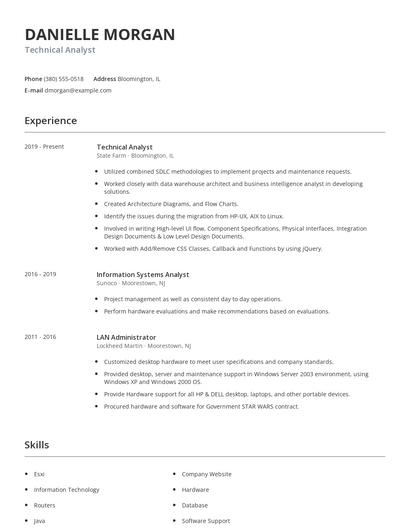
Compare different technical analysts
Technical analyst vs. Analyst lead
The duties of an analyst lead depend on one's line of work or industry of employment. Typically, their responsibilities revolve around performing research and analysis, coordinating with different departments to gather leads and data, reviewing findings, and producing reports and presentations for the stakeholders and other higher-ranking officials. Through the results, an analyst lead can provide advice, devise strategies for business optimization, spearhead the development of processes, identify strengths and weaknesses, and offer recommendations on areas in need of improvement. All of this is done while in adherence to the company's vision and mission.
There are some key differences in the responsibilities of each position. For example, technical analyst responsibilities require skills like "digital transformation," "technical support," "desktop," and "patients." Meanwhile a typical analyst lead has skills in areas such as "analytics," "project management," "powerpoint," and "cloud security." This difference in skills reveals the differences in what each career does.
Analyst leads tend to make the most money working in the finance industry, where they earn an average salary of $110,488. In contrast, technical analysts make the biggest average salary, $88,568, in the retail industry.analyst leads tend to reach higher levels of education than technical analysts. In fact, analyst leads are 6.1% more likely to graduate with a Master's Degree and 0.8% more likely to have a Doctoral Degree.Technical analyst vs. Support analyst
The role of support analysts is to resolve problems with hardware, computer programs, and peripherals. They may focus on a particular aspect of the information technology (IT) department or give technical support to end-users. They mainly detect issues with IT equipment and software and devise solutions to resolve these issues. Also, they are responsible for answering queries from users, preparing service records, and handling escalations. Support analysts also support the company's IT operations and best practices by creating and distributing relevant IT documents.
In addition to the difference in salary, there are some other key differences worth noting. For example, technical analyst responsibilities are more likely to require skills like "digital transformation," "c #," "desktop," and "web services." Meanwhile, a support analyst has duties that require skills in areas such as "application support," "issue resolution," "strong customer service," and "data entry." These differences highlight just how different the day-to-day in each role looks.
Support analysts earn a higher average salary than technical analysts. But support analysts earn the highest pay in the finance industry, with an average salary of $93,871. Additionally, technical analysts earn the highest salaries in the retail with average pay of $88,568 annually.Average education levels between the two professions vary. Support analysts tend to reach similar levels of education than technical analysts. In fact, they're 3.0% less likely to graduate with a Master's Degree and 0.8% more likely to earn a Doctoral Degree.What technology do you think will become more important and prevalent for technical analysts in the next 3-5 years?
Rebecca Sarver
Lecturer in Human Services Studies, Elmira College
Technical analyst vs. Business analyst
Business analysts are employees who are responsible for interpreting business data and coming up with business solutions. They are well-versed in whatever business the company is in, and they have strong business acumen. They collect data related to the business and then interpret and analyze the data. Business analysts should be able to conduct different levels of analyses and must also be able to create a sound study. Once the analysis is done, they provide recommendations or strategic direction to decision-makers that will help the business become sustainable and grow.
There are many key differences between these two careers, including some of the skills required to perform responsibilities within each role. For example, a technical analyst is likely to be skilled in "customer service," "c #," "troubleshoot," and "technical support," while a typical business analyst is skilled in "project management," "business analysis," "user stories," and "scrum."
Business analysts earn the highest salary when working in the finance industry, where they receive an average salary of $91,354. Comparatively, technical analysts have the highest earning potential in the retail industry, with an average salary of $88,568.When it comes to education, business analysts tend to earn higher degree levels compared to technical analysts. In fact, they're 6.5% more likely to earn a Master's Degree, and 0.0% more likely to graduate with a Doctoral Degree.Technical analyst vs. Software analyst
A software analyst is responsible for creating and designing software programs and applications, as well as modifying existing ones for optimization according to business requirements. Software analysts work with the technical team to draw system codes, analyze programming languages, and ensure the stability and efficiency of software navigation by running multiple quality checks to the system. They inspect the application's performance, configure servers, and improve software infrastructure according to quality findings. A software analyst records resolution reports and provides progress updates, ensuring that the project adheres to budget limitations and set timetables.
Even though a few skill sets overlap between technical analysts and software analysts, there are some differences that are important to note. For one, a technical analyst might have more use for skills like "digital transformation," "customer service," "strong analytical," and "c #." Meanwhile, some responsibilities of software analysts require skills like "c++," "software development," "test data," and "scrum. "
Software analysts enjoy the best pay in the manufacturing industry, with an average salary of $86,986. For comparison, technical analysts earn the highest salary in the retail industry.The average resume of software analysts showed that they earn similar levels of education compared to technical analysts. So much so that theyacirc;euro;trade;re 1.5% more likely to earn a Master's Degree and more likely to earn a Doctoral Degree by 0.2%.Types of technical analyst
Updated January 8, 2025
