What does a test analyst do?

The duties of a test analyst depend on one's line of work or industry of employment. In the information technology setting, a test analyst is responsible for testing computer software or hardware to ensure its quality before being released in the market. They participate in the development process to monitor the product specifications, review and analyze documentation, and create test systems, implementing them promptly and efficiently. As a test analyst, it is essential to produce progress reports, prepare presentations, and even give recommendations.
Test analyst responsibilities
Here are examples of responsibilities from real test analyst resumes:
- Implement reusable test strategy to rewire QA methodology and achieve increase in efficiency.
- Execute end to end regression testing which include executing multiple processes in UNIX, running automate test scripts and performing validation.
- Organize daily meetings with QA team and Dev team to recognize the blocking issues within the project.
- Test the stored procedures functionality vs. ETL mapping after the migration of code from PL/SQL to ETL mappings.
- Report bugs to developers using JIRA and after rectification from developers perform regression testing.
- Document and champion defects in QC ALM.
- Used SoapUI tool to test web services used for the application.
- Implement and design the frame work for android testing automation tools.
- Create and execute both load and functional tests for web services using SoapUI.
- Used Jenkins as continuous integration tool to schedule and run the automated test scripts.
- Implement major functionalities in automation test script using selenium 2.0 in c #.net.
- Create and modify defects in QC and create the testing mail id for the test team.
- Create and execute test cases to facilitate verification of GUI forms and emails throughout work flows.
- Trouble shooting critical issues and providing root cause to the Dev team as part of value addition.
- Used JIRA tool to record, track and resolve issues, bugs, defects and new request changes.
Test analyst skills and personality traits
We calculated that 6% of Test Analysts are proficient in Test Scripts, Test Plan, and Regression.
We break down the percentage of Test Analysts that have these skills listed on their resume here:
- Test Scripts, 6%
Mapped requirements to test scripts using Mercury Quality Center for tracking Created defects and tracked defect status using Mercury Quality Center
- Test Plan, 5%
Analyzed the Business Requirement Specification, Functional Requirement Specification & Design documents and prepared the Test plans for different Testing stages.
- Regression, 5%
Performed regression testing by executing automation jobs for retrieving and validating ETL components of the Data Warehouse system.
- Test Results, 5%
Involved in documenting test results and follow defect management procedure to raise/report/track/close defects using Quality Center.
- Java, 5%
Implemented Page Object Model Pattern based automation testing framework utilizing Java, TestNG and Selenium WebDriver.
- Manual Test Cases, 5%
Increased more than 60% efficiency of testing team by automating manual test cases using IBM Rational Robot.
Common skills that a test analyst uses to do their job include "test scripts," "test plan," and "regression." You can find details on the most important test analyst responsibilities below.
The three companies that hire the most test analysts are:
- Deloitte113 test analysts jobs
- BMO Capital Markets53 test analysts jobs
- Highmark46 test analysts jobs
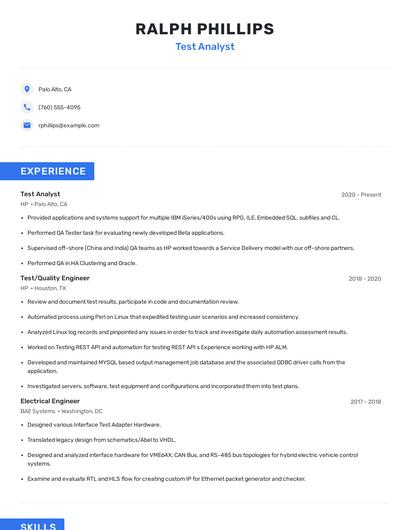
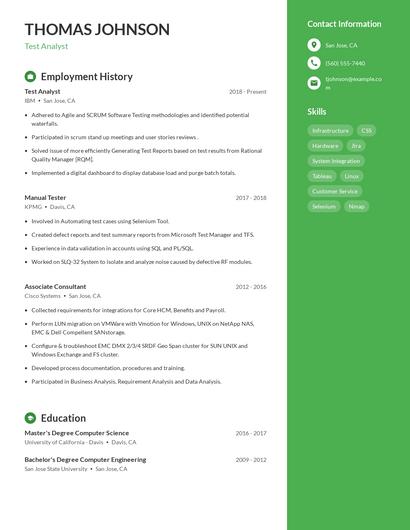
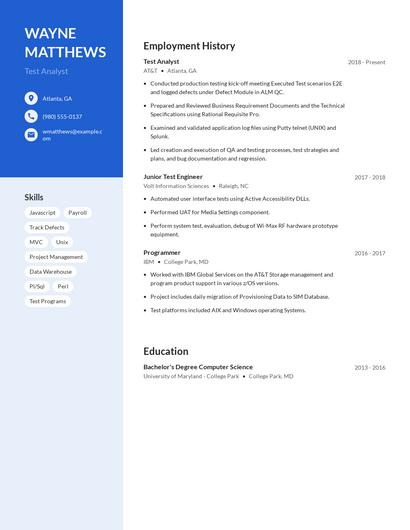
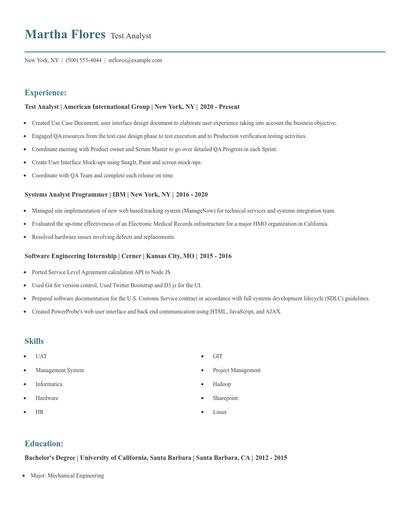
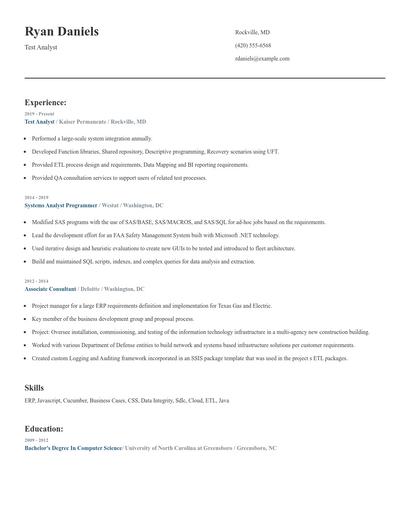
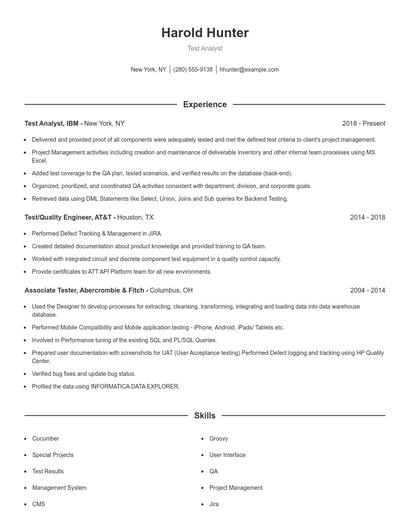
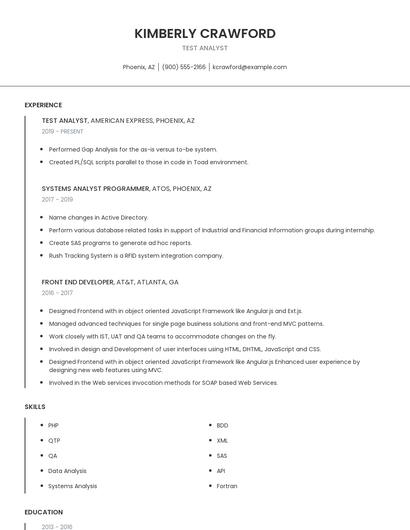
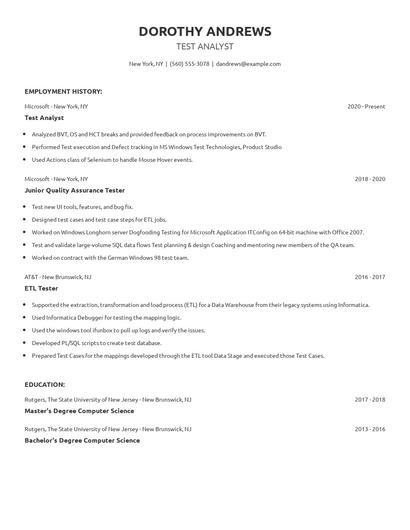
Choose from 10+ customizable test analyst resume templates
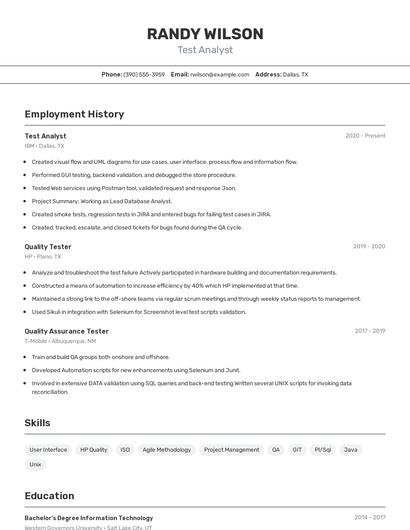
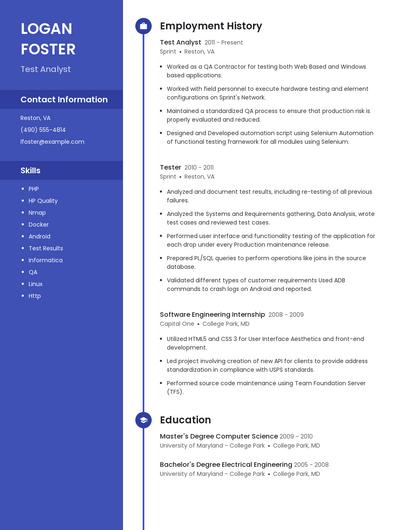
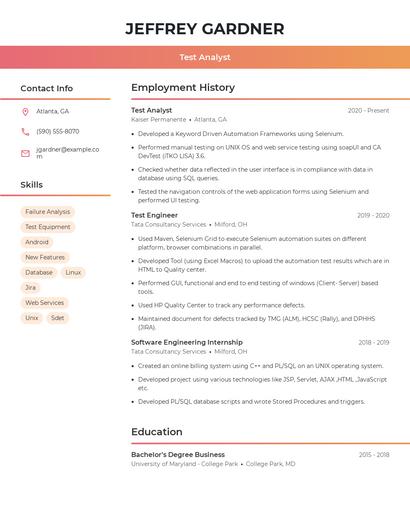
Build a professional test analyst resume in minutes. Our AI resume writing assistant will guide you through every step of the process, and you can choose from 10+ resume templates to create your test analyst resume.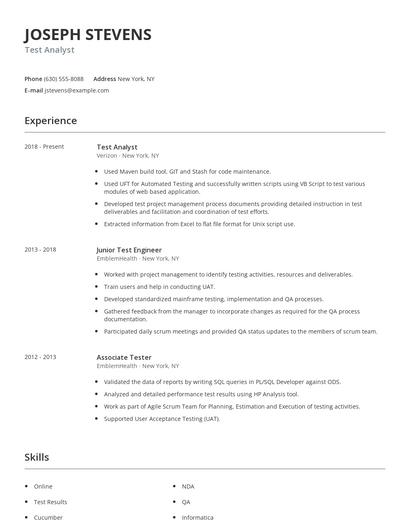
Compare different test analysts
Test analyst vs. Systems tester
A systems tester is an information technology expert who specializes in developing test structures to identify the strengths and weaknesses of systems and software. They primarily work to identify and eliminate bugs to ensure quality and client satisfaction. They may also perform clerical tasks such as preparing reports and findings. Furthermore, as a systems tester, it is essential to recommend solutions against problem areas, all while adhering to the project's budgets and the company's policies and regulations.
These skill sets are where the common ground ends though. The responsibilities of a test analyst are more likely to require skills like "test plan," "status reports," "selenium webdriver," and "strong problem-solving." On the other hand, a job as a systems tester requires skills like "python," "c++," "c #," and "test automation." As you can see, what employees do in each career varies considerably.
Systems testers tend to make the most money working in the finance industry, where they earn an average salary of $104,166. In contrast, test analysts make the biggest average salary, $74,197, in the finance industry.The education levels that systems testers earn slightly differ from test analysts. In particular, systems testers are 1.9% less likely to graduate with a Master's Degree than a test analyst. Additionally, they're 0.2% more likely to earn a Doctoral Degree.Test analyst vs. Senior quality assurance analyst/lead
A senior quality assurance analyst/lead organizes and manages a lot of quality assurance testing procedures before the release of a product or service to the public. This is considered a skilled profession requiring prior quality assurance experience and industry-specific skills or certifications. The duties and responsibilities of senior quality assurance analysts/leads depend on the specific project or industry in which they are working. The job requires core skills such as strong interpersonal communication skills, a keen eye for details, and excellent time and project management skills. Also, the education requirements to qualify for the position vary depending on the industry.
In addition to the difference in salary, there are some other key differences worth noting. For example, test analyst responsibilities are more likely to require skills like "test plan," "manual test cases," "strong problem-solving," and "data warehouse." Meanwhile, a senior quality assurance analyst/lead has duties that require skills in areas such as "test cases," "api," "dev," and "automation framework." These differences highlight just how different the day-to-day in each role looks.
Senior quality assurance analyst/leads may earn a higher salary than test analysts, but senior quality assurance analyst/leads earn the most pay in the retail industry with an average salary of $123,698. On the other hand, test analysts receive higher pay in the finance industry, where they earn an average salary of $74,197.Average education levels between the two professions vary. Senior quality assurance analyst/leads tend to reach higher levels of education than test analysts. In fact, they're 6.7% more likely to graduate with a Master's Degree and 0.2% more likely to earn a Doctoral Degree.What technology do you think will become more important and prevalent for test analysts in the next 3-5 years?
Rebecca Sarver
Lecturer in Human Services Studies, Elmira College
Test analyst vs. Senior quality assurance analyst
Senior quality assurance analysts are responsible for developing and implementing quality assurance standards within an organization. They collect and analyze data to reinforce proposed projects, systems requirements, and business cases. These will include writing scripts and test plans to monitor errors and fixes in product and software development, operational systems, and information systems. Besides, they are also responsible for several tasks, including preparing reports and recommendations, communicating with suppliers and vendors in assessing applications, and conducting internal audits.
There are many key differences between these two careers, including some of the skills required to perform responsibilities within each role. For example, a test analyst is likely to be skilled in "test plan," "selenium webdriver," "strong problem-solving," and "strong analytical," while a typical senior quality assurance analyst is skilled in "selenium web," "front end," "api," and "qc."
Senior quality assurance analysts earn the best pay in the finance industry, where they command an average salary of $99,710. Test analysts earn the highest pay from the finance industry, with an average salary of $74,197.When it comes to education, senior quality assurance analysts tend to earn higher degree levels compared to test analysts. In fact, they're 5.5% more likely to earn a Master's Degree, and 0.4% more likely to graduate with a Doctoral Degree.Test analyst vs. Business analyst/quality analyst
A business analyst/quality analyst is responsible for evaluating business outputs and operational processes to ensure that everything adheres to the quality standards and business regulations. Business analysts/quality analysts support senior management in determining solutions to improve the company's services and provide the highest satisfaction for the customers and clients. They also conduct data and statistical analysis by assessing the market trends to identify opportunities that would generate more revenue resources and increase profitability for the business.
Even though a few skill sets overlap between test analysts and business analysts/quality analysts, there are some differences that are important to note. For one, a test analyst might have more use for skills like "test plan," "manual test cases," "status reports," and "selenium webdriver." Meanwhile, some responsibilities of business analysts/quality analysts require skills like "test cases," "microsoft visio," "business process," and "application development. "
The finance industry tends to pay the highest salaries for business analysts/quality analysts, with average annual pay of $94,836. Comparatively, the highest test analyst annual salary comes from the finance industry.In general, business analysts/quality analysts hold higher degree levels compared to test analysts. Business analysts/quality analysts are 7.9% more likely to earn their Master's Degree and 0.4% more likely to graduate with a Doctoral Degree.Types of test analyst
Updated January 8, 2025
